Category Archives: politics

State of the Campaign: Spring Break

maps

Well, we’ve had the first four contests in February. We’ve had three Super Tuesdays! We’ve also had a smattering of other days and un-super Tuesdays, like this week’s confabs in Arizona, Idaho and Utah. Along the way, we’ve whittled things down from 22 candidates to five. From here, things take a little break. The Republicans don’t have another outing for 13 days, and after three contests this Saturday the Democrats are out too until everybody gets back together for Wisconsin on April 5th. So how are things looking on the eve of the campaign’s Spring Break?

Democrats

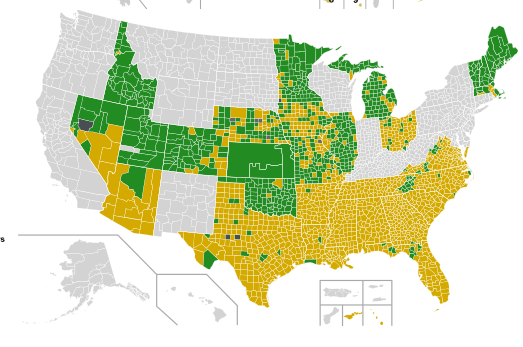
If you look on a county-by-county basis, there’s almost a Mason-Dixon line going on the Democratic side:

MD

Tuesday’s results reinforced that, with Hillary doing well in Arizona (probably inadvertently helped along by state Republican officials voter suppression strategies), and Bernie doing very well in Utah and Idaho. In fact, Sanders got such lop-sided margins in those two states that he actually slightly reduced his delegate gap versus Clinton, something that he stands to do again this weekend with Alaska, Hawaii and Washington. This follows up on his win by a 2/3 margin of the Democrats Abroad primary announced this Monday. Statistical analysis of where he’s done well so far would also indicate he stands a good shot in the next two states once we resume again in April, Wisconsin & Wyoming.

Does all of this improve the outlook on his possibly winning the nomination? In a word: Probably not. Okay, it was two words, you got me. My fellow Berners pretty much aren’t speaking to me at this point because of my stubborn insistence upon the existence of math. She is indeed a harsh mistress, but a fairly clear one. Based purely on pledged delegates (not those wily Superdelegates) this is where the math currently stands:

math

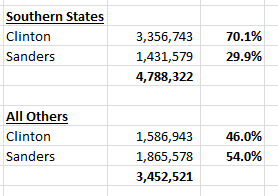
The good news for Sanders? There are no more Southern States, and while Clinton has trounced him in the South, he’s actually narrowly beaten her in total votes for all contests outside that region:

math2

There’s also some interesting analysis out there indicating that Clinton, where she is winning, is doing so largely based on early voting that happened weeks or months ago, and Sanders is beating her on election day voting. Even given all that, though, the numbers still don’t add up. So far, he’s gotten a little over 50% of the vote in all non-Southern states. He’d need to get 69% of all remaining delegates in order to win. One can imagine circumstances where this could happen, a la major Clinton scandal. But in any vaguely status quo scenario, you would be very surprised to see his average in the remaining 25 contests jump to 69% compared to 50% for the 18 non-Southern contests that have happened so far.

Republicans

The outlook here is much cloudier. Trump won resoundingly in Arizona, but Cruz meanwhile did very well in Utah.

map2

The catch is that, unlike Democratic primaries and caucuses, which are almost all proportional to vote, Republican contests often feature some kind of rule- winner-take-all, delegate allocation based on who gets the majority in each congressional district, minimum percentage cut-offs to qualify for any delegates- that tends to magnify the lead of a front-runner. Even if you are a front-runner by virtue of only getting 30-something percent of the vote, you’ll get a much higher percentage than that of the delegates. So that works to Trump’s favor, but the field was fractured enough for long enough that it is very borderline whether he can get to the total before the convention.

If it’s hard to see how he can pull off the total in time, it’s pretty near impossible to see how Cruz or Kasich could do it. The numbers currently stand as follows:

math3

Even if Rubio were to endorse Cruz and pledge his delegates to him (as there are some rumblings may happen), and even given that the party establishment is working its way toward supporting Cruz, despite the fact that they don’t like him much, there isn’t an easy to see scenario where he gets the percentage of delegates he’d need in order to catch Trump before the convention. Meanwhile, Kasich would actually need to win 116% of the remaining delegates, i.e. he has no path forward that doesn’t involve a time machine.

Prominent Republicans continue to say that whoever arrives at the convention with the clear preponderance of delegates should be the nominee. So, Trump. A number of them also continue to say that they’re deeply troubled by Trump’s behavior, and a surprising number hedge on whether they would support him if he is the nominee. So, maybe not Trump. If nothing else, this should be fascinating to watch!


Super Tuesday 3!

St3

This election is kind of silly with Super Tuesdays, but in this case, it’s not overkill. We have the above assortment of 5 fine upstanding states, four of which happen to be among the most populous states in the union. So what happens here could indeed be pretty consequential for the race.  Here’s what we have at stake on each side.

Democrats

You may recall that I made the case last week that Sanders is, mathematically speaking, a dead man walking. This was before his surprise win in Michigan, which I was certainly gratified by. So am I changing my tune? Well, I’m modifying the key slightly, but not really.

The thing about last week is that Sanders won a narrow victory in Michigan. A historically unprecedented, great news for his campaign victory, but still narrow. Clinton meanwhile won a lopsided victory in Mississippi, as she has throughout the South. It was so lopsided that, even though Mississippi is a significantly smaller state than Michigan, she ended up with more total votes and more delegates on Tuesday than Sanders, thus increasing the gap between them. Bluntly put, you can generate the best headlines ever, but if your opponent keeps scoring on you like this, you’re not going to win.

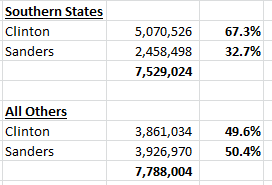
So wither my humming in a different key? This recent HuffPo piece makes a good case that Michigan presages that the next phase of the campaign is going to be tougher for Clinton and better for Sanders. We’ve all been noticing all along how lopsided her Southern victories have been. This got me mathematically curious, So I re-ran my totals from last week, honing in on the difference between Southern results and everywhere else. Overall, Clinton/Sanders are at 60/40 for vote totals so far, but if you break it down from there, it looks a bit different:

southern

The significant thing about this is, Clinton is almost out of Southern states. North Carolina and Florida are the only ones left. so one could make a not ridiculous argument that Sanders might win a majority of votes and delegates for the remainder of this race after Super Tuesday 3. Ultimately, though, that doesn’t change the math. Right now, excluding Superdelegates, we’re at:

math

If Sanders performs at the average of his non-Southern state totals for the remaining contests, he would still be under pace for the total of remaining delegates that he needs to win. Clinton would too, but not by as much, and the big wins she’s likely to get in Florida and North Carolina tomorrow will Probably bring it in range- she’ll need mid to high 40s percentage of remaining delegates, and she can be expected to average mid to high 40s percentage of remaining votes.

Sanders, meanwhile, based on where he’s done well so far, will probably win Missouri, and be quite competitive in Ohio and Illinois, maybe even score a narrow victory in one of them. I don’t think this changes the ultimate trajectory, but he now has every chance of remaining in the race, and strongly so, for the duration.

Republicans

The big story here is the winner-take-all contests in Florida and Ohio. Unlike the Democrats, who generally reward delegates proportional to vote most everywhere, the Republicans have many states where the highest placing candidate gets all the delegates. In this case, interestingly, it intersects with the home states of two of the remaining candidates, Marco Rubio and John Kasich.  Unfortunately for Rubio, all signs are that this won’t work out for him:

florida

Kasich, meanwhile, seems to have a pretty decent shot of taking his home state, and all of its delegates:

Ohio

All of this is quite volatile. You can make a good case that, notwithstanding what happens in Florida and Ohio, Trump could do well enough in the other states to effectively put the whole thing away. On the other hand, you could also make the case that Cruz is close enough that, if Super Tuesday 3 ends up knocking out both Kasich and Rubio, he could still win a one-on-one with Trump. We could also have a case where, by virtue of winning Ohio while Rubio loses Florida and places badly elsewhere, Kasich becomes the surviving establishment candidate, holding down a roughly equal percentage of votes to Cruz going forward, and keeping all three of them below the threshold before the convention.

This is where the numbers stand at the moment:

math2

Where they are at this point next week will be fascinating to see!


State of the Race: Post Super Tuesday And Swell Saturday

state

stae2


In last week’s column, I posited that it was super-possible that both nominations would effectively be decided on Super Tuesday. Now that the Tuesday in question has come and gone and we’ve also had a pretty swell Saturday’s (and pinch of Sunday) worth of contests, how am I doing? In all honesty, I’d have to give myself a 42.5%. As follows…

Democrats

I think it’s important to fully out myself before I say what I’m about to say. No surprise to anybody who knows me, I lean toward the Progressive side of the fence. I would vastly prefer to see Sanders be the nominee instead of Clinton, and I think he’s the only major candidate in the race who is even close to talking about the magnitude of changes we’ll need to make to avoid disaster at home and as a global species in the coming decades. I voted for him in our primary in Vermont, contribute to his campaign every pay day, and will continue to do so as long as he’s in the race. Despite all this, I am, reluctantly, 85% confident that the Democratic Race has in fact been decided for Clinton, though it will take the numbers a while to catch up.

It comes down to some simple facts of math. Counting just the pledged delegates because, as many people have pointed out, Superdelegates can (and do) change their votes as the race shifts, we currently have:

delegate

Given what each candidate has, how many delegates are remaining, and how many are needed for the nomination, this is the percentage of remaining delegates each would have to win to get the nomination:

maths

The issue with pledged delegates on the Democratic side is that they are more or less proportional- if you win, say 60% of the votes, you would expect to also win roughly 60% of the delegates. Some of the caucus states don’t report their numbers in a way that votes can be tabulated, but of the seventeen states and territories that have voted so far that we can add up votes for, this is the percentage breakdown:

bdown

Refer back to the delegate target numbers above. Clinton has won 61% of the vote so far, and she would need roughly 54.5% of the remaining delegates. She could actually do about 10% worse than she’s done so far in all the remaining contests and still do it. Sanders has won 39% of the vote so far, but he’d need to win 60% of the remaining delegates. He would have to do about 50% better than he’s done so far in all the remaining contests to take it.

Is this categorically impossible? No. Bernie clearly has the financial and enthusiastic supporter resources to stay competitive, and is still less well known than Clinton, so he has room to grow. And Clinton has often proven to be a less appealing campaigner when she’s ahead than when she’s behind, and also has investigations brewing which (based on bullshit or not) could blow up at any time. Barring something truly disruptive, though, you would be surprised to see Clinton do markedly worse in the 2/3 remaining than the 1/3 behind. And you’d be really surprised to see Sanders do 50% better.

Republicans

As for my prediction about Trump before Super Tuesday, I would have to mark myself as totally wrong! It looked quite possible, going in, that Cruz wouldn’t win anything except his home state of Texas, and Rubio wouldn’t win anything. But, while Trump did quite well, Rubio won Minnesota and hung in there in other races (albeit much less well than he would have if Kasich weren’t still hanging around). Cruz, meanwhile, won several states, and racked up some more this weekend.

You can’t as readily do the kind of delegate vs. votes analysis I did above for the Democrats with the Republicans, as they have several large winner-take all states, and also have many states where there’s a threshold of 20% to get any delegates at all. However, their delegate math at the moment is:

totals

And their vote totals have been:

totals2

In other words, even allowing for the distorting effects of Republican delegate allocation rules, nobody so far has had nearly a total vote percentage even roughly comparable to the delegate percentage total they’d need. This outlook could change if it got down to a two-person race. However, that’s not remotely likely to happen until after March 15th, since Rubio and Kasich both aim to win their respective winner-take-all home states that day (Florida and Ohio).

Another 12 states and territories will have had contests by then, including five of the ten most populous states in the country (Florida, Illinois, Michigan, North Carolina & Ohio). So, come 3/16, more than half of all delegates will have been handed out, and odds are three candidates will have major blocks, all of them needing much more to go to get to the total. If anything, at this point, I might start to put my money on a brokered convention.

New Hampshire, and the importance of being second

new hamsphire.jpg

Hi friends! Isn’t it exciting that people are finally voting? Actual election results cut through so much blather. Not to mention mow down superfluous candidates. Iowa alone winnowed out Huckabee, O’Malley, Paul & Santorum. You read my pre-Iowa prognostication. So what do I think of New Hampshire? Actually (barring an extremely interesting upset), who’s in first is pretty apparent on each side, and the real action is all about the nature of second.

Democrats

Whether you look at poll averages:

RCP

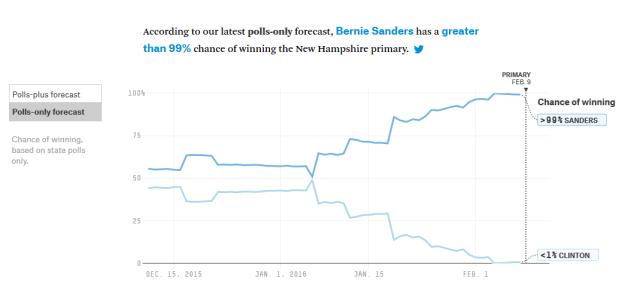
538.com’s “polls only” and “polls plus” models:

NH pollsonly

NH polls+

Or the betting markets:

NHdembets

The story is the same. Bernie Sanders is overwhelmingly favored to win New Hampshire. And therein lies the trap for him. As the analysts at 538.com have noted, Sanders strongest demographic is white, liberal voters, and so it would be expected that Iowa and New Hampshire would be very strong states for him. States to come have many more non-white voters, and self-describerd moderates, segments he has made much less polling headway with so far. So he would be really benefited by the maximum possible bounce out of these first two states.

You’ll notice the narrowing in his New Hampshire margin following Iowa in the first chart above. This narrowing seems to have backed off a bit, but primary polling  can be remarkably unpredictable (add to which Superbowl Sunday was a very ineffective day to be polling most Americans). It is certainly possible that Sanders could end up under 50%, and Clinton within single-digits of him. And if so, she benefits from the “better than expected” narrative. On the other hand, if he gets a wide margin, the press will probably run with the “she only tied Iowa, and just lost New Hampshire big” storyline. In which case Bernie is close to the best case scenario I laid out last time-he wins Iowa, then New Hampshire, and does better than-expected in Nevada and South Carolina, and goes on to get a striking distance 40% or more of the states and delegates on Super Tuesday.

Of course “best case” is still an uphill slog for him, but at least it’s a possible slog.

Republicans

As with the Democrats, poll averages:

RCP

538.com’s “polls only” and “polls plus” models:

538 New Hampshire

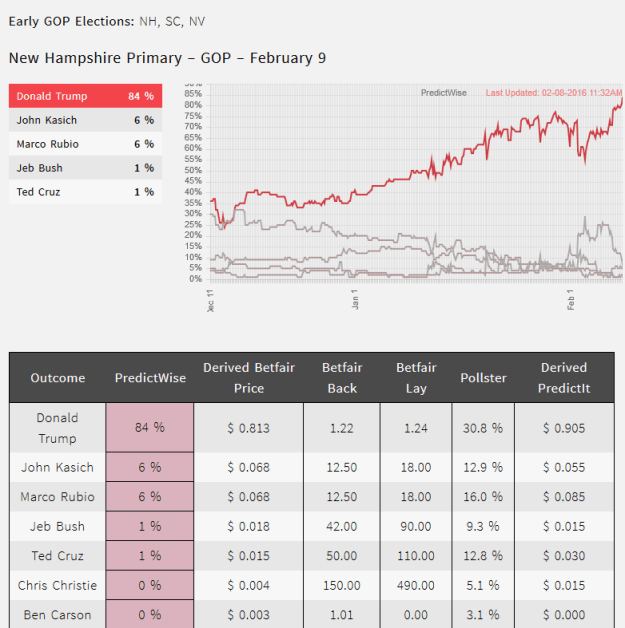
Or the betting markets:

NHdrepbets

All produce the same likelihood- Trump easily carries New Hampshire. Which really makes the race for second the story everyone will focus on. In this regard, Rubio had a New Hampshire surge after nearly passing Trump for second in Iowa, but it seems to be fading. Add to this what was widely seen as a poor debate performance this weekend, there is a serious chance he gets eclipsed by Cruz or Kasich in New Hampshire.

Kasich deserves further thought. New Hampshire is much more moderate, as Republican politics goes, than Iowa. So this is the kind of state he’d have his best shot in. A third place finish wouldn’t really get him a lot of attention past New Hampshire, but a second could have the party establishment re-evaluating whether he’s the alternative to Trump and Cruz that they might want to back instead of Rubio. The nightmare scenario for Rubio, of course, would be to actually end up fourth, if both Kasich and Cruz pass him by. That could make for a very messy, and interesting, South Carolina and Super Tuesday.

We’ll have to tune in Tuesday night and see!

Four things I’ve avoided by not writing about the 2016 election until now

Capture

I’m going to be breaking from my usual themes occasionally over the next year to talk about the presidential election. I really can’t help it, I’ve been a political junkie for actually longer than I can remember- my mom tells me as a three year old, I was fascinated with watching “the Watergate” on TV. My promise in my coverage: I have my leanings (solidly Democratic). But my analysis will be fact-based, to the chagrin of both leftie friends and rightie friends. You can look back at my postings from 2012 to get an idea of what that will look like.

However, to keep it in synch with my more usual blog themes, this first entry will be in the form of a list. The thing about Presidential politics is, there’s a lot of noise in media coverage that tends to drown out the signal. Before Nov. 1 of the year before the election, it isn’t even worth paying attention to, really, because the early speculation is based on so little, empirically, and early numbers aren’t indicative of much of anything. Here’s a few things I’ve been able to avoid talking about by not writing about it until now:

1. 4 whole candidates! First, and in an originally 22-candidate field, the value of this is not to be overlooked, by waiting I’ve avoided having to talk about Chaffe, Perry, Walker and Webb at all! Especially relieving, because I would have thought Walker had a decent chance at the Republican nomination, so it’s nice not to have to endure the daymare that would have been.

2. Joe Biden. I love Uncle Joe! Always have. He was actually one of my two preferred candidates at the start of 2008 (the other was Bill Richardson, which goes to show you what I know). But it would have been a long shot for him, and explaining that to people imbibing the latest media narrative would have grown tiresome. Now I don’t have to!
3. Arguing about Bernie Sanders. I actually can’t win with Bernie. My small cadre of rightie friends starts in on the whole tired socialist trip whenever I talk about Bernie. And my Progressive friends call me a cynic when I try to talk realistically about his chances (which have been, and remain, low according to every reliable indicator). Then I have my mainline Democratic friends who try to convince me that Bernie is worthless or even dangerous and Hillary is golden. By not writing about the election until now, I’ve at least had some break from this argument.

4. Dismissing Trump. My early take was that he would be gone before voting started, and certainly would not be in the top three by Super Tuesday. I’m glad I didn’t have a chance to write more about this, because I’m starting to question my premise. Nate Silver at 538.com, who I put a lot of stock in, still thinks Trump is ultimately doomed, because he’s so unpalatable to the party power brokers, and they have numerous opportunities in the process to derail him one way or another. It’s a solid argument. But, now that he’s been in the lead for three and a half months straight, is polling first or second in the three first primaries, and actual voting starts in 90 days, I’m a little less sure. I still don’t expect him to be the nominee (my current best guess is Rubio), but he’s actually in this thing for real.

More to follow!
48-Hour Warning: Last Call for Prognostication!

In (actually less than) 48 hours now, we will begin voting. Technically, many of us already have, in a pattern that, incidentally, seems to favor Obama so far. But I digress. My point is, the game is almost over. Below are the leading indicators as they currently stand.

Popular Vote

RCP polling average (a straight average of selected recent polls):
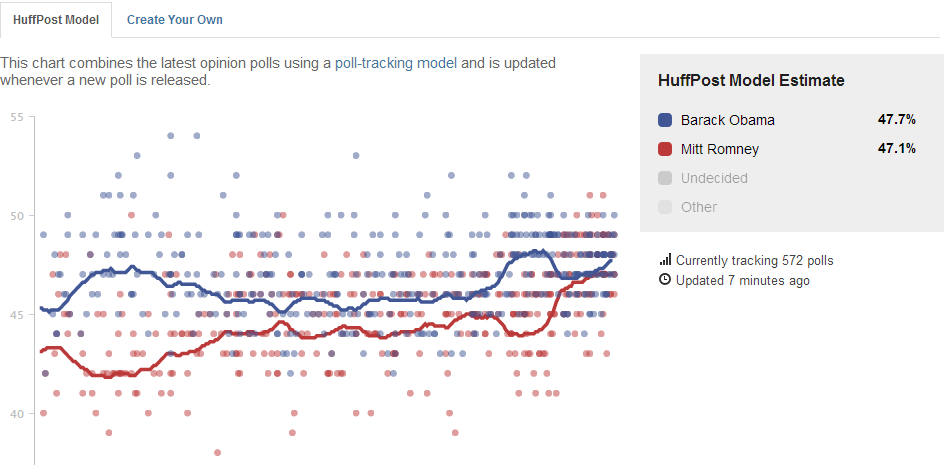
HuffPost Pollster polling average (an average of a wider set of polls, with adjustments for state-national variance and house bias):
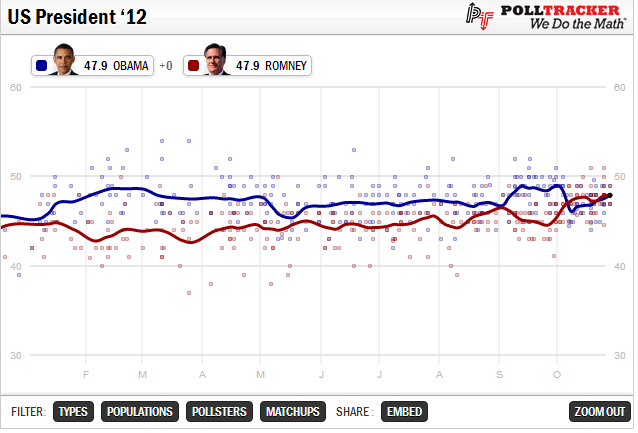
TPM polling average (selection of polls, and with regression trends added in):
If you take the average of all three, it looks like this (also showing the collective movement for both Obama and Romney over the last 10 days):
So, in sum, slight advantage Obama, but so small compared to the margin of error that it could just as easily be either candidate ahead or behind, probably within 1 point of each other. 
Now, there are those who disagree. Throughout the campaign, the average of state totals have seemed to add up to a different number than national polls have been showing. Nate Silver at FiveThirtyEight has a good argument that the state totals are the more reliable of the two, and indicate a stronger lead for Obama than national polling averages are showing. Simon Jackman, a Political Science professor at Stanford, concurs, using a similar analysis. Based on this line of thought (and the math behind it) Silver’s model indicates the following result for election day:
  
Electoral Vote
Even as its polling average shows a slight lead for Obama, the state averages at RealClearPolitics show Obama with leads in 9 of 12 ostensible swing states. His lead is less than 2% in only two of these (Colorado and New Hampshire). RCP’s “no toss up” map currently shows:
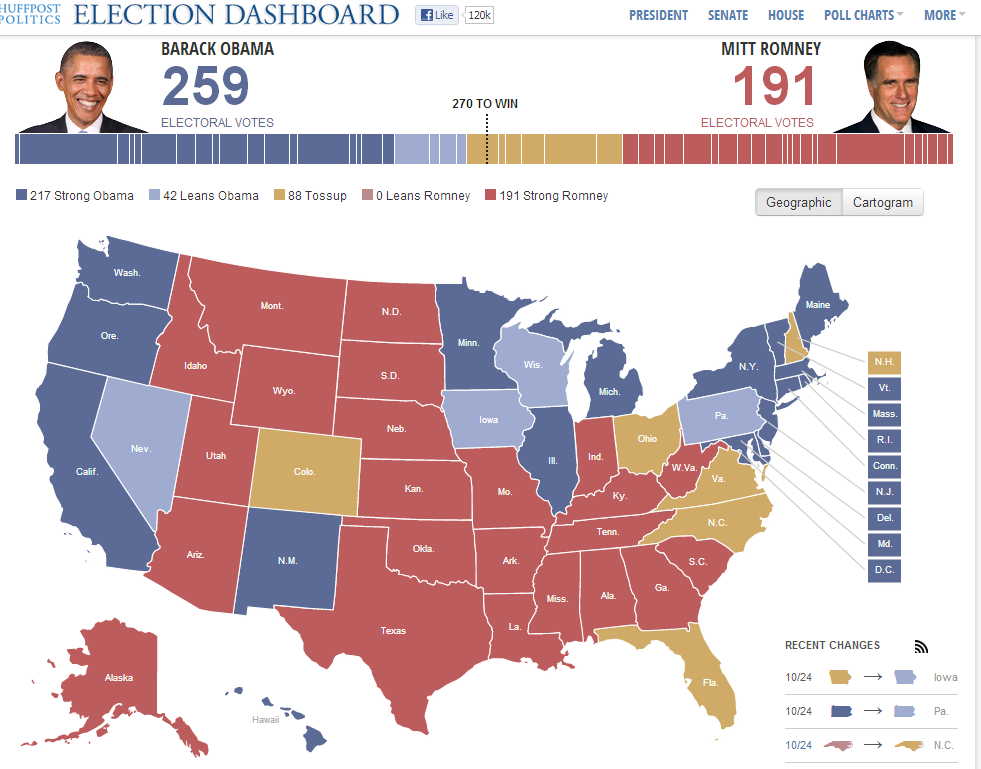
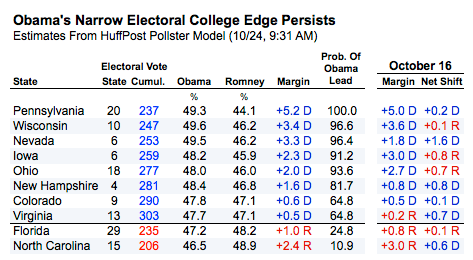
Over at HuffPost Pollster, their model, which has been updated with 120 swing state polls in the past week, currently shows:   
To paraphrase the math, Obama is overwhelmingly likely to reach at least 277, with a strong chance of up to 303.
FiveThirtyEight similarly updates its electoral model with all new polls, and then makes adjustments for house bias and historical dynamics in each state. In the past two days, they’ve only found a Romney lead in 1 out of 20 swing state polls released Friday, and 2 out of 21 released Saturday. Their map currently looks like this:
  
The only states on the map that have below an 80% chance of an Obama victory are Colorado, New Hampshire and Virginia, and the lowest (Colorado) still shows a 68% chance. On this basis, Silver’s model is predicting an overall 85% chance of Obama victory, and a map that adds up to 303-235.  
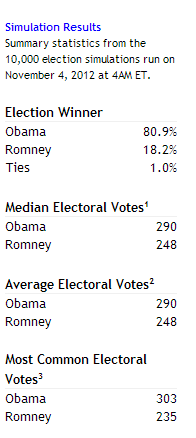
Finally, we have 270towin, which has built up a database of all recent state polling, and uses it to run 10,000 simulations a day. Their most recent batch comes out like this:
Based on all available evidence, Obama seems very likely, whatever the national popular vote, to win the electoral college.
Oddsmakers
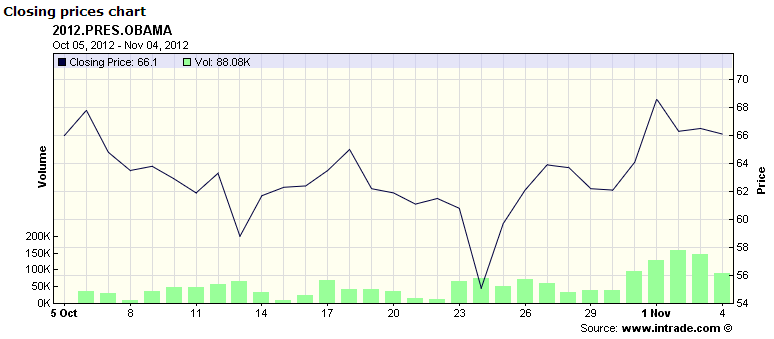
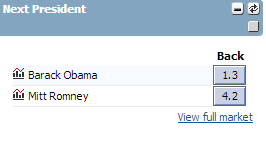
Of course, it isn’t all poll averages and simulation models. There are several betting markets that aggregate the bets of large numbers of participants (like, really large- over 100,000 on an average day). Two of the largest are Intrade, which currently shows a 66% chance of Obama’s reelection:
And Betfair, who’s current odds are:
These are odds against, so if you translate them back to percentage terms, it comes out to around 76%-24%.
The betters are predicting very high odds for Obama winning. 
Approval Rating
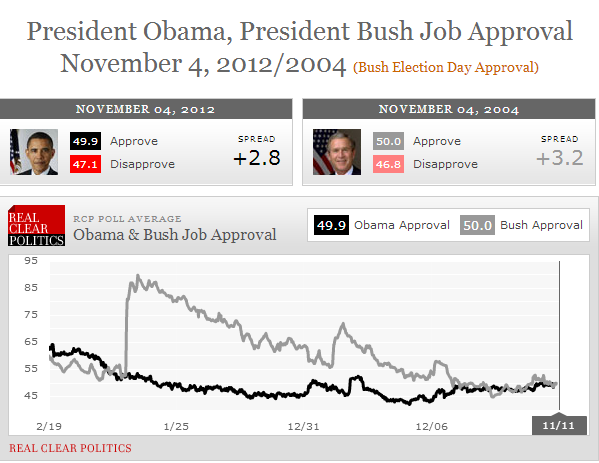
One last data point. RCP also tracks Obama’s job approval rating over time based on an average of multiple surveys, and it currently adds up to:
Obama is just a whisker under 50% approval, and his approval leads disapproval by nearly 3 points. This is much more likely to signal reelection than not. It also, perhaps not coincidentally, is very similar to where Bush was on election day in 2004 when he won a narrow, but hardly ambiguous, victory:

Final Thoughts
Many people are presenting the race in this final stretch as “too close to call”. This certainly makes sense for reasons of better news leads and partisan positioning, but I don’t believe that it’s accurate. As I shared in my “one week to go” posting, I learned a hard lesson in 2004: if the preponderance of numbers are pointing in a direction, believe that direction over any story you may see, no matter how compelling a case it makes,  about why the preponderance of numbers is actually wrong.
With less than 48 hours to go, the preponderance of numbers indicate that Barack Obama will be reelected. 
Since I’ve been throwing everyone else’s forecast around here, I’ll add mine to get some numbers where my mouth is. On the popular vote front, taking the average of RCP, Pollster and TPM as my starting point, and assuming a 1% 3rd party vote (which is pretty typical of years that don’t have an Anderson, Perot or Nader 2000), we get 3.8% still undecided. To the extent that there is any evidence of closing momentum, it seems to be slightly toward Obama. So I tilt the split of the undecideds very slightly in his favor. And on this basis, I’m going to predict a popular vote margin of Obama 49.7% to Romney 49.3%.

In the electoral college, I’m going to go with all the states where Obama currently leads by more than 1% going to him, all the ones that Romney leads by any amount going to him, and Colorado, where Obama leads by less than 1%, and the only state where the early voting trends do not seem to favor him, going to Romney. On that basis, I predict Obama 281 to Romney 257.   
As anyone who’s worked with me in my finance jobs over the past 15 years (eeek-is it really that long?) will tell you, I tend toward a (numerically) conservative bias in my forecasting. So, to the extent that there is upside to this forecast, I would expect it to be in Obama’s favor.
And that is my final “before” word on the subject. My next stop will be live blogging election night. Join me then!

One Week To Go: Margins & Momentum

This, apparently, is my 29th posting on the election over the past year! We were all so young and innocent when I kicked off my coverage, and followed with my first bit of electoral numerology. And now here we are, with a week to go.

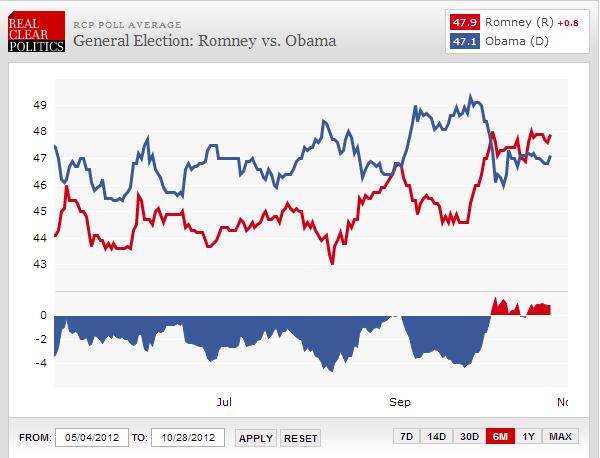
At the moment, the popular vote looks like this:

Or this:

Or this:

All of which doesn’t really tell us a lot, for two reasons:

1. RealClearPolitics, as you’ve seen above, currently has Romney in the lead by 0.8%. But the 8 polls that average is made up of currently have an average margin of error of 3.13%. Even if you assume that pooling them together cuts the collective margin of error, say, in half, it would still be around 1.5%. So Romney and Obama’s separation is well within that margin of error. I.e. the margin we’re seeing could just as easily be the product of statistical noise.

Similarly, HuffPost Pollster’s numbers have Romney ahead by 0.7%, but their estimate of their model’s margin of error is around 1.2%. Once again, Obama could just as easily be ahead. Or Romney could be further ahead than he seems. Or they could be nearly exactly tied. The point is, the numbers are so close together that they aren’t really useful in distinguishing which of these it is.   

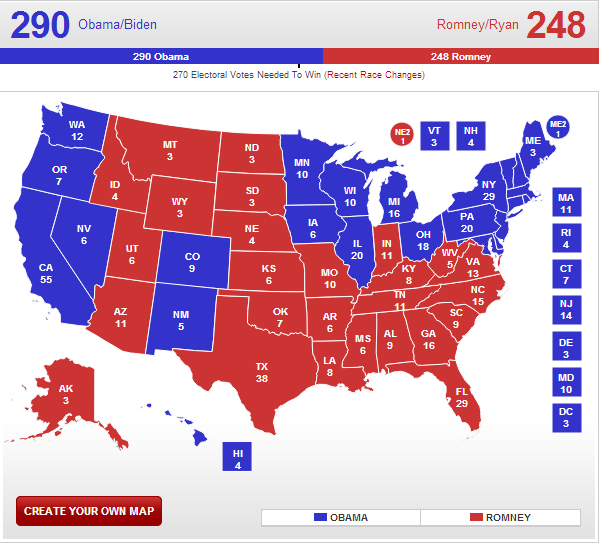
2. As David Rothschild helpfully reminded all us poll junkies today, the popular vote doesn’t actually matter. The electoral vote determines who is elected President. RCP, the aggregator of the three featured here that currently has the widest Romney margin, has a no toss-up electoral map that looks like this:

So, that’s that for margin. But what about momentum? We’re looking at what the numbers look like today, but what matters is what they’ll look like a week from now. Does one of the candidates have significant momentum? To get a handle on this, I crunched some numbers.

If we compare the popular vote numbers at RCP, HuffPost Pollster and TPM for today versus a week ago, we see:

If you average the three (which are themselves averaging multiple polls, and adjusting their mix in various ways), it would seem that both candidates have, at best, a smidgen of momentum, and Romney’s is a bit larger. If you rolled the change over the last week forward another week, we’d be at Romney 48, Obama 47.4. Then it would all be about how the remaining undecideds split. Even if they split disproportionately toward Romney (and there’s good historical perspective and recent analysis that casts doubt on that), we’d probably still be looking at something that’s within one percent.

But wait, you say, didn’t I just maintain that the popular vote doesn’t really matter? Why yes, yes I did.

So let’s do a similar analysis on the swing states. The below looks at the swingiest of the swing states, where current margins are withing 3%. I took numbers from RCP and HuffPost Pollster, since both have nicely updated state by state projections, and did the same analysis of today’s numbers versus a week ago. For compactness, I’m representing the margins between Obama and Romney here, with plus Obama as a positive number and plus Romney as a negative number:

Looking at the average, Iowa and New Hampshire have the most significant-looking potential swings (>0.5%), but in opposite directions, New Hampshire toward Obama and Iowa against. The others don’t show a lot of evidence of momentum beyond what might just be statistical noise. Let’s say you take all the swings over the past week, and roll them forward another week. Even if you build an electoral map where you only assign Obama the states that would be projected to be for him by more than 1%, the map looks like this:

  
And 270, of course, wins it, even if nationally you’re behind by 1 percent. And if Iowa, Colorado and Virginia squeak past the line for Obama too, it could even get up to 303.

My take? I learned a hard lesson in 2004. I consumed loads of analyses about how Kerry might be stronger than it looked in the home stretch, polls might have sampling biases that underestimated his position, the undecideds might break more for the challenger. I convinced myself that it could be true. In the end, it turned out just as the numbers were saying: final polling averages for Bush indicated a 1.5% lead, and he ended up winning by more than 2%.

I believe what the numbers are saying now too. Obama will likely lose the popular vote, or, at best, finish ahead by the tiniest fraction. Either way, the margin will be within 1% or so. But Romney will equally likely lose the electoral vote, even if he leads Obama nationally. Exactly 7 days from now, we shall see if I was right!

Election 2012: It’s all over but the shouting (oh yeah, and the voting)

So here we are, having finally cleared the last debate, with less than two weeks standing between us and finally, actually, choosing the next President. When I wrote my first post-primary review almost five months ago, this day seemed wearyingly far away. I was expecting one of the longest, nastiest campaigns ever. Instead, we’ve gotten one of the most vapid. And this is where it’s left us, a VP-pick, two conventions and four debates later (map from HuffPost Pollster):

For those of you just joining us, here’s what’s happened so far:

Mitt Romney ran a pretty uneven campaign and Barack Obama ran a pretty good one throughout June and July, during which Obama usually held a  2-3% lead. Then a combination of Obama doing Romney in with a neo-Swift Boatian barrage of advertising tearing down his business past and Romney doing himself in with his mouth during his foreign trip led to an early August gap that reached 4 points at its height. By virtue of a VP pick that galvanized the Conservative base and a solidly serviceable convention, Romney deflated the Obama bubble and inflated his own numbers, bringing it to a tie by the beginning of September. The Democrats then had a very good convention (though, shades of trouble to come, Bill Clinton made a better case for Obama there than Obama made for himself) that shot Obama back up to a 3+ point led. Then, incredibly, by opportunistically pouncing on the Libyan attack and standing behind his “47%” comments when they were leaked, Romney let Obama hang on to that lead for about a month, and grow it even further. Enter talk of a Democratic blowout victory.

Except, in contravention to all conventional wisdom about debates having minimal impact, Obama had just about his worst night ever on the same night that Romney had one of his best at the first debate. This turned what was a natural rebound for Romney and cooling off of Obama’s highs into an out and out surge for Romney and collapse for Obama. Enter talk of Obama being toast. Any time you see a sudden swing you can expect it to back off a little, and it’s done so, no doubt aided by Joe Biden proving the party still had some fight left in it at the VP debate, and Obama deciding to show up this time for the second debate. The new normal now appears to be Obama stabilized, and Romney much stronger, giving Romney a small but persistent polling lead. You could make a case that the third debate will further attenuate this, but probably not much further in Obama’s direction than an even closer near-tie.

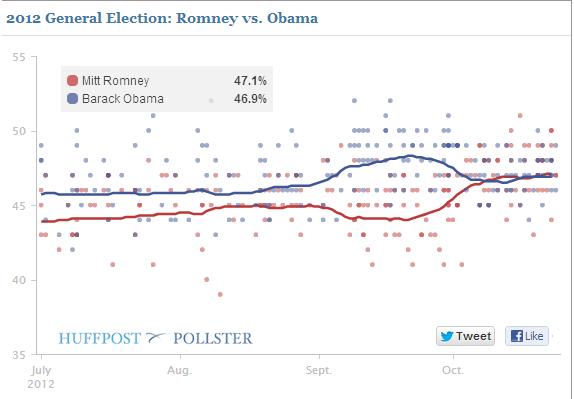
It’s good to keep in mind that current numbers need to be taken with a grain of salt. For one thing, RealClearPolitics builds its average off of whole numbers, such that, for example, an ABC News/Washington Post poll released today is listed there as Romney 49%, Obama 48%. But, in fact, far from being a 1% difference, it was actually a .07% difference, with the raw numbers 48.51% to 48.44%. RCP hasn’t done anything deceptive by doing this, they just have a rounding standard, and they followed it. Issues of which polls they select to list and which they don’t are potentially more troubling, and have led to accusations of bias in the past. Rather than saying yea or nay to them specifically, we can observe an alternate data point, both in wider poll selection and precision of presentation, from Mark Blumenthal at HuffPost’s Pollster:

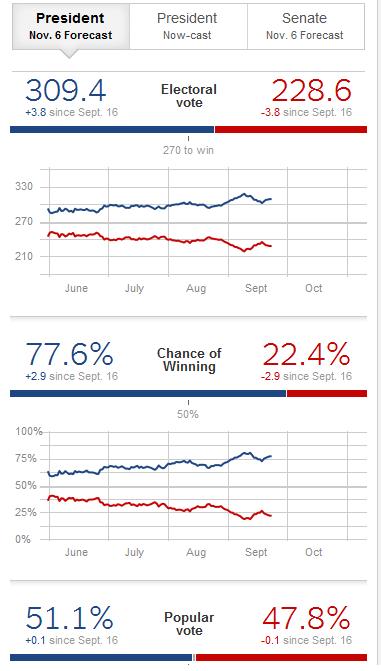
Grains of salt 2 and 3: The election does not happen today, and it is actually 51 separate elections, in 50 states + DC. Nate Silver at FiveThirtyEight takes this into account by doing a projection based on current polls, past trends, and balancing national polling with state by state totals. His model was very accurate in 2008, and his current forecast for Nov. 6th is a 1.1% popular vote victory for Obama:

By far the largest grain of salt, however, is that the popular vote doesn’t determine who becomes President, who gets 270 votes in the electoral college does. This is, of course, well know, but it can be dramatic how much the two can differ. Al Gore was ahead by 0.5% nationwide in 2000, but lost due to narrowly losing Florida. If John Kerry had gotten about 60,000 votes more in Ohio in 2004 and George Bush around 60,000 less, Kerry would have become President even while losing the popular vote nationally by almost 3 million votes. And the current state of the electoral vote? Even as it shows Romney ahead by 0.6% in polling, RCPs “no Toss Ups” map of all current leads looks like this:

Similarly, over at HuffPost Pollster we have an estimated current lead of well over 270 with the most likely states, and a total of 303 with all leads:

Over at 270 To Win, they run 10,000 simulations a day based on current state polling numbers. Their electoral college results for today:

And on the forward looking side, Nate Silver’s electoral college forecast current shows:

Any way you slice it, Obama looks like he has a narrow, but totally sufficient, electoral college edge even with national polling that puts him slightly behind. In the June 2nd post I mentioned in the opening above, I wrote:

“I don’t see anything fundamentally changing the picture that points to an ongoing nearly break-even that eventually (and narrowly) breaks for Obama.”

It’s even narrower than I thought it would be, but I still stand by that prediction today!              

How Mitt Romney solidified Obama’s bounce (and lost the race?)

Well, here we are…

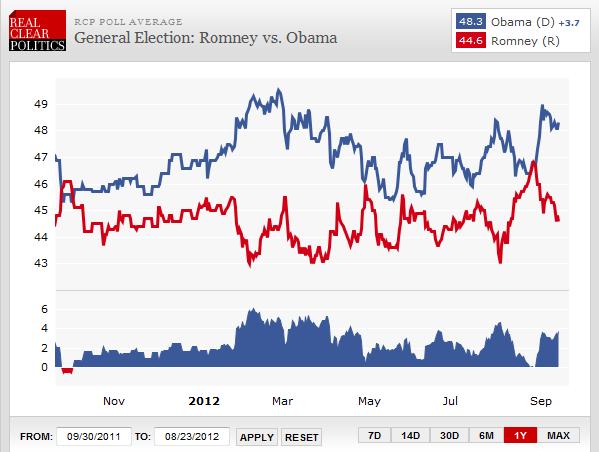
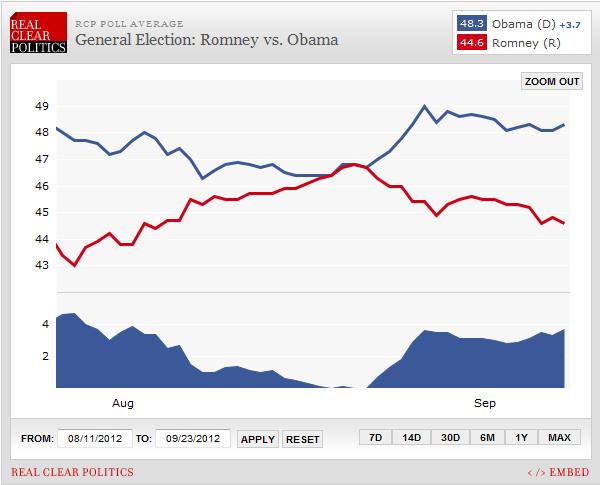
With 44 days to go, President Obama is polling above 48%, and is ahead of Mitt Romney by 3.7%. And this is not just any check-in. At the time of our last update, we had yet to see the effect of much real news on the race. Now we have quite a bit of real news under our belts. It’s now been:

  • 43 days since Romney selected Paul Ryan as his running mate
  • 24 days since the Republican National Convention ended (on which, see my final review and links to the earlier ones here)
  • 17 days since the Democratic National Convention concluded (further reviews on that here)
  • 16 days since the truly grim August jobs report was released
  • 12 days since the embassy attacks on the anniversary of 9/11
  • 5 days since video of Romney writing off 47% of the nation before wealthy donors emerged

So now these numbers can be considered quite a bit more indicative than before. And what do they show? You’ve seen the graph above. Also worth considering is the electoral college map, since that, of course, is how the President is actually elected. If one takes the most conservative route of only assuming Obama carries that states where he’s currently polling even higher than his 3.7% national average, the map looks like this (courtesy of RealClearPolitics):

If we look at the map with all leads, it’s a blow-out for Obama, with only Indiana, North Carolina, and Nebraska’s split vote flipped from Obama’s 2008 total to Romney:

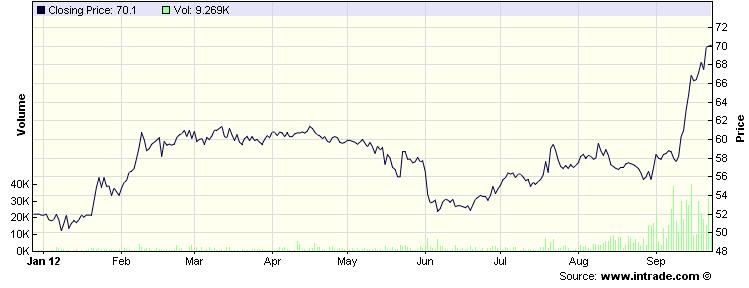
In other words, any way you slice it, it’s a pretty convincing lead. The odds-makers over at InTrade tend to agree:

As does Nate Silver’s model over at FiveThirtyeight.com:


You’ll see many stories in the days ahead about how Romney isn’t as hosed as he seems. Like this one for example. Most will be written by partisans trying very hard to believe, but that doesn’t mean they’re completely wrong. Indeed, to see the FiveThirtyEight model on the flipside, it’s saying if you run the race 44 days forward from where it is now 10 times, you’d expect Romeny to win at least twice, even given present numbers. This thing will certainly tighten up from where it is now.

However, as laid out above, we now have a lot of news behind us, and the debates are the remaining major campaign driver. Based on historical experience, it would be a mistake to expect them to change things fundamentally (for more on this, see this article from the American Prospect). Which leaves external events. There is no doubt more fallout from Libya, and more uncertain economic indicators. These are the kinds of things that can take the edge off of Obama’s numbers, but not the kind of things that would totally change the dynamic. To understand how we got here, I think it’s useful to look at the period since the Ryan announcement:

As you can see, the announcement, and the convention, actually helped Romney quite a bit, bringing him from a trough of 43% up to around 46.8% at his height. Moreover, the two combined took a lot of steam out of Obama’s numbers, bringing them down from 48% to 46% at his lowest point. The effect of all of this, though, was just to tie it. And if all you are is tied after the maximum burst of positive attention on you, well… So then Obama got his own convention bounce, and Romney’s numbers took a corresponding dive. Then, as Obama’s bounce was beginning to fade, and Romeny’s numbers stabilizing for a likely rebound to some extent, news happened. It looks to me like the effect of Romney’s bungled response to the Libyan crisis and the leak of his “writing off 47%” comments (not to mention his digging in and doubling-down every chance he got once these stories started to play badly for him) has been to send his numbers sideways (and even somewhat downward) just when they should have been recovering a little. And, on the other side, they allowed Obama to keep more of his post-convention buzz than he otherwise would have.

This is going to fade a little bit toward the mean from here, but at levels much more difficult for Romney to recoup from than they would have been minus his two weeks of mis-steps. For example, let’s say Romney had good debate showings that were worth a point of swing, and Obama had a string of negative external news that was worth another point of swing, plus a general tightening of a point. That would be some major shifts all in Romney’s direction, and it would still leave Obama ahead by 0.7%. Barring major crisis or huge debate surprises, Obama’s solid lead is the new normal for the race, and it’s going to be a very tough hill for Romney to climb.


DNC Review II: I Want To Believe

Well, this weekend has quite gotten away from me, though through the best means possible (helping a friend celebrate an important anniversary Friday night, and going to the Boston Arts Festival with my dearly beloved and our cousin yesterday. So I will have to try to catch up with the remainder of the Democratic National Convention speeches today. You can find Part I of my DNC review here, and can also peruse parts I, II and III of my RNC reviews, should you be so inclined.

Since I listened to Rick Santorum’s defense of the rights of the unborn at the RNC, it seems only fair to give some time the woman Rush Limbaugh made famous by mocking for not wanting to get unintentionally pregnant, Sandra Fluke:

Moral of this story- don’t be the nominee of a party that tries to hold a hearing on contraception without inviting a single woman, and then when one of the most prominent figures of your party mocks  a woman who did testify about contraception earlier by calling her a slut, not say anything in her defense. Because if you decide to be that guy, you deserve to get this speech thrown your way, and she gave it very well.  

Now on to John Kerry, the heartbreak of 2004, speaking about Romney’s foreign policy proposals:
Using “Respect” as the intro is an interesting choice. Weird to think that if he had won in 2004 and then won re-election, this could have been making his speech as incumbent tonight. Ah, alternate history… Oh, good one about his outsourcing the job of Commander in Chief to Neocons. And finally somebody addressing American exceptionalism as being something produced by doing exceptional things. Like standing up for freedom and fighting global warming. This is really a nice succinct argument for Obama’s foreign policy. Eliminating more of Al Qaeda in the last three years than in the previous eight? I like this “he promised” “he did” motif he’s got going here. And now name-checking Netanyahu against Romney. Refused to accept the false choice between diplomacy without force and force without diplomacy. You go, John! Really gratifying, this is like anti swift-boating. And now he’s throwing “for it before you were against it” back at them too. It really is amazing that the party of defense and strength abroad turned out Romney as a nominee. Kind of a testimony to how well Obama’s been doing, that things seems stable enough that it isn’t even a major issue.
And now to the woman who would be my Senator, Elizabeth Warren, who gave  a speech I’ve already heard plenty about, busy as my work-week was. Let’s see if it was as rabble-rousing as I’ve been led to believe:

Awww, it’s her first convention! And darned if they aren’t chanting for her now. Uh-oh, now she’s talking about hard-working people. Too radical! “The game is rigged against them” is the line I kept hearing, but nobody quoted the second half- it wasn’t always this way. As she’s arguing now, America did invest in it’s middle class, and it’s that policy that’s been reversed now. And the people who have been rolled over by that  are the people she’s fighting for. It’s a funny America where talking about the interests of working people over those of billionaires is radical. Uh-oh, Cayman Islands. We celebrate success, we just don’t want the game to be rigged. And now she’s talking about Progressivism in the Teddy Roosevelt sense. Well done, Liz, well done. Level the playing field, fair share, fair shot, build the country from the bottom up. Her little huff exasperation sound is almost as distracting as Ryan’s weird little laugh-sigh sound. Oh good one- sure they believe in government. They believe in government to help themselves and their friends. And now very powerful on corporations not being people, and people being who we represent. Now presenting Obama versus the lobbyists on the Consumer Protection Agency, on the side of the people. While of course reminding us the agency was her idea. Is this a winning strategy for her? I don’t know, but it’s winning my vote. Now linking stealing your purse on the street with stealing your pension on Wall Street. And now closing with Matthew 25:40 and the ghost of Ted Kennedy. Go Liz go!

Who was she introducing by the way? Oh yes, that’s right, one former President William Jefferson Clinton:

Ah, that’s right, he was formally placing Obama’s name in nomination in his speech. Aww, look at Rahm Emmanuel smiling up at him all starry-eyed. Like me, he wants to believe, and Bill Clinton always reminds him of when he did. Hence my use of another icon from the 90s icon to introduce this posting. We’re all in this together- the centerpiece of the Progressive ethos. Ah, now breaking down job creation since 1961 by administration. Investing in people is both morally right and good economics. Oh, Billy, we do miss you. Now he’s talking up Eisenhower and Reagan and pointing out how he’s never hated Republicans anything like the way the right now hates Obama. Because we focus on solving problems and seizing opportunities rather than fighting all the time. Cooperation over conflict, nobody’s right all the time, but the current Republicans don’t see it that way. And now holding up Obama as someone committed to cooperation, pointing out that he brought Republicans into his cabinet and his 2008 rivals. Including, yes indeed, Hillary Clinton. And, you know, while you can point to times when Obama’s been too inflexible, the other side has pretty much made the argument for him by being TOTALLY inflexible. Now skewering the Tampa convention, conceding they’re honorable people who will keep their commitments, then reminding us what those commitments are. And now selling the case for Obama- he put a floor under the crash, and has built the foundation for a future that works. And comparing it to his experience in ’94/’95, reminding us that Obama started with an economy in far worse shape. If you renew the President’s contract, you will feel the recovery. That’s it, that’s the argument. Love the job scores: job growth following the stimulus plan plus the auto restructuring versus Congress killing the jobs bill and Romney opposing saving the auto industry. Education so people can fill the already open jobs in the new economy, and what Obama is doing to support that. Man, this is a masterpiece-logical, thorough and impassioned. I understand now why folks were raving. For the last two years, health care cost growth under 4% per year for the first time in 50 years! Oh good, now he’s going after the “robbing Medicare” line. Did Ryan really think nobody would notice that the rationale, and even the amount, is exactly what he himself proposed? He’s a master of describing the other sides positions accurately, and making them seem absurd. The Republicans try that too, but outright lie to represent the other side’s argument along the way. Now shredding the Obama attacked the Welfare work requirement lie. And ending by talking about debt reduction, aka taking the bull by the horns. They quadrupled the debt the twelve years before he took office and doubled it the eight after he left. Ain’t no arguing that. The Obama plan as passing the arithmetic test and the values test. Plus a little voting rights on the way out. Fantastic speech and one that, by the way, unlike Romney or Ryan’s, passed fact checking with flying colors. There’s only one problem with a speech like this…

Somebody has to follow it. And the somebody who’s speech would most strongly compared to it, for good or ill, of course, would be President Obama‘s. I’ve heard that it was more restrained than many were expecting, but I wonder if some of that was the comparison effect. Let us see:
Did they really move inside because of the rain? Maybe yes, probably no. But it is a nicely filled-out room. Okay, I’m already doing the compare to Romney game. I have to think the guy who seems more optimistic and relaxed is going to take it. Look at Bush/Gore. Look at Bush/Kerry. And it’s already clear who’s on what side of that between these two speeches. Although he does keep slipping in to this slightly pugnacious look. I guess this race has him riled up! Beats Romeny’s exaggerated-eyed aloof nod, to be sure. A choice between two paths, good. I’m liking this, we’ve been there and tried that, and we are moving forward. And, however it plays, I have to admire the, “I’m here to tell you the truth- it won’t be easy, it won’t be quick.” Didn’t work so well for Carter or Mondale, but it’s still the higher road. Interesting to observe to the side, as I’m watching this on YouTube- 1.165 million views, 11,702 likes versus 3,388 dislikes. (Update- the most viewed one I could find had 356K views, with 2,804 likes versus 3,558 dislikes.) Even given that the net audience skews younger and better educated, therefore more likely Progressive, that’s pretty good. Remind me to check Romney’s stats after… Asking us to choose a path that leads to more manufacturing jobs and less imported oil dependence. Reminding us that climate change is not a hoax, and the dangers it poses to our children’s future is not a joke. And now education as the key to future competitiveness, which government has a role in, but everyone has to work on together. Now reminding us of his foreign policy promises, and how they’ve been delivered on, sounding almost Bushian with the new tower rising and Osama Bin Laden is dead line. And remembering to mention the troops in harm’s way (boy do I bet Romney regrets that one) but tying it back in to policies to take care of the troops when they come back home. You know, I think what this really sounds like is the more sober, responsible speech of a sitting President. It’s appropriate, I think, and the way you put down a challenger by contrast. Definitely some chutzpah on the foreign policy inexperience of Romney and Ryan given he came in with none himself, but hey, he’s delivered. I’m liking this “I refuse” line, listing the things that benefit the middle class that he’s not willing to give up on so that an upper income tax-cut can happen. Pivoting from that to, “this is the choice we now face.” And packaging the Republican policy prescription as being something that’s not who we are. Believing in the next little girl who might become President! Government can’t solve all of our problems, but it isn’t the source either. “We” like a thousand times. Nice- “you were the change”, “you did that” to counter the “you built that.” The party certainly knows how to not roll over and play dead by ceding all language of citizenship and patriotism to the Republicans. Interesting end- owning up to his failings and limitations, but how we give him hope. Like 2008 inverted. And if we share that hope, then he asks us for our vote. Wow, that was an end!    
Do I have any closing remarks that compare the two? Why yes, yes I do. In the boring realm of facts, the Democrats did much better. Witness, for eample, Factcheck.org’s rundown of Biden and Obama’s speeches (By the way Joe- I apologize for dropping you from this review. You know I dearly love you, but my time was too limited, and you know how Bill likes to go over…), and contrast the exaggerations there (and surely there were some) to the outright lies documented there for Romney and Ryan. As far as tone goes, I agree with Sean Trende’s column from RealClearPolitics that the Democrats actually seemed like the riled-up and enthusiastic challengers this year. As for Obama’s speech, I’m not sure I agree with those who found it comparatively lackluster. As I said above, I found it to be more appropriately sober and honest about the road ahead without ceding a single policy or rhetorical point. That being said, I can understand Joe Klein’s take on it, and I think he’s on to something: An ideal Democratic candidate might be accomplished by a mind-meld between Obama and Clinton. Maybe I’ll run on that…      
And there you have it. Our conventions are done, less than 60 days to go. Ding! for round two!