
First of all, before we go any further, let’s stipulate that polls at this stage of an election are not very good at predicting final results, though not as bad as they are a year out. You really need to start looking at polling a week or two after both conventions are over, which would be mid-August or so. But you just can’t help it, can you?
Let’s start with this basic fact: Generally, if a candidate had this kind of net unfavorablity rating, you wouldn’t give that candidate a very high chance of being elected:

Unless they were running against this candidate:

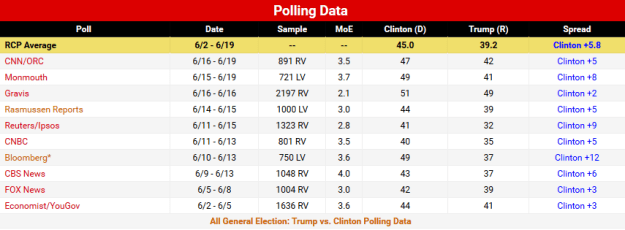
Score one for Clinton! What about head-to-head polls? Despite my above caveat, there is some sensibility to looking at the polls now. Trump has eliminated his opponents, Clinton’s has gone quiet, nobody really disputes that either is the prospective nominee now, and the last week’s worth of polls even captures reactions after a major news event involving two hot-button issues, terrorism and guns. If we start with the day that Trump became the Republican’s all-but-certain nominee and run through today, we get:

You can see that Trump gained some ground after wrapping up his nomination, and Clinton lost some as her’s dragged on. But she’s now gotten a drift up following her consolidation of nomination, while Trump has dropped. Note that RCP employees a straight averaging of recent major polls:
However, not all polls are created equal. Different polling firms have different track records of reliability, and also some built-in tendency to skew either Democratic or Republican. 538 does a good overview of this, if you’re interested. Ideally, you’d do some re-balancing of your poll weightings based on historical accuracy and partisan skew. Huffpost Pollster does some version of this, and they’re showing the following:

It’s worth mentioning that in either polling aggregation, Clinton’s lead is well outside the average margin of error. Of course, the popular vote isn’t everything. In fact, in a U.S. Presidential election, it isn’t even the thing that determines the winner. RCP doesn’t yet have a “no toss-ups” version of their electoral map, but based on the latest state polls, they’re showing the following solid, leaning and toss-up states:

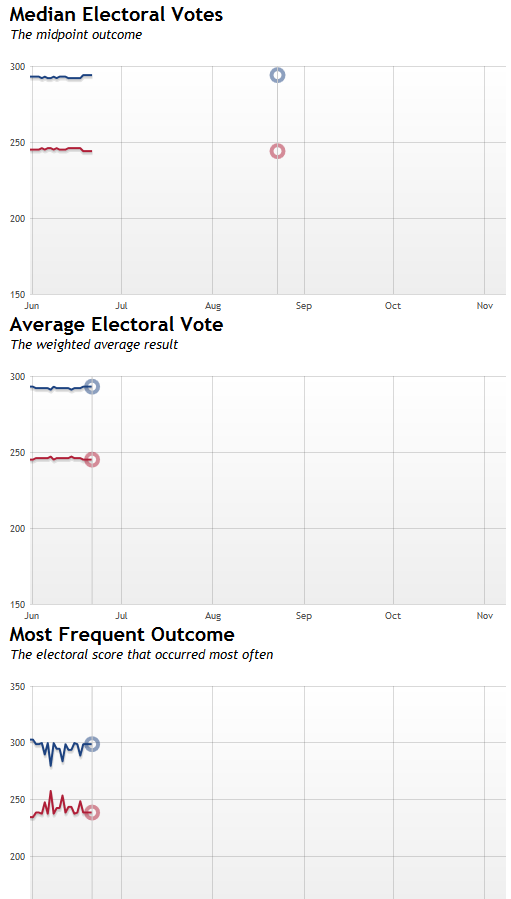
You see a lot of the usual “toss-up state” suspects here, but you also see two that indicate the Republicans are stretched in more territory than usual: Arizona and Georgia. Meanwhile 270towin.com, based on recent state polls where available and extrapolations from 2012 where there isn’t good recent polling, has an electoral simulator that can be fun and terrifying to watch. This simulator does a run of 10,000 simulations a night, for which the latest results are:

They’ve been doing this for three weeks now, and there hasn’t been a lot of variability:
In addition to silly things like polls and electoral votes, we can also look at the betting markets. These can be much handier to pay attention to than the opinions of pundits because they do the same thing (indicate the opinions of election watchers) but with the advantage of aggregating many thousands of those opinions, and literally asking the opiners to put their money where their mouth is. PredictWise.com, based on the results of several different betting sites, is currently showing:

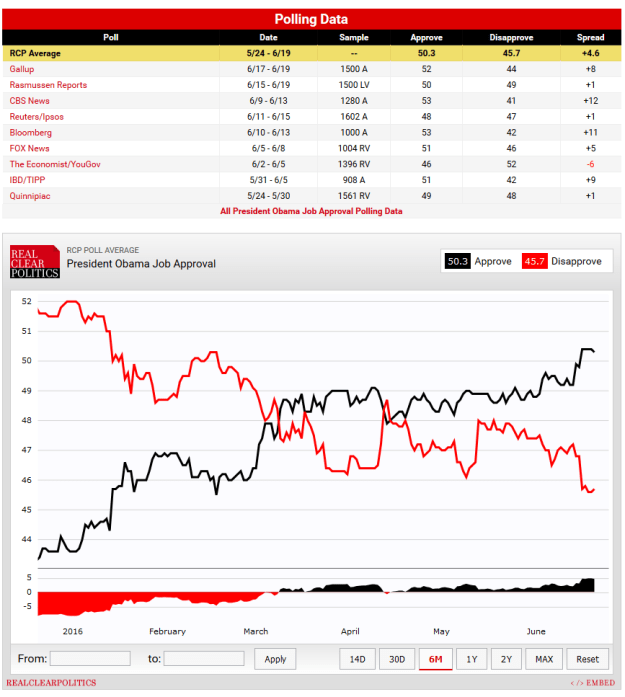
Finally, we can look at the popularity of the incumbent party. This isn’t as reliable as when an incumbent is running for reelection themselves (for example, Bill Clinton was sitting on around 60% popularity in early November 2000, but Al Gore ended up with 48.4% of the vote), but it certainly has some value as an indicator. Obama’s approval ratings over the last 6 months look like this:
It’s certainly early days still, but looking at every statistical leading indicator we have, you would have to say that Hillary Clinton’s chances look pretty good.













 A History of God (Karen Armstrong)– Because Christian Fundamentalism is such a strong voice in our current culture wars (as well as the boogeyman of Islamic Fundamentalism), it can be easy to equate Fundamentalism with religious belief itself, and to think that it has always been so. One of the very useful things I got from Karen Armstrong’s survey of 4,000 years of Jewish, Christian & Muslim thought about God is just how rich a variety of viewpoints there have been in all three religions, and what an outlier 20th/21st century Fundamentalism is. Traditional religion turns out to have never been all one thing, and God is an idea that continues to evolve as all three faiths grapple with it.
 Answer to Job (Carl Jung)– Jung starts by looking at the Book of Job, and the thundering non-answer God gives Job when questioned about suffering. He then presents the Gospels as God “reconsidering” his answer, with an outpouring of love and self-sacrifice to relive our suffering. However, this is too abrupt a shift from the sometimes judgmental God of the Old Testament, leaving an unintegrated remainder of the capacity for wrath. And thus we get the Book of Revelation… This fascinating examination of the Bible in the context of psychology and mythology opens up whole new ways to understand scripture.
 God : A Biography, Christ: A Crisis in the Life of God (Jack Miles)– In many ways, Miles two books follow up on this approach. But Miles instead approaches scripture from the vantage point of literary criticism, examining what kind of character God, as presented in the Bible, is. The first volume covers the troubled evolution of God’s character in the Old Testament, and the second presents the New Testament as a response to the crisis that God’s character comes to, which is radically resolved through incarnation and sacrifice. Again, coming at things from a fresh direction can break open how the story can reach us today, and what it can mean.
 Rescuing the Bible from Fundamentalism: A Bishop Rethinks the Meaning of Scripture (John Shelby Spong)– A (now retired) Episcopalian Bishop, Spong made it his life’s work to consider what scripture can mean in the age of science. He points out that a literal understanding as modern Fundamentalism thinks of it is actually a very modern phenomenon, and would have made no sense, for example, to medieval Jewish Rabbis, or classic theologians like St. Augustine. The Bible, he contends, can and should be understood in its original cultural and historical setting, and considered in light of what its essential meaning is in our current setting.
 Stalking Elijah (Rodger Kamenetz)– In his earlier book, The Jew in the Lotus, Kamenetz described the journey from his Jewish upbringing to Buddhism. After it came out, the Dalai Lama challenged his to search for practices of mindfullness in his own spiritual tradition. His resulting talks with several contemporary Jewish mystics uncovers a lively and longstanding tradition of mystical contemplation in Judaism. It turns out that being a Jew and a Buddhist aren’t necessarily as different as one might think…
 The Coming of the Cosmic Christ (Matthew Fox)– Fox, like Spong, sought to bring new understanding to the church from within, but met with a little more resistance, ultimately resulting in him being expelled as a priest from the Dominican Order of the Catholic Church. One of the key points of the schism was his rejection of the idea of “original sin”, instead focusing on the original blessing of creation, and how a church focused on this can atone for its own sins against women, the unempowered, other faiths, etc. and develop an ecologically-centric, globally-minded and gender-balanced idea of what Christ represents. As Fox says, “The power of native religions to regenerate Christianity and to reconnect the old religion with the prophetic Good News of the Gospels has yet to be tapped.”
 The Gospel According to Jesus (Stephen Mitchell)– Starting in the 19th Century and accelerating into the 20th, there has been a lot of scholarship based on archaeology, literary study and the latest discoveries of ancient texts on who the historical Jesus was, and what his original teachings may have been vs. what is later accretion by the Church as it grew. Mitchell wrote this book in an attempt to make that scholarship more available to a lay-audience. He also puts Jesus’ teachings in the context of spiritual traditions from around the world. This book had a profound impact on me when I first read it, unlocking a vitality and compassion in the Gospel message that is all too easily obscured by dogma and history at this point.
 The Jesus I Never Knew (Philip Yancey)– Yancey’s book actually does something very similar, but from a diametrically opposite direction. Yancey is a mainstream Evangelical author, but he takes the gospel message down to its fundamentals, and lets every challenging thing that Jesus asked of his followers stand in sharp relief. Again, as with Mitchell, this has a way of cutting through history and dogma, and re-revealing how radical the message of Jesus really was, and remains today.
 The Left Hand of God: a Biography of the Holy Spirit (Adolf Holl)– In the fine tradition of Fox, Holl is a Catholic writer and theologian who served as a priest and professor of Theology for almost 20 years until he was dismissed due to conflicts with church authorities. They may dismiss him, but I found his biography of the Holy Spirit to be very arresting. He looks at the third “person” of the traditional Christian Trinity through its affect on a variety of inspired figures throughout history, including Catholic saints, founders of alternate religions, U.S. Pentecostals and Malcom X. This approach leaves the Spirit as it should be, very much alive and active in the world.
 Signal to Noise (Silvia Moreno-Garcia) Book clubs are good. Geeks are good. Speculative Fiction is good. For all these reasons, and including the lovely people involved, the
  Nonzero (Robert Wright) At any given time, I try to rotate between something from fiction, nonfiction and spiritual (that tricky category that straddles both realms). I’m currently at the non-fiction stage in the rotation, and so am reading this, Robert Wright’s exploration of the “meta-story” of social evolution. It’s been on my list for a long time, ever since I saw it on a list of books former President Clinton was reading some time in the early 2000s. After I finished weeping thinking of “reading” in connection with the then-current occupant of the White House, I made a note to check it out. It’s been well worth it. So far, I’m in the section that reviews the “arrow” of social/technological/economic development running through history. The very hopeful thesis is that, despite the vagaries of history and temporary ups and downs, there’s an underlying trend toward larger scale, increasingly complex societies based on the “nonzero” game of cooperation. I’m really interested in getting to the part where Wright speculates about, based on where we’ve been, where we’re going next.
 Lucky Fish (Aimee Nezhukumatathil) I also have some poetry in the hopper at any given time. On the “new school” side, I’m currently reading the latest volume by one of my favorite contemporary poets, Aimee Nezhukumatathil. Her work is a wonderment of connections between personal and global history, the natural world, the interior world, and popular culture. Illuminated throughout by wit and compassion. And she is, incidentally, the featured poet in the forthcoming annual print edition of
  Poems and Songs (Robert Burns) And kicking it “old school” on the poetry side, I have this collection by Robert Burns going. If 18th hunner years romantic bards writing in scots sassenach wi’ wit ‘n’ verve ur yer thing, ye micht wantae check this oot. Quite seriously, besides the delight of looking up new words in the glossary in back, the lyrical nature of his verse is second to none. And you don’t just have to take my word for it- Steinbeck, J.D. Salinger and Bob Dylan are all pretty fond of him as well.
 The UFO Enigma (Peter Sturrock) Ever since I was a wee lad, I’ve liked my unexplained phenomenon, and none more so than UFOs. It’s a subject that’s been so thoroughly ridiculed at this point that it’s difficult to discuss seriously. Speaking of signal-to-noise, around 95% of UFO reports are clearly noise- low-quality reports, misidentifications, hoaxes, etc. But there remains a residue of around 5% “signal” that is genuinely baffling and highly unknown to contemporary science. This book is a presentation of the proceedings of a scientific panel brought together by Laurance Rockefeller in 1997 to examine some of the “best evidence” that investigators had to present. I’m looking forward to reading their conclusions, because the truth is still out there…
 Holy Qur’an Were we just talking about truth? About 1.6 billion people world-wide consider this to be the most perfect version of a religion that has been continually revealed to humankind throughout history, starting with the Jews, and then the Christians, and culminating here. As a syncretic panentheist I don’t really do exclusive claims to truth. But I do respect spiritual traditions from around the world and throughout history, so I’m almost always reading somebody’s scripture.
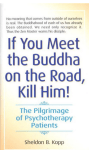 If You meet the Buddha on the Road, Kill Him! (Sheldon Kopp) Take that, scriptures! Sheldon Kopp uses the language of psychotherapy, mythology and numerous religious traditions to highlight what he sees as a universal human journey from looking for the answer from someone else to realizing that it is only found within. This is my “car book”, I read a page or two to provide myself with a moment of zen before heading in to the office.
 JLA Vol. 6 (Joe Kelly, Doug Mahnke, Tom Nguyen, David Baron) On the topic of religion and myths, comics writer Grant Morrison thinks superheroes are our contemporary legends. I usually have a comics collection on my Nook for night-time reading before bed, and I couldn’t be happier than with this one. Though I’ll always be a Marvel boy at heart, things don’t get any bigger or more legendary than the heaviest hitters from DC Comics, the Justice League.
