
Well, we’ve had the first four contests in February. We’ve had three Super Tuesdays! We’ve also had a smattering of other days and un-super Tuesdays, like this week’s confabs in Arizona, Idaho and Utah. Along the way, we’ve whittled things down from 22 candidates to five. From here, things take a little break. The Republicans don’t have another outing for 13 days, and after three contests this Saturday the Democrats are out too until everybody gets back together for Wisconsin on April 5th. So how are things looking on the eve of the campaign’s Spring Break?
Democrats
If you look on a county-by-county basis, there’s almost a Mason-Dixon line going on the Democratic side:
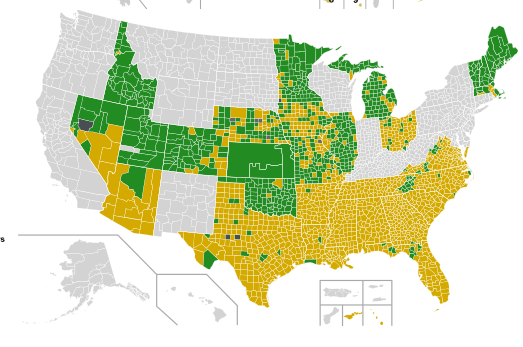
Tuesday’s results reinforced that, with Hillary doing well in Arizona (probably inadvertently helped along by state Republican officials voter suppression strategies), and Bernie doing very well in Utah and Idaho. In fact, Sanders got such lop-sided margins in those two states that he actually slightly reduced his delegate gap versus Clinton, something that he stands to do again this weekend with Alaska, Hawaii and Washington. This follows up on his win by a 2/3 margin of the Democrats Abroad primary announced this Monday. Statistical analysis of where he’s done well so far would also indicate he stands a good shot in the next two states once we resume again in April, Wisconsin & Wyoming.
Does all of this improve the outlook on his possibly winning the nomination? In a word: Probably not. Okay, it was two words, you got me. My fellow Berners pretty much aren’t speaking to me at this point because of my stubborn insistence upon the existence of math. She is indeed a harsh mistress, but a fairly clear one. Based purely on pledged delegates (not those wily Superdelegates) this is where the math currently stands:

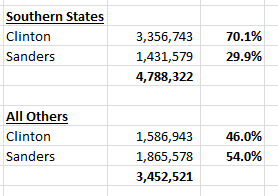
The good news for Sanders? There are no more Southern States, and while Clinton has trounced him in the South, he’s actually narrowly beaten her in total votes for all contests outside that region:
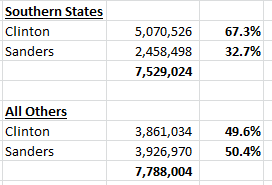
There’s also some interesting analysis out there indicating that Clinton, where she is winning, is doing so largely based on early voting that happened weeks or months ago, and Sanders is beating her on election day voting. Even given all that, though, the numbers still don’t add up. So far, he’s gotten a little over 50% of the vote in all non-Southern states. He’d need to get 69% of all remaining delegates in order to win. One can imagine circumstances where this could happen, a la major Clinton scandal. But in any vaguely status quo scenario, you would be very surprised to see his average in the remaining 25 contests jump to 69% compared to 50% for the 18 non-Southern contests that have happened so far.
Republicans
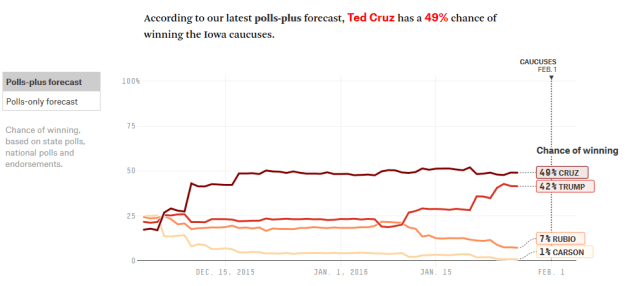
The outlook here is much cloudier. Trump won resoundingly in Arizona, but Cruz meanwhile did very well in Utah.

The catch is that, unlike Democratic primaries and caucuses, which are almost all proportional to vote, Republican contests often feature some kind of rule- winner-take-all, delegate allocation based on who gets the majority in each congressional district, minimum percentage cut-offs to qualify for any delegates- that tends to magnify the lead of a front-runner. Even if you are a front-runner by virtue of only getting 30-something percent of the vote, you’ll get a much higher percentage than that of the delegates. So that works to Trump’s favor, but the field was fractured enough for long enough that it is very borderline whether he can get to the total before the convention.
If it’s hard to see how he can pull off the total in time, it’s pretty near impossible to see how Cruz or Kasich could do it. The numbers currently stand as follows:

Even if Rubio were to endorse Cruz and pledge his delegates to him (as there are some rumblings may happen), and even given that the party establishment is working its way toward supporting Cruz, despite the fact that they don’t like him much, there isn’t an easy to see scenario where he gets the percentage of delegates he’d need in order to catch Trump before the convention. Meanwhile, Kasich would actually need to win 116% of the remaining delegates, i.e. he has no path forward that doesn’t involve a time machine.
Prominent Republicans continue to say that whoever arrives at the convention with the clear preponderance of delegates should be the nominee. So, Trump. A number of them also continue to say that they’re deeply troubled by Trump’s behavior, and a surprising number hedge on whether they would support him if he is the nominee. So, maybe not Trump. If nothing else, this should be fascinating to watch!
















 The Big Book of Alcoholics Anonymous– I first encountered this book at the age of 29, by which point addictive behaviors of various stripes had made my life completely unmanageable. Up until then, I had perused spirituality in an intellectual way. What I lacked was what this book provided, and I could no longer do without: a practical, step-by-step (all puns intended) guide to how to put spiritual principles in to practice in everyday living. Yes the language is a little outdated now (it first came out in 1935). But the common-sense and extremely low-dogma approach to spirituality is as relevant as ever. Over the years, I have heard Christian fundamentalists dismiss its concept of choosing a Higher Power of your own understanding as being too wishy-washy, and Atheist fundamentalists dismiss it as being Christian propaganda. Anything that can stay in a sensible middle of both extremes must be on to something!
 The Televisionary Oracle– Some of you may be familiar with Rob Brezsny from his irreverent, fiercely intelligent, and radically freedom-insistent
  The Artist’s Way– If the Big Book helped show me how to practically apply spiritual principles to my life, The Artists’ Way did something similar to the most important part of my life, my creativity. This was also after my divorce, as I was finally getting back to writing, after years away from it. Julia Cameron’s credo in this book is that, “God is an artist. So are we. And we can cooperate with each other. Our creative dreams and longings do come from a divine source, not from the human ego.” But this idea is then put into action through a twelve-week course of daily exercises that allow the reader to re-connect to their creativity, and connect their creativity to their spirituality, in a thoroughly non-denominational way that draws from multiple sources. I’ve been through it twice, and each time it’s turbo-charged my creative process, and led me in new directions. I haven’t worked through it in ten years at this point, so it may be time to do it again…
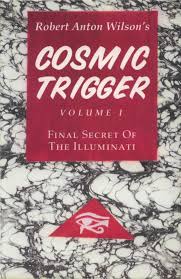 Cosmic Trigger 1: The Final Secret of the Illuminati– Running in parallel to my lifelong interest in spirituality has been an equally lifelong interest in the paranormal and conspiracy theories. As a kid, I literally kept files of clippings and photocopies of articles on unexplained phenomenon- I recall UFOs, ghosts, ESP, Bigfoot, the Loch Ness Monster and several other topics each having their own file. I’m pretty sure Chris Carter owes me some kind of copyright infringement settlement. But what I’m actually here to talk about is how writer/philosopher/maverick Robert Anton Wilson spent his life tuned in to the intersection of conspiracy theories, the paranormal, mysticism, science and religion. And from that, he produced (among many other things) this delightful volume that asserts nothing, implies everything, and encourages the reader to keep an open mind. I’m basically the perfect target audience for this book, and upon reading it in my mid-30s, the paranoia that is the birthright of Gen-Xers like myself somehow turned to profound amusement, and I’ve never looked at things in quite the same way again.
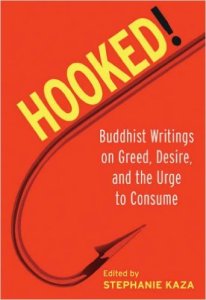 Hooked: Buddhist Writings on Greed, Desire, and the Urge to Consume– This book is actually a collection of essays that addresses the unrest without (consumer culture, capitalist excess, environmental degradation) and links it to the unrest within (addictions, greed, spiritual dissatisfaction). It turns out that Buddhism has been keyed in to this essential human difficulty in experiencing “enough” the whole time, and the voices collected in this volume have a lot to say about possible ways forward through our modern dilemma. Reading this as I approached 40 really helped me see where my decades-long interest in Buddhism could directly speak to both my internal unrest and the unrest of the world whose future I increasingly fear for. In a dark age, it’s important to remember that there are deeper forces in the world, and there’s a chance that our karma may be in the process of working itself out.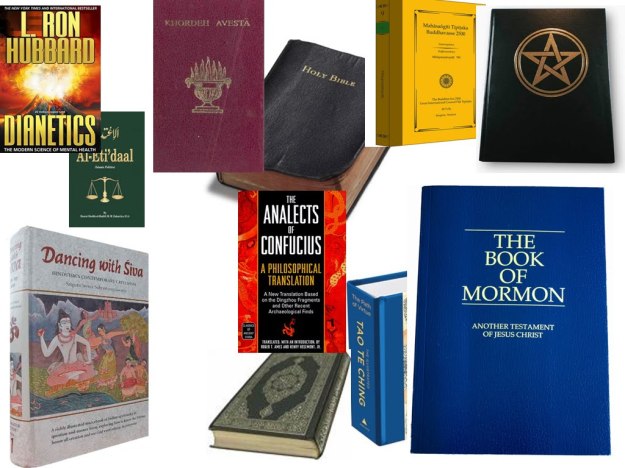
 The Children’s Bible– Given the aforementioned areligious household, I can’t imagine who even gave this to me. It’s possible I asked for it myself! This was a tome of shortened versions of Old and New Testament passages written for a children’s reading level. besides being beautifully illustrated, it had an admirable willingness to not sanitize adult details, like Absalom’s donkey getting him hung from a tree. I later had an obsession with biblical prophecy, took a Bible correspondence course, was in Bible studies groups in various churches in teens and twenties, have read through the whole thing several times, sometimes taking notes the whole way through, and have perused more books on the history and meaning of Judaism and Christianity than you can shake a library at. But this book retains a special place in my heart as my first foray into the area.
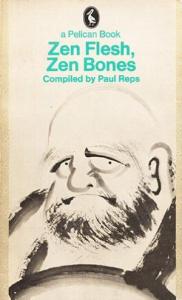 Zen Flesh, Zen Bones– This collection of Zen stories, anecdotes and Koans (short riddles meant to prompt moments of enlightenment) was one of my first introductions to Buddhism. I remember at the time (I can’t place it exactly, but it would have been late teens) feeling that Buddhist philosophy intuitively felt right, and fit with my experience of the world. I went on from there to more intensive study, being parts of mediation groups at various times, and checking out Daoism and Hinduism too. And I still feel instinctively drawn to and in-sync with Buddhism to this day!
 What Religion Is– After teaching English in Japan following college, my future ex-wife and I went back-packing around Asia for several months. This remains one of the grander adventures of my life. On the more mundane side, travel means a lot of long distance hauls on trains and buses. One of the things that really helped pass the time in India was the cheap paperbacks available from vendors at every train station. I had previously heard of Swami Vivekananda, one of the key figures in popularizing Eastern Religions in the West, so I eagerly picked up this book, an expanded version of his remarks to the Parliament of the World’s Religions at the Columbian Exposition in Chicago in 1893. His central premise, that the world’s various religions are at heart one, and are different adaptations to bring the message to different people’s at different times, has been tremendously influential for me ever since. In subsequent study of the scriptures of Buddhism, Christianity, Daoism, Hinduism, Islam, Judaism, Sikhism, etc., I have found that, sure enough, once you delve underneath the framework of specific historical and cultural context, the central message of what life is, how to live it, and how to treat each other has an astonishing underlying unity.
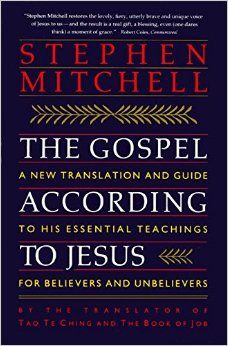 The Gospel According to Jesus– I have heard it said that it’s very hard to understand a box from inside the box. Nowhere is this more true than with our cultural “boxes”. What Jesus taught is so sunk in to (and so inconsistently practiced by) Western culture that it’s easy to lose sight of how revolutionary his message actually was. And is. In this slim volume, Stephen Mitchell takes advantage of the best of recent historical scholarship and comparisons with spiritual traditions from around the world to re-present the teachings of Jesus. Having started with the Bible, and then diving into Eastern Religion, reading this in my mid-20s brought Jesus back to me and gave me a renewed love for him and his message.
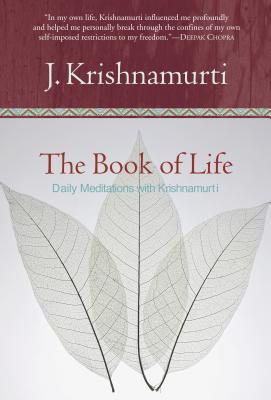 The Book of Life– In my late 20s, I was working in Hong Kong. It was a highly charged, and in many ways, very dark period of my life. I was, selfishly and ill-advisedly, living apart from my future ex-wife, working ridiculous hours at an international trading company, and spiraling down into various addictions. This collection of daily meditations from Krishnamurti provided me with glimmers of hope during this difficult period. Krishnamurti himself is a very interesting figure- in childhood he was identified by the heads of Theosophy as the coming “World Teacher” who would unveil their message to the world. In his 20s, he had a profound spiritual experience that eventually led him to repudiate Theosophy, and his identified role, and announced: “I maintain that truth is a pathless land, and you cannot approach it by any path whatsoever, by any religion, by any sect. That is my point of view, and I adhere to that absolutely and unconditionally. Truth, being limitless, unconditioned, unapproachable by any path whatsoever, cannot be organized; nor should any organization be formed to lead or coerce people along a particular path. … This is no magnificent deed, because I do not want followers, and I mean this. The moment you follow someone you cease to follow Truth. I am not concerned whether you pay attention to what I say or not. I want to do a certain thing in the world and I am going to do it with unwavering concentration. I am concerning myself with only one essential thing: to set man free. I desire to free him from all cages, from all fears, and not to found religions, new sects, nor to establish new theories and new philosophies.” Of course, it’s not that easy to get out of being a messenger once you’ve been tapped, and he did go on to become a spiritual teacher of sorts, one whose compassionate and unflinching message of radical spiritual liberation helped get me through a very dark time.
