
Now that the Presidential Campaign is on a brief but merciful lull, I can get back to my more usual blog fare: reading, writing, and writing about writing and reading. At any given time, I have several different volumes of several kinds going. Here’s what I’m currently up to:
 Signal to Noise (Silvia Moreno-Garcia) Book clubs are good. Geeks are good. Speculative Fiction is good. For all these reasons, and including the lovely people involved, the Geek Mountain State Book Club is one of my ongoing delights. If you know Geek books, you know that some of them can get quite lengthy, so I try and read ahead. So I’ve just started this, which we have up for discussion in May. It’s actually not a long book, but I try and front-load! Too new to say much about it yet, but it involves mix tapes and urban fantasy, set in Mexico City in the 80s. On subject matter alone, there is approximately a 0% chance that I won’t love it. Speaking of zeroes…
 Nonzero (Robert Wright) At any given time, I try to rotate between something from fiction, nonfiction and spiritual (that tricky category that straddles both realms). I’m currently at the non-fiction stage in the rotation, and so am reading this, Robert Wright’s exploration of the “meta-story” of social evolution. It’s been on my list for a long time, ever since I saw it on a list of books former President Clinton was reading some time in the early 2000s. After I finished weeping thinking of “reading” in connection with the then-current occupant of the White House, I made a note to check it out. It’s been well worth it. So far, I’m in the section that reviews the “arrow” of social/technological/economic development running through history. The very hopeful thesis is that, despite the vagaries of history and temporary ups and downs, there’s an underlying trend toward larger scale, increasingly complex societies based on the “nonzero” game of cooperation. I’m really interested in getting to the part where Wright speculates about, based on where we’ve been, where we’re going next.
 Lucky Fish (Aimee Nezhukumatathil) I also have some poetry in the hopper at any given time. On the “new school” side, I’m currently reading the latest volume by one of my favorite contemporary poets, Aimee Nezhukumatathil. Her work is a wonderment of connections between personal and global history, the natural world, the interior world, and popular culture. Illuminated throughout by wit and compassion. And she is, incidentally, the featured poet in the forthcoming annual print edition of Mud Season Review, a literary journal where I’m the co-editor of Poetry. We’re thrilled to have her!
 Poems and Songs (Robert Burns) And kicking it “old school” on the poetry side, I have this collection by Robert Burns going. If 18th hunner years romantic bards writing in scots sassenach wi’ wit ‘n’ verve ur yer thing, ye micht wantae check this oot. Quite seriously, besides the delight of looking up new words in the glossary in back, the lyrical nature of his verse is second to none. And you don’t just have to take my word for it- Steinbeck, J.D. Salinger and Bob Dylan are all pretty fond of him as well.
 The UFO Enigma (Peter Sturrock) Ever since I was a wee lad, I’ve liked my unexplained phenomenon, and none more so than UFOs. It’s a subject that’s been so thoroughly ridiculed at this point that it’s difficult to discuss seriously. Speaking of signal-to-noise, around 95% of UFO reports are clearly noise- low-quality reports, misidentifications, hoaxes, etc. But there remains a residue of around 5% “signal” that is genuinely baffling and highly unknown to contemporary science. This book is a presentation of the proceedings of a scientific panel brought together by Laurance Rockefeller in 1997 to examine some of the “best evidence” that investigators had to present. I’m looking forward to reading their conclusions, because the truth is still out there…
 Holy Qur’an Were we just talking about truth? About 1.6 billion people world-wide consider this to be the most perfect version of a religion that has been continually revealed to humankind throughout history, starting with the Jews, and then the Christians, and culminating here. As a syncretic panentheist I don’t really do exclusive claims to truth. But I do respect spiritual traditions from around the world and throughout history, so I’m almost always reading somebody’s scripture.
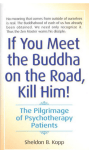 If You meet the Buddha on the Road, Kill Him! (Sheldon Kopp) Take that, scriptures! Sheldon Kopp uses the language of psychotherapy, mythology and numerous religious traditions to highlight what he sees as a universal human journey from looking for the answer from someone else to realizing that it is only found within. This is my “car book”, I read a page or two to provide myself with a moment of zen before heading in to the office.
 JLA Vol. 6 (Joe Kelly, Doug Mahnke, Tom Nguyen, David Baron) On the topic of religion and myths, comics writer Grant Morrison thinks superheroes are our contemporary legends. I usually have a comics collection on my Nook for night-time reading before bed, and I couldn’t be happier than with this one. Though I’ll always be a Marvel boy at heart, things don’t get any bigger or more legendary than the heaviest hitters from DC Comics, the Justice League.
So that’s what I’m currently reading! How about you?



















 The Big Book of Alcoholics Anonymous– I first encountered this book at the age of 29, by which point addictive behaviors of various stripes had made my life completely unmanageable. Up until then, I had perused spirituality in an intellectual way. What I lacked was what this book provided, and I could no longer do without: a practical, step-by-step (all puns intended) guide to how to put spiritual principles in to practice in everyday living. Yes the language is a little outdated now (it first came out in 1935). But the common-sense and extremely low-dogma approach to spirituality is as relevant as ever. Over the years, I have heard Christian fundamentalists dismiss its concept of choosing a Higher Power of your own understanding as being too wishy-washy, and Atheist fundamentalists dismiss it as being Christian propaganda. Anything that can stay in a sensible middle of both extremes must be on to something!
 The Televisionary Oracle– Some of you may be familiar with Rob Brezsny from his irreverent, fiercely intelligent, and radically freedom-insistent
 The Artist’s Way– If the Big Book helped show me how to practically apply spiritual principles to my life, The Artists’ Way did something similar to the most important part of my life, my creativity. This was also after my divorce, as I was finally getting back to writing, after years away from it. Julia Cameron’s credo in this book is that, “God is an artist. So are we. And we can cooperate with each other. Our creative dreams and longings do come from a divine source, not from the human ego.” But this idea is then put into action through a twelve-week course of daily exercises that allow the reader to re-connect to their creativity, and connect their creativity to their spirituality, in a thoroughly non-denominational way that draws from multiple sources. I’ve been through it twice, and each time it’s turbo-charged my creative process, and led me in new directions. I haven’t worked through it in ten years at this point, so it may be time to do it again…
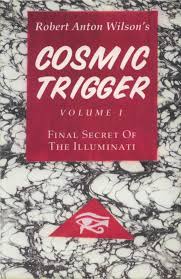 Cosmic Trigger 1: The Final Secret of the Illuminati– Running in parallel to my lifelong interest in spirituality has been an equally lifelong interest in the paranormal and conspiracy theories. As a kid, I literally kept files of clippings and photocopies of articles on unexplained phenomenon- I recall UFOs, ghosts, ESP, Bigfoot, the Loch Ness Monster and several other topics each having their own file. I’m pretty sure Chris Carter owes me some kind of copyright infringement settlement. But what I’m actually here to talk about is how writer/philosopher/maverick Robert Anton Wilson spent his life tuned in to the intersection of conspiracy theories, the paranormal, mysticism, science and religion. And from that, he produced (among many other things) this delightful volume that asserts nothing, implies everything, and encourages the reader to keep an open mind. I’m basically the perfect target audience for this book, and upon reading it in my mid-30s, the paranoia that is the birthright of Gen-Xers like myself somehow turned to profound amusement, and I’ve never looked at things in quite the same way again.
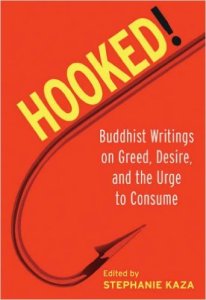 Hooked: Buddhist Writings on Greed, Desire, and the Urge to Consume– This book is actually a collection of essays that addresses the unrest without (consumer culture, capitalist excess, environmental degradation) and links it to the unrest within (addictions, greed, spiritual dissatisfaction). It turns out that Buddhism has been keyed in to this essential human difficulty in experiencing “enough” the whole time, and the voices collected in this volume have a lot to say about possible ways forward through our modern dilemma. Reading this as I approached 40 really helped me see where my decades-long interest in Buddhism could directly speak to both my internal unrest and the unrest of the world whose future I increasingly fear for. In a dark age, it’s important to remember that there are deeper forces in the world, and there’s a chance that our karma may be in the process of working itself out.

