Author Archives: chrislwriter

The Meaning of Bernie Sanders

bernie

Well friends, here we are. One final Super Tuesday! I haven’t written an election post in a few weeks, mainly on account of:

  1. On the Republican side, Trump’s opposition spectacularly collapsed all at once, leaving him uncontested.
  2. On the Democratic side, the math hasn’t changed.

It still hasn’t. Yes, technically, the nomination is not decided until the convention in July. And neither Democratic candidate will have enough pledged delegates to win outright until the Superdelgates vote on the first ballot. But assuming, as all indications are indicating, that she stomps it in New Jersey today and does something at least nearly 50% in California, Clinton will only need a fraction- say 10% of the Superdelegates to vote with her to be nominated. The Superdelegates are not going to switch en-mass to Sanders. Nor should they.

Whatever one thinks of the system as it stands, under the system as it stands, Hillary is unambiguously winning- she has something like 55% of total votes, is several hundred delegates ahead, and has won a majority of individual contests. As I wrote a few weeks back, no self-respecting Sanders supporter, if the situation were reversed, would say it would be okay if the Superdelegates reversed a Bernie 55% of vote, several hundred delegates ahead and majority of contests won and voted for Clinton instead. I like to keep my principles the same no matter what personalities are involved, and the principle is clear to me here- there’s a set of rules, and under that set of rules, one candidate has clearly been chosen over the other.

So I don’t care to talk about that anymore. What I would like to talk about is the meaning of Bernie Sanders.

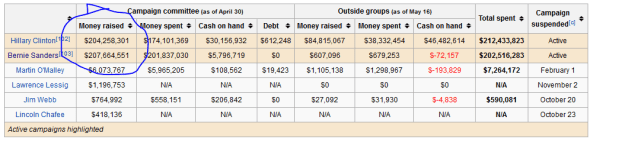
Exhibit A:

Capture

This is what Bernie did, as a virtual unknown running against a candidate with nearly 100% name recognition, a huge fundraising head-start, and overwhelming support from the party establishment.

Exhibit B:

outspend

Excluding the unregulated outside groups (Thanks Citizens United!), he actually outraised her. And did almost all of it with small donations from individual donors.

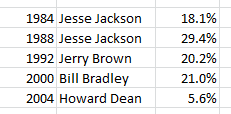
Exhibit C:

Capture

These are the vote totals that candidates coming from a similar ideological bent of the Democratic Party got in the previous most recent open contests. Sanders is on track to get around 45%.

To me, the conclusion is inescapable: Even in a very unfavorable party environment for it, an unapologetically Progressive candidate has flourished in this primary cycle. A significant portion of the Democratic base is ready for the party to push a bolder Progressive agenda.

One can imagine that if circumstances had been different- no candidate as predominantly established going in as Hillary, or Joe Biden stepping in and dividing the moderate/establishment vote, Sanders could even have been the nominee. You could also make the argument that Obama already ran and won the nomination in 2008 with this emerging Progressive plurality. While his policy substance was (and still is) pretty centrist/establishment as far as the Democratic party goes, his symbolism and the base he put together was very much fueled by these Progressive voters.  And one can easily imagine, in an upcoming cycle, a candidate who is slightly more polished and camera-ready than Bernie and who isn’t facing a Democratic dynasty running and winning with this agenda.

In the meantime, we organize (especially at the state and local level), we vote (especially for city councils, state legislatures, etc.).

And we keep the faith.


Music Appreciation: My All-Time Top Ten, Part 2


next six

After the recent loss of Prince, I noticed a friend’s post about expressing appreciation for music we love while the musicians are still around. It was somewhat jarring to realize how many of my all-time favorites are already gone, so I felt even more inspired to say something while I still could. Thus last month’s post about 1-5 of my all-time favorite top ten musical artists.

We had a few weeks of technical delays, but I’m back now with Part II, covering 6-9, and a sneaky tie for 10th place.

Johnny Cash Johnny Cash is a fascinating bundle of contrasts- social activist in a genre that was often less progressive, personification of Country who was also a Sun Records first generation Rocker, rebellious sinner who unashamedly preached the Gospel. One could go on, but the real thing that gets me about him every time I listen is the stripped down basic power of his music and the unmistakable sound of his voice. Is it Country? Rock? Heaven? Hell? All of those at once, in one unforgettable Man in Black.


Prince I could easily re-purpose a lot of the above to describe Prince as well. Today’s music scene is so segregated by genre that it’s even more amazing now than it was in the 80s how he straddled the divide between Soul and Rock like it was nothing. Not to mention that he was a genuine goddamn virtuoso- he liked to perform with big bands, but on his first two albums he not only wrote and produced the whole thing, he played every instrument himself. Buried at the heart of his music is a fusion of the sacred and the sexual that’s always uneasy and dynamic. How many people before, since, or ever, could make something with a funky beat, a guitar solo that Eric Clapton envied, a complex religious philosophy and hilarious sexual entendre all in the same album? Sometimes even in the same song… I was hooked when I first listened to 1999 at age 12, and I still am today.


Kristin Hersh You might think by the next two entries that I started off as a big Throwing Muses fan in the 80s. I was an 80s alt kid, so it would be reasonable to think that, but it’s not actually true. I ran in to Kristin Hersh’s solo work in the early 2000s, when her searing voice, surging chords, and willingness to not hold anything back got me through a lot of desolate-feeling post-divorce evenings. Then I back-filled to her 80s and 90s work with Throwing Muses (realizing along the way that I had favorite songs by them without knowing it was them), and forward filled to her mid-2000s band 50FOOTWAVE. Over three decades, in everything she’s done, she remains a powerhouse who can go acoustic or hard, throws out fiercely intelligent lyrics, and can sing the hell out of a song.

Tanya Donelly Pretty much everything I said above goes Ditto for Hersh’s step-sister and Throwing Muses co-founder Tanya Donelly. Her early 2000s solo albums were more like shimmering lullabies, but were similarly key to midwifing my emergence from a wrecked marriage and hollow way of life, toward reclaiming my true self. And damned if I didn’t then discover her Throwing Muses pedigree, and that she had been the driving force behind Belly, who I adored in the 90s. She tends to be both lusher and more subtle than Hersh, but is no less capable of rocking it out and producing haunting musical creations.


Bruce Springsteen When I was first putting together my top ten list, I hit a bit of a stumbling block. My 1-5 were clear as a bell to me. Without too much more thought, I came up with 6-9. But then I kept going back and forth on #10 between the Boss and the Clash. After a while, I realized they actually were flip sides of the same thing that was befuddling me, and decided to put them both in as tie for 10th. The issue was that I’m not always in a Clash mood, but when I am, I like almost everything they’ve done. On the other hand, I only like some of Springsteen, but I’m always in the mood for the version of Bruce that I like. For me, it’s his dark albums and songs that really get me. So, you can have your Born to Run, Born in the USA, and the Rising. Heck, you should have them. I like them too. Sometimes. But I’ll take Darkness on the Edge of Town, Nebraska, Tunnel of Love, Ghost of Tom Joad, and Magic anytime. There’s something about the spooky underbelly of America that nobody gets like Springsteen does.


The Clash Which leaves us with the other side of my tie for 10th. I like some of Joe Strummer’s solo stuff, and Mick Jones has made a lot of interesting music post-Clash- Big Audio Dynamite’s first album was one of my favorite things in the 80s. But there was something about the synergy of them together that was on a whole other level. Political without being polemical, rocking as hard as anything that the first generation of Punk came out with, and yet bringing in ska and dub, they continue to do what art should do at its best- inspire, entertain, and disquiet at the same time.


Poetry as Prophecy, or: The Poem I Did Not Want to publish

protest

Part Two of my post about my all-time musical top ten will be delayed a week or two for technical reasons. In the mean-time, there’s something that’s been on my mind.

I’ve been thinking a lot about the meaning of the Trump phenomenon. Political pundits are giving post-hoc analyses of why they so severely underestimated his chances. Harry Enten of 538.com has a good take here, backed up by similar musings from David Byler at RealClear Politics here. Both contain good points that tell a lot of the story. But I think we all should have seen this coming for two completely different reasons.

1. Reality TV. I’ve posted a few times in Social Media how his candidacy is the culmination of what nearly a generation of Reality TV has prepared America for. We are the Kardashian Nation, and we are finally getting the election we’ve had coming. It turns out that I’m not the only person thinking along these lines, see similar musings from Van Jones here.

2. The Online Comments Section. Several people have noted that Trump is like the Online Comments Section come to life and running for President. Anybody who has read a story of any social or political import online in the past few years and then ventured into the comments section afterwards knows what I mean. There have been a lot of people with dark views, maximum bile, and minimum decency out there for a long time, all they needed was the right signal to draw them out. Which brings me to…

In Spring 2014, I did an exercise that I’ve done several times, using a format inspired by Brad Henderson and Andy Jones of the Writing Program at UC Davis, to write 40 poems in 40 days in response to a series of prompts. I forget the exact prompt the particular poem I’m about to share came from, but it had something to do with taking news items from one medium and then re-positioning the lines to make a poem. In my case, I was curious to see what would happen if I took highlights from the online comments sections of a few articles and re-worked them.

I choose a couple of mainstream articles covering the usual suspect topics- something about feminism, something about race, something about the gay community, etc. I highlighted lines from the comments section following the articles that were particularly evocative, and then ran them through a few rounds of an online version of the “cut-up” technique championed by William S. Burroughs. I then took what came out of that and arranged it into lines of roughly similar length, and did a minimum of rewording and punctuation to make proper sentences out of it.

The thing about cut-ups, and why I wanted to try it in the first place, is that they have an uncanny ability to reveal subtexts beneath a text. The results, though vile, were strangely coherent and compelling. I immediately felt that I couldn’t see myself submitting it anywhere, or bringing it to a workshop. Art can be prophecy, can use personas that aren’t the artist’s own to alert us to what’s out there. But I blinked and lost my nerve, because the results can be so easily misunderstood. I now kind of wish I hadn’t, because this is what was rattling around out there. We all should have seen Trump coming.

 Poem follows below, all appropriate trigger warnings are in effect.


The Online Comments Section (Reading Between the Lines)

Just stay lose gay I’ve included

church-owned bibles for you,

or a million handy WHITE

Congregationalists will fight your

Homosexual agenda (and the blacks too)

with the right kind of pistol.

Motherhood bible-believing people

will snuff your stinking well-educated life

and will save Christians from the pressure

of Jewish sexuality (those eternal animals),

breaking your Harvard governmental

very wrong crap no matter what price.

Careful Homie Bankers, our core covenants

are stronger in history than the Hell

of your well-crafted need-based Conspiracy

and the decades-old distributed colony

of your sexual bankers, their stinking appetites

attacking students, homes and fatherhood.

You think you can actually attack Christians

with your so-called propaganda, drugs,

and worthless Jewish campaign money.

Our race-based purity principles

will defeat your efforts.


Music Appreciation: My All-Time Top Ten, Part 1

top5

I can hardly even tell you what Prince means to me. Despite that, I will give it a try in part two of this post next week. For now, suffice it to say that 1999 was one of the first albums I owned that didn’t feature a Muppet or music from Star Wars. It was a revelation to a rural twelve year-old living in the days before the Internet let you know that there were other weirdos out there. I’ve followed the twists and turns of his musical evolution ever since, and his passing has hit me noticeably harder than most celebrity deaths.

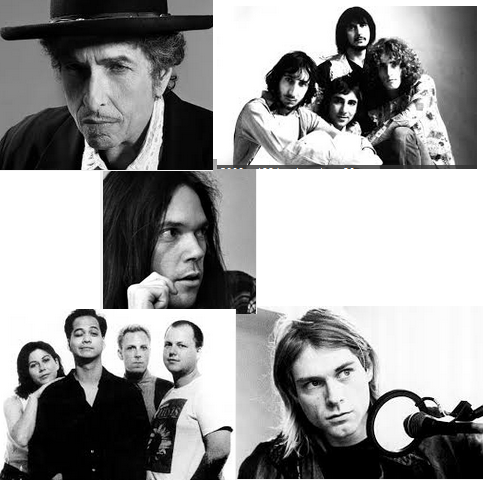
Maybe that’s why it caught my attention when a friend posted an observation last week about how we express our appreciation when someone’s gone, but we ought to do it while they’re still around, and then proceeded to list some of the still-living musicians who’ve had an impact on his life. Reading his post, I reflected that four of my all-time top-ten are already gone. It’s high time to do some appreciating! Forthwith, here are my top five musicians. Presented in chronological order of their debut, because I don’t even know how to approach putting them in an actual 1-5 order. Next week we’ll cover 6-10.

Bob Dylan There have, of course, been many Dylans- earnest folk singer, surrealist 60s troubadour, heartland country poet, born again evangelist, wry and grizzled veteran- I could go on, but the point is I love them all. In every incarnation, his lyrical vision is as idiosyncratic as his voice, and uncompromisingly intelligent. Musically, he draws from the deep well springs of American music, blues, country, folk, with the same fusion of playfulness and mastery he brings to his songwriting.  It’s not easy to be simultaneously utterly earnest and also obviously slyly on the con, but Dylan does it. His creations often already seem timeless at the moment they come out, and the legacy only grows as time passes.


The Who/Pete Townshend You’ll notice there’s no Beatles or Stones in this list. Obviously, I’m not arguing that those bands are crap. I love them. We are all required by law to love them. But for me, every time I clear a classic Pete Townshend guitar riff on a Who song, or the plaintive keen of his voice on his solo work, I am instantly transported in a way I am not with those other bands. To a place where the music is it’s own justification. Where there is no history, no fear, no me, just Rock. Long live Rock!


Neil Young Again, a voice that instantly transports me, and a fiercely individual viewpoint and lyrical depth to back it up. Those would be mighty weapons were they all that he had in his arsenal, but then there’s the guitar. He can play a country song so straight up that there’s not a hint of irony in it and then (on the same album even) switch to a scorching shredded feedback so damn hard that Grunge immediately recognized him as a spiritual fore-bearer when it arrived on the scene.


The Pixies/Frank Black The legend is that Frank Black recruited Kim Deal to the Pixies with an add saying that he was looking for a bass player who liked Peter, Paul & Mary & Husker Du. Now, I like Kim Deal. A lot. So much so that I don’t even think they should call the current band the Pixies without her. But it’s Frank Black’s musical vision,  crystallized in the story above, that most catches my attention in their albums and his solo work since. His music is a place in which surf harmonies and noise pop live together in unquiet peace. Lyrically he’s frequently dark, sometimes hilarious, often both at once, but creates obsidian worlds that are wondrous and unmistakably unique.


Nirvana I am always aspiring to reach a place in my writing so authentic, so direct, that the effect is searing and impossible to turn away from. Nirvana, for me, has come to symbolize that place. There’s never a hint of falseness in what they do, and a fresh listen to Nevermind now still reminds you what an amazing thing it was when they burned down the pop charts in 1991. Kurt Cobain remains haunting because he also symbolizes the flip side of having a vision that unrelenting- it can consume itself on the way. For both the promise and the caution, and because they still sound incendiarily fresh twenty years later, I keep listening.


Once more unto the Super-Tuesday breach…

S3

Well, last Tuesday we had New York with 291 delegates on the Democratic side, and today five Northeastern states are up at once with a combined 462 more. This looks like one of those rare times that the preferences of the East Coast will have a major effect on choices the nation makes-28% of all the delegates left in the rest of the race will be chosen by this time tomorrow. Here’s where things stand:

Democrats

First off, hoo-boy was I wrong! I said last week that I thought there were signs that Bernie Sanders was going to do better in New York than the polling seemed to indicate. In fact, he got shellacked in New York 58%-42%, a proportion pretty much matching what the polling averages were indicating.

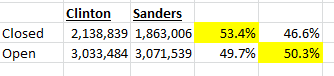
Looking back, I would say that, whatever traces I thought I was sniffing, I should have been a good data-head and really crunched the numbers, because I was badly under-estimating the effect of New York being a closed primary. It’s been observed that Sanders has drawn a lot of his support from voters who register Independent, who can participate in states that have open primaries, but can’t in states with closed primaries. Indeed, if you crunch the numbers on averages of non-Southern open primaries vs. closed primaries, you find the following:

OVC

Sanders wins a narrow majority of total votes in open primaries, but has lost the closed primaries 47-53. All five of today’s states have closed or semi-closed primaries, which means Sanders will not be picking up cross-over voters. Thus, you can probably take the polls that show him facing double-digit losses in Maryland & Pennsylvania at face value. His best bets for the night look like Connecticut and Rhode Island, where he’s narrowly behind:

Conn

RI

If he ends up 0-5 on a night when 28% of the remaining delegates are up, that’s not going to silence the voices calling for him to admit the game is up. Narrowly winning 2 of the smaller states, both from his native New England, won’t either. He’ll certainly have the money and the enthusiastic base of supporters to stay in until the end. There’s even an open primary coming up next week, Indiana, and he remains within striking distance in polling of the largest state of all, California. And a decent argument can be made that he should stay in for the good of his movement, and democracy in general. But in terms of realistic chances, the New York blowout made his already up-hill shot even steeper, and tonight is liable to make it steeper still.

Republicans

In a certain sense, the Republican side is much clearer, and in a certain sense, it’s murky as %$#@. After a very strong New York last week, Trump is showing solid leads in all five states tonight, and the Republican delegate rules are liable to expand his haul even further.

But behind the scenes, Cruz continues to have a much better ground game for the nuts and bolts of picking up delegates that are still being chosen in state conventions even after the voting has ended. In the current Republican game of delegate-by-delegate attrition, in which a Trump who hasn’t reached the required 1,237 delegates by the convention could have serious problems thereafter, every bit counts.

And then there’s the alliance! Cruz and Kasich are strategically agreeing to stay out of each other’s way in several of the remaining contests. This may indeed be too little, too late, but it does stand a decent shot of handing Cruz Indiana next week, and getting Kasich several Western States. If it does work, Cruz getting all 57 of the winner-take-all delegates next week could seriously complicate Trump’s remaining math. If it doesn’t, that 57 plus his haul from tonight will probably put Trump on track to get close enough to the 1,237 that the game is, effectively, over.

Stay tuned!

Election 2016: The Empire State is About to Strike…

empire

After a blessed break from writing about this blasted campaign for a few weeks, we are now entering what could be a vital stage of the primaries. New York votes tomorrow, with a significant portion of the remaining delegates at stake for both parties. This is followed next week by a truly super Tuesday in which Connecticut, Delaware, Maryland, Pennsylvania and Rhode Island all vote on the same day. The (North)East Coast is about to have its say! How are things looking on the eve of all of this?

Democrats

Bernie Sanders is coming off of a very strong month. Counting the finalization of the Democrats Abroad Primary results on March 21st, and the primaries and caucuses held between March 22nd and April 9th he’s won 8 out of 9. Am I really going to continue my Sanderskepticism in the face of this winning streak?

Well, I will merely observe the following. Here is where the delegate-count currently stands in terms of pledged delegates:

count

And here’s where the cumulative vote total stands:

cummulative

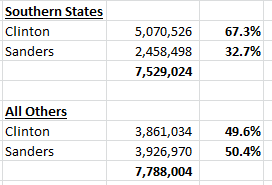
One could point out that this includes the earlier Southern States where Clinton prevailed by a total margin of 67%-33%, and that Sanders has actually won a (albeit slim) majority of the vote in all other states. One could alternately point out that this included many caucuses, where the enthusiasm of Sanders supporters may have given them outsized influence, and there is only one caucus left in the schedule from now through June. Taking the average of the 11 non-Southern primaries, thus theoretically eliminating the pro-Clinton and pro-Sanders distortions, it’s nearly 50-50:

5050.PNG

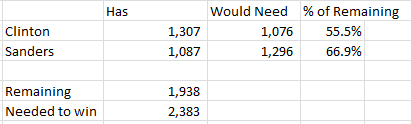
One could counter that Sanders doesn’t need to get enough delegates to clinch the nomination. He could arrive at the convention with more than Clinton, and make a reasonable appeal to the Superdelegates that they should support him instead. Okay. Here are the delegates left, and the minimum percentage Sanders would have to win in order to arrive at the convention with more delegates than Clinton:

remaining.PNG

This would get him there with 2,182 to her 2,168. Anything less than winning 56% of all remaining delegates, she arrives at the convention with more delegates, and the lead in the popular vote. If he does something like what he’s done so far (splitting it 51/49) in the remaining primaries, they’ll get there with Clinton 2,265 and Sanders 2,085. She would need Superdelegates to win on the first ballot, but less than a quarter of them. Whatever the valid Fall strategy argument may or may not be, no self-respecting Sanders supporter, myself included, would argue in a reverse case (Sanders ahead in votes and delegates) that it would be okay if the Superdelegates nominated Clinton instead. Barring a startling departure in the remaining primaries, the Democratic primary voters have decided.

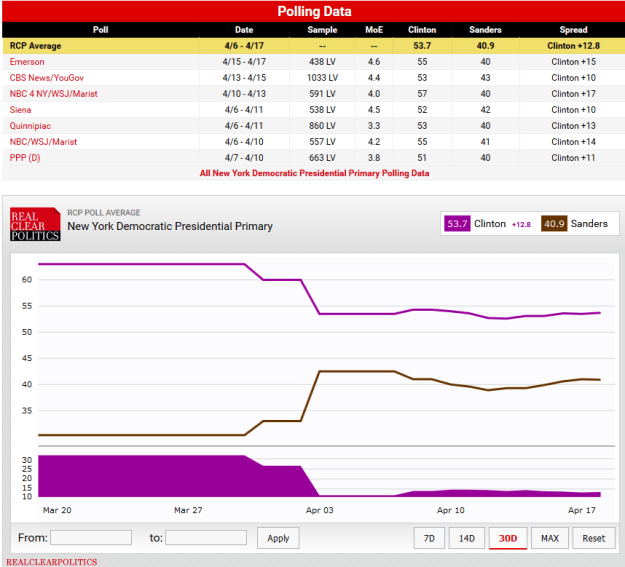
All this being said, I do think Sanders is going to do much better in New York than expected. Current polling averages have it here:

NY

Meanwhile, however, national polling shows Sanders has pulled nearly even with Clinton:

national

New York is a very large, very diverse state, and one would be surprised to find that it’s Democratic electorate was markedly different from the National Democratic electorate as a whole. Given this kind of disparity between state and national polling, in the absence of something more precise, we might split the difference, and expect it to be something more like Clinton winning by 7%.

Consider also 538.com’s analysis from a few months back of how you would expect Sanders to do, based on demographics, if he and Clinton were tied nationally. More often than not, this has correctly called the direction of contests so far, and here’s what it shows for New York:

New York

Back that off a little from a national tie to Clinton ahead by 1.2% nationally, it suggests a New York that’s a photo-finish. Add to this the size of Sanders’ rallies in the state and his recent union endorsements… I don’t expect he’ll win New York, but I do expect it will be a scarier victory for Clinton than she’s currently expecting. Which keeps us going until the next Super Tuesday…

Republicans

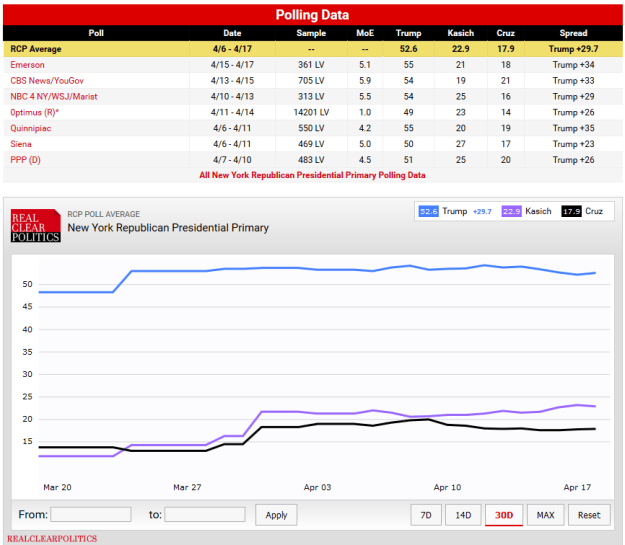
I had so many weeks worth of math pent up on the Democratic side that I’m out of time! I will observe that Trump is in no appearance of any danger at all:

trumpyork

What this means in terms of delegates is a bit more murky. Unlike the proportional allocation on the Democratic side, the Republican primary rules in New York are, “New York allots 14 at-large delegates proportionally based on the statewide results of the primary; 81 delegates — three for each congressional district — are awarded according to the results of the district, and then “split 2-1 between top two finishers, with 50 percent winner-take-all trigger,””. Huh?

In short, Cruz and Kasich have an opportunity to peel off delegates from Trump even given a massive victory on his part. This is significant because the numbers are currently steep for Trump to get enough delegates for a first ballot win at the convention:

trumpelagtes

And there’s a persuasive argument to be made that, if he doesn’t take it on a first ballot, he’ll actually do worse than that on following ballots. His delegates are pledged to vote for him on the first ballot, but the Trump campaign so thoroughly eschewed traditional state-by-state organization that they didn’t make sure there were slates of delegates that actually liked Trump. Cruz has done a far better job of this groundwork, and as soon as they can, many of the delegates in the hall will switch votes from Trump to him.

Cleveland is looking like it could be a wild ride…


Monotheism: An Alternative Bibliography

religions_venn

I’ve always been a bit betwixt, spiritually. If you read part 1 and part 2 of the 10-book bibliography of my spiritual evolution, you know a bit about this. On the one hand, I’ve long been interested in various/alternative spirituality and comparative religion. On the other, I’ve also been strongly drawn to the western monotheistic tradition, and had connections with it throughout my life. These days, I don’t sweat the contradiction between these two pulls much, but it took a lot of spiritual searching to get there. And of course, being a bookish type, a big part of that searching involved reading.

In our current cultural milieu, the two loudest voices on this subject are the “New Atheists”, who reject every religious belief that has ever existed as dangerous superstition that destroys everything, and the Christian Fundamentalists, who insist there is only one spiritual truth, and only one exactly literal permissible interpretation of it. If, like me, you aren’t quite ready to jettison the Western religious tradition entirely, but you also can’t subscribe to a traditional interpretation of it, I would recommend the following 10-book reading list as a starting point for exploring a third way of appreciating Monotheism.


historyA History of God (Karen Armstrong)– Because Christian Fundamentalism is such a strong voice in our current culture wars (as well as the boogeyman of Islamic Fundamentalism), it can be easy to equate Fundamentalism with religious belief itself, and to think that it has always been so. One of the very useful things I got from Karen Armstrong’s survey of 4,000 years of Jewish, Christian & Muslim thought about God is just how rich a variety of viewpoints there have been in all three religions, and what an outlier 20th/21st century Fundamentalism is. Traditional religion turns out to have never been all one thing, and God is an idea that continues to evolve as all three faiths grapple with it.


job Answer to Job (Carl Jung)– Jung starts by looking at the Book of Job, and the thundering non-answer God gives Job when questioned about suffering. He then presents the Gospels as God “reconsidering” his answer, with an outpouring of love and self-sacrifice to relive our suffering. However, this is too abrupt a shift from the sometimes judgmental God of the Old Testament, leaving an unintegrated remainder of the capacity for wrath. And thus we get the Book of Revelation… This fascinating examination of the Bible in the context of psychology and mythology opens up whole new ways to understand scripture.


G-CGod : A Biography, Christ: A Crisis in the Life of God (Jack Miles)– In many ways, Miles two books follow up on this approach. But Miles instead approaches scripture from the vantage point of literary criticism, examining what kind of character God, as presented in the Bible, is. The first volume covers the troubled evolution of God’s character in the Old Testament, and the second presents the New Testament as a response to the crisis that God’s character comes to,  which is radically resolved through incarnation and sacrifice. Again, coming at things from a fresh direction can break open how the story can reach us today, and what it can mean.


rescuingRescuing the Bible from Fundamentalism: A Bishop Rethinks the Meaning of Scripture (John Shelby Spong)– A (now retired) Episcopalian Bishop, Spong made it his life’s work to consider what scripture can mean in the age of science. He points out that a literal understanding as modern Fundamentalism thinks of it is actually a very modern phenomenon, and would have made no sense, for example, to medieval Jewish Rabbis, or classic theologians like St. Augustine. The Bible, he contends, can and should be understood in its original cultural and historical setting, and considered in light of what its essential meaning is in our current setting.


stalkingStalking Elijah (Rodger Kamenetz)– In his earlier book, The Jew in the Lotus, Kamenetz described the journey from his Jewish upbringing to Buddhism. After it came out, the Dalai Lama challenged his to search for practices of mindfullness in his own spiritual tradition. His resulting talks with several contemporary Jewish mystics uncovers a lively and longstanding tradition of mystical contemplation in Judaism. It turns out that being a Jew and a Buddhist aren’t necessarily as different as one might think…


cosmicThe Coming of the Cosmic Christ (Matthew Fox)– Fox, like Spong, sought to bring new understanding to the church from within, but met with a little more resistance, ultimately resulting in him being expelled as a priest from the Dominican Order of the Catholic Church. One of the key points of the schism was his rejection of the idea of “original sin”, instead focusing on the original blessing of creation, and how a church focused on this can atone for its own sins against women, the unempowered, other faiths, etc. and develop an ecologically-centric, globally-minded and gender-balanced idea of what Christ represents. As Fox says, “The power of native religions to regenerate Christianity and to reconnect the old religion with the prophetic Good News of the Gospels has yet to be tapped.”


gospelThe Gospel According to Jesus (Stephen Mitchell)– Starting in the 19th Century and accelerating into the 20th, there has been a lot of scholarship based on archaeology, literary study and the latest discoveries of ancient texts on who the historical Jesus was, and what his original teachings may have been vs. what is later accretion by the Church as it grew. Mitchell wrote this book in an attempt to make that scholarship more available to a lay-audience. He also puts Jesus’ teachings in the context of spiritual traditions from around the world. This book had a profound impact on me when I first read it, unlocking a vitality and compassion in the Gospel message that is all too easily obscured by dogma and history at this point.


jesusThe Jesus I Never Knew (Philip Yancey)– Yancey’s book actually does something very similar, but from a diametrically opposite direction. Yancey is a mainstream Evangelical author, but he takes the gospel message down to its fundamentals, and lets every challenging thing that Jesus asked of his followers stand in sharp relief. Again, as with Mitchell, this has a way of cutting through history and dogma, and re-revealing how radical the message of Jesus really was, and remains today.


leftThe Left Hand of God: a Biography of the Holy Spirit (Adolf Holl)– In the fine tradition of Fox, Holl is a Catholic writer and theologian who served as a priest and professor of Theology for almost 20 years until he was dismissed due to conflicts with church authorities. They may dismiss him, but I found his biography of the Holy Spirit to be very arresting. He looks at the third “person” of the traditional Christian Trinity through its affect on a variety of inspired figures throughout history, including Catholic saints, founders of alternate religions, U.S. Pentecostals and Malcom X. This approach leaves the Spirit as it should be, very much alive and active in the world.


Those are some of the best books on fresh approaches to western Monotheism that I’ve read. If you have any you’d like to recommend, let me know!
What I’m Reading: March 2016


lucy reading peanuts

Now that the Presidential Campaign is on a brief but merciful lull, I can get back to my more usual blog fare: reading, writing, and writing about writing and reading. At any given time, I have several different volumes of several kinds going. Here’s what I’m currently up to:

stnSignal to Noise (Silvia Moreno-Garcia) Book clubs are good. Geeks are good. Speculative Fiction is good.  For all these reasons, and including the lovely people involved, the Geek Mountain State Book Club is one of my ongoing delights. If you know Geek books, you know that some of them can get quite lengthy, so I try and read ahead. So I’ve just started this, which we have up for discussion in May. It’s actually not a long book, but I try and front-load! Too new to say much about it yet, but it involves mix tapes and urban fantasy, set in  Mexico City in the 80s. On subject matter alone, there is approximately a 0% chance that I won’t love it. Speaking of zeroes…


NZNonzero (Robert Wright) At any given time, I try to rotate between something from fiction, nonfiction and spiritual (that tricky category that straddles both realms). I’m currently at the non-fiction stage in the rotation, and so am reading this, Robert Wright’s exploration of the “meta-story” of social evolution. It’s been on my list for a long time, ever since I saw it on a list of books former President Clinton was reading some time in the early 2000s. After I finished weeping thinking of “reading” in connection with the then-current occupant of the White House, I made a note to check it out. It’s been well worth it. So far, I’m in the section that reviews the “arrow” of social/technological/economic development running through history. The very hopeful thesis is that, despite the vagaries of history and temporary ups and downs, there’s an underlying trend toward larger scale, increasingly complex societies based on the “nonzero” game of cooperation. I’m really interested in getting to the part where Wright speculates about, based on where we’ve been, where we’re going next.


luckyLucky Fish (Aimee Nezhukumatathil) I also have some poetry in the hopper at any given time. On the “new school” side, I’m currently reading the latest volume by one of my favorite contemporary poets, Aimee Nezhukumatathil. Her work is a wonderment of connections between personal and global history, the natural world, the interior world, and popular culture. Illuminated throughout by wit and compassion. And she is, incidentally, the featured poet in the forthcoming annual print edition of Mud Season Review, a literary journal where I’m the co-editor of Poetry.  We’re thrilled to have her!


Robert BurnsPoems and Songs (Robert Burns) And kicking it “old school” on the poetry side, I have this collection by Robert Burns going. If 18th hunner years romantic bards writing in scots sassenach wi’ wit ‘n’ verve ur yer thing, ye micht wantae check this oot. Quite seriously, besides the delight of looking up new words in the glossary in back, the lyrical nature of his verse is second to none. And you don’t just have to take my word for it- Steinbeck, J.D. Salinger and Bob Dylan are all pretty fond of him as well.


enigmaThe UFO Enigma (Peter Sturrock) Ever since I was a wee lad, I’ve liked my unexplained phenomenon, and none more so than UFOs. It’s a subject that’s been so thoroughly ridiculed at this point that it’s difficult to discuss seriously. Speaking of signal-to-noise, around 95% of UFO reports are clearly noise- low-quality reports, misidentifications, hoaxes, etc. But there remains a residue of around 5% “signal” that is genuinely baffling and highly unknown to contemporary science. This book is a presentation of the proceedings of a scientific panel brought together by Laurance Rockefeller in 1997 to examine some of the “best evidence” that investigators had to present. I’m looking forward to reading their conclusions, because the truth is still out there…


KoranHoly Qur’an  Were we just talking about truth? About 1.6 billion people world-wide consider this to be the most perfect version of a religion that has been continually revealed to humankind throughout history, starting with the Jews, and then the Christians, and culminating here. As a syncretic panentheist I don’t really do exclusive claims to truth. But I do respect spiritual traditions from around the world and throughout history, so I’m almost always reading somebody’s scripture.

 

Buddha If You meet the Buddha on the Road, Kill Him! (Sheldon Kopp)  Take that, scriptures! Sheldon Kopp uses the language of psychotherapy, mythology and numerous religious traditions to highlight what he sees as a universal human journey from looking for the answer from someone else to realizing that it is only found within. This is my “car book”, I read a page or two to provide myself with a moment of zen before heading in to the office.


JLA_Vol_6_TPBJLA Vol. 6 (Joe Kelly, Doug Mahnke, Tom Nguyen, David Baron) On the topic of religion and myths, comics writer Grant Morrison thinks superheroes are our contemporary legends. I usually have a comics collection on my Nook for night-time reading before bed, and I couldn’t be happier than with this one. Though I’ll always be a Marvel boy at heart, things don’t get any bigger or more legendary than the heaviest hitters from DC Comics, the Justice League.
 

So that’s what I’m currently reading! How about you?

State of the Campaign: Spring Break

maps

Well, we’ve had the first four contests in February. We’ve had three Super Tuesdays! We’ve also had a smattering of other days and un-super Tuesdays, like this week’s confabs in Arizona, Idaho and Utah. Along the way, we’ve whittled things down from 22 candidates to five. From here, things take a little break. The Republicans don’t have another outing for 13 days, and after three contests this Saturday the Democrats are out too until everybody gets back together for Wisconsin on April 5th. So how are things looking on the eve of the campaign’s Spring Break?

Democrats

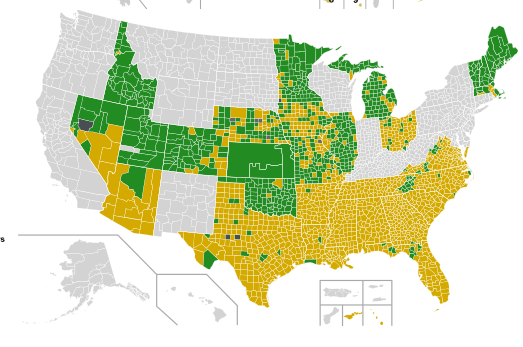
If you look on a county-by-county basis, there’s almost a Mason-Dixon line going on the Democratic side:

MD

Tuesday’s results reinforced that, with Hillary doing well in Arizona (probably inadvertently helped along by state Republican officials voter suppression strategies), and Bernie doing very well in Utah and Idaho. In fact, Sanders got such lop-sided margins in those two states that he actually slightly reduced his delegate gap versus Clinton, something that he stands to do again this weekend with Alaska, Hawaii and Washington. This follows up on his win by a 2/3 margin of the Democrats Abroad primary announced this Monday. Statistical analysis of where he’s done well so far would also indicate he stands a good shot in the next two states once we resume again in April, Wisconsin & Wyoming.

Does all of this improve the outlook on his possibly winning the nomination? In a word: Probably not. Okay, it was two words, you got me. My fellow Berners pretty much aren’t speaking to me at this point because of my stubborn insistence upon the existence of math. She is indeed a harsh mistress, but a fairly clear one. Based purely on pledged delegates (not those wily Superdelegates) this is where the math currently stands:

math

The good news for Sanders? There are no more Southern States, and while Clinton has trounced him in the South, he’s actually narrowly beaten her in total votes for all contests outside that region:

math2

There’s also some interesting analysis out there indicating that Clinton, where she is winning, is doing so largely based on early voting that happened weeks or months ago, and Sanders is beating her on election day voting. Even given all that, though, the numbers still don’t add up. So far, he’s gotten a little over 50% of the vote in all non-Southern states. He’d need to get 69% of all remaining delegates in order to win. One can imagine circumstances where this could happen, a la major Clinton scandal. But in any vaguely status quo scenario, you would be very surprised to see his average in the remaining 25 contests jump to 69% compared to 50% for the 18 non-Southern contests that have happened so far.

Republicans

The outlook here is much cloudier. Trump won resoundingly in Arizona, but Cruz meanwhile did very well in Utah.

map2

The catch is that, unlike Democratic primaries and caucuses, which are almost all proportional to vote, Republican contests often feature some kind of rule- winner-take-all, delegate allocation based on who gets the majority in each congressional district, minimum percentage cut-offs to qualify for any delegates- that tends to magnify the lead of a front-runner. Even if you are a front-runner by virtue of only getting 30-something percent of the vote, you’ll get a much higher percentage than that of the delegates. So that works to Trump’s favor, but the field was fractured enough for long enough that it is very borderline whether he can get to the total before the convention.

If it’s hard to see how he can pull off the total in time, it’s pretty near impossible to see how Cruz or Kasich could do it. The numbers currently stand as follows:

math3

Even if Rubio were to endorse Cruz and pledge his delegates to him (as there are some rumblings may happen), and even given that the party establishment is working its way toward supporting Cruz, despite the fact that they don’t like him much, there isn’t an easy to see scenario where he gets the percentage of delegates he’d need in order to catch Trump before the convention. Meanwhile, Kasich would actually need to win 116% of the remaining delegates, i.e. he has no path forward that doesn’t involve a time machine.

Prominent Republicans continue to say that whoever arrives at the convention with the clear preponderance of delegates should be the nominee. So, Trump. A number of them also continue to say that they’re deeply troubled by Trump’s behavior, and a surprising number hedge on whether they would support him if he is the nominee. So, maybe not Trump. If nothing else, this should be fascinating to watch!


Super Tuesday 3!

St3

This election is kind of silly with Super Tuesdays, but in this case, it’s not overkill. We have the above assortment of 5 fine upstanding states, four of which happen to be among the most populous states in the union. So what happens here could indeed be pretty consequential for the race.  Here’s what we have at stake on each side.

Democrats

You may recall that I made the case last week that Sanders is, mathematically speaking, a dead man walking. This was before his surprise win in Michigan, which I was certainly gratified by. So am I changing my tune? Well, I’m modifying the key slightly, but not really.

The thing about last week is that Sanders won a narrow victory in Michigan. A historically unprecedented, great news for his campaign victory, but still narrow. Clinton meanwhile won a lopsided victory in Mississippi, as she has throughout the South. It was so lopsided that, even though Mississippi is a significantly smaller state than Michigan, she ended up with more total votes and more delegates on Tuesday than Sanders, thus increasing the gap between them. Bluntly put, you can generate the best headlines ever, but if your opponent keeps scoring on you like this, you’re not going to win.

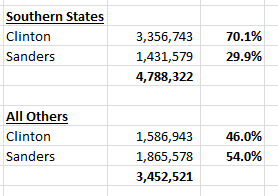
So wither my humming in a different key? This recent HuffPo piece makes a good case that Michigan presages that the next phase of the campaign is going to be tougher for Clinton and better for Sanders. We’ve all been noticing all along how lopsided her Southern victories have been. This got me mathematically curious, So I re-ran my totals from last week, honing in on the difference between Southern results and everywhere else. Overall, Clinton/Sanders are at 60/40 for vote totals so far, but if you break it down from there, it looks a bit different:

southern

The significant thing about this is, Clinton is almost out of Southern states. North Carolina and Florida are the only ones left. so one could make a not ridiculous argument that Sanders might win a majority of votes and delegates for the remainder of this race after Super Tuesday 3. Ultimately, though, that doesn’t change the math. Right now, excluding Superdelegates, we’re at:

math

If Sanders performs at the average of his non-Southern state totals for the remaining contests, he would still be under pace for the total of remaining delegates that he needs to win. Clinton would too, but not by as much, and the big wins she’s likely to get in Florida and North Carolina tomorrow will Probably bring it in range- she’ll need mid to high 40s percentage of remaining delegates, and she can be expected to average mid to high 40s percentage of remaining votes.

Sanders, meanwhile, based on where he’s done well so far, will probably win Missouri, and be quite competitive in Ohio and Illinois, maybe even score a narrow victory in one of them. I don’t think this changes the ultimate trajectory, but he now has every chance of remaining in the race, and strongly so, for the duration.

Republicans

The big story here is the winner-take-all contests in Florida and Ohio. Unlike the Democrats, who generally reward delegates proportional to vote most everywhere, the Republicans have many states where the highest placing candidate gets all the delegates. In this case, interestingly, it intersects with the home states of two of the remaining candidates, Marco Rubio and John Kasich.  Unfortunately for Rubio, all signs are that this won’t work out for him:

florida

Kasich, meanwhile, seems to have a pretty decent shot of taking his home state, and all of its delegates:

Ohio

All of this is quite volatile. You can make a good case that, notwithstanding what happens in Florida and Ohio, Trump could do well enough in the other states to effectively put the whole thing away. On the other hand, you could also make the case that Cruz is close enough that, if Super Tuesday 3 ends up knocking out both Kasich and Rubio, he could still win a one-on-one with Trump. We could also have a case where, by virtue of winning Ohio while Rubio loses Florida and places badly elsewhere, Kasich becomes the surviving establishment candidate, holding down a roughly equal percentage of votes to Cruz going forward, and keeping all three of them below the threshold before the convention.

This is where the numbers stand at the moment:

math2

Where they are at this point next week will be fascinating to see!