Tag Archives: trump

State of the Race: Post Super Tuesday And Swell Saturday

state

stae2


In last week’s column, I posited that it was super-possible that both nominations would effectively be decided on Super Tuesday. Now that the Tuesday in question has come and gone and we’ve also had a pretty swell Saturday’s (and pinch of Sunday) worth of contests, how am I doing? In all honesty, I’d have to give myself a 42.5%. As follows…

Democrats

I think it’s important to fully out myself before I say what I’m about to say. No surprise to anybody who knows me, I lean toward the Progressive side of the fence. I would vastly prefer to see Sanders be the nominee instead of Clinton, and I think he’s the only major candidate in the race who is even close to talking about the magnitude of changes we’ll need to make to avoid disaster at home and as a global species in the coming decades. I voted for him in our primary in Vermont, contribute to his campaign every pay day, and will continue to do so as long as he’s in the race. Despite all this, I am, reluctantly, 85% confident that the Democratic Race has in fact been decided for Clinton, though it will take the numbers a while to catch up.

It comes down to some simple facts of math. Counting just the pledged delegates because, as many people have pointed out, Superdelegates can (and do) change their votes as the race shifts, we currently have:

delegate

Given what each candidate has, how many delegates are remaining, and how many are needed for the nomination, this is the percentage of remaining delegates each would have to win to get the nomination:

maths

The issue with pledged delegates on the Democratic side is that they are more or less proportional- if you win, say 60% of the votes, you would expect to also win roughly 60% of the delegates. Some of the caucus states don’t report their numbers in a way that votes can be tabulated, but of the seventeen states and territories that have voted so far that we can add up votes for, this is the percentage breakdown:

bdown

Refer back to the delegate target numbers above. Clinton has won 61% of the vote so far, and she would need roughly 54.5% of the remaining delegates. She could actually do about 10% worse than she’s done so far in all the remaining contests and still do it. Sanders has won 39% of the vote so far, but he’d need to win 60% of the remaining delegates. He would have to do about 50% better than he’s done so far in all the remaining contests to take it.

Is this categorically impossible? No. Bernie clearly has the financial and enthusiastic supporter resources to stay competitive, and is still less well known than Clinton, so he has room to grow. And Clinton has often proven to be a less appealing campaigner when she’s ahead than when she’s behind, and also has investigations brewing which (based on bullshit or not) could blow up at any time. Barring something truly disruptive, though, you would be surprised to see Clinton do markedly worse in the 2/3 remaining than the 1/3 behind. And you’d be really surprised to see Sanders do 50% better.

Republicans

As for my prediction about Trump before Super Tuesday, I would have to mark myself as totally wrong! It looked quite possible, going in, that Cruz wouldn’t win anything except his home state of Texas, and Rubio wouldn’t win anything. But, while Trump did quite well, Rubio won Minnesota and hung in there in other races (albeit much less well than he would have if Kasich weren’t still hanging around). Cruz, meanwhile, won several states, and racked up some more this weekend.

You can’t as readily do the kind of delegate vs. votes analysis I did above for the Democrats with the Republicans, as they have several large winner-take all states, and also have many states where there’s a threshold of 20% to get any delegates at all. However, their delegate math at the moment is:

totals

And their vote totals have been:

totals2

In other words, even allowing for the distorting effects of Republican delegate allocation rules, nobody so far has had nearly a total vote percentage even roughly comparable to the delegate percentage total they’d need. This outlook could change if it got down to a two-person race. However, that’s not remotely likely to happen until after March 15th, since Rubio and Kasich both aim to win their respective winner-take-all home states that day (Florida and Ohio).

Another 12 states and territories will have had contests by then, including five of the ten most populous states in the country (Florida, Illinois, Michigan, North Carolina & Ohio). So, come 3/16, more than half of all delegates will have been handed out, and odds are three candidates will have major blocks, all of them needing much more to go to get to the total. If anything, at this point, I might start to put my money on a brokered convention.

It’s Super-possible both nominees will be chosen Tuesday

12741984_772007845014_2167794878190818737_n

Yes, that image is from 2008. But it so Super-well combines two of my loves, Presidential Politics and Comics, that I had to do it. You may have heard that this Tuesday is Super. Some election cycles it’s more super, some less so, but this year on both sides the calendar is so front-loaded that half of all the delegates will be chosen by the end of March. So this kickoff with more than a fifth of the states in the Union voting on the same day is pretty significant. In fact, I think a good case can be made that both nominations will effectively be decided tomorrow…

Democrats

Sanders had been hewing pretty close to what I pegged in my first election blog of the year as his “best case”: “he wins Iowa, then New Hampshire, and does better than-expected in Nevada and South Carolina, and goes on to get a striking distance 40% or more of the states and delegates on Super Tuesday”. Until Sunday, when he lost South Carolina by almost 50%.

The campaign made a deliberate decision over the past week to basically concede the state, and concentrate resources on making as big a splash later in March as possible. It’s an understandable strategy in a case where you know you’re going to lose a state anyway and so does everyone else. But there’s “lose” and then there’s “get obliterated”. 538.com has an analysis suggesting that, if he performs as poorly with Black voters on Super Tuesday as he did he in South Carolina, even if he wins several other states, Clinton may do so well in the Southern states with larger delegate totals that she’ll open a delegate lead he just can’t catch even if he has upside surprises later in the month.

Another way to look at is to work backwards from the national numbers. Currently the averages show the following:

Capture

These numbers are kind of so all over the place that you can wonder what’s up, but it does look like the momentum is tipping back to Hillary. If you take the old data analysis trick of removing the highest and lowest (Clinton ahead by 17 and Sanders ahead by 3) and averaging the rest, you’d still come to the conclusion that Clinton is ahead by about 6% nationally. Over at 538.com, Nate Silver has a pretty sophisticated analysis indicating where Clinton and Sanders would be state by state if tied nationally. Let’s zoom in on the “Super Tuesday” portion of that:

gap

If, instead of being tied, you assume Clinton is ahead by 6 points nationally, you’d expect Sanders to win Vermont, Minnesota, Colorado, and Massachusetts, and Clinton to take everything else. Since everything else in this case includes some very populous states, her delegate haul from that would put him far enough behind that he would not only have to perform, but outperform the rest of the contests to catch up. This is pretty much what Obama did to Clinton in 2008, and she was unable to rally back even though she stayed competitive the whole time, with several big wins along the way. And if Sanders doesn’t even manage to capture all four of those states…

Clearly he has the money and the core supporter enthusiasm to stick it out throughout March and well into April. And even if he does slip as I’m outlining here, I’d expect some surprises in March and April that will lead to “Sanders is back!” headlines. But the mathematical path forward is hard to see unless he really outperforms tomorrow.

Republicans

If I think it’s starting to smell like Clinton pulls into an uncatchable lead tomorrow, this is doubly so for Trump. The Republicans have even more states on the docket than the Democrats do:

docket

Some of these states haven’t had any recent good polling. But if you look at the RCP run-down of the ones that have, you’ll immediately see that Cruz has a lead in Arkansas and his home state of Texas, but everything else is coming up Trump. If Cruz isn’t performing better than that in the Southern states that should be his strongest, it’s hard to find a plausible scenario where he overtakes Trump later. Rubio has a somewhat more conceivable path, namely that if he can get himself into a one-on-one with Trump, he can start winning some of the large and more moderate “winner take all” states that are coming up later in the calendar.

Except, Cruz has every incentive to see how many delegates he can build up through the end of March, and Kasich is showing every sign of refusing to clear the stage for Rubio at least until his home state of Ohio votes  on March 15th. By then, Trump will have cleared enough of the board that he will be very hard to catch. We may know as soon as tomorrow if Rubio and Cruz are effectively unable to catch up. They could still stay in and keep anyone from getting enough delegates to take it before the convention , leading to a floor fight there. But the major donors are already showing reluctance to spend against Trump, and he’s getting his first establishment endorsements. The party may decline to join their fight, and instead get on board with Trump.

Tune in tomorrow, and we shall see!


A Slot Machine and a Palmetto walk in to a voting booth…

NevSC

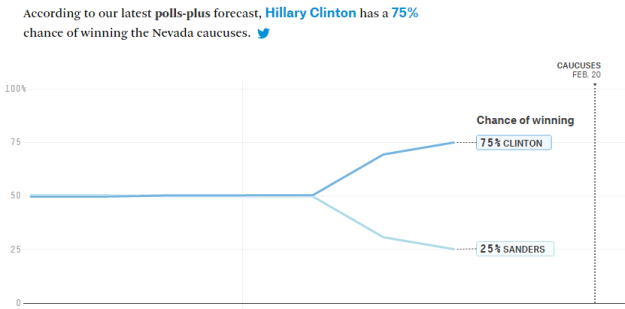
…and a President walks out? Well, probably not quite this early, but the next stage of our little every four-years elimination death match is happening this Saturday, courtesy of the Republican primary in South Carolina and the Democratic caucus in Nevada. (Nifty graphic above from FiveThirtyEight.com, by the way.) So, how’s it looking?

Democrats

All the leading indicators are giving Clinton an edge over Sanders, but also indicating that he’s surprisingly competitive. Let’s start with the straight polling. Nevada has only been lightly polled so far, but the recent polls all have Sanders and Clinton within a few points of each other:

rcpnev

Keep in mind that this is a state which, as recently as late December, Clinton led by more than 20 percent. Over at 538.com, their polls-only and polls-plus models are both tilting to Clinton:

538nevpo

538nevpp

In terms of margin, their polls-only model (which takes an average of polling, weighted by reliability of the pollster) has Clinton ahead by 4 points, and their polls-plus model (which takes the polling but also adds in effects of national polls, trend-line changes, outside factors like endorsements, etc.) has her ahead by 7 points. This is basically the same outcome as 2008, where Clinton beat Obama in the state 50.1% to 45.8%. It is, in other words, a very strong showing for Sanders, even if he doesn’t win.

If you recall my first election column of the year, Sanders seems to be not too far off what I outlined there as his “best case” scenario: “he wins Iowa, then New Hampshire, and does better than-expected in Nevada and South Carolina, and goes on to get a striking distance 40% or more of the states and delegates on Super Tuesday.” So far, he’s tied Iowa, blown-out New Hampshire, and is definitely better than expected in Nevada. Of course my next sentence in that column was that “best case” gives him, at best, a tough, but at least still conceivable path to the nomination. 538.com has just done an excellent state-by-state overview of what that might look like for him. If nothing else though, a strong Nevada showing for Sanders will keep South Carolina interesting when Democrats vote there next weekend.

Republicans

All indications are that Donald Trump retains a solid lead in South Carolina. Which, let’s pause to think about it for a second, is really remarkable. A win there this weekend would make him legitimately the front runner of a party that continues to not want him, to the extent that a packed room of party operatives kept booing him at this past weekend’s debate, and he hasn’t picked up a single endorsement from a current or former Republican Governor, Representative, or Senator, despite being almost-continuously in the lead since he announced in July. The numbers, though, are hardly ambiguous. Based on eight polls all from the last few days, RCP has this:

rcpsc

538.com is showing the following:

538sc

And the betting markets agree:

predictsc

As with New Hampshire, the real interest here may be in the second spot. Rubio seems to have recovered from his pre-New Hampshire debate stumble and fifth (!) place finish there, and is clearly narrowing in on Cruz. 538’s “polls plus” model actually has him narrowly beating Cruz. If Rubio can get a second-place, it will go a long way to bolstering his claim to being the anti-Trump that the party is looking for. Cruz, meanwhile, has a strategy that depends on gaining momentum from strong showings in the Southern states voting in March. A distant second, or much worse, a third, in a state that should be a good fit for him would cloud that path.

Of course the whole party’s path is somewhat cloudy at the moment. Trump is clearly viable, Cruz has every incentive to hang in there until the March voting is done, and Rubio continues to split the “consensus” party vote with Bush and, though probably not for much longer given his South Carolina numbers, Kasich. Mutterings about a brokered convention are beginning to seem more plausible…

New Hampshire, and the importance of being second

new hamsphire.jpg

Hi friends! Isn’t it exciting that people are finally voting? Actual election results cut through so much blather. Not to mention mow down superfluous candidates. Iowa alone winnowed out Huckabee, O’Malley, Paul & Santorum. You read my pre-Iowa prognostication. So what do I think of New Hampshire? Actually (barring an extremely interesting upset), who’s in first is pretty apparent on each side, and the real action is all about the nature of second.

Democrats

Whether you look at poll averages:

RCP

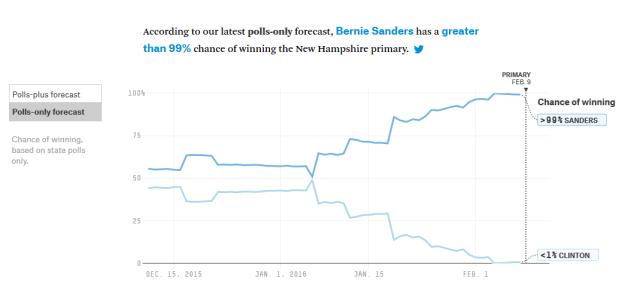
538.com’s “polls only” and “polls plus” models:

NH pollsonly

NH polls+

Or the betting markets:

NHdembets

The story is the same. Bernie Sanders is overwhelmingly favored to win New Hampshire. And therein lies the trap for him. As the analysts at 538.com have noted, Sanders strongest demographic is white, liberal voters, and so it would be expected that Iowa and New Hampshire would be very strong states for him. States to come have many more non-white voters, and self-describerd moderates, segments he has made much less polling headway with so far. So he would be really benefited by the maximum possible bounce out of these first two states.

You’ll notice the narrowing in his New Hampshire margin following Iowa in the first chart above. This narrowing seems to have backed off a bit, but primary polling  can be remarkably unpredictable (add to which Superbowl Sunday was a very ineffective day to be polling most Americans). It is certainly possible that Sanders could end up under 50%, and Clinton within single-digits of him. And if so, she benefits from the “better than expected” narrative. On the other hand, if he gets a wide margin, the press will probably run with the “she only tied Iowa, and just lost New Hampshire big” storyline. In which case Bernie is close to the best case scenario I laid out last time-he wins Iowa, then New Hampshire, and does better than-expected in Nevada and South Carolina, and goes on to get a striking distance 40% or more of the states and delegates on Super Tuesday.

Of course “best case” is still an uphill slog for him, but at least it’s a possible slog.

Republicans

As with the Democrats, poll averages:

RCP

538.com’s “polls only” and “polls plus” models:

538 New Hampshire

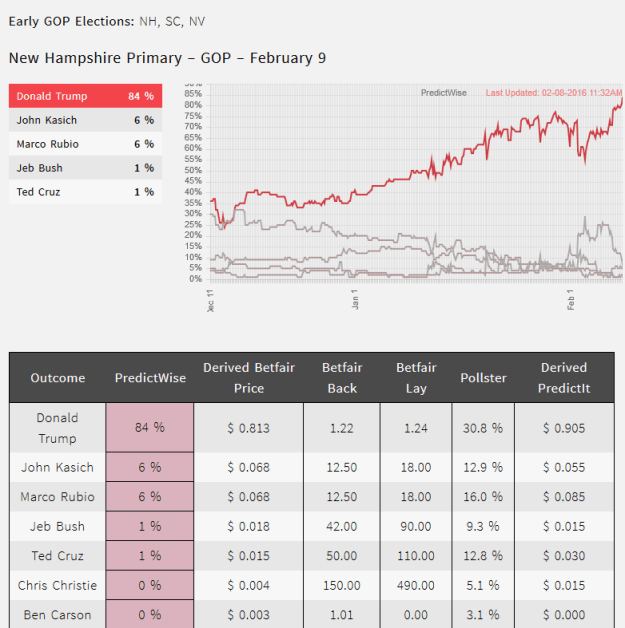
Or the betting markets:

NHdrepbets

All produce the same likelihood- Trump easily carries New Hampshire. Which really makes the race for second the story everyone will focus on. In this regard, Rubio had a New Hampshire surge after nearly passing Trump for second in Iowa, but it seems to be fading. Add to this what was widely seen as a poor debate performance this weekend, there is a serious chance he gets eclipsed by Cruz or Kasich in New Hampshire.

Kasich deserves further thought. New Hampshire is much more moderate, as Republican politics goes, than Iowa. So this is the kind of state he’d have his best shot in. A third place finish wouldn’t really get him a lot of attention past New Hampshire, but a second could have the party establishment re-evaluating whether he’s the alternative to Trump and Cruz that they might want to back instead of Rubio. The nightmare scenario for Rubio, of course, would be to actually end up fourth, if both Kasich and Cruz pass him by. That could make for a very messy, and interesting, South Carolina and Super Tuesday.

We’ll have to tune in Tuesday night and see!

Election 2016: Iowa (By the numbers)

iowa_caucus_400_267-280x150

Well, we have almost reached a momentous event in the 2016 election. Somebody, somewhere is about to actually vote, giving us meaningful data instead of all the flap-trapping that’s been going on so far! In the midst of all the flap-trapping, I tend to hew to the numbers anyway, since empirical data is handy at cutting through bullshit, spin and partisan bias. So here’s my take on Iowa, with 6 days to go.

The Democrats

If you look at the poll trend-lines over the past fourteen days, you can see that we’re at more or less a dead heat, with a very slight indication of a an up-trend for Bernie and down-trend for Hillary:

polls

There are three cautions that need to be kept in mind about this:

1) Not all polls are equally high-quality, so adding them together without weighting them can mislead.

2) Even shortly before Iowa, the polls don’t have a great track record– they’ll show who’s in range, but can still be pretty variable compared to final results.

3) A caucus is not a primary. In a  primary, people show up, go in to a booth, vote, and leave. In a caucus they have to get to the caucus site, and stay and advocate for their candidate, sometimes hour after hour, until that site comes up with a winner. So caucus states tend to benefit those candidates who have highly motivated supporters, and a strong on-the-ground presence to do the logistics of getting those supporters to show up at the sites and stay.

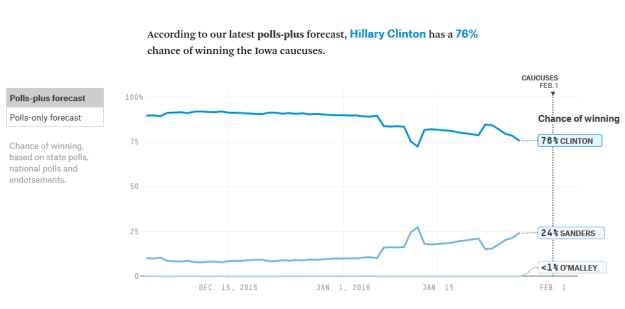
Based on these additional factors (weighting polls according to reliability, and adding in factors like logistical strength, etc.), the folks at data-driven election site 538.com have produced a”polls only” and “polls plus” forecast for Iowa, both of which show Hillary as the favorite.

polls

polls

There’s one more thing we can look at, which is the betting markets. These aggregate the current bets of several thousand users who, extremely usefully to cutting down spin, have literally put their money where their mouth is. Those markets also have Hillary as a favorite to win:

bet

My take? Bernie definitely has an enthusiasm edge over Hillary. His ground game, while quite strong, is not as strong as her’s, and nowhere near as strong as Obama’s when he pulled off an upset victory in Iowa in 2008. If you take the two as roughly cancelling each other out, it’s… more or less a toss-up. I know, way to waffle!

The thing that strikes me is that winning Iowa gives Bernie a shot at his best case- he wins Iowa, then New Hampshire, and does better than-expected in Nevada and South Carolina, and goes on to get a striking distance 40% or more of the states and delegates on Super Tuesday. A Sanders who does all that doesn’t have a lock, but he does have a competitive chance. A Sanders who doesn’t win Iowa probably still wins New Hampshire, but that’s discounted since it’s expected, and he then gets buried in South Carolina. He’s probably then mathematically finished on Super Tuesday by not winning any state except Vermont, and getting less than 40% of the delegates up for grabs. What he’d have to do to win the nomination from there would be prohibitive- it would have to be something like getting 65% of all the remaining delegates


The Republicans

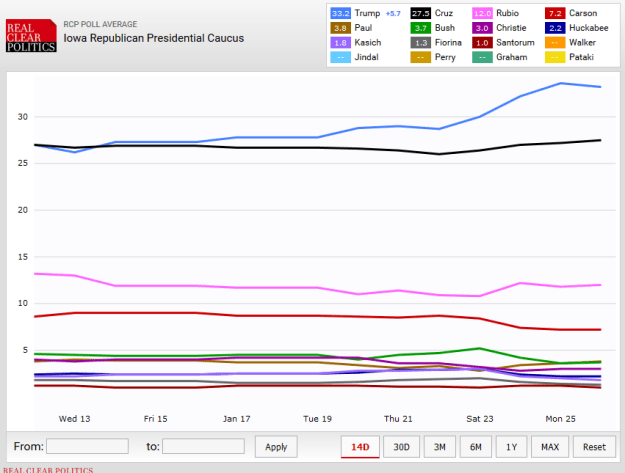
Trump has actually had a bounce-back against Cruz over the past 14 days in a straight-poll setting:

polls

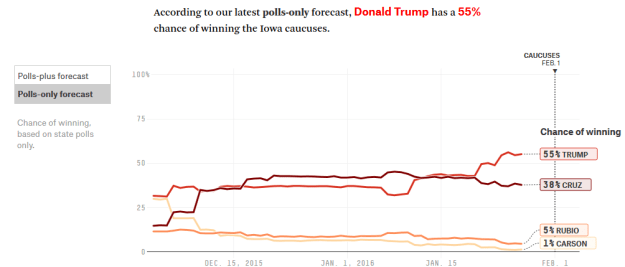
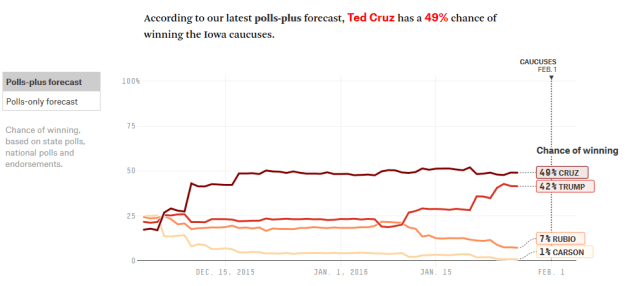
Over at 538, their two models have actually diverged, with “polls-only” giving an edge to Trump, and “polls-plus” giving an edge to Cruz:

polls

polls

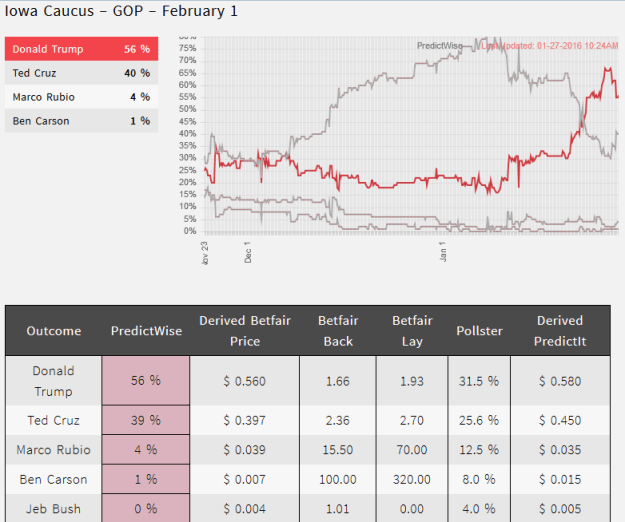
Meanwhile, the bettors are still picking Trump, but there’s some strong narrowing in the last few days:

bet

I’d suspect Cruz will take it. While his perpetual-motion PR machine is second to none, Trump doesn’t have a good ground game most anywhere, and in Iowa that can really have an effect. Cruz also fits the profile of Republican caucus candidates who do well in Iowa- strong Evangelical backing is key there, and gave Huckabee a win in 2008 and Santorum in 2012. 538.com has a lively discussion on just how important winning Iowa is to Trump’s long game.  You could make a case that it could be the beginning of the end for him, showing that his strong poll numbers don’t necessarily translate to real registered and showing-up-at-the-polls voters. On the other hand, you could also say that caucuses aren’t his thing, but the divided field of more moderate candidates in New Hampshire allows him to walk away with that state, and then the more straight-up vote primary in South Carolina. He would then be in a very strong position through Super Tuesday.

What’s your take? Tune in on Tuesday and we shall see!


Four things I’ve avoided by not writing about the 2016 election until now

Capture

I’m going to be breaking from my usual themes occasionally over the next year to talk about the presidential election. I really can’t help it, I’ve been a political junkie for actually longer than I can remember- my mom tells me as a three year old, I was fascinated with watching “the Watergate” on TV. My promise in my coverage: I have my leanings (solidly Democratic). But my analysis will be fact-based, to the chagrin of both leftie friends and rightie friends. You can look back at my postings from 2012 to get an idea of what that will look like.

However, to keep it in synch with my more usual blog themes, this first entry will be in the form of a list. The thing about Presidential politics is, there’s a lot of noise in media coverage that tends to drown out the signal. Before Nov. 1 of the year before the election, it isn’t even worth paying attention to, really, because the early speculation is based on so little, empirically, and early numbers aren’t indicative of much of anything. Here’s a few things I’ve been able to avoid talking about by not writing about it until now:

1. 4 whole candidates! First, and in an originally 22-candidate field, the value of this is not to be overlooked, by waiting I’ve avoided having to talk about Chaffe, Perry, Walker and Webb at all! Especially relieving, because I would have thought Walker had a decent chance at the Republican nomination, so it’s nice not to have to endure the daymare that would have been.

2. Joe Biden. I love Uncle Joe! Always have. He was actually one of my two preferred candidates at the start of 2008 (the other was Bill Richardson, which goes to show you what I know). But it would have been a long shot for him, and explaining that to people imbibing the latest media narrative would have grown tiresome. Now I don’t have to!

3. Arguing about Bernie Sanders. I actually can’t win with Bernie. My small cadre of rightie friends starts in on the whole tired socialist trip whenever I talk about Bernie. And my Progressive friends call me a cynic when I try to talk realistically about his chances (which have been, and remain, low according to every reliable indicator). Then I have my mainline Democratic friends who try to convince me that Bernie is worthless or even dangerous and Hillary is golden. By not writing about the election until now, I’ve at least had some break from this argument.

4. Dismissing Trump. My early take was that he would be gone before voting started, and certainly would not be in the top three by Super Tuesday. I’m glad I didn’t have a chance to write more about this, because I’m starting to question my premise. Nate Silver at 538.com, who I put a lot of stock in, still thinks Trump is ultimately doomed, because he’s so unpalatable to the party power brokers, and they have numerous opportunities in the process to derail him one way or another. It’s a solid argument. But, now that he’s been in the lead for three and a half months straight, is polling first or second in the three first primaries, and actual voting starts in 90 days, I’m a little less sure. I still don’t expect him to be the nominee (my current best guess is Rubio), but he’s actually in this thing for real.

More to follow!