Tag Archives: bernie sanders

There can be only one…

candidatessss.PNG

I hadn’t expected to begin my regular coverage of the 2020 Presidential campaign so early, but I better get started sooner rather than later because, as you may have heard, there are currently 19 candidates for the Democratic nomination. Or 20 if you believe that Mike Gravel is actually running, and not being held captive in a basement by a bunch of 4Chan teenagers who are impersonating him on social media. And with the inevitable Biden still pending, it will soon be 21.

How on Earth can anyone keep track of 21 candidates? Well the good news that I’m here to deliver is that you don’t have to because, in reality, there aren’t 21 candidates. There are really only eight candidates. I’ll explain in a moment.

First, let’s address the issue of analyst bias. Specifically, mine. Like anyone, I have some candidates I like more than others. In the interests of full disclosure: In the 2016 primary I supported Sanders, and made contributions to his campaign through the final primary. So far this year, I have made at least one contribution (sometimes more) to Pete Buttigieg, Julian Castro, Kirsten Gillibrand, Kamala Harris, Wayne Messam, Beto O’Rourke, Elizabeth Warren, William Weld, and Marianne Williamson.

In fact, I have a color-coded classification of my preference for all the declared candidates. If you correctly decipher the coding, you’ll know exactly what I think:

color code

So, I have opinions, leanings, etc. Those are entirely irrelevant to this exercise though, because what I’m actually going to look at is three measures that have a high degree of correlation to who the eventual nominee will be. It’s a little early for all of them yet, but by the eve of Iowa, they’ll give a pretty solid indication of which way the nomination will go. Already, certain patterns can be seen.

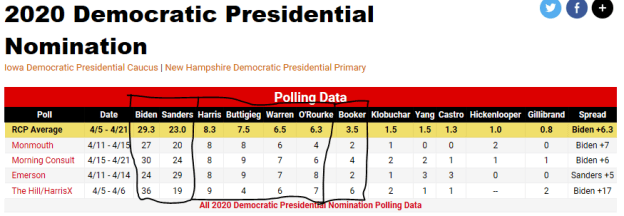
First up, rather straightforwardly, is polling. It seems a little silly on the face of it to look at national polling for what is in fact 50-something individual caucuses and primaries, but it turns out that, by the time you get to Iowa, who’s leading in national polls has about a 60% correlation with who will win the nomination.

If you look at current rankings (courtesy of Real Clear Politics), you can easily spot a top tier of two front-runners, a second tier, and then a third tier I might name “well, at least he’s not dead in the water”. All told, seven candidates who appear to be contenders:
polls

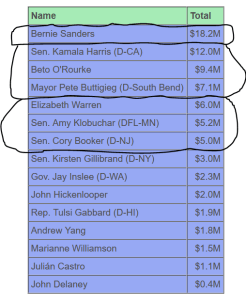
Another leading indicator is fundraising. The early fundraiser leader ends up being the nominee 62% of the time. We have a ways to go before this measure becomes predictive at that level, but already based on the Q1 fundraising numbers, we can spot a similar three-tier structure. There’s a clear front-runner, a strong second tier, and a third-tier who are around $5 million:
fundssss

Finally, there’s a theory in political science circles known as “The Party Decides”. The basic idea is that institutional support from party elites is the key indicator of who the nominee will be. Once you reach the eve of Iowa, this measure does in fact call the winner 63% of the time.

Most potential endorsers are staying on the sidelines until things develop further, but with the party leaders who have committed so far, you’ll see a familiar three-tier structure. Two front-runners on top, a strong second tier placer, and then a third tier clustered within 10 points or so of each other:

endorsements

You would naturally suspect these three measures have a lot of correlation with each other, and aren’t really totally independent variables. Like, of course, somebody doing well in the polls is probably also doing well in fundraising, and is thus attracting potential endorsements. But they probably also aren’t perfectly correlated. So, if they’re 60% accurate individually, collectively they might be 2/3? 75%? accurate.

Keeping that in mind, looking at the three measures together, each is calling out pretty much the same set of people, albeit in different order. Put together, the candidates who seem to have any shot at all are:

Biden, Booker, Buttigieg, Harris, Klobuchar, O’Rourke, Sanders, Warren

That’s it. You may dispense with the other thirteen!

The necessary caveat at this point is that it’s still very early. To give two examples, Bernie Sanders at this point in ’16 was polling around 4%, and Rudy Giuliani at this point in ’08 was the clear Republican front-runner. That being said, I was pretty generous with my tiers, and while somebody on the lower end now might well be in the upper tier by the end of the year, I’d be pretty surprised if the eventual nominee isn’t in this group at all.

But, hey, if I’m wrong, you’ll see! Tune in again in mid-July for further refinement following the first debates and Q2 fundraising numbers!

It’s Super-possible both nominees will be chosen Tuesday

12741984_772007845014_2167794878190818737_n

Yes, that image is from 2008. But it so Super-well combines two of my loves, Presidential Politics and Comics, that I had to do it. You may have heard that this Tuesday is Super. Some election cycles it’s more super, some less so, but this year on both sides the calendar is so front-loaded that half of all the delegates will be chosen by the end of March. So this kickoff with more than a fifth of the states in the Union voting on the same day is pretty significant. In fact, I think a good case can be made that both nominations will effectively be decided tomorrow…

Democrats

Sanders had been hewing pretty close to what I pegged in my first election blog of the year as his “best case”: “he wins Iowa, then New Hampshire, and does better than-expected in Nevada and South Carolina, and goes on to get a striking distance 40% or more of the states and delegates on Super Tuesday”. Until Sunday, when he lost South Carolina by almost 50%.

The campaign made a deliberate decision over the past week to basically concede the state, and concentrate resources on making as big a splash later in March as possible. It’s an understandable strategy in a case where you know you’re going to lose a state anyway and so does everyone else. But there’s “lose” and then there’s “get obliterated”. 538.com has an analysis suggesting that, if he performs as poorly with Black voters on Super Tuesday as he did he in South Carolina, even if he wins several other states, Clinton may do so well in the Southern states with larger delegate totals that she’ll open a delegate lead he just can’t catch even if he has upside surprises later in the month.

Another way to look at is to work backwards from the national numbers. Currently the averages show the following:

Capture

These numbers are kind of so all over the place that you can wonder what’s up, but it does look like the momentum is tipping back to Hillary. If you take the old data analysis trick of removing the highest and lowest (Clinton ahead by 17 and Sanders ahead by 3) and averaging the rest, you’d still come to the conclusion that Clinton is ahead by about 6% nationally. Over at 538.com, Nate Silver has a pretty sophisticated analysis indicating where Clinton and Sanders would be state by state if tied nationally. Let’s zoom in on the “Super Tuesday” portion of that:

gap

If, instead of being tied, you assume Clinton is ahead by 6 points nationally, you’d expect Sanders to win Vermont, Minnesota, Colorado, and Massachusetts, and Clinton to take everything else. Since everything else in this case includes some very populous states, her delegate haul from that would put him far enough behind that he would not only have to perform, but outperform the rest of the contests to catch up. This is pretty much what Obama did to Clinton in 2008, and she was unable to rally back even though she stayed competitive the whole time, with several big wins along the way. And if Sanders doesn’t even manage to capture all four of those states…

Clearly he has the money and the core supporter enthusiasm to stick it out throughout March and well into April. And even if he does slip as I’m outlining here, I’d expect some surprises in March and April that will lead to “Sanders is back!” headlines. But the mathematical path forward is hard to see unless he really outperforms tomorrow.

Republicans

If I think it’s starting to smell like Clinton pulls into an uncatchable lead tomorrow, this is doubly so for Trump. The Republicans have even more states on the docket than the Democrats do:

docket

Some of these states haven’t had any recent good polling. But if you look at the RCP run-down of the ones that have, you’ll immediately see that Cruz has a lead in Arkansas and his home state of Texas, but everything else is coming up Trump. If Cruz isn’t performing better than that in the Southern states that should be his strongest, it’s hard to find a plausible scenario where he overtakes Trump later. Rubio has a somewhat more conceivable path, namely that if he can get himself into a one-on-one with Trump, he can start winning some of the large and more moderate “winner take all” states that are coming up later in the calendar.

Except, Cruz has every incentive to see how many delegates he can build up through the end of March, and Kasich is showing every sign of refusing to clear the stage for Rubio at least until his home state of Ohio votes  on March 15th. By then, Trump will have cleared enough of the board that he will be very hard to catch. We may know as soon as tomorrow if Rubio and Cruz are effectively unable to catch up. They could still stay in and keep anyone from getting enough delegates to take it before the convention , leading to a floor fight there. But the major donors are already showing reluctance to spend against Trump, and he’s getting his first establishment endorsements. The party may decline to join their fight, and instead get on board with Trump.

Tune in tomorrow, and we shall see!


Election 2016: Iowa (By the numbers)

iowa_caucus_400_267-280x150

Well, we have almost reached a momentous event in the 2016 election. Somebody, somewhere is about to actually vote, giving us meaningful data instead of all the flap-trapping that’s been going on so far! In the midst of all the flap-trapping, I tend to hew to the numbers anyway, since empirical data is handy at cutting through bullshit, spin and partisan bias. So here’s my take on Iowa, with 6 days to go.

The Democrats

If you look at the poll trend-lines over the past fourteen days, you can see that we’re at more or less a dead heat, with a very slight indication of a an up-trend for Bernie and down-trend for Hillary:

polls

There are three cautions that need to be kept in mind about this:

1) Not all polls are equally high-quality, so adding them together without weighting them can mislead.

2) Even shortly before Iowa, the polls don’t have a great track record– they’ll show who’s in range, but can still be pretty variable compared to final results.

3) A caucus is not a primary. In a  primary, people show up, go in to a booth, vote, and leave. In a caucus they have to get to the caucus site, and stay and advocate for their candidate, sometimes hour after hour, until that site comes up with a winner. So caucus states tend to benefit those candidates who have highly motivated supporters, and a strong on-the-ground presence to do the logistics of getting those supporters to show up at the sites and stay.

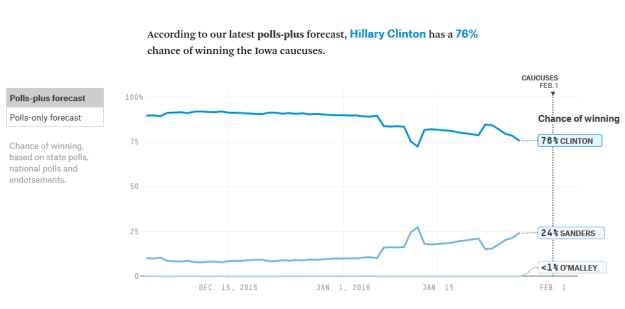
Based on these additional factors (weighting polls according to reliability, and adding in factors like logistical strength, etc.), the folks at data-driven election site 538.com have produced a”polls only” and “polls plus” forecast for Iowa, both of which show Hillary as the favorite.

polls

polls

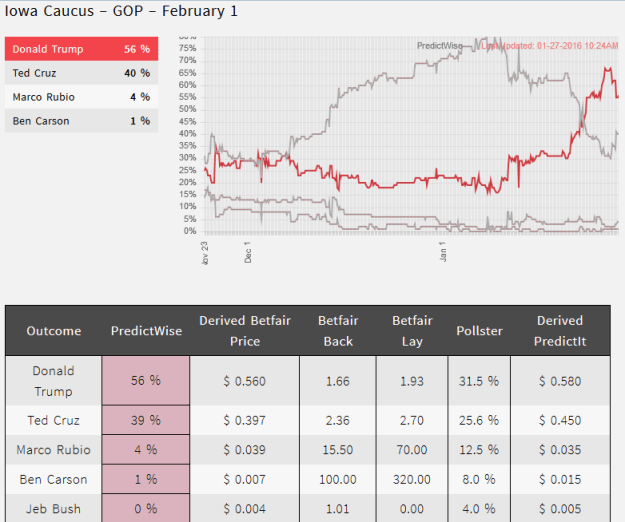
There’s one more thing we can look at, which is the betting markets. These aggregate the current bets of several thousand users who, extremely usefully to cutting down spin, have literally put their money where their mouth is. Those markets also have Hillary as a favorite to win:

bet

My take? Bernie definitely has an enthusiasm edge over Hillary. His ground game, while quite strong, is not as strong as her’s, and nowhere near as strong as Obama’s when he pulled off an upset victory in Iowa in 2008. If you take the two as roughly cancelling each other out, it’s… more or less a toss-up. I know, way to waffle!

The thing that strikes me is that winning Iowa gives Bernie a shot at his best case- he wins Iowa, then New Hampshire, and does better than-expected in Nevada and South Carolina, and goes on to get a striking distance 40% or more of the states and delegates on Super Tuesday. A Sanders who does all that doesn’t have a lock, but he does have a competitive chance. A Sanders who doesn’t win Iowa probably still wins New Hampshire, but that’s discounted since it’s expected, and he then gets buried in South Carolina. He’s probably then mathematically finished on Super Tuesday by not winning any state except Vermont, and getting less than 40% of the delegates up for grabs. What he’d have to do to win the nomination from there would be prohibitive- it would have to be something like getting 65% of all the remaining delegates


The Republicans

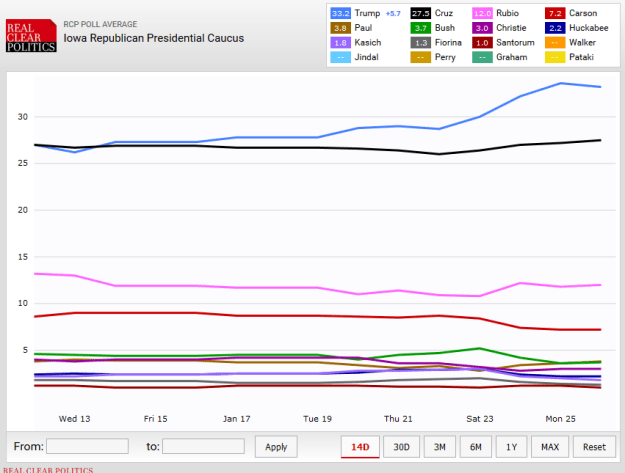
Trump has actually had a bounce-back against Cruz over the past 14 days in a straight-poll setting:

polls

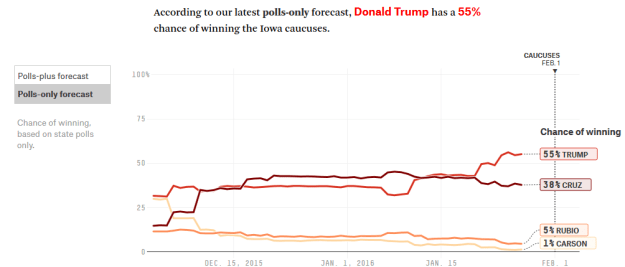
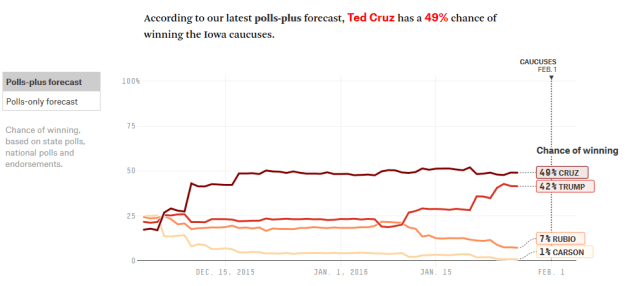
Over at 538, their two models have actually diverged, with “polls-only” giving an edge to Trump, and “polls-plus” giving an edge to Cruz:

polls

polls

Meanwhile, the bettors are still picking Trump, but there’s some strong narrowing in the last few days:

bet

I’d suspect Cruz will take it. While his perpetual-motion PR machine is second to none, Trump doesn’t have a good ground game most anywhere, and in Iowa that can really have an effect. Cruz also fits the profile of Republican caucus candidates who do well in Iowa- strong Evangelical backing is key there, and gave Huckabee a win in 2008 and Santorum in 2012. 538.com has a lively discussion on just how important winning Iowa is to Trump’s long game.  You could make a case that it could be the beginning of the end for him, showing that his strong poll numbers don’t necessarily translate to real registered and showing-up-at-the-polls voters. On the other hand, you could also say that caucuses aren’t his thing, but the divided field of more moderate candidates in New Hampshire allows him to walk away with that state, and then the more straight-up vote primary in South Carolina. He would then be in a very strong position through Super Tuesday.

What’s your take? Tune in on Tuesday and we shall see!