Category Archives: Uncategorized

Four more years? (one month to go edition!)

It’s hard to believe. Even more so since we’ve had, like, a year’s worth of news in the last week. But, as of this past weekend, it was officially one month to go until Election Day! When we last checked in a month ago, the conclusion was, “Biden remains in a very strong position with two months to go.” If that was true then, it’s even more so now.

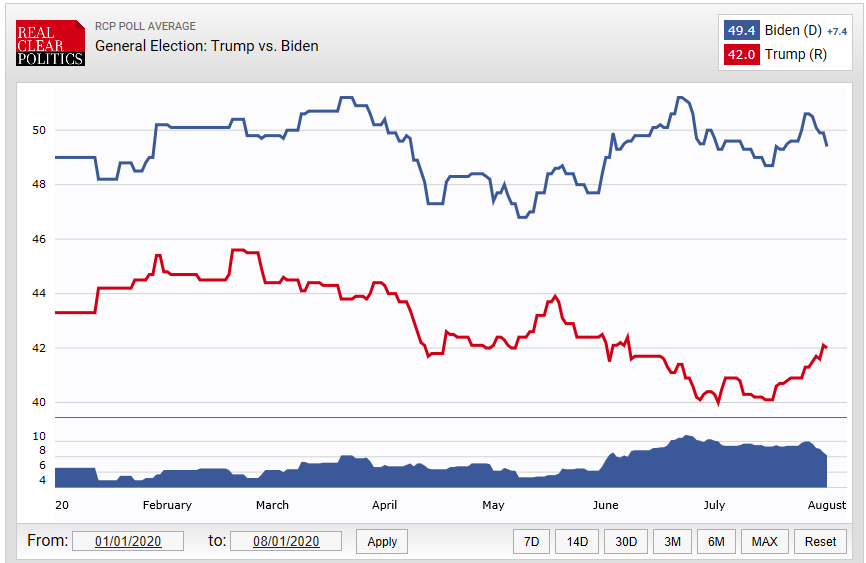
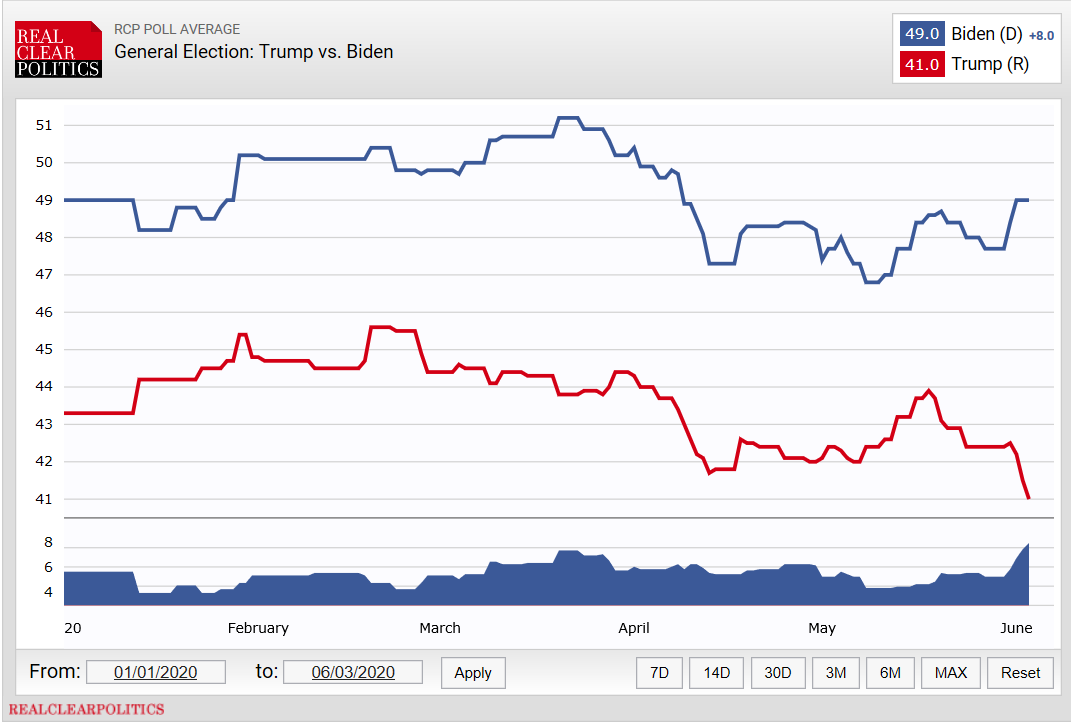
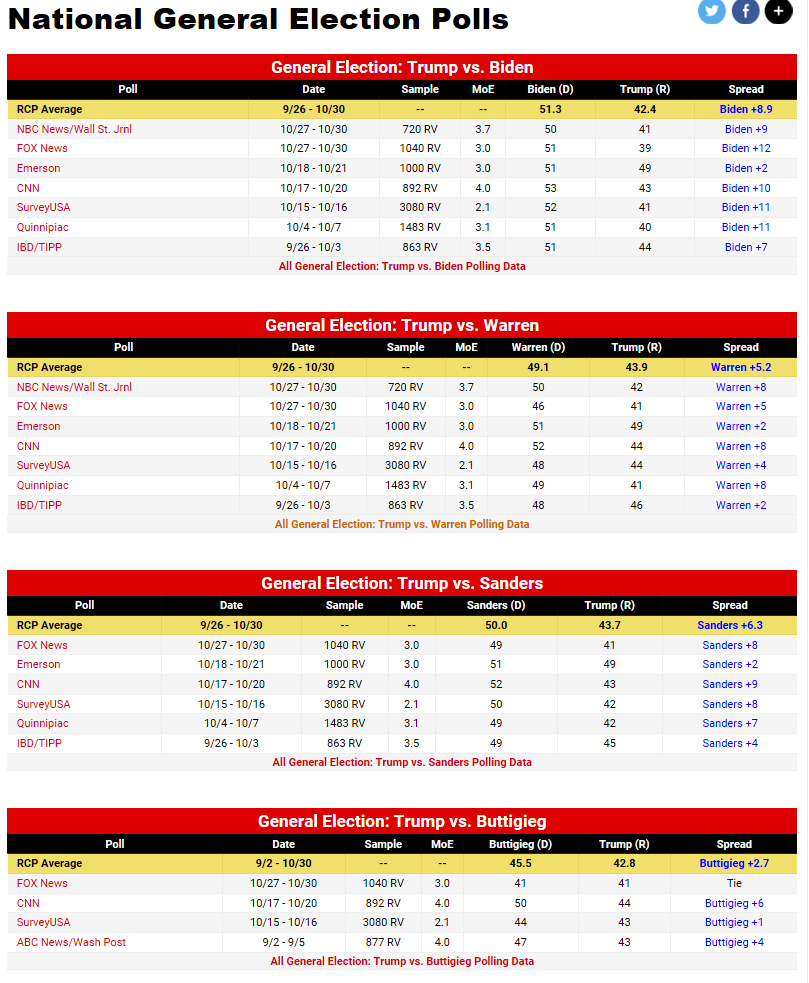
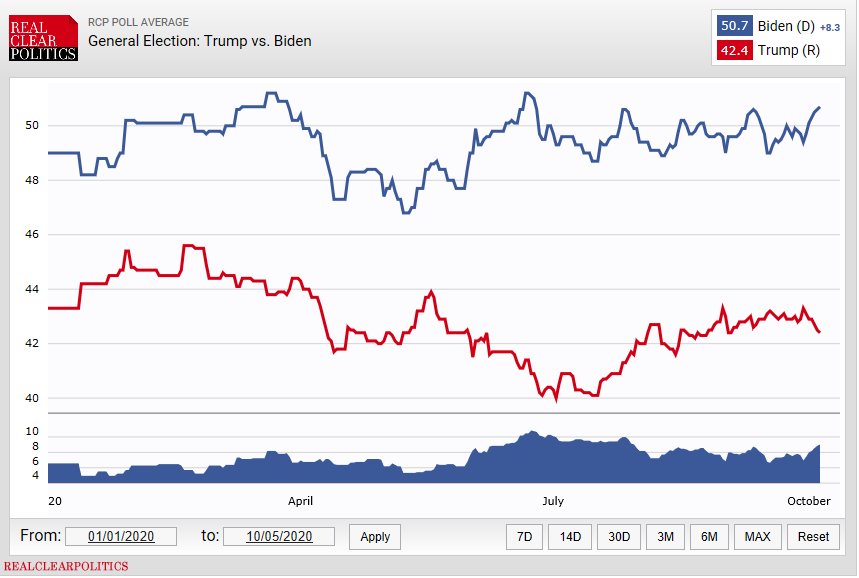
Let’s start with national polling. Using their average of recent polls (also note, the majority of these now include post tax story/debate news, but don’t yet have data since revelations of Trump’s COVID diagnosis), RCP currently has Biden leading by 8.3%:

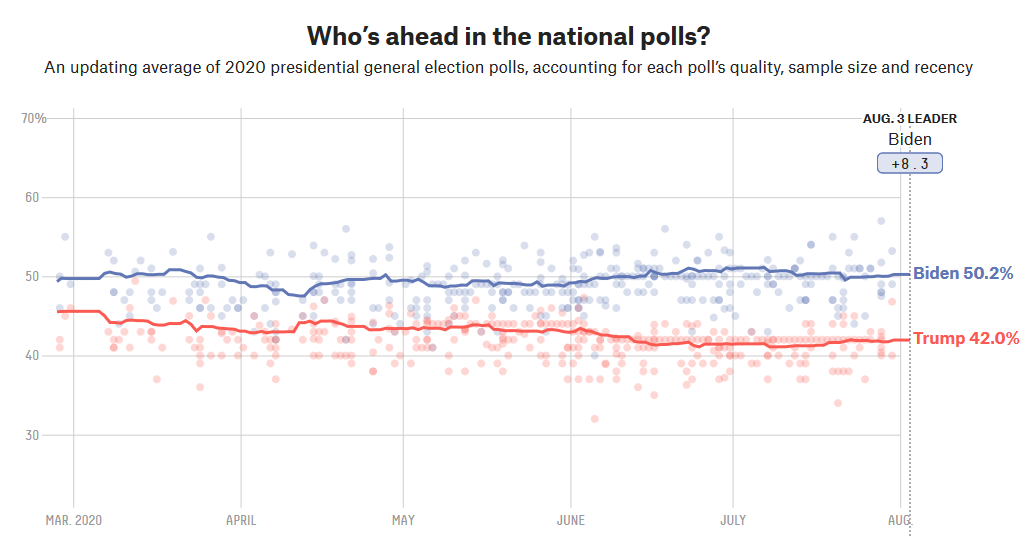
RCP’s average is “naive” in the sense that it just adds together recent polls and takes their average. Over at FiveThirtyEight, they also adjust their weightings for pollster’s history of accuracy, compare national polls to state tallies for a “sanity check”, and take into account pollsters that have a historical partisan lean in one direction or another. This is certainly a more robust methodology, but at the moment it produces a nearly identical result, Biden +8.2%:

There are two things worth noting about this lead. The first is that it isn’t a meaningless data point, since more than 2 million votes have already been cast, and voting is taking place in more than 30 states right now while Biden has this healthy lead:

The other point worth talking about is margin of error. Even the best polling, irreducibly, has a roughly +/- 3% margin of error. To take the above 538.com numbers as an example, Trump could be as high as 45.7%, and Biden could be as low as 47.9%. That means that, at worst (from his point of view) Biden’s lead could be as little as 2.2%. Of course, equally, Biden might be as high as 53.9%, and Trump might be as low as 39.7%.

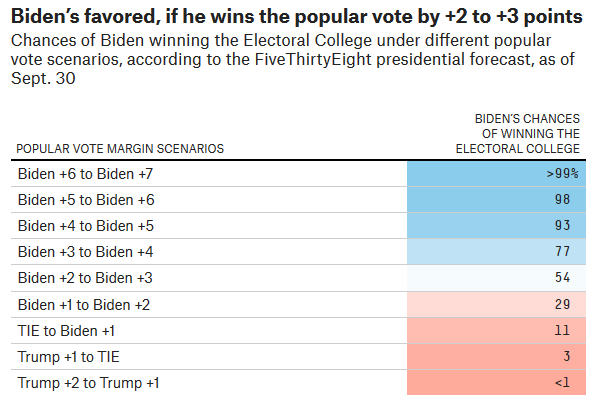
This matters because, as 2016 showed us, a narrow popular vote lead can still be an electoral college loss, depending on how the individual states fall. FiveThirtyEight has tried to quantify this, and at a 2% to 3% national lead, Biden has around a 50% chance to win the Electoral College. Of course, this currently looks to be Trump’s absolute best case scenario, and if Biden is ahead by more than 3%, his chances shoot up accordingly.
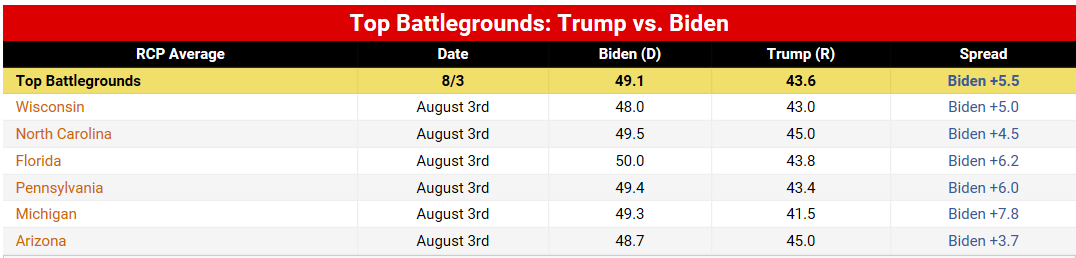
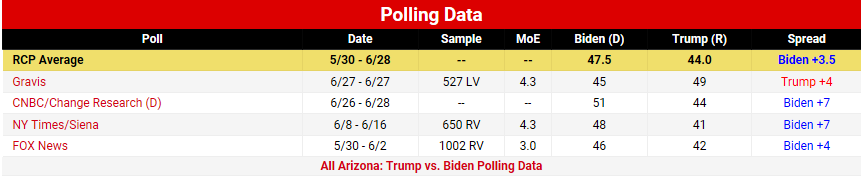
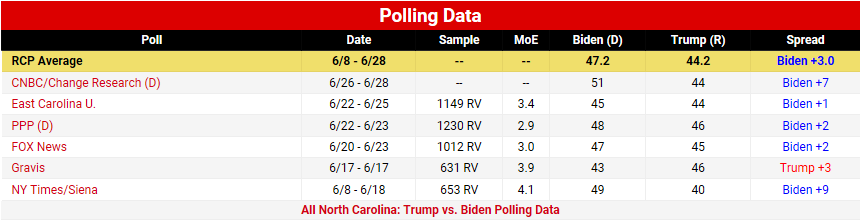
Did I mention individual states above? Indeed, and that is what the election ultimately swings on. As it happens, Biden currently enjoys a lead in all of the most probable swing states:

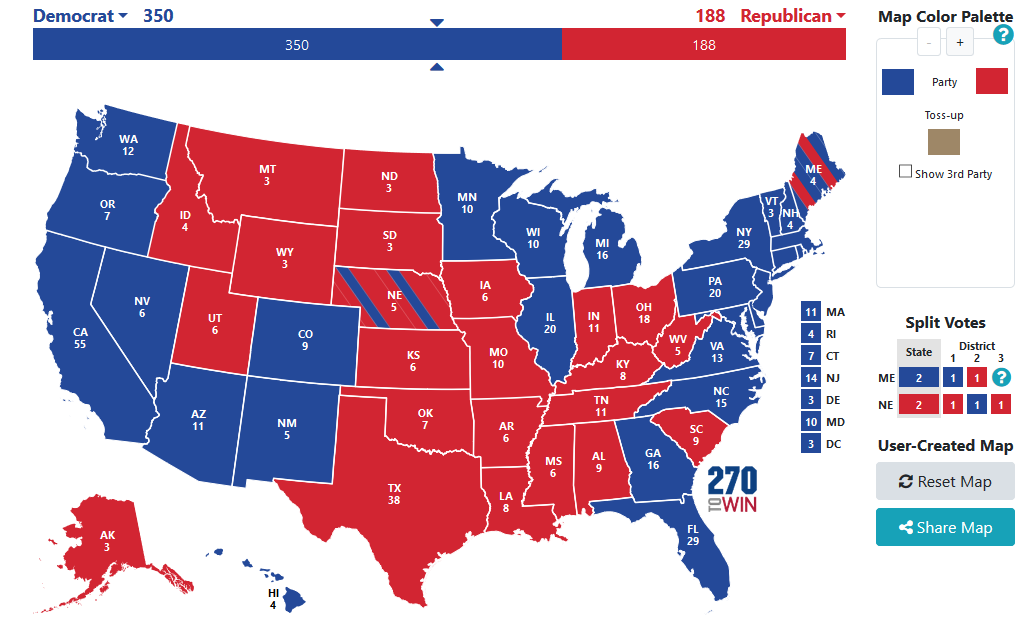
Granted that some of these leads are narrow, even restricting the map to just states where his lead exceeds 5% takes him over the top:

If we were to go further and look at RCP’s “No Toss-ups” map of all the states based on current polling averages, we get this map:

Using their sophisticated state-by-state model, 538 is currently predicting an 81% chance that Biden wins:
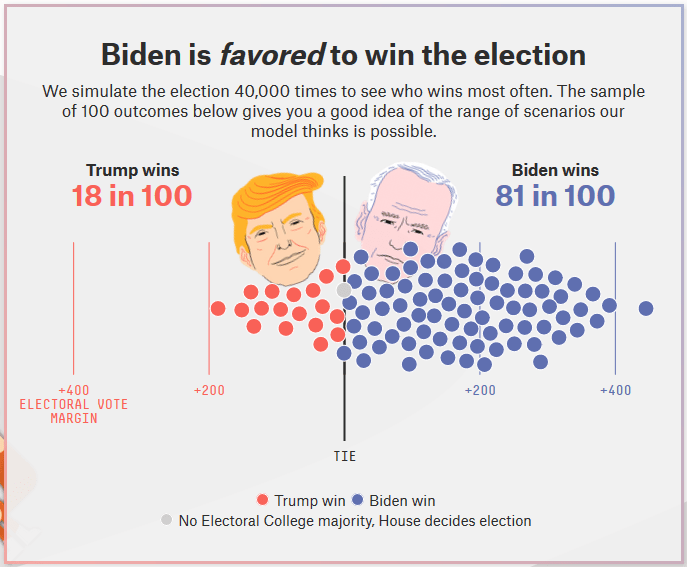
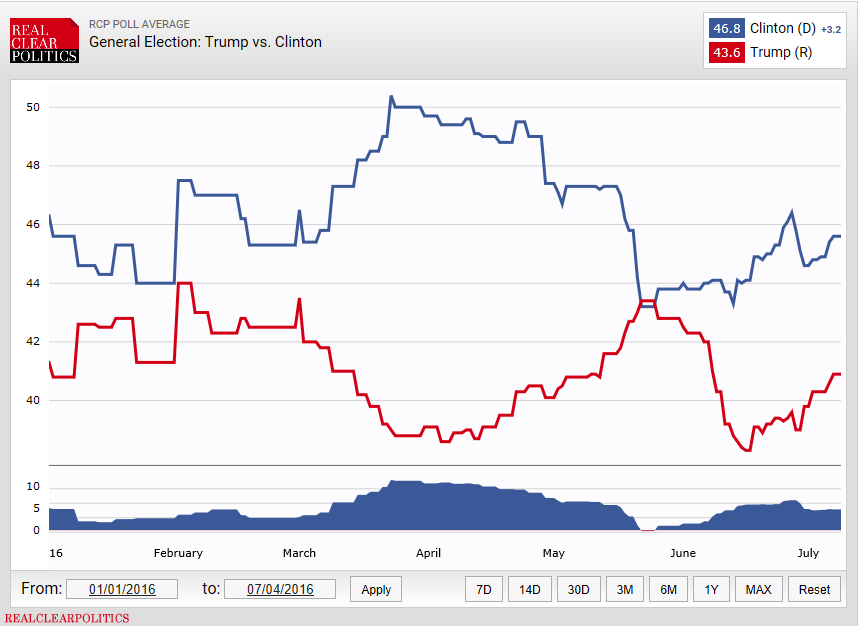
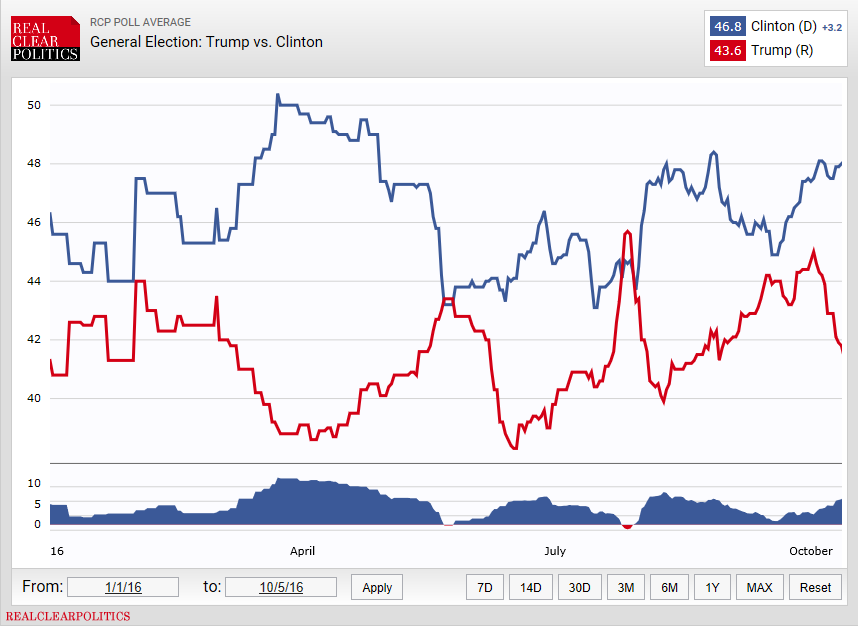
Note that this model in part reflects the uncertainties of still being a month out. To put this another way, every day we get closer to the election with Biden still having these kind of national and state numbers, that percentage rises. For reference, in 2016 538’s model had a 29% chance that Trump would beat Clinton on the eve of the election. Biden is in substantially better shape than that, as a quick side-by-side comparison confirms:
I do this list a lot, but because I think it’s instructive I’ll do it again!

  • Clinton frequently had a lead as low as 2% or less over Trump, Biden has never had a single day under 4%.
  • At two points, Trump actually led Clinton, he has never led Biden for even a single day.
  • Biden has spent significant time over 50%, and almost no time under 48%, whereas Clinton was often below 48%, and only topped 50% for a single day.

National polls, state polls, and the comparison to 2016 all confirm the notion that Biden is in very good shape with a month to go. What do other data points have to say?

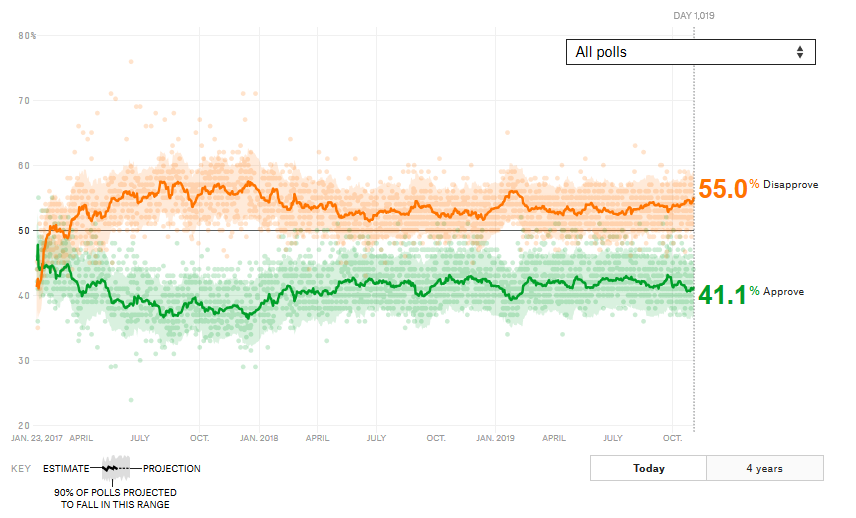
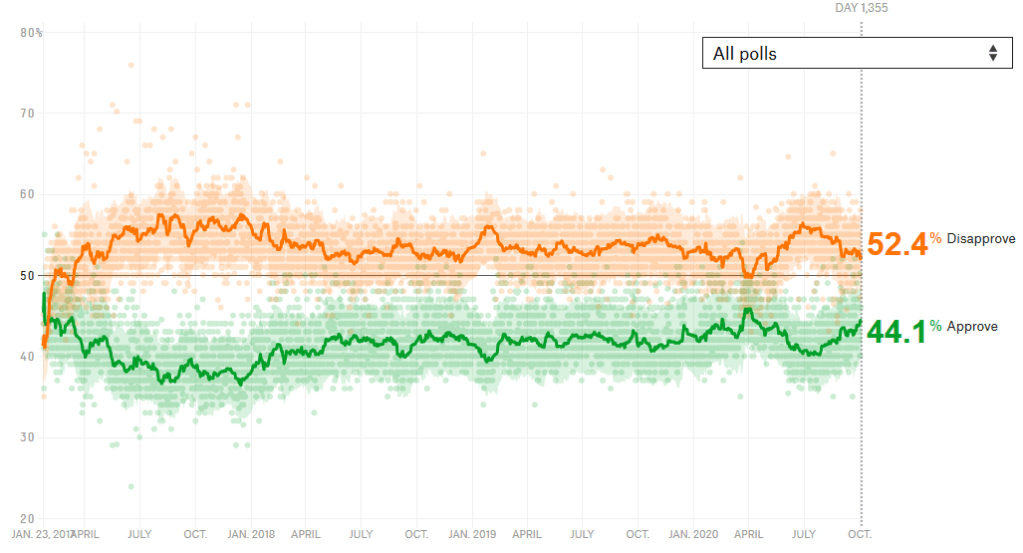
According to FiveThirtyEight’s average, Trump’s net approval rating is currently more than eight points underwater:
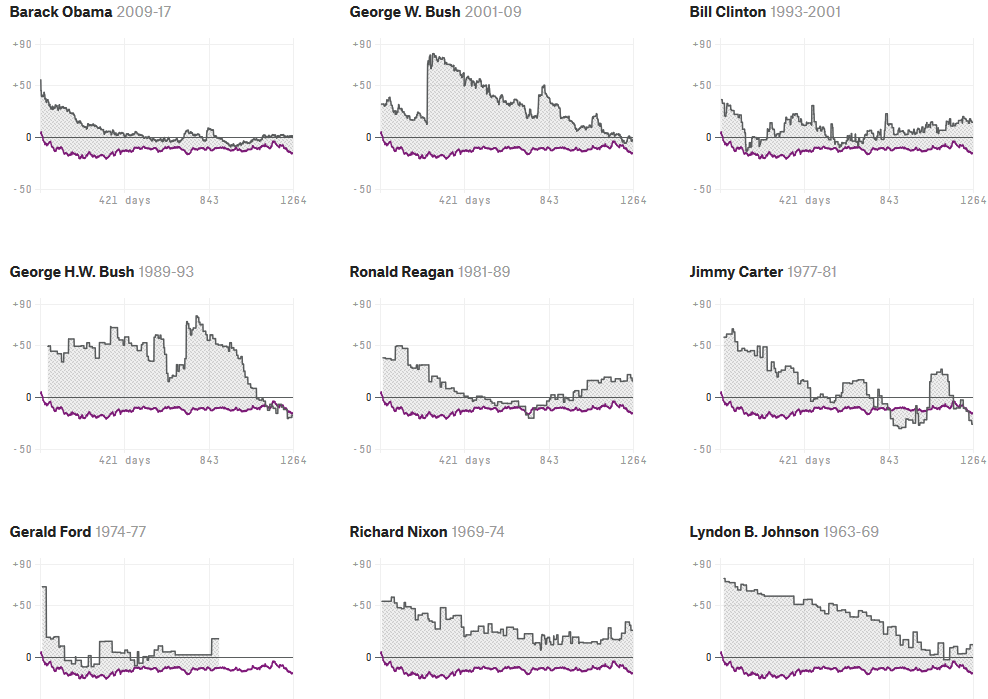
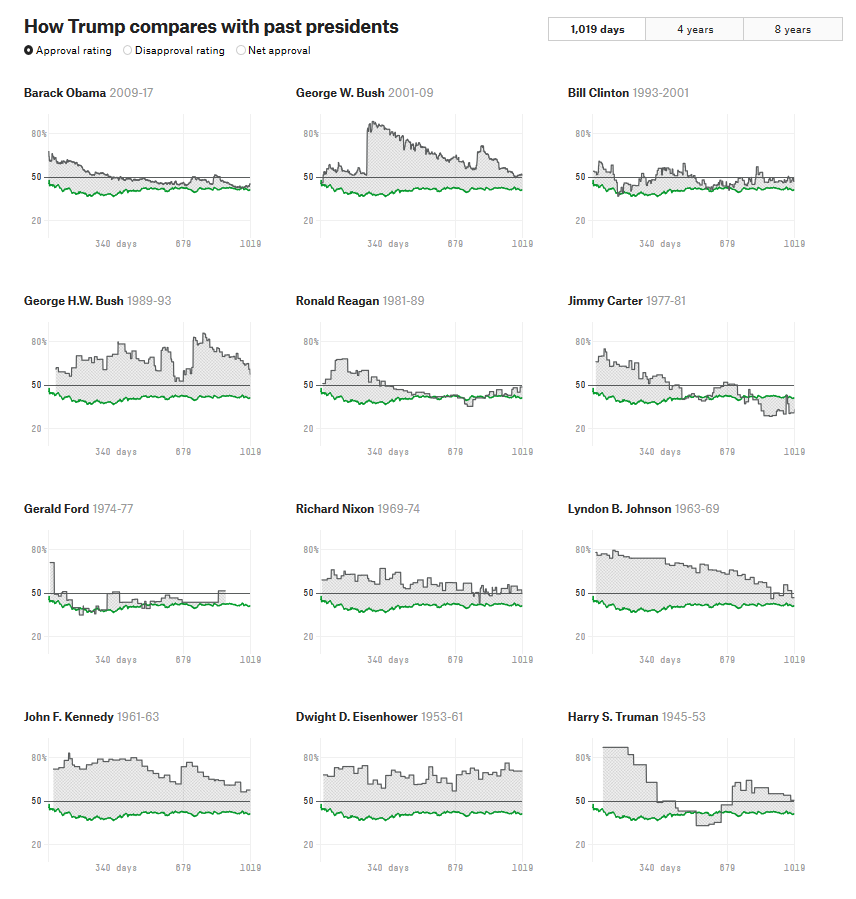
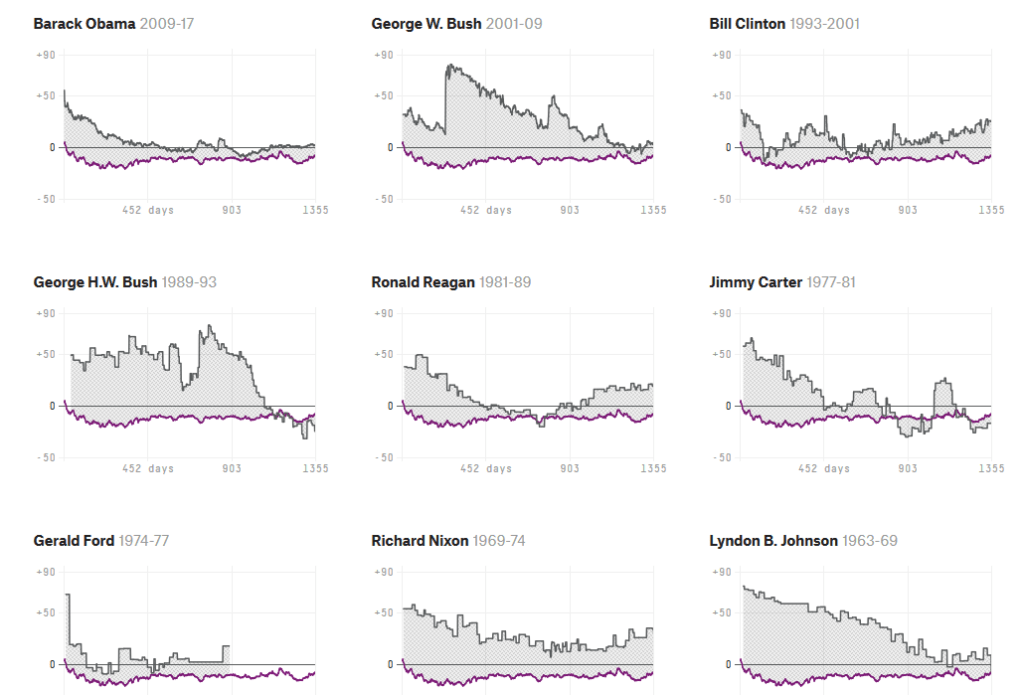
To put that in historical perspective, Trump’s net approval numbers are worse at this point than any other President of the last 50 years except for Bush I and Carter, both of whom were about to be defeated:
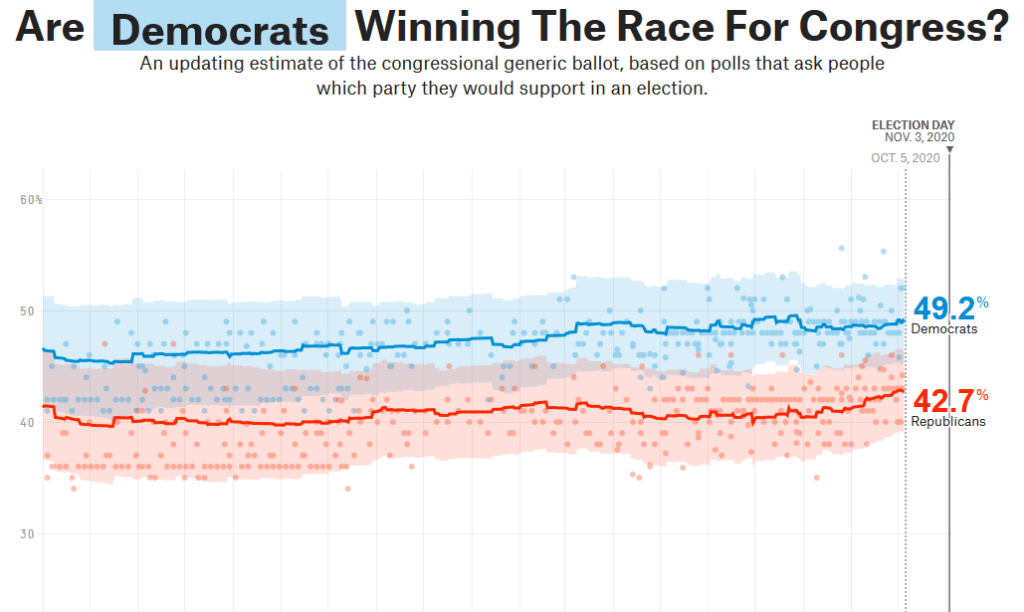
Democrats are leading the Generic Congressional Approval ballot by 6.5%, meaning that their hold on the House is not in any danger, and could even expand slightly:
RCP’s “No Toss-ups” Senate polling averages map shows Democrats re-taking control of the Senate:

And FiveThirtyEight’s Senate forecast model gives Democrats a 65% chance of doing so:
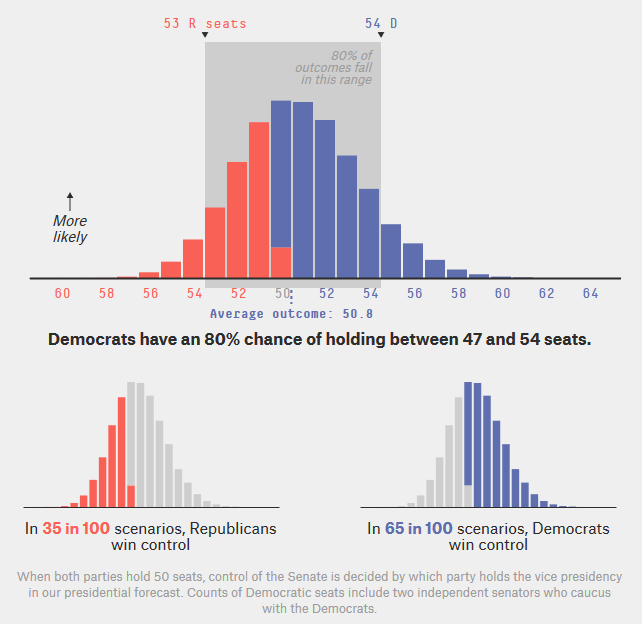
In short, reference to Trump’s net approval numbers and the House and Senate outlook further bolsters the idea that Biden’s lead is as robust as it appears.

There are, of course, factors that this analysis doesn’t take into account. Election night returns may temporarily show Trump leading before absentee ballots are tallied and reflect the full picture. And Trump has given every indication that he plans to dispute results. But none of that, ultimately, changes the fundamental fact that, a month out from the election, Biden has a very solid chance of prevailing on 11/3/20 (plus a week or two).

Tune in again two weeks from now for the two week outlook!

Four more years? (3 months to go edition!)

countdown

Is it just me, or was that a fast month? When last we gathered with four months to go, Biden’s position was looking very solid, and even better than it had at five months or six months. How are things different at this point?

To start with, the polling numbers have tightened up a little, but not a lot:

BvT

It hasn’t so much been Biden falling out of his usual range as Trump having bounced back a little from a dismal bottom beneath his usual range. Overall, Biden’s position remains very strong. One thing to keep in mind about the RCP average, is that it’s just that- an average. But not all polls are created equal.

Over at FiveThirtyEight, they address this by weighting pollsters according to their history of accuracy (more accurate ones being given more weighting than less accurate ones) and historical partisan skew (adjustments being made to pollsters that are regularly more +D or +R). This more nuanced approach has Biden up by a little more:

538poll

Another useful way to think about the RCP polls is to compare Biden’s YTD numbers with Clinton’s for the same time period in 2016:

This side by side comparison makes immediately apparent that Biden’s 2020 position is much stronger than Clinton’s 2016 position:

  • Biden has never been less than 4 points ahead, compared to Clinton, who was frequently within 2 points, and twice was briefly behind Trump.
  • Biden has been above 48% 2/3 of the time or more, Clinton was above 48% only 1/3 of the time or less.
  • Biden has had several runs above 50%, whereas Clinton was only above 50% for a single day.

Of course, we in America are blessed with that cute little Constitutional anachronism known as the Electoral College, so national polls can only tell one so much. We do have a pretty good idea from 2016 and trends since then what some of the key states will be, and Biden currently leads in all of them. Not only does he lead, he’s well outside the margin of error in every state here except Arizona:

battlegrounds

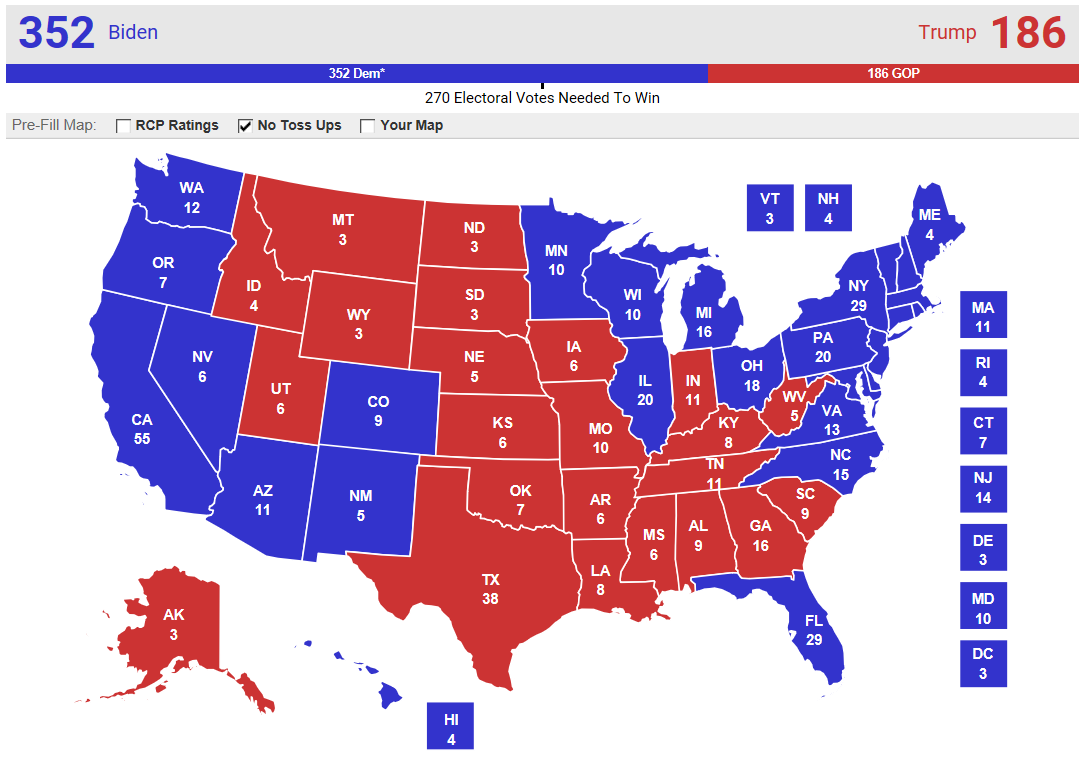
If we look at RCP’s current “No Toss-Ups” map, Biden is in very strong shape:

NoToss

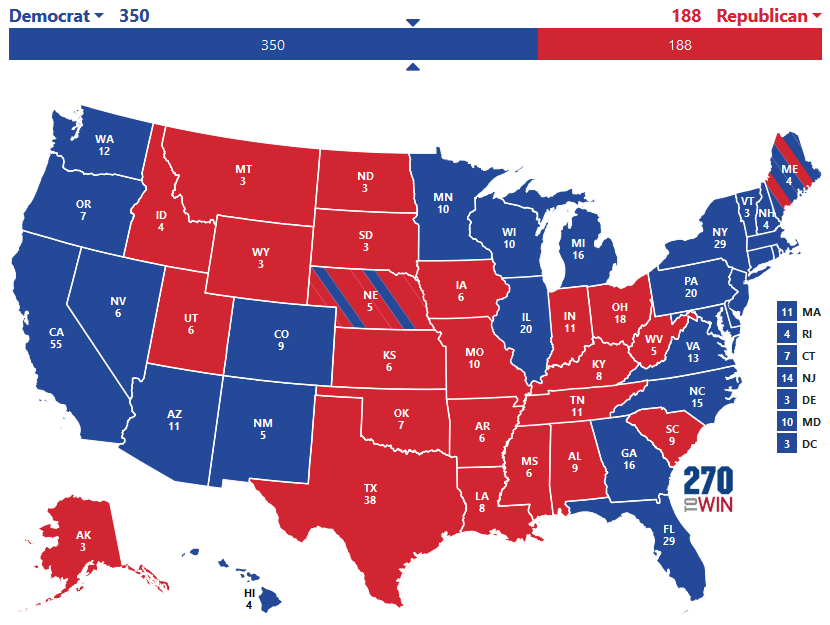
Even if one just looks at the states where Biden leads by 5 points or more, the map looks like this:

5plus

“But the polls were wrong in 2016!” First of all, no. Polls can be wrong, but they are rarely 5% wrong. Also, in some of the 2016 states, a major problem was that, because they weren’t widely believed to be competitive, the were under-polled. We may be looking at the wrong states now, but for the ones that were surprises last time, they are very well polled this go-around.

Take Michigan as an example. The current RCP average there is based on four major polls that all have data from the last two weeks:

MI

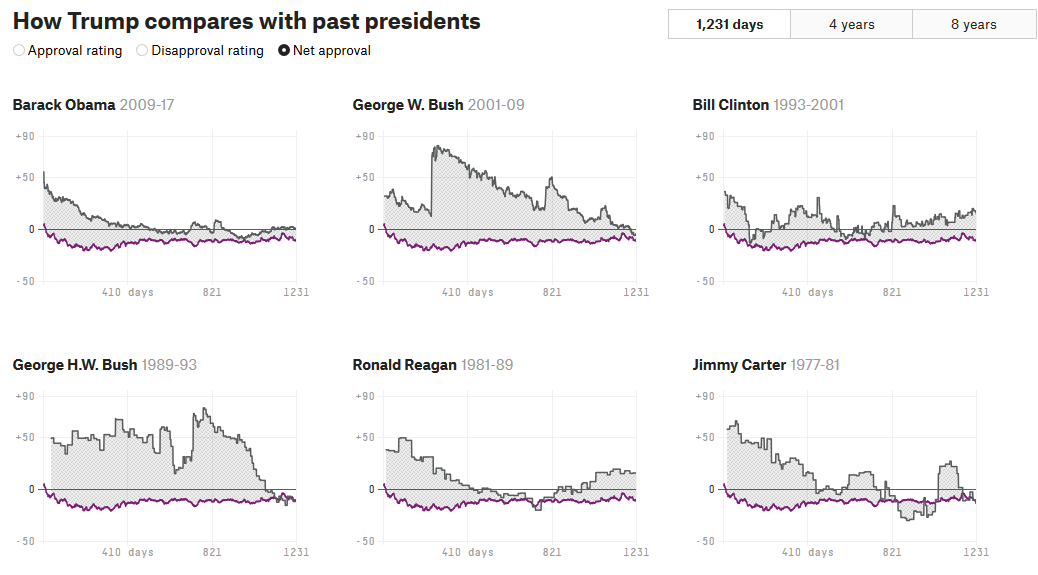
A final useful check-in is on Trump’s net approval numbers in comparative perspective:

NetPop

One can clearly see that, except for a few days right at the beginning of his term, Trump has never had positive net approval numbers, and has consistently lagged every President of the last 50+ years. The only two his current numbers really compare to are Carter and Bush I, first term Presidents who were going to electoral defeat.

So, while the polling numbers have tightened up a  little, by every concrete measure we have, Biden remains in a very strong position. Let’s tune in again in a month (and after the pseudo-conventions and Biden’s VP pick to boot!) to see what things look like two months out!


Four more years? (4 months to go edition!)

US-POLITICS-TRUMP-INAUGURATION-SWEARING IN

Look, I get it! Of course I do. To be of a Leftward persuasion, and to have closely followed Presidential politics for years is to know heartbreak. The Supreme Court halting the counting in 2000 and selecting Bush as President. Seeing John Kerry haplessly roll over and play dead, losing a winnable election in 2004. “Losing” 2016 while finishing 3 million votes ahead. Michael Dukakis being up 17 points in late July 1988, and going on to lose by 8 points!

So I get why instinctive panic, and a mistrust of any numbers, creeps in. Instinctive panic, however, is both irrational and tactically unhelpful, and data can be clarifying. When we took our “five months to go” look in June, Biden actually seemed to be in pretty good shape. Friday last week was four months to go. Does that still seem to be the case?

Let’s start by looking at the latest polling averages:

JoeB

Biden has a more than 8-point lead. But that’s not all. As I’ve mentioned before, I find it instructive to look at Hillary Clinton’s averages for the same YTD time period:

HC

A few things immediately stand out from this comparison:

  • Biden has been above 50% for about half the time YTD. Clinton was only above 50% for a single day.
  • Clinton was rarely above 48%. Biden has rarely not been above 48%.
  • Biden has never had less that a 4 point lead over Trump. Clinton was down to less than 2% several times, and Trump even briefly had a lead over her.

To me, the conclusion that the Biden campaign is in much better shape than the Clinton campaign was at the same point is unmistakable.

Of course, as we all too sadly know from 2000 and 2016, winning the popular vote doesn’t win you the election, winning the electoral college does. However, being more than 8% up almost certainly wins you the electoral college. If we add the 6.6% higher Biden’s current numbers are compared to Clinton’s final 2016 margin (2.1%) to her state-by-state totals, we get this electoral map:

plus67

2020, of course, isn’t 2016, and dynamics in the individual states may be quit different this time. So what happens if we look at current polling in the potential swing states? As it happens, Biden is currently leading in all of them:

AZFLMINCPAWI

In addition to this, Iowa, Ohio, and even Texas are all close enough to be in play. Polling inherently has a margin of error, even when using polling averages, but just keeping the states where Biden’s lead exceeds 5% results in this map:

moe

One more statistical check-in is helpful here. This is the President*’s net popularity vs. other Presidents of the past 50+ years at this same point in their terms:

net

Lest we forget, Trump is, and has been the whole time, historically unpopular. The only two Presidents his current net (un)popularity looks comparable to are Carter and Bush I, who were both headed to first term defeat.

One last sanity check is to think about these numbers in the larger electoral context. In latest figures, Biden and the DNC are out-raising Trump and the RNC. The Generic Congressional preference numbers are about as positive for the Democrats as they were in 2018, when they gained around 40 seats. Democratic candidates are polling strongly in the swing Senate races. All of this fits together into a consistent picture.

Up above, I asked if Biden’s four-month outlook still looks as strong as it did at five months. The answer, given the above, is a clear yes. If anything, it looks a little better. Take nothing for granted about this- donate, phonebank, textbank, write letters, organize on social media. But be encouraged in doing so, and know that bed-wetting for other than recreational purposes is not called for.

Onward!


Four more years? (5 months to go edition!)

mappie

About 6 weeks ago, I did my latest update on the election outlook. At the time, I concluded that Biden seemed to have a pretty strong chance based on prevailing indications, and there were plenty of signs that Trump was in trouble. Today marks five months out. Is there anything to add to our previous examination? I think so!

Let’s start with the basics. Yes, Biden is still the all-but-certain nominee. Not only have all rivals dropped out, all endorsed him including chief rival Bernie Sanders, the prior nominee endorsed him, and the last Democratic President endorsed him, as of last night’s Super Tuesday, he is sitting less than 100 delegates off of making it official:

StX

Basics number two- an average of recent polls gives Biden a healthy lead:

rcp

More than that, year-to-date Biden has always had a healthy lead. It’s instructive in this regard to compare his numbers to Clinton’s 2016 numbers for the same time period. A key thing to note is that she was rarely above 48% (where she ultimately finished) and spent only a single day above 50%:

clinton 16

In contrast, Biden has mostly been above 48%, and has spent significant time over 50%:

bidenover50

Of course, as 2016 painfully demonstrated, the popular vote isn’t what ultimately matters. The election is determined by that cute little antiquated Constitutional mechanism, the Electoral College. To do an initial “face value” analysis of that, Clinton “lost” in 2016 by being at +2% nationally, and Biden’s average is currently +8%. If you add 6% to Clinton’s state-by-state 2016 margins, you get this map:

Clintonplus six

An interesting ballpark, but I’ll grant you, things are not that straightforward. 2016 really came down to a handful of swing states, and the dynamics of those swing states will be different in 2020 than they were in 2016. What do current polling averages of these states currently show?

swing

That’s a Biden lead in 5 out of 6, and Trump’s lead in the 6th is razor-thin. If we just take only the states where Biden’s lead is outside of a 3 -point margin of error, we get the following map:

MOEplus3

If we took the “no toss-ups” approach for all current state polling averages, the map looks like this:

notoss

The other way to look at this is to consider the President’s approval rating according to an average of recent polls. It’s currently more than ten percent net negative, which is where it’s been for much of his Presidency:

approval

More than that, except for literally the first few days of his term, he’s never had a net-positive rating. Comparing his net approval to other recent administrations reveals the stark difference. The only recent Presidents who his net numbers are similar to at the moment are Carter and Bush I, who of course were both first term Presidents who were about to be defeated:

net

My final appeal is to common sense. Consider the following:

  • The Libertarian and Green parties had well-known candidates who had previously run nationally in 2016. This time they have comparatively unknown newcomers.
  • The 2016 nominee had been the target of decades of character attacks. Literal generations of Conservatives hated her. This campaign will get very nasty, but there just isn’t that kind of base of animosity to activate in regards to Biden.
  • Clinton was the subject of active investigations which continued to dog her as late as 10 days before the election. The attempts of the Administration to stir up something similar for Biden have fizzled out, and their most concrete result so far was to get Trump impeached.
  • A national crisis has killed 100,000 of us and counting in just a few months, and the  widespread perception is that the current administration has badly mishandled it.
  • The economy is in recession, and unemployment is higher than it’s been at any time since the Great Depression. That’s never good for an incumbent.
  • The country is, actually, on fire. It’s true that “law and order” issues often rebound to the Republican candidate’s favor, but more than that, they almost always come to the detriment of the party in power.

So, has the outlook changed since our last check in? Yes, in that it’s gotten better for Biden and worse for Trump. It could be that the current crisis reverses this trend, but my instinct is that it won’t. More than anything, the thing that most stands out is how durable the dynamics of the race have been year-to-date no matter what external events have been in play.

I’m not saying take it as a sure thing. Not even remotely. I am saying be very encouraged as you go out to do the work that needs to be done over the next five months to make it so.  Tune in some time in early July to see if it’s looking different with four months to go!


There can be only one… (Superb Tuesday in the Time of Plague edition)

1920px-Democratic_Party_presidential_primaries_results_by_county,_2020.svg

In last week’s preview of “Swell Tuesday” I wrote:

“Unless Sanders draws in a significantly larger share than the Progressive candidates in total have so far this cycle, and than he did last cycle, it could be very difficult for him to overtake the “Moderate” block that has coalesced around Biden.

Tune in next week to see if this outlook has changed after tomorrow!”

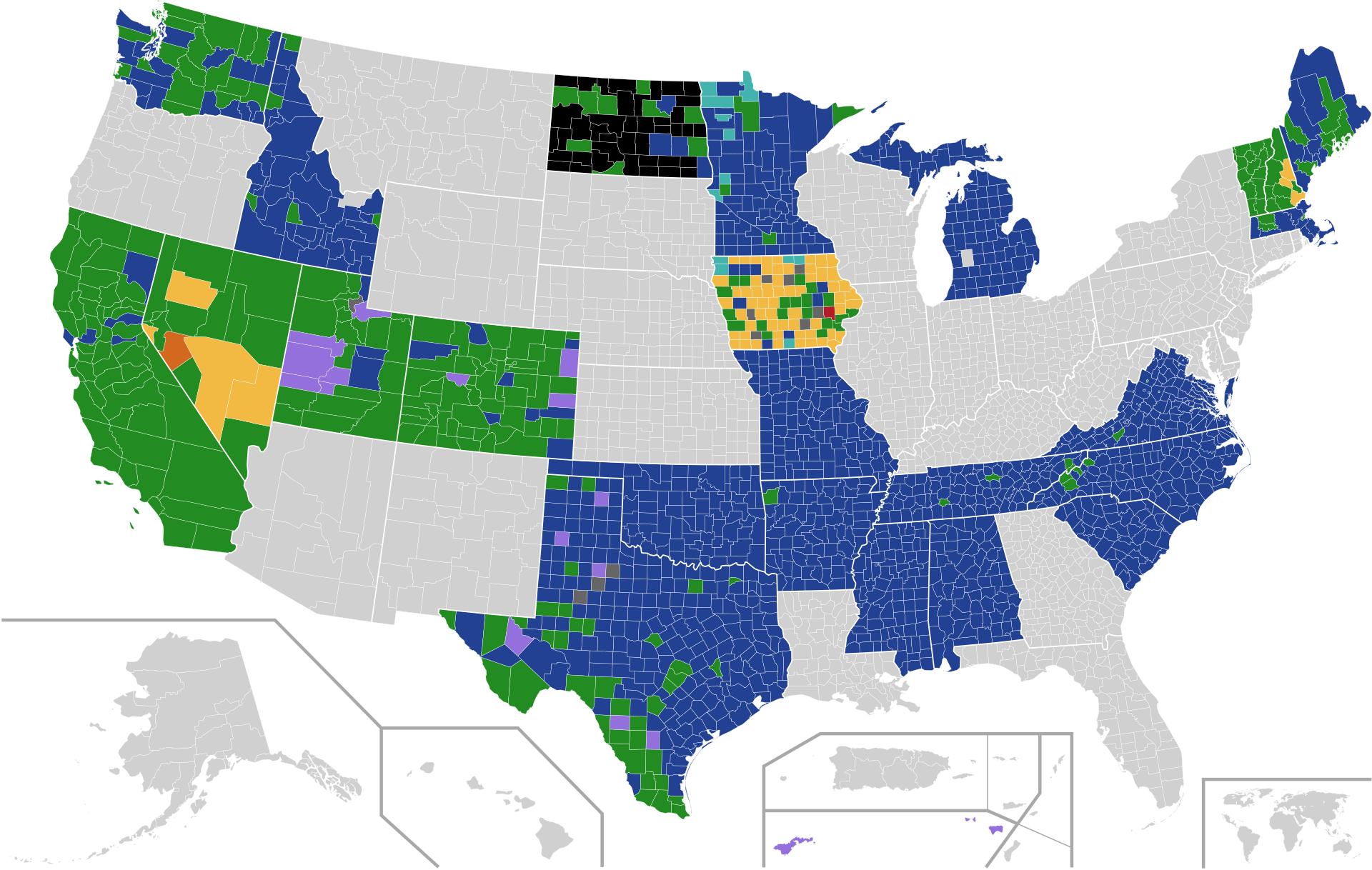
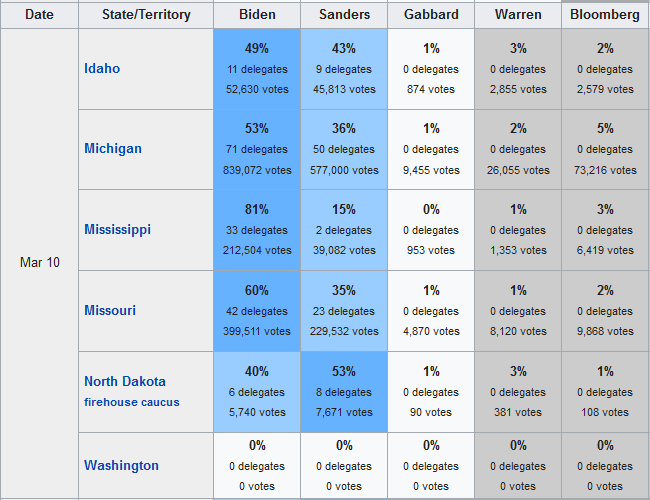
The very short answer is: This outlook has not changed. And, though there is a significant external variable we must discuss, things are not liable to change after tomorrow either. First, a quick look at the March 10th results:

March 10th

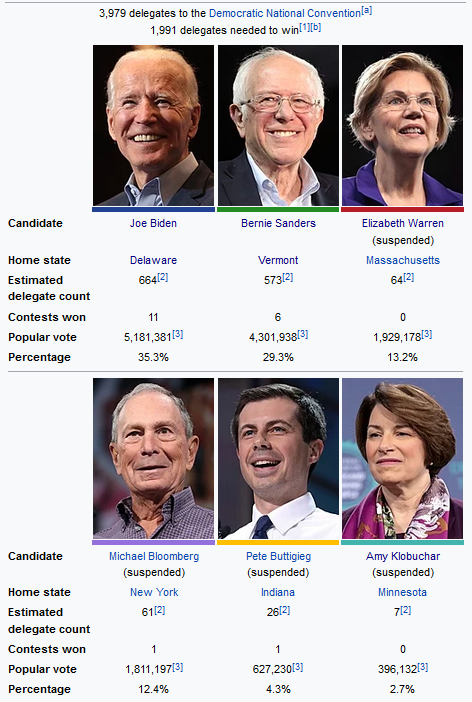
Biden nearly swept the field, and, crucially, easily won Michigan, the site of Sanders’ surprise victory in 2016. Washington still has not been finalized due to the number of outstanding mail-in ballots, but indications are that Biden is headed toward a narrow victory there too (Washington, in caucus form, was another state Sanders had won in 2016). Following these races, this is where overall results to date currently stand:

results3

On the face of it, a 150 delegate lead might not seem insurmountable. As we know from previous years though, it often is. Obama came out of February 2008 with about a 100 delegate lead over Clinton, for example, and she was never able to overcome that despite staying competitive to the end. To do so, the trailing campaign has to be getting more than 50% every election day from then on. And not all election days are created equal…

If two Tuesdays ago was “Super”, and one Tuesday ago was “Swell”, I’d say tomorrow is “Superb”. 577 delegates are at stake in Arizona, Florida, Illinois, and Ohio. Once Wednesday morning dawns, 62% of the total delegates will have been chosen. So it’s a big day, and it will rapidly move things along. Could Sanders catch up? Current indications are not promising:

March 17th

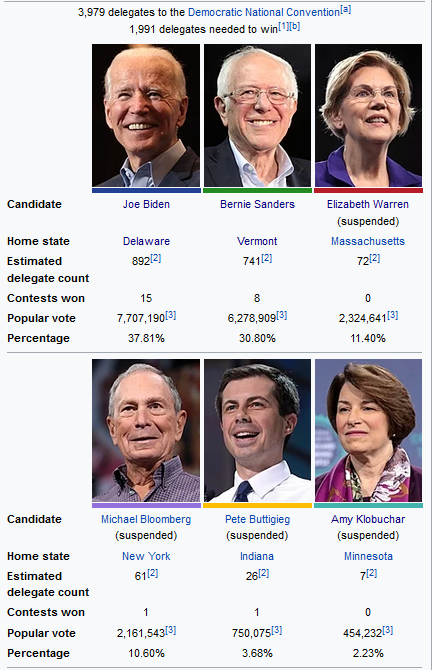
Right now, at 892 to 741, Biden would need to capture 52% of the remaining delegates to clinch the nomination, while Sanders would need 59%. A quick look at national polling indicates that this is very in-range for Biden, and very difficult to foresee for Sanders:

national2

Examining the overall popular vote totals to date for the “Moderate” vs. “Progressive” candidate blocks reinforces this notion:

blocks

As the only remaining “Moderate”, one can easily picture Biden winning 50-something percent of the remaining delegates. As the almost only remaining “Progressive” (sorry, Tulsi), Sanders would have to be doing about 1/3 better than that entire block has done to date to get the 59% of delegates he needs.  After tomorrow, if the above-mentioned state polling indications hold, this number is liable to be even more formidable for Sanders, and even more achievable for Biden.

There is a caveat: The one thing even the best forecast can’t totally control for is major unexpected external events.

Because of concerns about safety around COVID-19, Georgia has cancelled its March 24th primary, and will instead hold it in May. Louisiana likewise is moving  its April 4th primary to June. This is unlikely to change the overall result, which will be pretty much set in stone by Wednesday morning. But it could certainly prolong how long it takes to become official. And the longer a campaign lingers, the more unexpected things may occur…

There can be only one… (“Swell Tuesday” Preview edition)

super-tuesday-2020-results-promo-1583316015941-superJumbo-v2

Well that was really something!

A lot has happened since last we tuned in, one short week ago. It was inevitable that Super Tuesday was going to knock a few things loose in the race. Indeed, even before it happened, as I was hitting “publish” last Monday, Buttigieg and Klobuchar both dropped out, endorsing Biden to boot. Following Tuesday’s results, Elizabeth (this world does not deserve you) Warren and Mike (we’re glad your money is still around) Bloomberg both dropped out as well.

This leaves us with only three candidates remaining: Bernie Sanders, Joe Biden, and Tulsi “she still exists” Gabbard. From 28 that we have had at one point or another to three, bringing us ever closer to the point at which…

there-can-be-only-one

In this regard, Tuesday’s results certainly may give us a clue which way the wind is blowing. As predicted here, Biden had a very good day. Following wins in 10 out of 14 contests last Tuesday, he is now sitting on leads in both the popular vote and total delegates:

results2

It’s also immediately clear what effect Tuesday’s wins, and the endorsements (Bloomberg also endorsed him after dropping out, and former candidates Cory Booker and Kamala Harris have now done the same) have had on Biden’s national polling numbers:

polling

For those not well versed in math, that’s a thirty point gain in one week! Both the establishment, and voters, seem to be quickly coalescing around Biden.

“Ah-ah!” you say. “Not so fast! It’s the vote still to come that matters.”

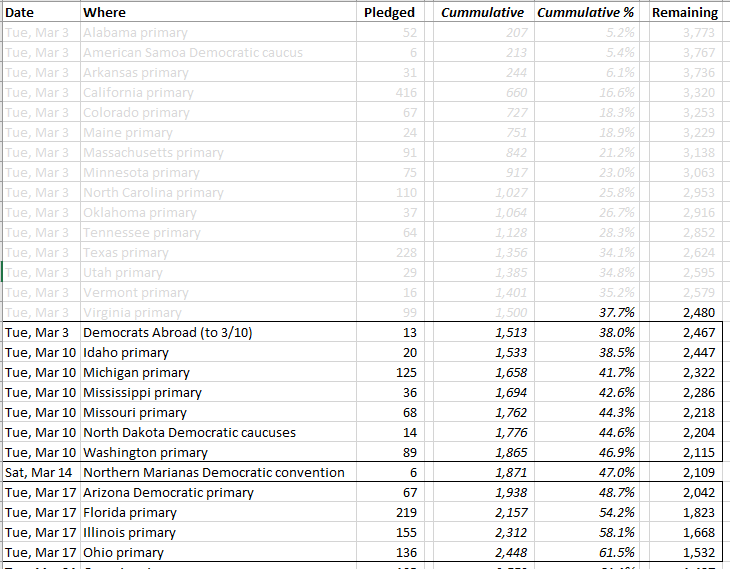
Indeed it is, and that vote will matter very rapidly. For better or for worse, we’ll have an almost definitive read on how things are looking by Wednesday of next week.  As of now, around 38% of total delegates have been chosen. By the end of the day tomorrow, this will be at around 47% (which is nearly half in most parts of the world). And then after Tuesday next week, it will be almost 62%:

totes

But first up, tomorrow. It’s not a “Super” Tuesday, but it’s pretty good. 365 delegates are at stake, including the electorally key state of Michigan. I’m calling it “Swell Tuesday”.

Sanders’ surprise narrow win in Michigan in 2016 was a major turning point for him, and what should have been an indicator that the state could be a problem in the Fall. With due humility for how far off the polls there were last time, they are pointing in an easy-to-spot direction at the moment:

Michigan

Sanders also did very well in Washington in 2016, but with the key difference that it was a caucus then, and is a primary this time. Allowing for the likelihood that many of Warren’s voters will swing toward Sanders, he looks to be on a path to a win there, but not an overwhelming one like he had in the 2016 caucus:

Wa

Another sizable state up tomorrow is Missouri. It was a virtual tie last time, with Sanders finishing less than 600 votes behind Clinton. One would not bet on it being that close this time:

Mo

Based on his Southern results so far, Biden can be expected to crush it in the remaining large state up tomorrow, Mississippi. He’s also currently favored in both Idaho and North Dakota. What this all adds up to is a likely narrow Sanders win in a state he won big in last time (Washington), a loss in the surprise win state that garnered so much attention for him in 2016 (Michigan), and Biden going four for four on the other states up tomorrow.

If so, and given a March 17th that looks like very fertile territory for Biden, Sanders could run out of room very quickly. Are surprises possible? Certainly. But the fundamental problem I see is this. If you take the grossly simplified view that the candidates can be grouped together into two blocks, this is the popular vote so far:

math

For reference, the 2016 total came out as Clinton 55.2%, Sanders 43.1%. Unless Sanders draws in a significantly larger share than the Progressive candidates in total have so far this cycle, and than he did last cycle, it could be very difficult for him to overtake the “Moderate” block that has coalesced around Biden.

Tune in next week to see if this outlook has changed after tomorrow!

There can be only one… (“First South Carolina, then the World!” edition)

2020_south_carolina_primary

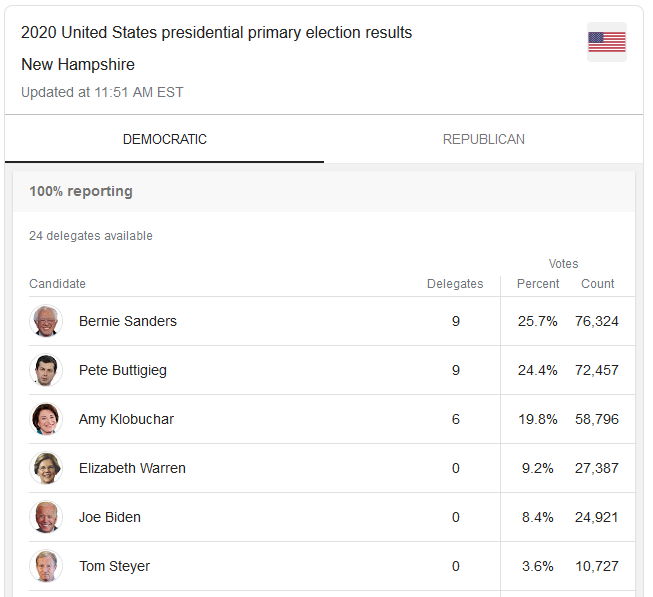
Since last we checked in, there have been two more contests, the New Hampshire primary and the Nevada caucuses.

New Hampshire continued Iowa’s theme of “near photo finish” but advantage Sanders, and also featured a dismal fifth place by Joe Biden that opened up the question of whether he’s in complete free-fall:

NH2

Nevada featured a strong win by Sanders across multiple demographics, and his third popular vote victory of the first three. Which, following on the heels of his coming in to the lead in national polling, caused some to wonder whether he might deliver a de facto knockout punch on Super Tuesday:

Nevada

Oh, and we’ve also had some further attrition due to New Hampshire! Goodbye Bennet, Patrick, and Yang! Delaney, I didn’t even notice you’d dropped out back in January! Of the 28(!) candidates we’ve had at one time or another, with a simultaneous field as large as 25, there are now only eight remaining. Eight is fewer than 28, but…

there-can-be-only-one

What does how things are looking going in to South Carolina tell us about who that one is likely to be?

After placing fourth in Iowa and fifth in New Hampshire, once front-runner Biden began to look like he might totally collapse. But, three (from his campaign’s perspective) useful things in a row happened. First, his Nevada showing, while not great, was a step up from the “on life support” numbers of Iowa and New Hampshire.

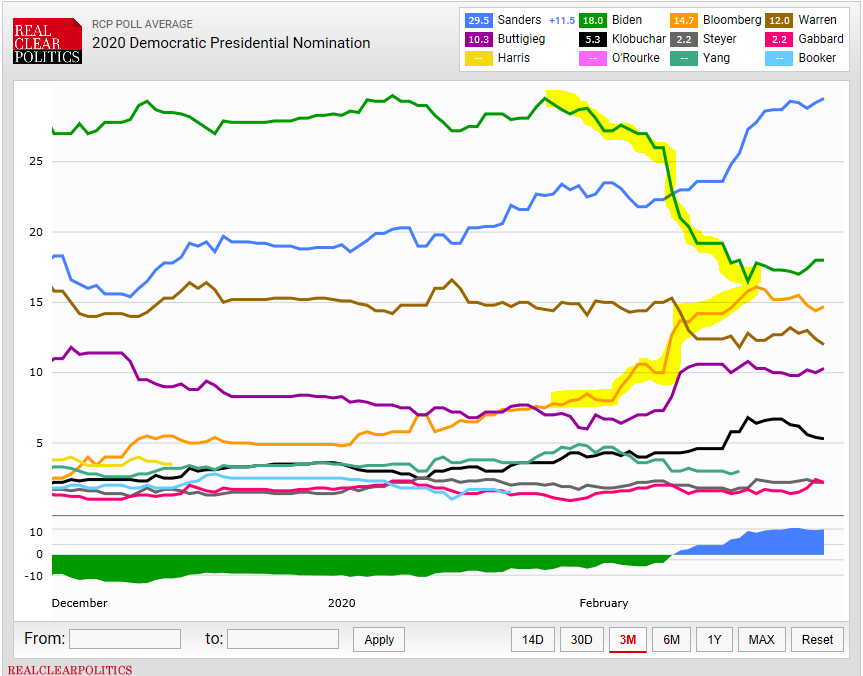
Second, the “moderate/establishment” vote had clearly started to flee from Biden to Michael Bloomberg, who isn’t on the ballot in South Carolina, but does serve as a kind of anti-barometer of how Biden is doing overall:

National1

However, as his star rose, rumblings also rose about whether Bloomberg’s past association with racially troubling policies and statements, sexual harassment allegations, and, well, actually having been a Republican, might make him unacceptable to too wide a portion of the Democratic base. I can testify that on my personal social media feed, many people who are not at all the “usual suspects” for this kind of thing were saying that he could be their exception to “I will vote for whoever the nominee is”.

This came to a head on 2/19, with Warren brutally and effectively taking Bloomberg to task during his first debate appearance. It was so effective that, as some online pranksters put it:

COD

Third, Biden has attracted the support of one of the most influential endorsements there is in South Carolina, third-ranking House member Jim Clyburn:

clyburn

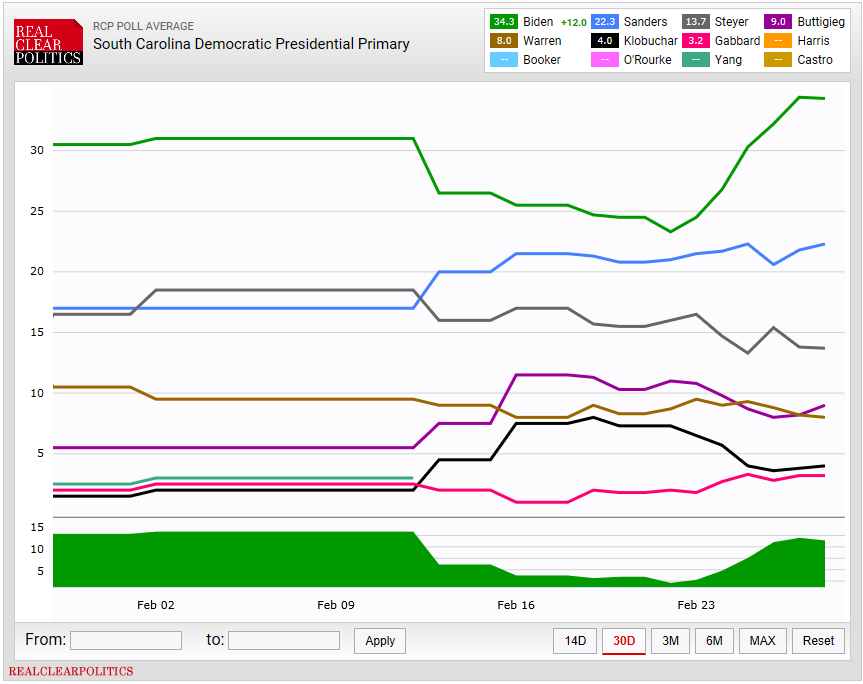
Was it that Nevada stopped the bleeding? Bloomberg being rapidly discredited as an alternative caused some of the nervous voters in search of a moderate to flock back to Biden? The networking and attention Biden has sunk into South Carolina paying off? Whatever the cause, he seem to be having a resurgence there just when he needs it most:

SC1

While just a few days ago it seemed like Biden might be headed for an embarrassing single-digit win or even a devastating surprise loss, I think he’s probably back on track for a strong double-digit win in South Carolina. And, of course, the real significance of South Carolina has always been momentum going in to Super Tuesday, and especially what it tells us about how well Biden is doing with the African-American voters he’s counting on to win Southern Primaries that day.

In which regard, if a big win in South Carolina does presage Southern strength for him, he could pick up as many as six states that day:

ST

This doesn’t change the fact that Sanders remains in a very strong position to also pick up a lot of delegates that day, quite probably even more than Biden. But South Carolina’s results this weekend may tell us a lot about whether we’re likely to see a “knockout punch” by Sanders on Tuesday of next week, or more like an almost-draw that keeps us all slogging through for a while to come.

Let’s check in again on Monday!


There can be only one… (one week to Iowa edition)


iowa

Some things have happened since our October update. Multiple candidates have admitted the inevitable and dropped, including once-strong contenders Kamala Harris and Cory Booker. Michael Bloomberg, against all good sense, has joined, and proven that unlimited money to spend can buy you a seat at the table without all that boring year-long prep-work. And most importantly, time has passed, to the extent that our 11 remaining candidates (down from a high of 25!) are now only one week from Iowa.

There are eleven remaining. But…

there-can-be-only-one

This series has been arguing since its inception in April of last year that three key indicators helped us sort out who was an even vaguely likely candidate, enabling us to ignore the other dozen+. (The “real” candidates were already only eight in April, down to five in October.) We also said that, by the eve of Iowa, those indicators would have a very high reliability in indicating who the eventual nominee would be. So here we are. What are they showing us?

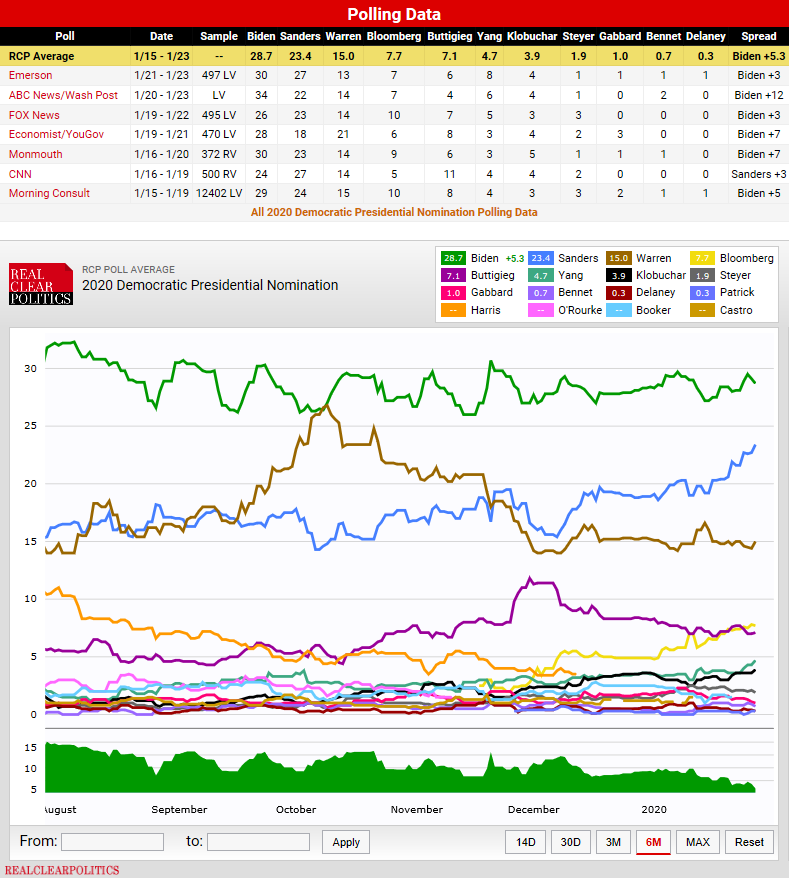
At this point, who’s leading in national polls has about a 60% correlation with who will win the nomination. The polling currently shows:

polls

Advantage Biden!

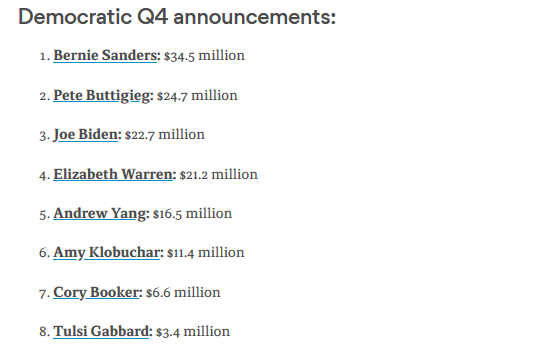
Fundraising is another key indicator, and the early fundraiser leader ends up being the nominee 62% of the time. The Q4 fundraising totals looked like this:

funds

Advantage Sanders! Wuh-oh, this is a split decision. We’ll look more closely at that shortly. But first…

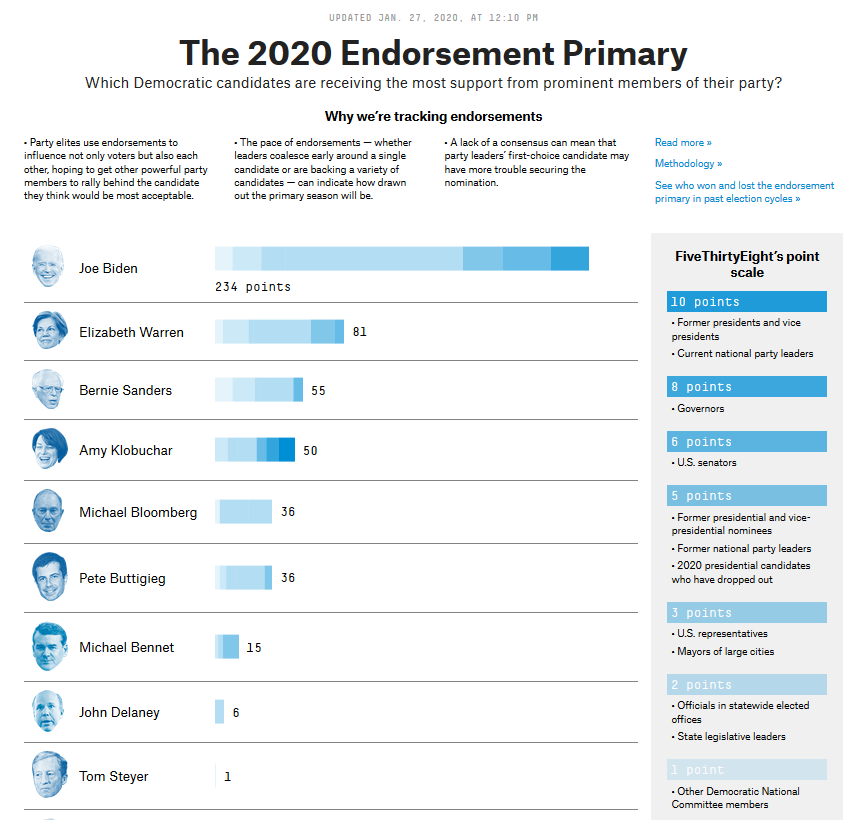
The final of the three leading indicators is party endorsements. This measure does in fact call the winner 63% of the time. The endorsements primary currently looks like this:

endorsements

Another advantage Biden! But with a different second place than the other two!

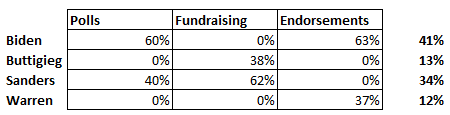
It’s actually a little unusual to have the indicators pointing in different directions like this at this stage, and particularly to have the polls and endorsements leader running third in fundraising. Sorry Joe! To try to get a handle on this, I did a weighted average, giving the percentage for each indicator to the leader in that category, and then allocating the remaining percentage to second place. When you do that, you get this:

weughted

When looked at this way, Biden remains the most likely nominee, but Sanders is not terribly far behind him. To put it another way, Biden is clearly the front-runner, but also clearly a weak front-runner historically speaking. And you can’t entirely count Liz and Pete out- there’s a 25% chance it might be one of the two of them instead. This thing remains extremely live! Exciting for political junkies, perhaps less so for those hoping for a clear and early verdict.

Everything will be tossed up in the air by Iowa, and then New Hampshire eight days later, which may help us sort out further. But as of right now, one would have to say that there are only four candidates who have a shot, and two of them, Biden or Sanders, are 75% likely to be the nominee.

We’ll tune in again next week!


Four more Years? One Year out edition!

2020

As of yesterday, we were officially one year out to the 2020 election. You may have been following my series on the Democratic candidates, if not you can find the latest edition here. And a few months back I did a first look at Trump’s chances for re-election. At that time, I concluded that, while he can quite possible win and we have to act with all due seriousness, the paralyzing fear that it’s already over and done for is- BALDERDASH!

I also said we’d revisit the issue in November, with one year left to go. So, here we are. How do things look now?

One quick way to get a ballpark on it is to look at the President’s popularity numbers. They currently aren’t great:

popularity

In fact, they’ve never even been what might be termed “good”. When you compare his position to other post-war Presidents at this same point in their first term, this quickly becomes apparent:

comp

Obama and Clinton were widely thought to be in potential trouble at this point in their first terms. Trump is below either of their positions. He’s actually below every post-war President at this point in their first term except Carter. And you may recall how the 1980 election went for Carter.

Another way to think about it is to look at polling versus potential opponents, now that the probable Democratic field is clearer. The three leading contenders all have a more than five-point lead at this time. Even the Mayor of South Bend Indiana has a lead, for Pete’s Sake:

leads

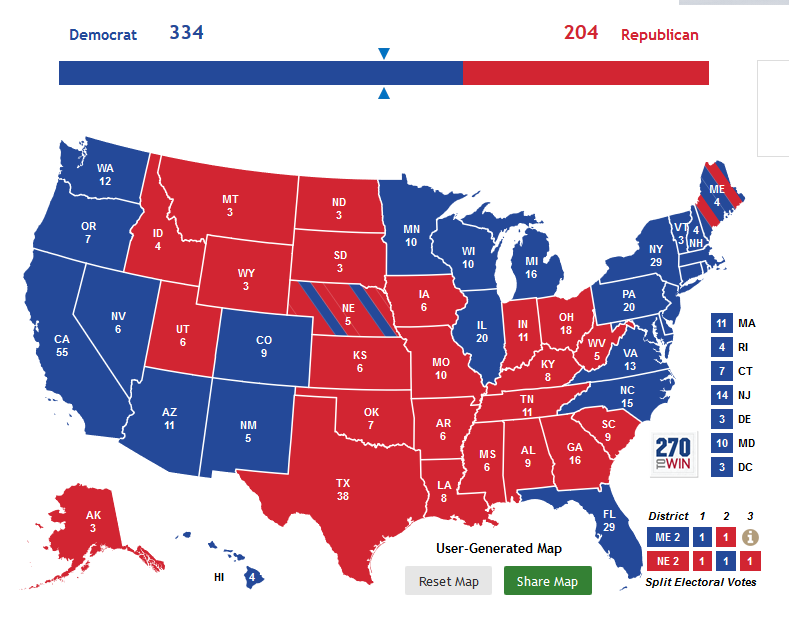
It’s worth noting that at this same point, Clinton’s lead was 3.2%, not far off at all from where it actually ended up being. Another quick note on percentages. President Trump’s popularity rating is currently 5% below the level he “won” with in 2016. If you subtract 5% from his state-by-state 2016 margins, this is the electoral map you get (with Georgia a fraction of a percent away from flipping too):

evnov2019

Do not get me wrong. I’m not saying at all it’s a sure thing. A friend of mine posted this yesterday, and I could not agree more with both sides of what she’s saying:

“Trump can win–I will never again doubt that. And there are a ton of unknowns and things outside our control. But I also have to believe that if we step up, if we reach out and talk to our neighbors and listen to our fellow citizens, if enough of us demand a government based on our fundamental values–decency, honesty, fairness, equity, accountability–we can achieve it”

Looking at things a year out, there is every sign that we can do this. So let’s get going!

There can be only one… (October 2019 update)

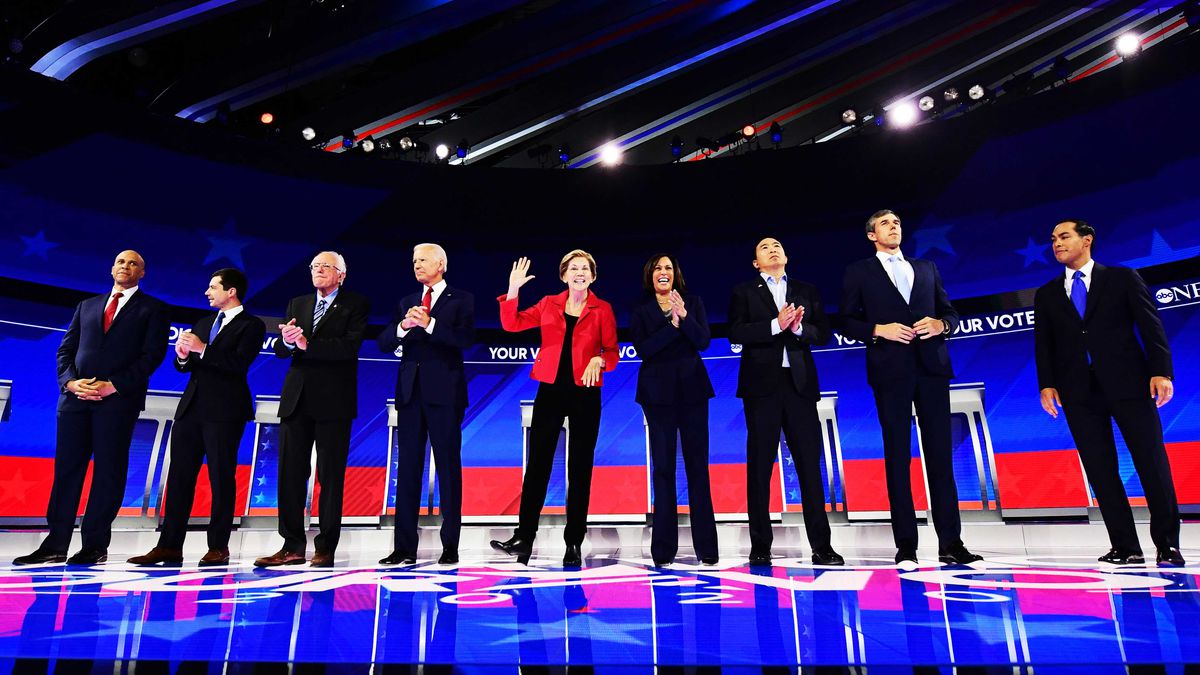
3rd debate

Well, we’ve lost a few since our July update. And we’ve even managed not to gain any! Hopefully rumors of Michael Bloomberg re-considering getting in are just that, because even with several drop-outs, we’ve still only just made it back to the teens. 19 candidates for the Democratic nomination, to be precise, down from a high of 25.

Not to worry, though! The good news is that there are, in fact, only five potential candidates for the nomination! That’s down from seven last time, and eight when we first looked at it in April. Progress!

How do we know this? As it happens, there are three measures that each, individually, have about a 60-65% reliability in indicating who the eventual nominee will be: Lead in national polls, fundraising, and insider endorsements. No one of them is full-proof, but taken together they give a pretty clear indication. So let’s look at each in turn.

The polling at this point is pretty unambiguous. There are three candidates that are leaps and bounds above everyone else:

polls

With only a little over three months to go until the Iowa caucuses at this point, it is very likely that the eventual nominee will be, if not the lead person in the polls, at least one of these three.

Over on the fundraising side, there’s also a pretty clear leading group of three at this point, albeit not exactly the same one as in polling:

Q3fundraising

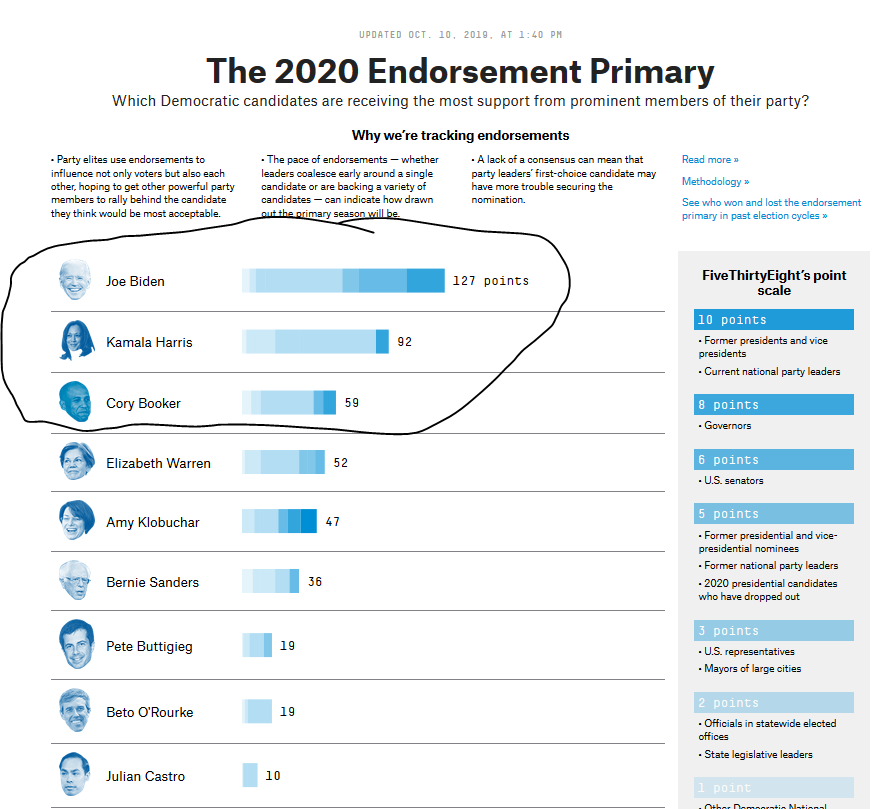
Most party insiders are still sitting on their endorsements, as they typically do until late in the game. But the ones that have announced so far also separate out three clear leaders:

Endorse

So there you have it. At this late stage in the pre-primary, the chances that the nominee isn’t someone in the top three in at least one of these measures is pretty slim. It is overwhelmingly likely that the Democratic nominee will be one of Bernie Sanders, Cory Booker, Elizabeth Warren, Joe Biden, or Pete Buttigieg. Some of these are more likely than others, but there’s about a 0% chance it will be one of the 14 not on this list.

Tune in once more in January, for a final pre-Iowa check-in. At that time, we should be able to narrow things even further!