Category Archives: presidential election

Six months out, Obama’s chances are looking pretty good

It’s the end of April. Month-ends can be good times to take stock. Today also happens to be three weeks since Rick “pro-petting, anti-Planned Parenthood” Santorum suspended his campaign, leaving Mitt Romney as the finally really now inevitable Republican nominee. So, where are we, three weeks in to the general election campaign? A good place to start to answer this question is to look at the Real Clear Politics polling average:

There are three things that immediately strike me:

1) Over a year of being the most likely challenger, even during times when Obama’s popularity rating has been much lower than it is now, Romney has had the lead for a total time of less than three weeks.

2) On the flip side, Obama has never been above 50%.

3) Most minds are already well made up, the undecided share is only about 8.5%.

It is certainly important to keep in mind that, as FiveThirtyEight reminds us, April polls are not a strong indicator of eventual results. Still and all, despite what the constant press cycles might make one think, Obama’s trend thus far has been much smoother, and more consistently in the positive, than Bush’s in 2004:
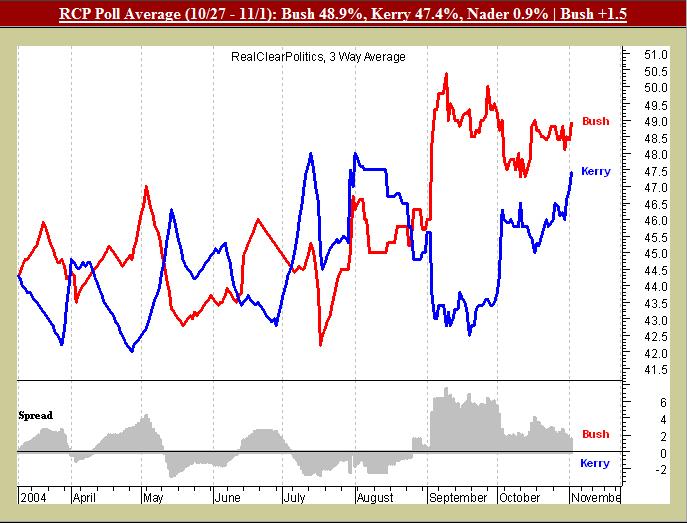
 In fact, it doesn’t look too different from his path in 2008, despite all the controversies he’s encountered:

So, it actually looks pretty good for Obama thus far. Indeed, over on Intrade, which allows people to make futures trades on all kinds of things, current odds on Obama’s re-election are running around 60%.

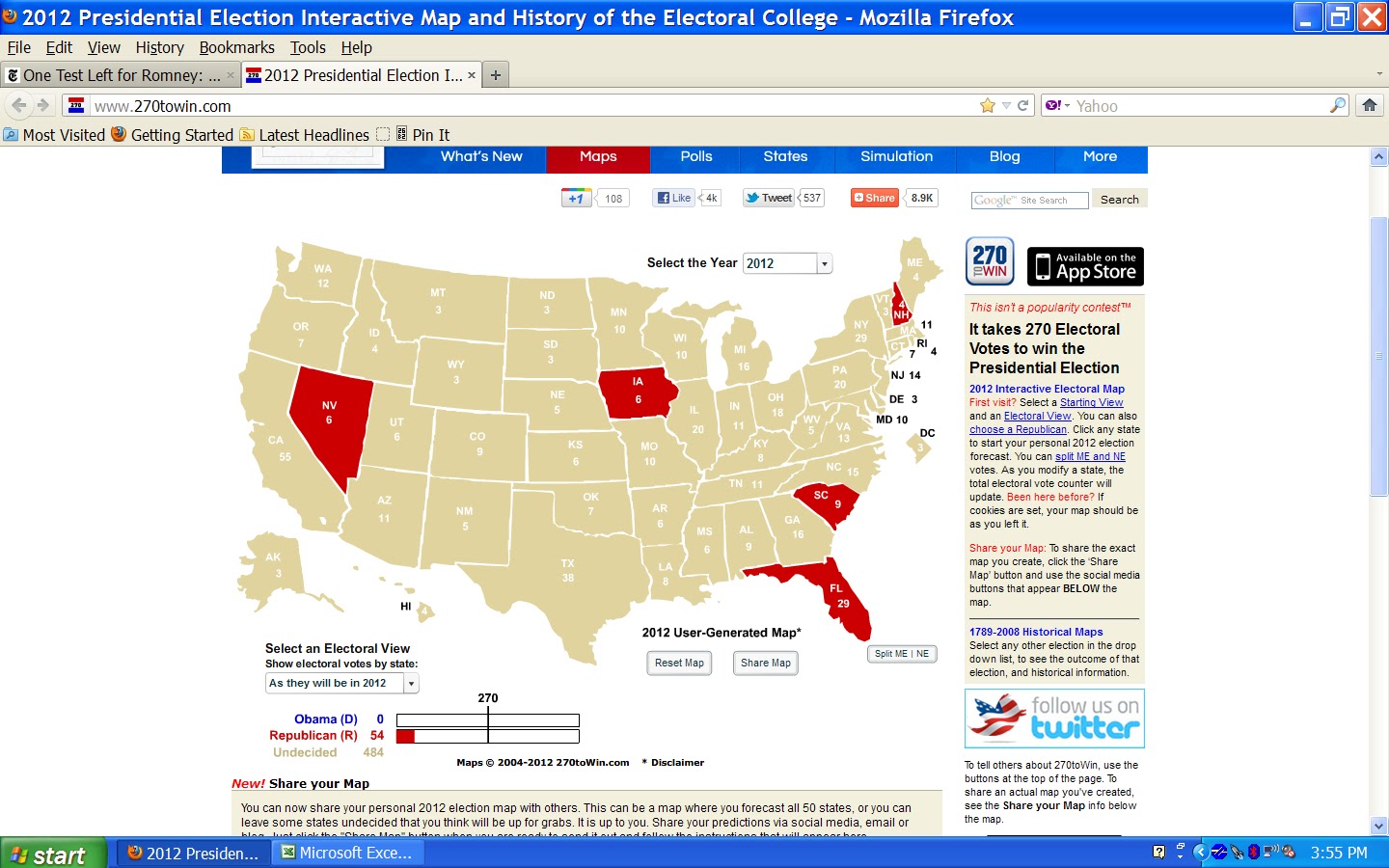
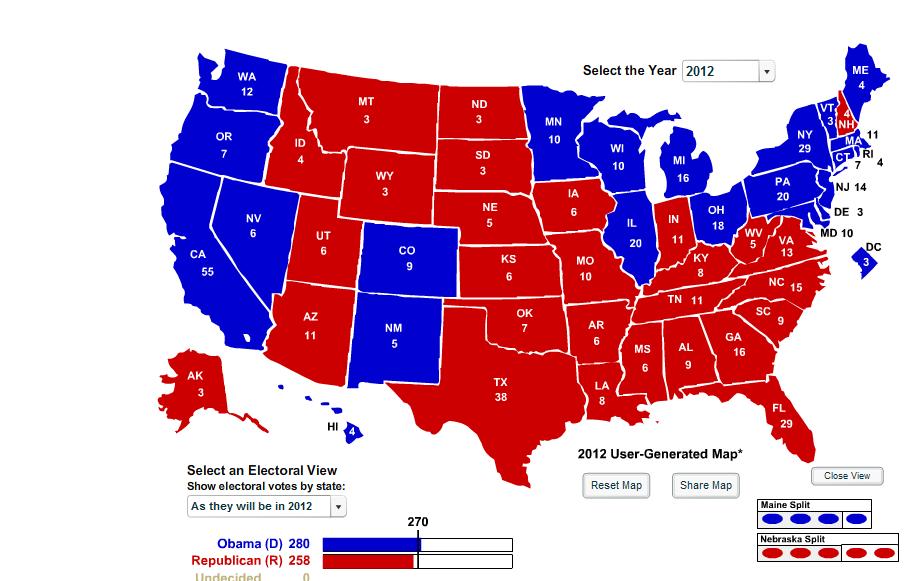
On the electoral college front too, all indications are that Romney’s path, while hardly inconceivable, is definitely steeper than Obama’s. Even if you take the relatively pessimistic tack of assuming that Obama only carries the states where his current polling lead is above 5% (compared to a 3% national average), that still gives him 280, 10 more than he needs. You can check out the latest polling for the swing states yourself at RCP by clicking on the states at the map there. The map for the scenario I describe above looks like this (and you can play around with your own at 270towin):
I think it’s worth thinking about 2008 for a second though. Obama ended up winning with 52.9% of the vote, which is actually the highest percentage anyone has had since 1988. But consider: the party in power had been there for eight years, its sitting President was intensely unpopular by the time of the election, the worst economic crisis in decades was blowing up, the Republican nominee ran a lackluster and often bumbling campaign, picked a crazy and crazily unqualified person as his running mate, and was running against the hugely well-funded, highly popular Obama who was running an extremely positive and skillful campaign. And with all that going for him, Obama still got less than 53%. It’s hard not to believe that this election is going to be very close. 

I happen to think both things are true: Obama will most likely win and his margin will seem (and will end up being) thin the whole time. I look forward to analyzing and writing further along the way, and hope you read along!

And so it ends…and begins! (First Question: How weak is Romney?)

As you may have heard, Rick Santorum dropped out of the race yesterday (or, technically, suspended his campaign). With Newt Gingrich already having fired his entire staff and outlined a plan of relying on social media going forward, that’s pretty much that. Mitt Romney will be the Republican nominee. (Sorry Ron Paul, but facts is facts.) And so it’s over. But also beginning!

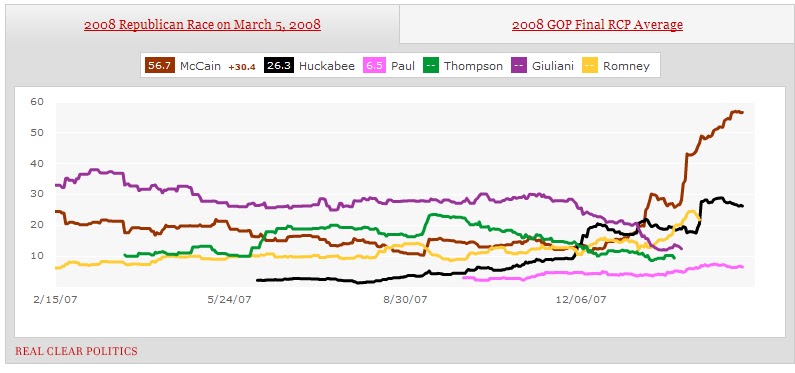
With the general election campaign de facto beginning today (with 208 days, aka 7 months to go, saints preserve us all) I’d like to muse about what kind of shape the primary campaign leaves Romney in vis-a-vis the general election. I think a couple of visual aids are instructive in this regard. First of all, let’s look at Romney’s trajectory getting here versus the previous Republican nominee, John McCain (charts courtesy of RealClear Politics):

What’s immediately visually apparent is that Romney’s had a heck of a harder time getting there than McCain did. McCain lagged until just before voting started in January, and then shot ahead and pretty much never looked back. Romney, in contrast, repeatedly had and then lost a lead, took a month longer to get to presumptive nominee status, and even as of the point of wrapping the whole thing up, has never been above 40% in national polls. Against, it should be noted, a far weaker field than McCain faced.

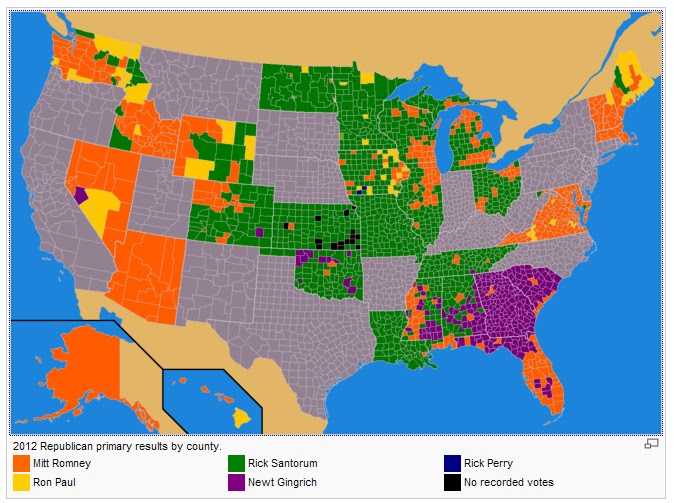
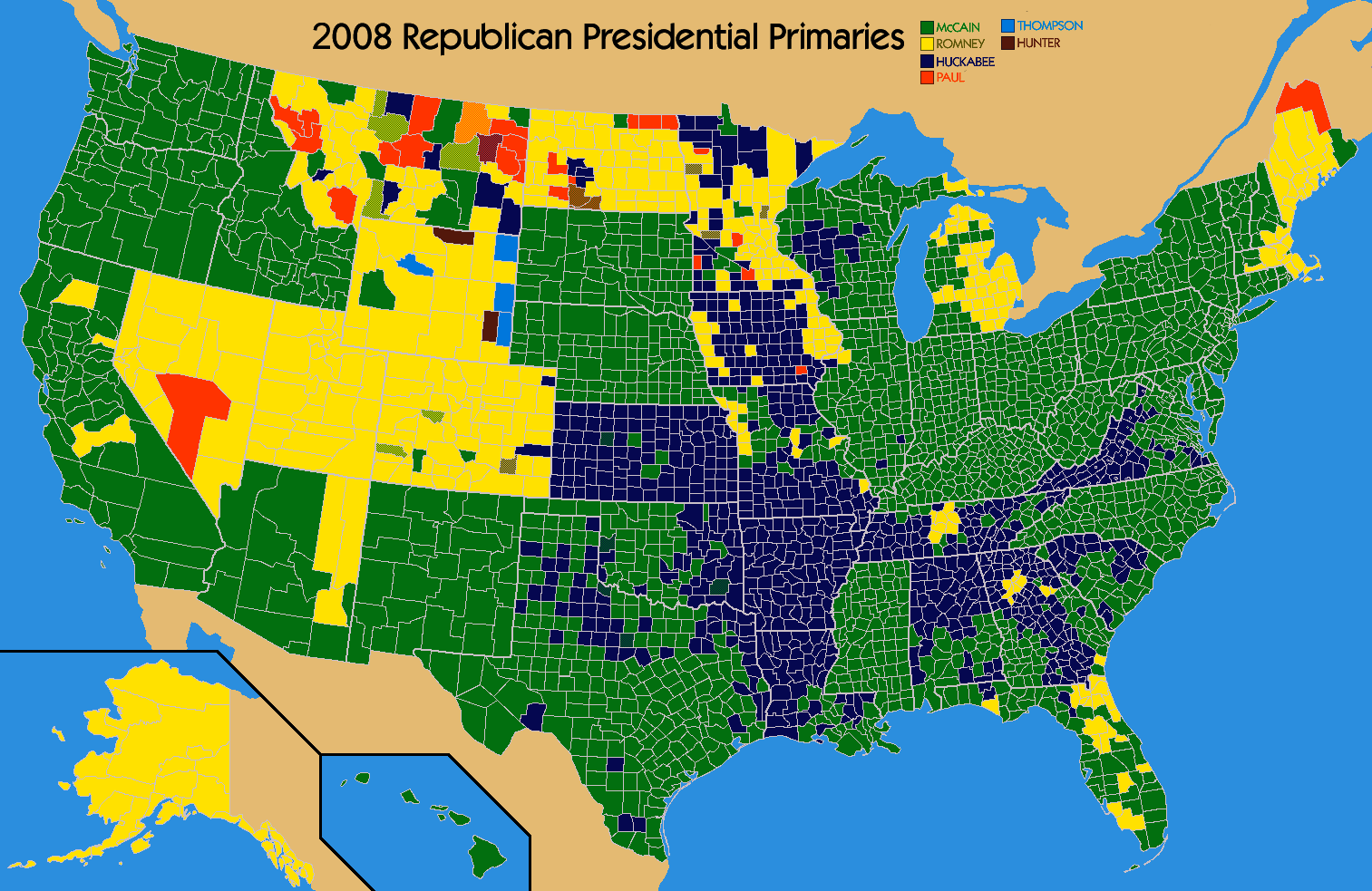
County-by-county results tell a similar story (maps courtesy of Wikipedia):

What is immediately apparent is that Romney 2012, excepting Virginia, where incompetence kept everyone else off the ballot, only wins certain kinds of counties. Namely, New England and Western (both areas he did well in 2008) and urban. There are many states where he won (like Illinois, Michigan, Ohio & Wisconsin) by virtue of taking the urban centers, while Santorum took almost all of the rural counties. Compare this to McCain, who, aside from some obvious weakness in the South (though he still did better, county by county, than Romney 2012), tended to sweep entire states when he won them. 

Why does this matter? McCain, so far, has been the most weakly supported Republican nominee of the modern era within the party:

While Romney’s total will no doubt climb from here, he’s currently trending much lower than McCain did in 2008, which was itself much lower than any other Republican nominee. In fact, so far Romney’s near the bottom for any nominee from either party. The party, any party, of course, supports their nominee. But enthusiasm matters. The only candidates who have gone in to the general election and won with less than 50% internal support were Jimmy Carter and Barack Obama, who were both heading in to elections a challenger would be heavily favored to win (worsening economy, scandal or discredit of existing administration, outgoing party had been in power for 8 years, etc.).

Now, I’m not predicting a blowout based on this. My gut feeling is that Obama has gone from having a 50/50 chance 6 months ago to being something more like a 60/40 or 70/30 now. In other words, he’s more likely than not to win. But it will never seem assured, it’s going to be close the whole way. In very close elections, as this one has all indications of being, even a marginal comparative lack of enthusiasm can be damaging. And Romney appears to have a pretty major internal lack of enthusiasm heading in.

Illinois changes nothing: Romney wins, but not until the end

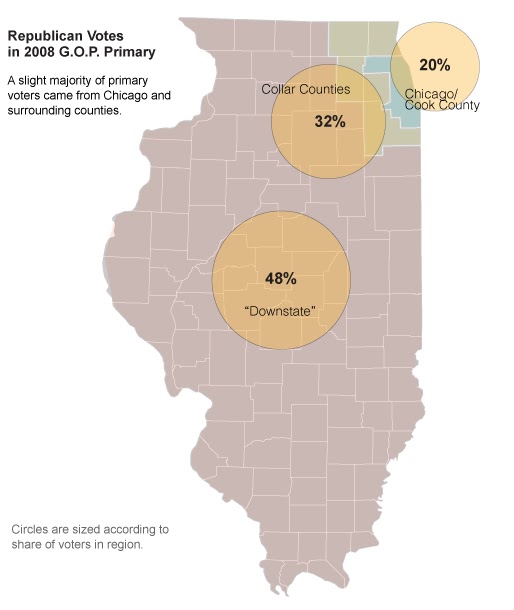
As you may have heard, this cute little state below is voting today, and all indications are that Romney will win, and win big (graphic from FiveThirtyEight.com):

A major victory in a populous winner-take-all state. Surely a turning point, no? Well… I don’t know if you’ve noticed, but one of the interesting things about “turning points” in this race is how little they’ve actually done to change the underlying dynamics. So far, 44% (or so) of the union, in population terms, has voted (graphic from Wikipedia): 

When Romney took Michigan and Arizona, that was considered a major win. When Santorum then won Colorado, Minnesota and Missouri, there was a lot of talk about Romney’s future being in doubt. Washington and Maine wins shored Romney back up. Then Santorum won Kansas by a huge margin (ah yes, but note that Romney got the majority of the delegates that day, thanks to caucuses in US territories). On Super Tuesday, Romney was on top after winning 6 states, including Ohio. Or was he shaky for losing 4 states and barely squeaking by in Ohio? Whichever, he got half the delegates that day. Then last week, Santorum won convincing victories in Alabama and Mississippi, where Romney placed third. Except that, thanks to Hawaii, and more US territory caucuses, Romney got about as many delegates as Santorum did that night.

Now, coming off of a big win this weekend in Puerto Rico, Romney will likely take Illinois tonight. He’s on his way! Except when Santorum wins Louisiana and Missouri this weekend. And on it will go…

The very earliest I could picture Santorum getting out would be after April 24th, if, say, he lost Wisconsin April 3rd, performed weakly in other contests, and then was embarrassed by losing his home state of Pennsylvania. More likely, he’ll do well enough in enough places that he’ll be encouraged to stay in going in to May. And Gingrich has made clear that he’s not going anywhere, even though all his best chances to break out have already passed.       

The upshot of all of this? Despite Gingrich’s self-justification for staying in, and Santorum’s continuing zeal, as Nate Silver makes clear, Romney’s machine is competing so strongly across the board, pulling in delegates even in places he doesn’t win, and taking winner-take-alls when they come, that he’s almost certain to get to 1,144 before the convention. Barring a candidacy-hobbling scandal (which, come on, a Mormon is not likely to give rise to), Romney will be the nominee.

But not very quickly. As noted above, about 44% of the country has voted, population-wise. And Romney has gotten (sound of computer clicking and whirring), yes that’s right, about 45% of the total he needs:

1,275 Delegates remaining to be selected as of 3/19/12
628 Romney still needs (1,144 total, minus 516  he currently has according to Real Clear Politics tally)
49.3% Percentage of remainder needed

There’s no reason, given the states remaining, that he should do worse than this. His popular vote total thus far is running at about 40%, but delegation allocation rules, and his campaign’s skillful targeting of opportunities for delegate upside, is giving him more than 50% of delegates on average. But there’s also no reason that he should do markedly better. As you’ll see below, there’s no real trend on his part toward getting above 50% thus far:

Mathematically, Romney will, almost certainly, be the nominee. And mathematically, he will, almost certainly, not get there until nearly the end (probably when California, New Jersey, New Mexico and South Dakota vote on June 5th, maybe not until Utah does on June 26th). Nothing that happens in Illinois tonight will change this.

Headed into Super Tuesday, Romney weakest Republican nominee in 40 years

First of all, let me restate what I said the last time I visited this topic- This is in no way an attack on Mitt Romney personally or politically. Personally, by all accounts, he’s a heck of a guy. Look at this story, for Pete’s sake! And politically, before he became a late convert to being “severely Conservative”, he was one of the Republicans I most respected in policy terms. This is purely a matter of facts and figures, and the facts and figures show the following: 

Going in to tomorrow’s Super Tuesday contests, Mitt Romney is the weakest Republican nominee of the last 40 years. And he likely still will be after tomorrow.

First, a recap of our story thus far. Almost a quarter of the states in the Union have now voted (graphic courtesy of Wikipedia commons):

If you tally the votes to date, you’ll see that Romney currently has about a 41% share of the total (my chart, based on final tallies from each state):

That, to be sure, is a lead. But it’s not that high of a lead. To place it in perspective, here’s his total thus far compared to the total that the eventual nominee of both parties has gotten in all contested races since 1972 (when modern primary and caucus rules start to apply) (my chart, based on Wikipedia figures for each year):

What becomes immediately clear is that Republican nominees, win or lose in the Fall, generally consolidate their internal support very well. The only Republican on the list who got less than 50% of his party’s total was John McCain, and it’s worth remembering that the party faithful were decidedly lukewarm about him. Romney thus far is running below that level, in a bracket usually reserved for Democratic nominees.  

One might expect Romney’s share of the vote to increase later on in the contest. But I’m not sure one would expect it to increase a whole lot. Looking back at the vote totals thus far, we can see that he’s only gotten above 50% in one of 13 states. Of the 10 states up tomorrow, most polls and forecast models (take for example, Nate Silver’s current projections at FiveThirtyEight) show him above 50% in only two states: Massachusetts, aka his home state, and Virginia, aka the state where Ron Paul is the only other candidate who got on the ballot.

It’s not Romney bashing to note that this is underwhelming support. The same weakness of underlying support is apparent in national polling. While he currently leads nationally, he’s seen four other candidates pull ahead of him five different times in the past six months:

Indeed, in the last six months, he’s only been in the lead for a total of approximately two months altogether. Again, it’s interesting to compare to McCain at the same point in 2008, a candidate who the party was lukewarm about and who only really started to pull ahead just before the primaries:

They weren’t excited about McCain, but once the voting started they lined up behind him pretty quickly.

Of course, winning the nomination is not about national polls, or even state vote totals, it’s about delegates. In that regard, the following offers some food for thought:

   1,932 Delegates remaining to be selected as of 3/5/12
     971 Romney still needs (1,144 total, minus 173  he currently has according to Real Clear Politics tally)
  50.3% Percentage needed

As noted earlier, his total of voting thus far is well below 50%, and isn’t likely to get much higher tomorrow. Of course, delegate allocation rules are quite complex and vary state to state, such that delegate allocation is not always directly related to proportion of vote. Nevertheless, to the extent that the two roughly track, we would expect Romney to not get much more than half of the remaining delegates. Indeed, the best guess on tomorrow is that he’ll get about 50% of total Super Tuesday delegates.   

At that pace, it will take him until June to wrap up the nomination. The only modern Republican race that went on anything like that long was 1976, when incumbent Gerald Ford was nearly unseated by challenger Ronald Reagan.

There is no serious scenario for anyone to beat Romney for the nomination, and’ even going on until June, there’s every reason at this point to think he’ll wrap it up before the convention, preventing anyone else from being drafted there. But any way you look at it, he is in an extraordinarily weak position vis-a-vis modern Republican nominees.

Whose "fault" is it?

About two years or so into the Obama administration I posted something on Facebook about cutting the guy some slack for not being able to totally undo in two years the destructive results of forty years of Republican policies. The usual back and forth started.

People: 40 years? How do you figure?

Me: From Nixon in 1968 to the 2008 election, Republican administrations have predominated.

People: Hey, what about Carter and Clinton?

Me: That would be 12 years versus 28, and by everyone’s account Carter was ineffectual, and Clinton actually implemented many Conservative policy goals (welfare reform, Defense of Marriage Act, etc.) to win reelection.

People: Hey, the President doesn’t really affect things that much anyway!

Me: (gritting teeth at the irony of getting this counterargument from people who post comments about Obama ruining our entire way of life) That may be so, but…

And so on.

The thing is, I got to thinking: They have a point. The Federal government, at least in theory, is made up of three co-equal branches, so you’d have to consider the Legislative and Judicial branches along with the Executive. Never mind that, there are also state and local levels of government that have a big effect on our lives. And never mind that, you could question how responsible government in total is for the way things are versus- corporations, religious bodies, mass media and all the other major players in society.

This obviously becomes a very big question, or series of questions. But I became curious, and decided to focus things more narrowly on something I could do some measurement of: 


To the extent that the Federal government has some effect on the way things are in the United States, which party has had a bigger overall effect on current conditions, good or bad, i.e. whose “fault” is it?

Keeping in mind our three branches, I decided to crunch some numbers. Starting with 1968 (not a bad point to pick, as it marks the start of the cultural transition from the 60s era, beginning of end of Vietnam, move to post-Civil Rights era, etc.), I gave each branch an equal weighting of 1/3, subdividing the Legislative branch 50/50 between the House and the Senate. For Executive and Legislative branches, I went with the most straightforward measurement- were the President, Speaker of the House, and Senate Majority leader Democratic or Republican? Judicial is certainly trickier, so I went with tenure of Chief Justice for simplicity, counting the eras of the Warren and Burger courts (1968-1986, in our time-frame here) as tilting more Democratic in influence, and the Rehnquist and Roberts courts (1986-2012, so far) as tilting more Republican. And the results are:

Rounding up and down to the nearest whole percentage, we get the following answer to my above question:


To the extent that the Federal government has some effect on the way things are in the United States, for the 1968-2012 era, the way things are is 52% the “fault” of the Republican Party and 48% the “fault” of the Democratic Party. 


That is close enough to 50/50 that I have to conclude, in the interests of fairness, that each party is about equally responsible for the state things are in now, good or bad. So maybe it’s time to stop talking in the language of “fault” and “blame” about what “they” did, and accept that it was us. That being so, what can we do, together, to forge a new way forward? 


Will Romney be the weakest nominee ever?

Let’s begin with appropriate clarifications:

This is in no way, shape or form an attack on the former governor politically or personally. Personally, he seems like a pretty decent guy, and politically, as far as Republicans go, I actually liked him tolerably well in his original pragmatic, moderate form. This is, as you’ll see below, an examination of cold, hard mathematical fact. As for “ever”, well, it’s always nice when you can slip some hyperbole into your headline. “Weakest ever” may be a little over the top, but again, as you’ll see in cold hard numbers below, for Republican nominees after 1968, so far it’s an accurate statement.

Let’s start with some pictures. Nearly 1/10th of the states in the Union have now spoken:

Granted, these are mostly smaller states, adding up to less than 100 electoral votes in total. But a quick look at the tallies from these states is interesting (my figures, based on final tallies for all but Maine):

So far Romney is clearly running ahead of the pack, but somewhat underwhelmingly.

To get a sense of just how underwhelmingly, it helps to do some comparison. As I mentioned last week, Democrats, as a more fractious lot, often end up having nominees who barely clear 50% of total votes in their primary and caucus contests, or even fall under 50%. For Republicans, though, this is much more uncommon. Taking all contested nominations (i.e. not considering candidates like Reagan in 1984 or Clinton in 1996 who ran without any serious opposition for their nominations) since the modern primary system rules were substantially reformed after 1968, only one Republican nominee has received less than 50% of the total votes (figures from Wikipedia, so they must be accurate):

Think about these numbers for a second. John McCain in 2008, a candidate that the Conservative base of the party was very distrustful of and who was running when the party was having a major post-Bush crisis of confidence, is the only Republican in the modern era to get below 50% of his party’s votes on his way to the nomination. And Mitt Romney, so far, is running below that level.  

“Ah yes,” you might say, “so far!” Granted, you would expect Romney’s totals to build as the race goes on. But maybe not by a whole lot, and maybe not terribly fast. We can, for instance, look at current national polls at Real Clear Politics:

Santorum is now the fourth (or fifth, if you count Gingrich as having done it twice) candidate in the last six months to jump to a national lead versus Romney. The latest polls indicate he now ties Romney for favorability among Republicans generally, and leads among Conservatives. On a state-by-state basis, the latest polls from Michigan show Santorum ahead for the February 28th primary there, and, moving in to Super Tuesday (March 6th), Gingrich has about even odds for taking Ohio according to fivethirtyeight.com, and leads in his native Georgia according to almost all polls there. Even in Arizona, where Romney is heavily favored to win on February 28th, he struggles to get to 50%.

So, at least through Super Tuesday, by which time almost half the states in the union will have held primaries or caucuses, Romney is very unlikely to rise above 40-something percent of the total cumulative vote. I would even submit that Romney may be getting close to the point where he can’t sew up the nomination until June, and maybe not even by then. As Hillary Clinton can tell you, this point can creep up on you earlier than expected.

Again, a little math is in order:

2,043 Delegates remaining to be selected as of 2/14/12
1,046 What Romney still needs (1,144 total, minus 98  he currently has according to the Real Clear Politics tally)
51.2% Percentage needed

Skipping back to the vote tallies by state earlier in this column, Romney’s running at 39% so far. He’s only topped 40% in two of the nine states that have voted, and hasn’t reached 51% in any of them. The math is a little wrinklier than that, since there are several winner-take-all contests (though fewer than there were even as recently as 2008), but the point is, the math is already tilting towards this going on into June.

There’s only been one Republican nomination contest like that in the modern era, when Ronald Reagan nearly outran the incumbent President Gerald Ford in 1976. Ford, of course, went on to lose the general election. Further food for thought: At 39%, Romney is not only bringing in a lower share of the total than any Republican nominee after 1968, he’s three spots from the bottom for any nominee of either party. Those spots belong to candidates who went on to lose 49 of 50 states in the general election.

I am not, of course, predicting that. While Obama’s chances for reelection have definitely ticked up over the past few weeks, all signs still indicate a close fight. But it is still an extraordinary sight to see a Republican nominee going in to that fight with support this soft.      

Will Mini-Tuesday mix things up?

For those of you just tuning in, 10% of the states in the union have now held primaries or caucuses. This is also known mathematically as five states:

One has to note that, with the exception of Florida, they’re smaller states, collectively accounting for 54 electoral votes, only 1/5 the total someone would need to win this fall. That being said, the group to-date isn’t a bad mix- Northeast, West, South, Midwest, and one large state with cross-regional and cross-cultural population groups are all represented. Based on the voting so far, where do the Republican candidates stand?

Let’s take a look…

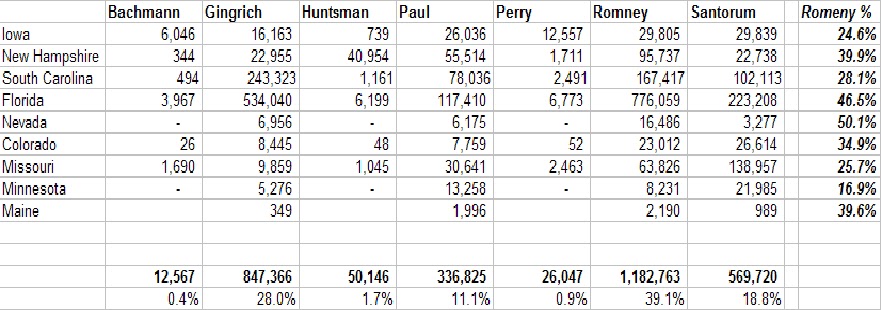
Looking at the numbers, I find a couple of things to be interesting:

  • Romney is clearly ahead, but if you total his and Huntsman’s votes versus 85% of the total so far for the conservative candidates (i.e. what you might expect a unified conservative candidate to have if there was one) it’s pretty close- 43% versus 40%, rounded off. 
  • If you’re Gingrich, you probably think you deserve to be the last Conservative standing, since you’ve gotten more than twice as many votes as Santorum has.
  • If you’re Santorum, you’re probably not totally convinced you should step down yet, since you’re third, you may have a good day today (more on that in a moment), and…
  • Romney’s lead is fairly weak, historically speaking.

To follow up on that last point, you’ll see above that he’s currently at around 41% of the total. Democrats tend to be a more fractious lot, and it’s not at all unusual for even a candidate that ends up tying up the nomination pretty handily to be under 50% of the total. For Republicans, though, it’s practically unheard of in the modern era. The lowest percentage I could find any Republican winning their nomination by post-1968 was McCain in 2008, who ended up with 46.5% of the party’s total votes. That was a nominee that the party was very lukewarm toward, running in an election that they expected to lose going in, and Romney is beneath that level.

Granted, you’d expect his total to rise as we go on, as the field narrows. And another three states (Colorado, Minnesota and Missouri) vote today in what’s being called Mini-Tuesday. Sort of. As Swing State Voter nicely explains, most of the voting today doesn’t directly result in delegates being awarded. Still, news is news, and it’s definitely an indication of where enthusiasm lies. So how’s it looking?

Actually, pretty scattered:

The most recent available polls for Colorado show Romney ahead, but as one of three candidates polling more than 20%, instead of as a runaway favorite. In Minnesota, he may actually be slightly behind Santorum. Missouri hasn’t attracted a lot of polling, but there’s a decent chance that Santorum could win there as well, or at least place strongly. Indeed, 538.com is noting that Romney is generally weaker in the Midwest and both Santorum and Gingrich could have some upset possibilities there.

So how much could today mix things up? A Santorum victory (or two) would certainly breathe some new life into his campaign. Gingrich is less likely to get any great news today, but he could continue to field double-digit results across the board, which will encourage him to stick around as well. This could make Michigan interesting later in the month. It also probably holds Romney down below 50% of the total until Super Tuesday at the earliest.

Could he lose the nomination? Unlikely. Ultimately, he remains the only candidate with the funds and organization to compete across the country (poor Newtie didn’t even manage to get on the ballot in Missouri for today!). But the longer Romney remains a circa 40% leader of a field that has three other candidates in double-digits, the longer the doubts that many of the Republican faithful have about him have to ferment. Which could leave the party less unified and enthusiastic than it typically is, making for a more difficult Fall campaign for them. Check back in next week!    

When Romney wins Florida it’s…over? Beginning? In the middle?

First things first, Romney, as you’ll see below, seems to be well-headed to victory in Florida on Tuesday:

As of Friday, his surge and Gingrich’s drop were plateauing, but at levels that leave Romney 8+ percent ahead. With about 9% undecided, almost all of them would have to break for Gingrich for him to regain the lead, and given his uneven performance in Friday’s debate, that doesn’t seem likely. The latest models at fivethirtyeight.com are also forecasting a Romney victory of 8.5%.

So what will this probable victory mean? Just 11 days ago, when I was expecting Florida to mark four Romney victories out of four, I thought it would mean the end of the race. Then Gingrich surged, Perry dropped out and Santorum retroactively became the victor in Iowa, causing me to recant just before South Carolina. Romney has rallied in Florida, getting muscular with attacks, clearing up his hedging on financial disclosure, and drawing in the establishment, who were suddenly panicked by Gingrich’s resurgence. Will a Romney Florida win knock Gingrich out and once again point us toward a quick sew up?

I think there are some reasons to be skeptical. For one thing, Santorum is just about out of money, and it’s not clear how a Florida third place that barely clears 10% would help him. Which leaves us with some interesting math:

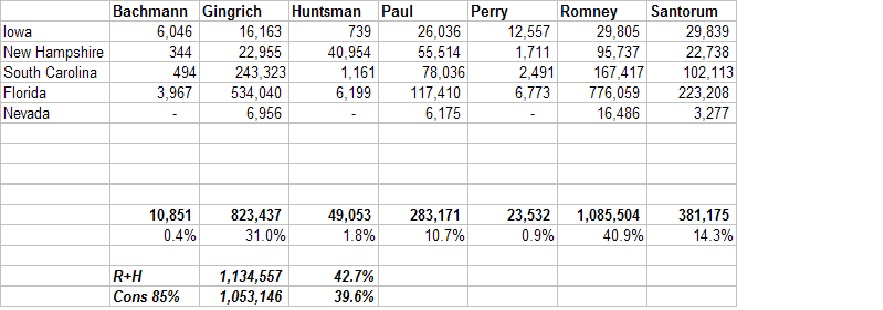
If you look at the votes so far for the seven Republican candidates that started out in Iowa, a few things stand out:
1. Elimination has been fairly rational, in the sense that everyone who only garnered single didgits is now gone.
2. If you are Gingrich, you’re so close to Romney overall so far that only an ultra-shellacking in Florida would convince you that you have no chance long term.
3. Assuming that all Huntsman votes would have gone to Romney if Huntsman hadn’t been in the race, and assuming that some, but not all of the conservative votes (I’ve taken 75% of totals for Bachmann, Gingrich, Perry and Santorum) would have gone to a single Conservative candidate if there was only one in the race, the hypothetical Conservative would lead Romney so far. If you assume even more Conservative overlap, and/or less than 100% Huntsman conversion to Romney, the Conservative would lead by even more.
4. Bachmann and Perry are gone, and Santorum is running out of money. Gingrich is, effectively, the only remaining figure Conservatives dissatisfied with Romney will have to flock to after Florida.
The schedule between Florida and Super Tuesday on March 6th gives Gingrich several chances to steal a surprise victory or two and rally those still looking for an alternative to Romney, keeping things interesting until Super Tuesday on March 6th.
Sat., February 4, 2012 Nevada
February 4–11, 2012 Maine
Tue., February 7, 2012 Colorado
Minnesota
Missouri
Tue., February 28, 2012 Arizona
Michigan
Sat., March 3, 2012 Washington
On the skeptical toward my skepticism side of the coin, it’s a heck of a lot of time, and a heck of a lot of geography to cover, for a candidate as underfunded and understaffed as Gingrich. It’s also worth noting that Gingrich’s best chance is probably in the arch-Conservative Arizona, but they don’t vote for four weeks after Florida. And the lightning rod issue there is immigration, just about the only issue in existence on which he is actually to the left of Romney. 
It will be interesting to see it all play out… 

South Carolina: This changes…Something!

Not in the long run, but still something.

Last week, I was thoroughly convinced that today’s primary in South Carolina would produce a clear victory for Romney, setting him up for a win in Florida and de facto ending the Republican nomination contest by the end of the month. Well, I’m a big enough Blogger to admit when I’m (partially) wrong. To wit, view the latest polling average from Real Clear Politics over the last three days:

As you can see, going in to the home stretch, Gingrich is in the lead, has upward momentum, and Romney, which is even worse for his chances today, has downward momentum. The model at the eminently respectable FiveThirtyEight.com is forecasting a Gingrich victory of around 38-30.

What happened? Gingrich has had some clear pluses this week: momentum from a strong debate performance Monday, Perry dropping out and endorsing him (which I did not foresee), and another strong showing on Friday night. He also had some pretty clear minuses in the last few days: Santorum’s endorsement by the Evangelical establishment, Santorum’s belated recognition as the victor in Iowa, and a decidedly unflattering interview with his ex-wife on national television Thursday night.

The pluses seem to be outweighing the minuses. Goes to show you what I know! I also realize that I made a fundamental error in my mathematical noodlings from last week in only considering reallocation of votes among candidates and not the additional factor that there were about 10% undecided who might break Gingrich’s way as well. Even so, I wouldn’t have called it, since I thought Perry would hang in there, and in addition to the votes from Perry, Santorum and undecideds going to Gingrich, Romney has been dropping the last few days.

Color me contrite! And, to clarify my above statement that I was partially wrong, I am probably, in fact, going to be completely wrong in my short term predictions from last week. If Gingrich wins today and Santorum is fourth, Florida becomes a real contest. And if Santorum is fourth there as well, Gingrich has an excellent chance of being the last Conservative standing and pulling in enough resources from that status to hang in there for many primaries and caucuses to come. As most everyone notes, Romney retains every advantage over the medium/long term. In that sense the “inevitable Romney” theory is probably still correct. But this could at least keep it interesting through Super Tuesday!

And it also has some bearing on Romney’s ultimate prospects, as the longer the competitive race, the more focus on him seems to be eroding his favorability rating. Everyone pulls together for their nominee eventually, of course, but enthusiasm matters, as does the opposition seeing what avenues of attack are likely to be most fruitful. Those of us who still believe in civility should put up the blast shields, because this fall could get nasty on both sides…            

South Carolina update: This Changes…Nothing

Mind you, there are a few things afoot that could affect this Saturday’s primary in South Carolina. Such as the fact that everybody else in the field finally realized Romney is about to walk away with it, and targeted him relentlessly in last night’s debate. Not to mention which, they are spending heavily in the state with advertising that focuses on him, rather than each other. Santorum certainly got a boost when the evangelical conference this past weekend decided he was their last best hope for a conservative alternative to Romney, and backed him with surprising unanimity. Meanwhile, in the pro-Romeny camp, Hunstman has decided to drop out and back Romney.

The net effect of all of this? Just about nothing. To see why, you have to look no further than the latest Real Clear Politics averages for South Carolina:

Gingrich is not getting any upward trajectory for all his spending, but neither is he dropping. Santorum has similarly plateaued after a weak New Hampshire showing. The state is friendly to them, but they both have limitations in field strength, and are competing with each other for the same votes. Perry is meanwhile making his last stand, but clearly not getting any traction out of it, and any hope he held onto that evangelicals would rally around him is clearly dashed after this weekend. Santorum could get some boost from the evangelical backing, but no recent poll has him closer than 15 points behind Romney, and that’s way too much to make up in 5 days, especially with Gingrich and Perry continuing to unroll their remaining advertising riches. And the considerable anti-Romeny advertising money that has been floating around is meanwhile largely focused on attacks on his business record that have actually caused conservatives to come to his defense, rather than on the social issues where he is much more vulnerable.

All of this combines to pretty much hold in place the following math, which you can see above:

Romney+Huntsman=37.3%
Gingrich=22%
Santorum & Paul=14.3% each
Perry=5.5%

Hypothetical united Conservative would win, narrowly, about 41%-37%, but neither Gingrich or Santorum will get that high unless almost all of the other’s votes plus Perry’s flow to them in the next five days. Which, absent a candidacy-ending scandal, isn’t going to happen. Meanwhile, Perry has insisted he’ll stay in through Florida, and Santorum and Gingrich have already spent so much money ahead in the state that they’ll be heavily tempted to as well no matter how South Carolina turns out. Which makes it very likely that another split field will hand Romney four in a row.