First of all, let me restate what I said the last time I visited this topic- This is in no way an attack on Mitt Romney personally or politically. Personally, by all accounts, he’s a heck of a guy. Look at this story, for Pete’s sake! And politically, before he became a late convert to being “severely Conservative”, he was one of the Republicans I most respected in policy terms. This is purely a matter of facts and figures, and the facts and figures show the following:
Going in to tomorrow’s Super Tuesday contests, Mitt Romney is the weakest Republican nominee of the last 40 years. And he likely still will be after tomorrow.
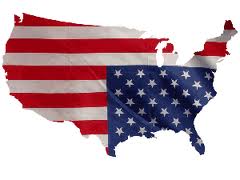
First, a recap of our story thus far. Almost a quarter of the states in the Union have now voted (graphic courtesy of Wikipedia commons):

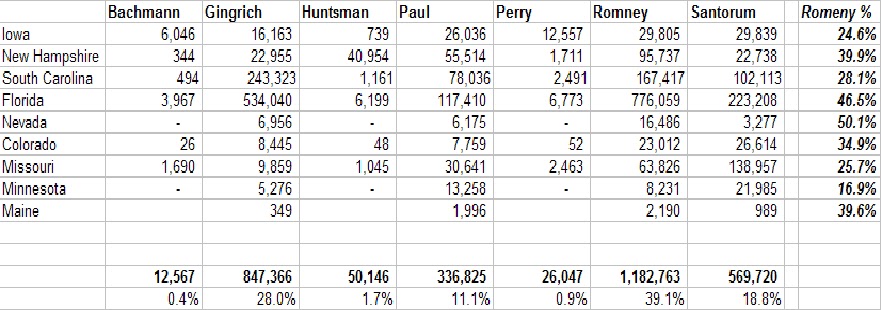
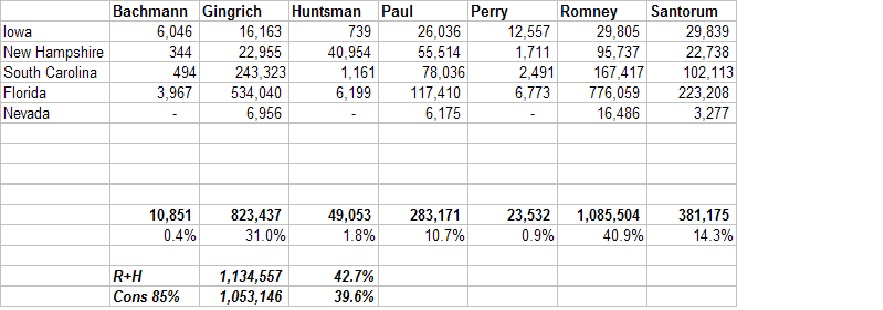
If you tally the votes to date, you’ll see that Romney currently has about a 41% share of the total (my chart, based on final tallies from each state):

That, to be sure, is a lead. But it’s not that high of a lead. To place it in perspective, here’s his total thus far compared to the total that the eventual nominee of both parties has gotten in all contested races since 1972 (when modern primary and caucus rules start to apply) (my chart, based on Wikipedia figures for each year):

What becomes immediately clear is that Republican nominees, win or lose in the Fall, generally consolidate their internal support very well. The only Republican on the list who got less than 50% of his party’s total was John McCain, and it’s worth remembering that the party faithful were decidedly lukewarm about him. Romney thus far is running below that level, in a bracket usually reserved for Democratic nominees.
One might expect Romney’s share of the vote to increase later on in the contest. But I’m not sure one would expect it to increase a whole lot. Looking back at the vote totals thus far, we can see that he’s only gotten above 50% in one of 13 states. Of the 10 states up tomorrow, most polls and forecast models (take for example, Nate Silver’s current projections at FiveThirtyEight) show him above 50% in only two states: Massachusetts, aka his home state, and Virginia, aka the state where Ron Paul is the only other candidate who got on the ballot.
It’s not Romney bashing to note that this is underwhelming support. The same weakness of underlying support is apparent in national polling. While he currently leads nationally, he’s seen four other candidates pull ahead of him five different times in the past six months:

Indeed, in the last six months, he’s only been in the lead for a total of approximately two months altogether. Again, it’s interesting to compare to McCain at the same point in 2008, a candidate who the party was lukewarm about and who only really started to pull ahead just before the primaries:
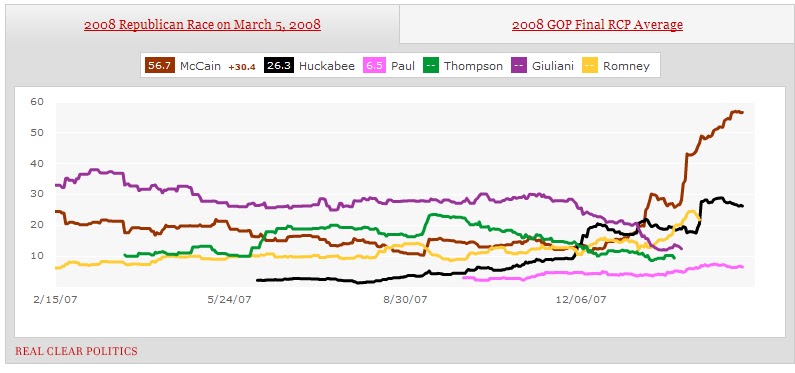
They weren’t excited about McCain, but once the voting started they lined up behind him pretty quickly.
Of course, winning the nomination is not about national polls, or even state vote totals, it’s about delegates. In that regard, the following offers some food for thought:
| 1,932 | Delegates remaining to be selected as of 3/5/12 |
| 971 | Romney still needs (1,144 total, minus 173 he currently has according to Real Clear Politics tally) |
| 50.3% | Percentage needed |
As noted earlier, his total of voting thus far is well below 50%, and isn’t likely to get much higher tomorrow. Of course, delegate allocation rules are quite complex and vary state to state, such that delegate allocation is not always directly related to proportion of vote. Nevertheless, to the extent that the two roughly track, we would expect Romney to not get much more than half of the remaining delegates. Indeed, the best guess on tomorrow is that he’ll get about 50% of total Super Tuesday delegates.
At that pace, it will take him until June to wrap up the nomination. The only modern Republican race that went on anything like that long was 1976, when incumbent Gerald Ford was nearly unseated by challenger Ronald Reagan.
There is no serious scenario for anyone to beat Romney for the nomination, and’ even going on until June, there’s every reason at this point to think he’ll wrap it up before the convention, preventing anyone else from being drafted there. But any way you look at it, he is in an extraordinarily weak position vis-a-vis modern Republican nominees.






 Chris LaMay-West