Category Archives: politics

Newt, we hardly knew ye…

In a few hours, we should all start feasting on the results of the first real honest-to-gosh voting in the country, from the Iowa Caucuses. (At least us political junkies will be feasting.)

The RealClearPolitics national poll of polls isn’t very up-to-date at this point, since it has only one poll of six that includes any results after 12/18. That’s actually no big loss, since from this point on individual state results are what matter. Here’s what the much more up-to-date Iowa polling average is showing:
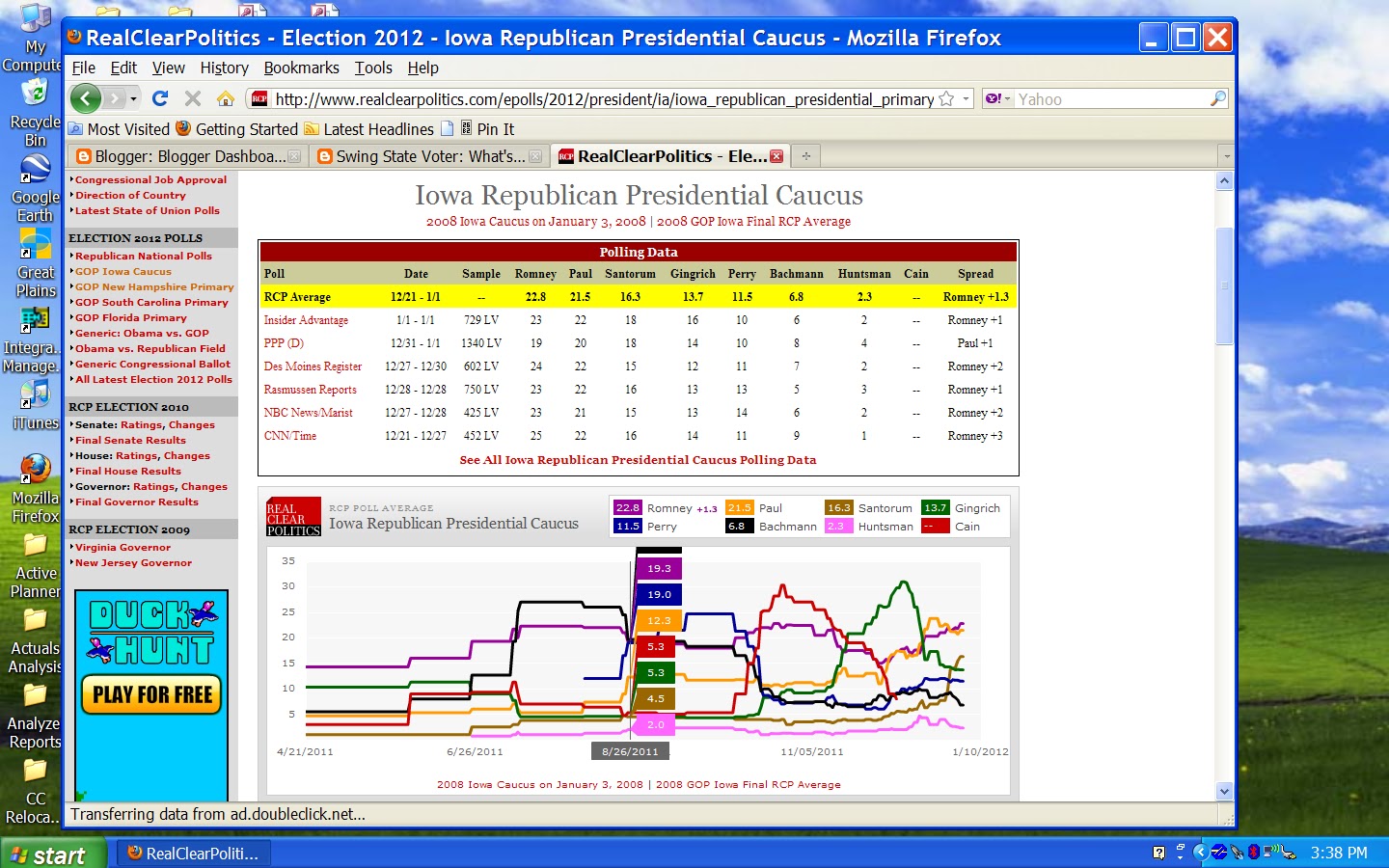
As you can see, Romney is currently eking out an extremely narrow lead over Ron Paul, and Rick Santorum is in the midst of a surprising last-minute surge that has him at third and rising. Poor Newt, who only a few weeks again was strongly leading, is now fourth.

These rankings may indeed hold, but, as my new friend Swing State Voter reminds us, a caucus is not like a primary. In short, it doesn’t depend on simple votes by secret ballot, but on committed voters showing up to very small meetings throughout the state, and publicly standing up for a candidate and convincing their neighbors to do so as well. This tends to favor candidates with the funding to organize and turn people out statewide (in this case Romney, and, though the polls don’t show it, Perry), or with a devoted following who will show up no matter what (Ron Paul to a T, and whoever the Evangelical vote most strongly backs, which seems at this point to be Santorum).

Absent from this list? Newt Gingrich, which could be very bad news for him.

It’s hard to see how a fourth place finish in Iowa wouldn’t result in a third or worse in New Hampshire, which would rapidly erode his position of strength in South Carolina and Florida later this month. Of course, as many analysts have pointed out, including Nate Silver at FiveThirtyEight.com, how you do relative to expectations actually ends up mattering more than where you place. If enough people think that Gingrich is a goner, and he then does better than expected in Iowa or New Hampshire, he could still remain viable. You may recall how in 1992 a cat named William Jefferson Clinton got blown out in Iowa and then placed second in New Hampshire, but compared to the DOA he was believed to be at that point, was actually able to spin that as a victory. Still, I wouldn’t advise Newt to hold his breath on pulling that off.

What about Romney? A win, even a narrow one, in Iowa, followed by almost certain victory in New Hampshire could turn this back into the quick coronation he’s wanted it to be all along. The only other candidates who were not sitting presidents that I could find who pulled this double-header off in the post-Watergate era were Al Gore in 2000 (who won 50 out of 50 primaries and caucuses) and John Kerry (who won 46 out of 50). But…

As Swing State has also pointed out, Santorum is the only person in that list who’s showing surging momentum, and as I’ve noted above, caucus dynamics favor “devotional” candidates like Ron Paul. Romney could just as easily end up third (even if very, very narrowly). He’d probably still win New Hampshire, but the fact that three other candidates there are sitting on double digits would be harder to spin away. The field would remain plenty feisty into Super Tuesday. And that field, which has concentrated on tearing each other down instead of targeting Romney in Iowa, could now start to spend against him heavily.

So it may not be quite over yet (before it’s begun!). Tune in in a few hours…   
The Gingrinch will not steal Christmas, but don’t count him out

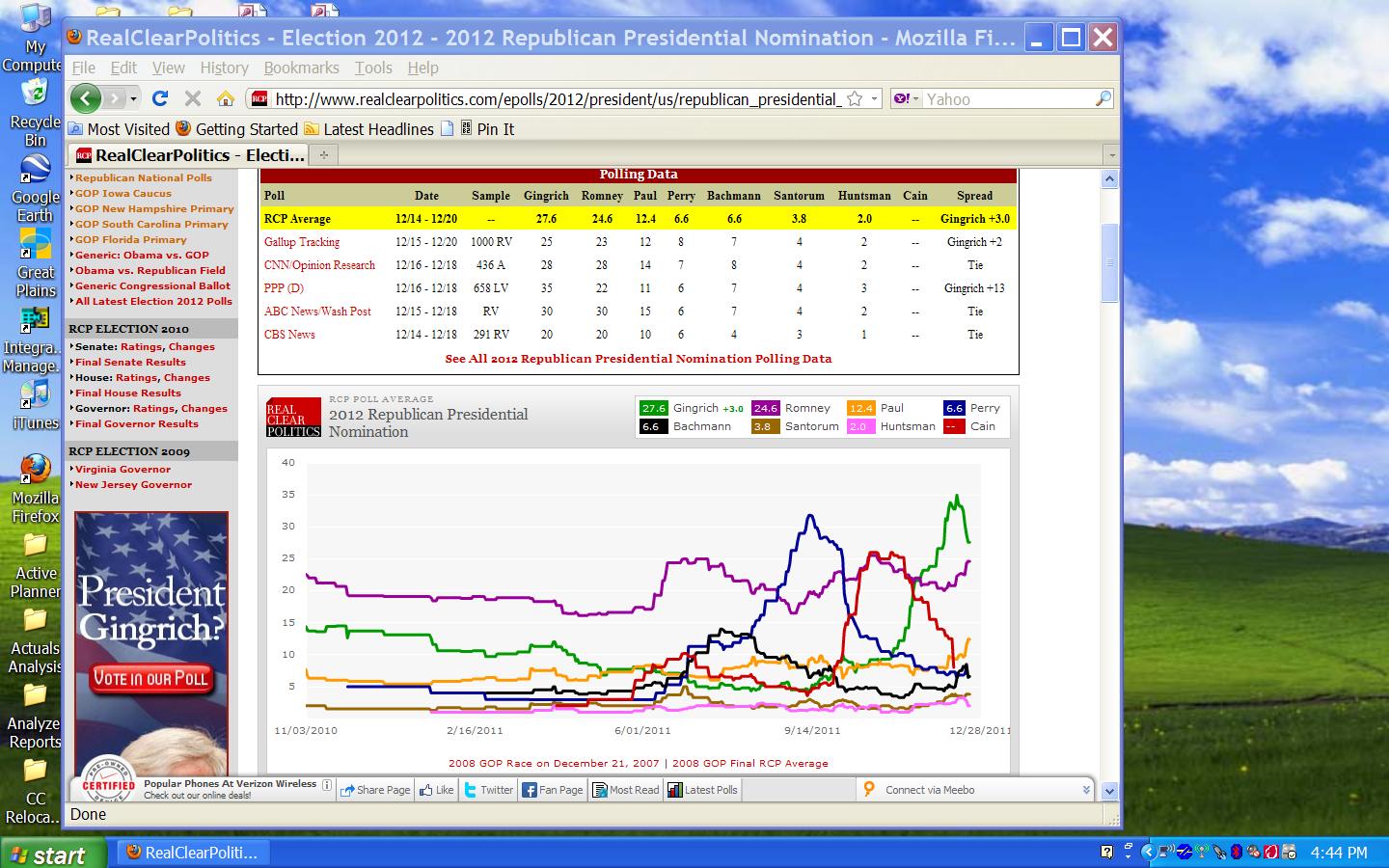
In my blog from a  few weeks ago about Gingrich’s sudden rise among Republican voters, I looked at the timing of the previous booms and busts of alternates to Romney. Based on the periodicity of Bachmann, Perry and Cain, I’d made a numerological guess that he would peak on 12/2, and start a sharp drop-off on 12/23. As you can see below, things have ended up working out a little differently:

In fact his high, of 35%, was reached on 12/13/11. And while the last three claimants to the anti-Romeny throne each had roughly three weeks on top before beginning their respective plunges, poor Newtie only seems to have gotten a few days. His polling average started a fall on 12/16, and as of 12/21, has fallen 5 percent in 5 days.

While this certainly looks to prevent him from running away with it (which I think he would have if he truly held on to a lead three weeks from his 12/13 peak, which would have had him still way on top when Iowa votes January 3rd), I think there’s equally good reasons to think he’s far from finished. He has a lot more going for him in terms of intellect, policy acumen and public presence than Bachmann and Perry, who wilted under scrutiny, and certainly doesn’t have the kind of problems that Cain did when he propositioned his way to collapse.

What’s going on is more like the effects of the whole field aiming their ammunition at him over the last 10 days, and the fact that the focus on him is showing him to be a little unpalatable. But, without the major handicaps of the others, there’s nothing here that would wipe him off the map. Which makes it quite possible that we end up with something like: Gingrich loses Iowa, but not by enough to be embarrassing (especially since current trends make it seem like Ron Paul might win!). Romney wins New Hampshire, but not by enough to be impressive. Gingrich then wins South Carolina and Florida, leaving three consistent vote-getting candidates to duke it out in February and March, maybe long enough that nobody has enough delegates to win the nomination until June. Or maybe not even then.

At the very least, Romney does not appear to be in for a cake walk. I read a piece recently that laid out four scenarios, none of which involved Romney quickly and decisively wrapping it up. I also read an interesting piece comparing Romney to Nixon in 1968 as an ideologically indistinct candidate that the party didn’t particularly want, but eventually swallowed its distaste for after repeatedly failing to find an alternative. Finally, the other day I read this article on Gingrich’s current fall which makes many of the same points I made in my original blog on November 19th.

Which, if nothing else, at least backs up my conviction that, in a parallel world where I’d opted for journalism school instead of years of misadventure in the business world, I could have made a pretty fair political journalist.

Gingrich at his peak? Maybe yes, maybe no…

My November 19th blog on Republican Booms and Busts used the admittedly small sample size of the average timeline of other Republican candidates’ rise and fall as alternatives to Romney to predict that the latest anti-Romney, Newt Gingrich, would hit a polling peak on December 2nd, and begin a plunge on December 23rd. So how’s it looking?

Actually not too bad for the first part. On December 1st, Gingrich reached his all-time peak (so far) of 26.6% on the Real Clear Politics polling average, and has remained at that level since then:

Might this be the peak? One good reason to think it could is that polling slowed down so much around Thanksgiving that there is only one national poll covering the period after 11/20, a Rasmussen Reports poll that had Gingrich at 38% and Romney at 17%. Since this is only a single poll, and Rasmussen polls historically tend to skew more conservative, the chances of it being an outlier are fairly high, and new polls that show Gingrich still ahead, but by less than 21%, would tend to back him off a little from the high this poll contributed to.

On the other hand, today’s piece of breaking news is that Herman Cain is suspending his campaign following the damage wrought this week by a woman who claims to be having an affair with him. While he denies it, he does admit to paying her bills and she has phone records that show months of contact between them. Prior to this, he had stabilized at around 15% despite the swarm of earlier allegations of woman trouble, and could probably have hung in around there until the voting started.

Now his votes will be looking for somewhere new to go, and all indications are that Gingrich and Perry are more likely to get them than Romney, which push Newt even higher and keep him near the top long enough to actually still be in the lead when voting starts one month from today.  

There are still plenty of good reasons to think that Romney will eventually be the nominee. Look at this Washington Post article, for example, to see the advantages his lead in money and organization give him in building a machine that will accumulate delegates throughout the process. But it’s looking increasingly like Newt might just hang in there long enough to at least make it interesting.

Republican Booms and Busts

Oddly, I’m not talking about the business cycle here. Instead, I’m talking about the following phenomenon (provided courtesy of the “poll of polls” updated daily at Real Clear Politics):

That green line now reaching for the sky on the far right (all appropriate puns intended) is Newt Gingrich, currently enjoying a popularity boom in the polls tracking candidates for the Republican nomination. As you’ll see to the left, the same thing has previously happened to Michelle Bachmann (black), Rick Perry (blue) and Herman Cain (red). Mitt Romney (purple), meanwhile, remains remarkably range-bound, never lower than 15%, never much higher than 25%, as various opponents shoot up and fade away.

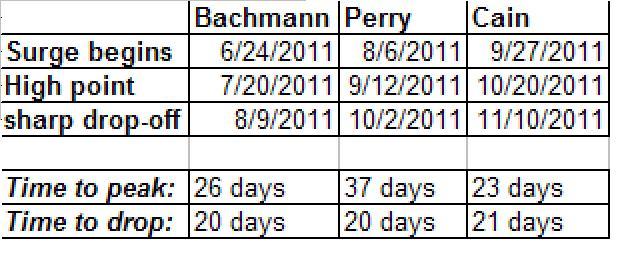
Now I’m hardly the first person to notice this. But, lover of figures and charts that I am, Gingrich’s path along the same boom as his predecessors made me wonder if there’s any regularity to the pattern. Curious, I tracked the timing of the beginning of the surge, reaching peak, and start of drop-off of the last three candidates:

It was interesting to see that, while the three boomlets so far have taken different amounts of time to reach a peak, that amount of time from peak to beginning of steep drop was remarkably similar. It makes me wonder if there’s some kind of structure to media saturation, boredom and vicious turn, such that the newscycle of three weeks is inherently how long you can stay on top once you get there. Even more fun, since we can spot on the polling graph the date of the beginning of Gingrich’s surge, it’s actually possible to predict the timing of his peak and fall based on the average of the last three:

So, if his cycle follows the average of the last three candidates, he’ll reach his polling high on December 2nd, and begin a steep drop-off December 23rd. Which won’t be a great Christmas present for him. Even worse giving the following dates:

1/3/12    Iowa
1/10/12  New Hampshire
1/21/12  South Carolina
1/31/12  Florida

In other words, his peak of popularity will likely come (and start to end) too early to translate into success in the first primaries and caucuses. Which would leave the consistently medium Mitt Romney again on top just as the voting starts, giving him the nomination despite GOP voters’ obvious equally consistent search for someone they’re more excited about than him. A lot of people have thought all along that this is the most likely outcome, and I tend to agree. But I can imagine a few reasons Newt’s experience might be different:

1. Everything tends to slow down over the holidays, and media cycles are probably no exception. Thanksgiving, Christmas and New Year’s just might stretch out the cycle enough that Newt is still at or near the top when voting starts.

2. If you look at the above dates, one thing that can be clearly seen is that, in each case the next comer was already starting to climb a few days before the previous person started to plunge. In other words, the “anybody but Romney vote” has probably remained consistent, and just looks for someone new to transfer to. This might work for Newt because there’s nobody else left. Bachmann, Perry and Cain have all had their day, Huntsman is too centrist for the field, Santorum has never gotten more than 2-3%, and Ron Paul is Ron Paul. Of course, someone new could get in, but this would be difficult at this point given early primary filing dates being closed or soon closing. So, the opposition to Romney might have to stick with Gingrich now, for better or for worse. 

3. A large part of what’s happened with the last three anti-Romneys is that they were still relatively unknown to a general audience, and the inevitable airing of their dirty laundry (plus just letting people hear the ridiculous kinds of things they say) started to pull down their popularity shortly after its surge. Gingrich has plenty of negatives, but they’re well known both in the party and among the public in general. If primary voters are liking him now, it’s not like they’re about to find out things they didn’t know that will make them reconsider.

Mind you, these are just reasons he might not totally self-incinerate before the voting starts in January. All this might really mean is that Romney is left with a somewhat credible opponent at that point. With his funding, organization, and consistent hanging in there, he’s still likely to be the nominee in fairly short order.

Which leaves us all with the shudder-inducing possibility that we could have a general-election that de facto begins by, say, April 1. Seven months of gaffes and spin and irresponsible rhetoric, saints preserve us all… 

Apparently, I’m most like the Dalai Lama and Nelson Mandela

You must be wondering, dear reader, what I am referring to. Perhaps my recent Nobel Peace Prize? No, alas, the Nobel Committee has ignored me for yet another year. And in any case, if they were to award me, it should no doubt be for literature. Duh.

I am referring instead to my score on the political compass test.

It’s a nifty little thing that proceeds on the idea that the traditional left-right spectrum we’re used to in the U.S. is too limited, in that it collapses together what should actually be two different axes, one for economic freedom/control and one for social-political freedom/control.

I’ve taken it a couple of times over the years. In my most recent round, I ended up in the middle of the lower left quadrant, adjacent to, as alluded to above, the Infinite Sea of Compassion and first President of a free South Africa. Not a bad neighborhood really, but what I find to be interesting is my drift over the years.

I recall taking the test in the early 2000s and ending up socially liberal, but economically more conservative. Kind of a classic “New Democrat” in the Clinton mold. Later on, say circa 2004/2005, the anti-personal freedom and pro-business control excesses of the Bush years had pushed me further leftward on the economic scale, landing me more in classic Liberal territory, aka FDR and Johnson’s Great Society.

And now, a few years later, the corporate shenanigans of the Great Recession, and the chilling proof of the plutocracy’s ability to control outcomes throughout the political system have pushed me further leftward on the economic spectrum. This actually makes sense to me in terms of how I currently feel- what I would call a compassion-based world view. We’re here to take care of each other while also giving each other the freedom and space to live our own lives. Rather like everyone is everyone else’s mom, but the really cool while at the same time totally responsible mom.

How about you? I’d be fascinated to hear other people’s scores on the test, and whether the results surprise them or not…   

The Rising Tide of Right Wing Violence

In April, when a Department of Homeland Security report on the potential emergence of right-wing domestic terror threats was partially leaked, the Right in this country went wild with scorn and mockery. The media widely reported the dissing of the report, but did very little analysis of the relative merits or lack thereof of the idea.

The title, “Right-Wing Extremism: Current Economic and Political Climate Fueling Resurgence in Radicalization and Recruitment”, pretty much gives you the thesis. You would think someone in the press at the time might have taken said thesis a little seriously based on:

– Jim Adkinson going on a shooting spree in a Unitarian church in June 2008 because, as explained in a letter he left behind, he “wanted to kill liberals”.

– Campaign rallies toward the end of the Presidential election where a beaming Sarah Palin said things like “You really get it!” to whipped-up crowds yelling “Traitor!” and “Kill him!” when Obama was mentioned.

– An assassination plot by skinhead groups that was broken up shortly after the election.

– Conservative groups organizing anti-Obama “Tea Parties” across the nation including one in which Texas Governor Rick Perry said frustration with the government might run so high that Texas might have to secede.

– Richard Poplawski in Pennsylvania, who frequently fretted about “the Obama gun ban that’s on the way” staging a domestic disturbance on April 4th, donning body-armor and loading an AK-47 to then shoot the officers who responded.

By April, was it really that ridiculous to think that economic hardship in the country, combined with a sudden political change and exacerbated by alarmism from Rightist media, might be creating a milieu of violent extremism?

One could certainly make the case that Adkinson and Poplawski were lone nuts, but as subsequent coverage has made clear, they weren’t lone nuts who appeared out of the ether. Officers found Liberalism is a Mental Health Disorder by radio talk show host Michael Savage, Let Freedom Ring by talk show host Sean Hannity, and The O’Reilly Factor by television talk show host Bill O’Reilly in Adkinson’s apartment after the shooting. The note he left behind specifically mentions wanting to kill the 100 people in Bernard Goldberg’s book 100 People Who Are Screwing Up America (And Al Franken Is #37). Poplawski turned out to be a follower of Alex Jones, who used to be a fringe 9-11 conspiracist but by March 2009 appeared on FoxNews.com hailed as “the one, the only, the great Alex Jones,” in a segment warning about “what the government has done to take your liberty and your property away.”

If mainstream media didn’t spot any emerging trend in April, you think they might have been on to one this summer, when, in the space of less than two weeks:

– Shawna Forde, a former member of the anti-illegal immigration border watch group the Minutemen, posed with another man as police officers in order to enter the home of a Hispanic family and kill them in Arizona on May 30th.

– Prominent abortion doctor Richard Tiller was gunned down in church in Wichita, Kansas on May 31st.

– White supremacist James Wenneker von Brunn went on a shooting spree in the National Holocaust Museum in Washington D.C. on June 10th.

Still not enough trend? How about Virginia Congressional candidate Catherine Crabill in July helpfully noting that, if candidates trying to stop “Marxism” fail to get elected in November, at least we still have guns to affect change? How about the town hall meetings and Tea Parties all fall where Obama has been excoriated in the most inflammatory language? Find Mark Williams of the group Tea Party Express, for example, calling Obama an “Indonesian Muslim and welfare thug”.

And then there’s Chris Broughton, who proudly wore an assault rifle and a handgun to an Obama rally in Arizona in August. Far from being a disconnected lone nut, Broughton is actually a member of a church congregation whose pastor, while disavowing calling for anyone in particular to do anything illegal, publicly prays that Obama “die and go to hell.”

Is it possible that a sitting member of Congress shouting “You Lie!” during a Presidential address is the relative ruly tip of an increasingly unruly iceberg of growing radicalization that is implicitly encouraged by leaders of the Conservative movement? Possible enough that we might want to take a serious look at what’s going on?

Before dismissing this as Liberal paranoia, let’s play a thought game:

What if, during the 2000 election, a radical leftist had gone on a shooting spree in an evangelical church leaving behind a note saying he wanted to, “kill conservatives?” Not long thereafter, Gore’s VP candidate had grinned and encouraged crowds shouting that Bush was a fascist who should be killed. After the election of Bush, left wing acts of violence dotted the country in the following months as prominent Liberals organized and encouraged town halls where Bush was described as dangerous and a threat. A Democratic congressional candidate advocated violent revolution if Liberals lost elections and a prominent Democratic governor mentioned seceding if Bush’s agenda continued. And then a gun-totting member of a radical Black church congregation whose pastor called for Bush’s death came to a rally that the President was at? How calm, nuanced, reasoned and balanced would Fox News and talk radio be in reporting on this?

Politics & Promises

So I like this Barack Obama kid. I use the term “kid” advisedly, as it’s true that he’s nine years older than me. Then again, I’m not running for President. And he is only about one third of the combined age of the two democrats in the race I most liked, Joe Biden and Bill Richardson. He’s also running against someone 25 years older than him, which is a whole almost-grown person’s worth of age.

Age and experience are not trivial matters in being able to manage the Presidency (cf. my earlier stated preference for Joe and Bill) but they are also not necessarily decisive. Teddy Roosevelt and JFK each filled out the office pretty darn well, and Mr. William Jefferson Clinton was the same age in 1992 that Mr. Obama is now. And Obama brings something that I still remain hopeful is going to matter: A vastly different perspective from anyone who has held the office in the last fifty years.

It’s not too much to hope, I think, that a bi-racial man raised in Indonesia and Hawaii who from birth has expected to live half his life in the twenty-first century will have a significantly different worldview from the previous occupants of the office. Going further out on a limb, one might hope that this difference will manifest in a different kind of politics, one more holistic than binary and better suited to this new millennium. I remain hopeful, but somewhat less so than I was a few months ago.

Yes, you do what you have to in a campaign in order to get elected. But when you start to do silly misconstsruals and misrepresentations of what your opponents say in order to score points (like harping on Mr. McCain’s “hundred years”), when you adopt positions you don’t really believe in to appeal to one base and then soft-pedal them when it comes time to switch to another (like renegotiating NAFTA), when you break a promise to abide by public funding because it’s become expedient to do so and then try to spin it as a protest against how broken the funding system is, well, it starts to seem…

Twentieth century. Old millennium. Typical. Disappointing to the expectations you yourself had stirred up that this time, things might be different.

John McCain, meanwhile, is championing public funding of elections, campaign finance reform, and is the one offering to have a live, no rules or handlers-mediated series of public debates throughout the country, to which the Obama campaign is saying, oh well, let’s wait and see. Who’s representing a different kind of politics now?

Don’t get me wrong, McCain himself has back-pedaled on so many admirable and risky against-the-grain positions that he formerly held and become such a creature of Bush policies that the reform sheen is decidedly off of him. And like I said, I do like this Obama kid, and remain hopeful that he will be a breath of fresh air in many useful ways.

I wish though, that instead of Obama vs. McCain we could get a contest of two committed reformers refusing to play the same old game. Like maybe pre-January Obama versus 2000 primary season McCain.

Now that would be a contest worthy of the land of the free and the home of the brave.

Hillary

So, I’m pretty much hoping that Hillary gets obliterated by Barack Obama in Michigan on Tuesday.

(Parenthetical note: I can’t believe this is the first blog I’ve written about the election. Watching presidential debates, election returns and analysis on television plays pretty much the same role for me that football season plays for most guys. And election night is like my Superbowl. Except that it only happens every four years, so it’s really more like my World Cup. (Parenthetical note inside the parenthetical note: it really doesn’t matter if Hillary gets obliterated in Michigan on Tuesday, since the delegates aren’t being recognized by the Democratic National Committee. (Tertiary parenthetical note: bravo Howard Dean for standing up to Michigan’s calendar-hoping hubris!)))

In any case, I realized today that I really am hoping that Hillary gets trounced in Michigan on Tuesday, and if not there, in Nevada on Saturday. I’m hoping it with a sort of visceral, nasty hope.

When I realized this, I was surprised- despite it being a popular pastime, I’ve never been a Hillary-basher. I certainly am not put off by the idea of a woman being president. Or a strong-willed, ambitious woman with an edge. Dare one use the “B” word, I habitually end up really liking women who are described by others (or themselves) as bitches. In fact, my favorite of all Hillaries was the pre-domesticated version who, long-hair flowing and eyes flashing, clad in a leather jacket, made a sarcastic apology on the Clinton campaign trail in 1992 for not, “Staying home and baking cookies like the other mothers.”

And yet I have felt strongly anti-Hillary throughout this campaign cycle. Thinking about it, I believe this is why: the candidate, her positions, her money, her voting for the war back when it mattered, issuing press releases that talk about Obama’s grade school essays, all of it, is pretty much part of the machine. You know the one I’m talking about- the machine that has us in Iraq, that wants us to buy a lot between Thanksgiving and Christmas, that depends on us remaining safely sedated in front of our televisions every night. It’s the machine in a woman suit, so it looks a little new and different, but at the end of the day it’s still just the machine.

This time around, though, the Democratic field has someone who not only has a non-machiney whiff about him, but also has an imaginable shot at nomination. I don’t think Barack Obama is the second coming. Compared to Dennis Kucinich, for example, he’s still clearly a pretty conventional candidate. But he’s a few degrees off of conventional enough that he’s worth getting excited about. He won’t be a boulder that crushes the machine, but he might be sand that wears it down.

I, for one, would like to see him pour.