As mentioned in our previous edition from June 27th, I’ve re-arranged things here more thematically, to hopefully make it easier to follow and locate content in the areas that interest you. Things that were under “Confirmed” and “Looking Probable” are now arranged under specific headings (Congressional Hearings, Special Counsel, Michael Flynn, etc.). “Unconfirmed” is still in a category of its own at the end, since the links there are more speculative.
So that’s the basic set-up. But first, an overview of the “big picture” of where we are:
Established
- Russian interests systematically interfered in the 2016 U.S. Presidential election. The consistent thrust of this interference was to boost Trump, and harm Clinton.
- This interference involved senior intelligence officials and business leaders close to Putin, and was approved of and directed by him.
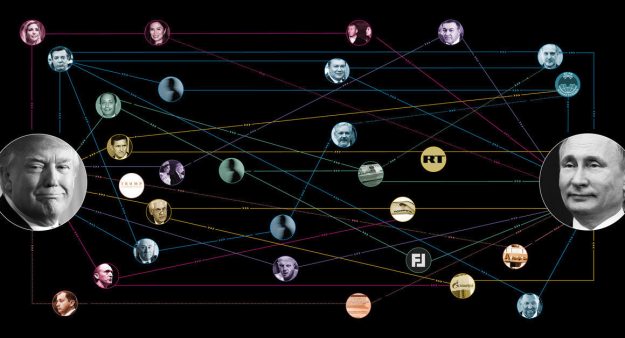
- There is an unusual density of business & personal contacts with Russian interests among key people in Trump’s campaign and/or administration. There isn’t a similar density of contacts with other nations equally (or more) important to the U.S..
- The actions of several Trump confidants in connection with Russia involve things that are illegal, either in initial commission or subsequent denial. Carter Page, Jeff Sessions, Michael Flynn, Paul Manafort, and Roger Stone certainly seem to be in this camp. Felix Sater, Jared Kushner, and Michael Cohen may well be.
- Despite denials and disavowals, Trump has years-worth of history of praising Putin and seeking contact with him.
- Despite denials and disavowals, Trump has years-worth of extensive involvement with Russian businesses and financiers, many of which are part of Putin’s inner circle, and some of whom have ties to Russian organized crime.
- The Russian interests working to interfere in the election actively cultivated and sought to make use of contacts with Trump-connected individuals.
- Trump administration officials, including the President himself, have taken multiple actions to discourage the progress of the investigation.
Open Questions
- Were Trump confidants aware of Russian election interference, either during the election or afterwards, and thus liable for not exposing it?
- Or, even worse, were any of Trump’s confidants active, knowing participants in this interference?
- If so, was Trump aware of it, either during or afterwards, and thus liable for not exposing it?
- Or, even worse, was Trump himself an active, knowing participant in these efforts?
- Do any of the actions that the President and his administration have taken to discourage the investigation amount to an actionable case of obstruction of justice?
- What else may come out as a result of this investigation now that an independent counsel has been appointed? Recall that Clinton’s Lewinsky scandal was an outgrowth of, but not in any way directly connected to, the Whitewater investigation.
And if you want to explore further based on this blog, the following sources may be of interest:
- An overview of the investigations currently underway (Washington Post)
- Interactive Graphic of Trump team’s Russia connections (Washington post)
- Parallel timeline of responses to Russian election interference by the Democratic campaign, Republican campaign, and Obama administration (Washington post)
- Multi-year timeline of Trump-Russia investigation (Mother Jones)
- Complete timeline of Trump-Russia affairs dating back to the 80s (Political Wire- 170 pp!)
Now, on to the news. Our sections are (each item here is linked to the corresponding section below):
- Congressional Hearings
- FBI Investigation/Special Counsel
- Russian Campaign Interference
- Trump-Russia Ties (general)
- Michael Flynn
- Jared Kushner
- Paul Manafort
- Carter Page
- Jeff Sessions
- Roger Stone
- The Steele Dossier
- Unconfirmed (use with extreme caution)
New items since the previous edition are in blue text…
********************************************************************************
Congressional Hearings
- FBI Director James Comey met with the Senate Intelligence Committee on 2/17/17 to brief them on the FBI investigation into Russian election interference and possible Trump campaign ties to Russia. Both Democratic and Republican senators afterwards said they were reassured on the investigation. The Intelligence Committee subsequently sent formal requests on 2/20/17 to more than a dozen organizations, agencies and individuals, asking them to preserve all materials related to the Russia investigation. Besides the Intelligence Committee, the Armed Services Committee, and Foreign Relations Committee have also been holding hearings, though Intelligence is now taking the lead. Some Senators are satisfied with this, but others, including John McCain, have urged the creation of a bipartisan select committee or independent commission, which would be less under control of a single party.
- Meanwhile, the House is not so interested in doing investigations on Russian election interference, or on Michael Flynns’s Russian contacts. However, Rep. Jason Chaffetz, the chairman of the House Oversight Committee, and Rep. Bob Goodlatte, chairman of the House Judiciary Committee sent a letter on 2/15/17 that urged the Office of Government Ethics to investigate who leaked information about Flynn to the media.
- The first Congressional hearings on Russian interference in the 2016 election and possible Trump ties to Russia, conducted by the House Intelligence Committee, opened on Monday 3/20/17 with testimony from FBI director James Comey and NSA Director Mike Rogers. Among the highlights:
- Comey disclosed not only that the bureau is investigating Russian meddling in the campaign but that it is also looking at what relationship the Trump campaign might have had to that meddling.
- Comey further disclosed that certain figures connected to the Trump campaign have been under investigation since July 2016. This news came as a surprise to several key Trump supporters. Citing the need to protect the ongoing investigation, Comey declined to identify the specific figures in question, though it is widely believed Michael Flynn, Paul Manafort, Carter Page, and Roger Stone are among them.
- There is no evidence Russian actions interfered in the 2016 vote totals themselves.
- Following the testimony, Republican co-chair of the committee Devin Nunes (R-CA) revealed on 3/22/17 that he had received information indicating that U.S. intelligence agencies, in the course of investigating foreign targets, had collected surveillance involving members of the Trump transition team. When he received this information, apparently at a White House meeting from an unidentified source, Nunes did not share it with fellow committee members or even mention it to them, and instead made a public announcement about it. This has raised questions about his impartiality in chairing the investigation, and led to renewed calls for an independent counsel and/or Nunes to recuse himself. A March 24th poll by Quinnipiac University indicates that 2/3 of Americans support having an independent special prosecutor. 65% agreed that the Russian investigation is important. Nunes, meanwhile, made it clear that he has no intention of stepping down.
- While not willing to step down, Nunes was willing on 3/29/17 to cancel a hearing on Russia where former acting Attorney General Sally Yates was to testify. This followed the Trump administration voicing objections to him about her planned testimony. Yates briefly led the Justice Department while Attorney General Jeff Sessions’ confirmation was pending, but was fired by Trump after she refused to defend in court his initial travel ban executive order. After she was fired, it was revealed that Yates had notified the White House that then-national security adviser Michael Flynn had not properly explained his contact with the Russian ambassador. The Washington Post reported that the Justice Department told Yates that her testimony would have to be seriously limited because of executive privilege, which she disputed.
- Subsequent reporting revealed that Nunes went to a secure National Security Council facility on the grounds of the White House and reviewed intelligence reports, with the assistance of Ezra Cohen-Watnick, senior director for intelligence at the National Security Council, and Michael Ellis, national security lawyer at the White House Counsel’s Office. Ellis is a former Nunes staffer, and Donald Trump had recently personally overruled H.R. McMaster, his national security adviser, to keep Cohen-Watnick in his position. The following morning, without informing any other members of the House Intelligence Committee about what he had learned, Nunes went back to the White House and briefed the President on those reports. He held press conferences, one at the Capitol and one outside the West Wing, before and after his meeting with Trump. In the controversy following these revelations, Nunes recused himself from further leadership of the House Intelligence Committee hearings on 4/6/17. Rep. Mike Conaway (R-Texas) will temporarily take over the committee’s investigation.
- The documents Nunes referenced involved Obama NSA director Susan Rice requesting the “unmasking” of the identities of US individuals’ involved in intelligence surveillance aimed at Russian targets. Some of these individuals apparently included members of Trump’s transition team. This led to Trump and some Republican officials alleging that Rice broke the law by requesting the “unmasking”. In fact, the practice in general is not unusual or illegal. CNN reported on 4/12/17 that, after a review of the specific intelligence reports obtained by Nunes, both Republican and Democratic lawmakers and aides have so far found no evidence that Obama administration officials did anything unusual or illegal.
- It was reported by the New Yorker on 4/18/17 that the White House sought information to support President Trump’s unsubstantiated claim that former President Obama had tapped his phone. “The White House said, ‘We are going to mobilize to find something to justify the President’s tweet that he was being surveilled,’ ” an intelligence source told Ryan Lizza, the author of the story, after reportedly “talking to people in the intelligence community.” Lizza’s story also casts doubt on claims that former Obama national security adviser Susan Rice targeted members of Trump’s transition team caught up in foreign surveillance. “There’s absolutely nothing there,” one source told Lizza. “Trump names remain masked in the documents, and Rice would not have been able to know in all cases that she was asking the NSA to unmask the names of Trump officials.”
- The Senate Intelligence Committee began its hearings 3/31/17. Among the highlights from the first two days of testimony:
- Marco Rubio’s campaign was also targeted by hackers with Russian IP addresses during the 2016 election.
- Former FBI agent and cybersecurity expert Clinton Watts further revealed that all the major Republican candidates were targeted.
- Such cyber-targeting continued even after the election, including attacks against Rubio on the first day of hearings, and coordinated social media attacks against Paul Ryan over recent weeks.
-
National Security Agency Director Keith Alexander and FireEye chief executive Kevin Mandia, a pair of cybersecurity experts, described how Russian agents and upwards of 1,000 paid Internet trolls working out of a facility in Russia pushed “fake news” during the election.
- Senate Committee members of both parties also took pains to differentiate themselves from the increasingly politicized House hearings, promising an unbiased and bipartisan approach.
- Connected to the Senate hearings, it was revealed by NBC on 3/31/17 that officials in the Obama administration compiled a list of classified documents related to the probe into Russian interference in the presidential election and gave it to senior members on the Senate Intelligence Committee in January. Sources indicate this was done “to share it with those on the Hill who could lawfully see the documents” and make it “harder to bury” the documents.
- The Senate Judiciary Subcommittee on Crime and Terrorism held hearings on Russia the week of 5/8/17. Key witnesses were former acting Attorney General Sally Yates and former Director of National Intelligence James Clapper. Among the highlights:
- Former Obama-administration national security advisor Susan Rice declined an invitation to testify to the Subcommittee on Russian hacking. Rice had initially accepted the invitation from committee chair Lindsey Graham, but then subsequently declined after being informed by Committee ranking Democrat Sheldon Whitehouse that the invitation was not issued with his knowledge, and was the only request for testimony the committee issued that was not bipartisan. Rice had earlier become the subject of allegations, which do not appear to be substantiated, that she had improperly unmasked and revealed information about surveillance of Trump-related personnel’s contacts with Russia.
- Yates detailed how she had informed Trump administration officials that then-national security adviser Michael Flynn was susceptible to blackmail from Russia 18 days before he was fired.
- She also testified that she warned White House counsel Don McGahn in late January that Flynn had misled Vice President Mike Pence and other senior officials and that as a result, public statements by White House officials were inaccurate.
- Clapper clarified earlier his remarks, oft-repeated by the Trump administration, that he had seen no evidence of collusion between the Trump campaign and Russia. He sought to make clear this statement reflects the fact that he had not seen the FBI evidence, and not an authoritative opinion that the evidence itself was lacking.
- Clapper stated that the Russians had also collected information on certain Republican Party affiliated targets but did not release any Republican related data, and only leaked information involving the Democratic Party.
- In relation to allegations involving Rice, Clapper explained that the request from intelligence officials for unmasking of a US citizen is “legitimate” and essential to determine motives of the foreign agent being monitored, and does not constitute “improper” leaking
- Yates and Clapper both told members of the Subcommittee that they had never leaked classified information to the news media, nor authorized anyone else to do so.
- Following questions to Clapper about information on Trump business dealings with Russia, Sen. Graham indicated that he wants to look into President Trump’s potential business ties to Russia as part of the Senate investigation.
- Congressional hearings on Russia continued as well. Some of the highlights from the second half of May include:
- On 5/22/17 former National Security Advisor Michael Flynn invoked the Fifth Amendement in order to not cooperate with Congressional subpoenas. This exposes him to potential charges of contempt of Congress.
- Former CIA Director John Brennan testified before the House Intelligence Committee on 5/23/17. Brennan stated that he was aware of intelligence and information that revealed contacts between Russian officials and U.S. persons involved in the Trump campaign, and was concerned that Russia was actively trying to exploit these contacts as part of its manipulation efforts.
- Brennan also revealed that he spoke to Alexander Bortnikov, the head of Russia’s FSB, in August 2016 and warned him against further interference.
- Representative Devin Nunes appeared to violate his previous recusal from the House Intelligence Committee investigation on 6/1/17 by issuing multiple subpoenas on 6/1/17 related to Obama administration “unmasking” of Trump-reated figures involved in intelligence gathering on Russian targets. Nunes’ actions earned widespread criticism from House colleagues and outside ethics experts.
- On 6/7/17 Director of National Intelligence Dan Coats and Adm. Mike Rogers, director of the National Security Agency, testified before the Senate Intelligence Committee. There had been reporting that Trump had asked Coats and Rogers to influence the FBI to shut down its investigation. In response to repeated questioning along these lines, both men refused to answer, invoking confidentiality and security, indicating they could not answer further in open hearings but might be able to be more forthcoming in closed hearings. They indicated that even then they might need to consult with White House counsel first. This was widely understood to indicate that the allegations could not be clearly refuted, and that legal concerns are now front and center as figures involved in the investigation seek to make sure they do not commit perjury in public statements.
- Former FBI-Director James Comey testified before the Senate Intelligence Committee on 6/8/17. Highlights of his testimony, and its aftermath include:
- Comey stated that there was absolutely no doubt that Russia had interfered in the 2016 election.
- He confirmed previous public reporting of numerous encounters initiated by Trump in which Trump encouraged him to drop the Flynn investigation, asked for loyalty, and confirmation that he was not personally under investigation.
- Comey started to document these as he felt the communications were improper, endangered the integrity of the FBI investigation, and did not trust Trump to be honest about what was said later.
- He told the committee that it was Trump’s tweet about the possible existence of tapes that spurred him to leak contents of his memos documenting interactions with the President to the press.
- Comey contradicted a February New York times story about U.S’ Intelligence Agencies concerns about extensive contacts between Trump-related parties and Russian intelligence officials saying it was, “in the main, not factual”. Predictably, Right-leaning media outlets cited a single New York Times article being contradicted as a complete refutation of all mainstream media Russia-related reporting.
- Comey also revealed that former Obama Attorney General Lynch ordered him to refer to the investigation into Hillary’s e-mail server as the “e-mail matter” and not as an investigation, and he felt a need to accelerate the investigation following Lynch’s airport tarmac meeting with Bill Clinton.
- Comey declined to publicly answer several questions, including the status of investigations into the Steele Documents, Jared Kushner’s activity regarding a “back channel” with Russia, if the FBI had indications of contact between Trump officials and Russian intelligence, and whether he thinks the President colluded with Russia. Such refusals are not in and of themselves indications of wrongdoing, but they do often indicate sensitive areas of ongoing investigation.
- In a private hearing later in the day, Comey indicated that the FBI had evidence that Jeff Sessions may have had an undisclosed additional meeting with Russian Ambassador Sergey Kislyak. He cautioned that this was based on intercepted communications between Russian officials, and that it’s possible they were exaggerating.
- Following the testimony, Trump chief-counsel Marc Kasowitz went on record to deny that the President had asked Comey to drop the investigation or asked him for loyalty. Kasowitz countered that Comey should be investigated for leaking.
- Trump followed up on 6/10/17 by stating that Comey lied in key aspects of his testimony, and offering to sit down with Robert Mueller and testify to this.
- Several House and Senate committees followed up on the testimony by again asking for copies of all memos and tapes that either Comey or the Administration had produced.
- On 6/11/17, Senator Diane Feinsten indicated that, based on Comey’s testimony, Congress should investigate Loretta Lynch’s possible interference in the FBI’s Clinton investigation. Feinstein indicated that such an investigation should be separate from the ongoing Russian hearings.
- Cybersecurity and Counterintelligence experts from the FBI and the Department of Homeand Security testified to the Senate Intelligence Committee on 6/21/17 that election systems in 21 states were targeted by Russian hackers. There is no indication that votes were changed, but voter registration records may have been deleted or altered.
- Attorney General Jeff Sessions testified before the Senate Intelligence Committee on 6/13/17. Among the highlights of his testimony:
- Sessions denied that he had deliberately withheld disclosures on his prior Russian contacts.
- He indicated that his recusal from the case was because of his campaign work for Trump, not because of any sense of impropriety about his Russian contacts.
- Sessions also denied that he had any undisclosed further meetings with Russian parties, though he allowed after further questioning that there may have been “an encounter’ but no substantive talk with Ambassador Kisylak at the Mayflower Hotel conference in April 2016.
- He did corroborate two key areas of Comey’s testimony: that Trump had asked Sessions to leave the room during a meeting and then talked with Comey privately, and that Comey had afterwards asked him not to leave him alone with Trump again.
- Sessions used some version of the line “I can’t recall” 21 times during his testimony.
- In an interesting aside, Sessions indicated that he had not closely followed the news on Russian campaign interference, and could not recall it being a subject of focus or concern at any point during the transition.
- Senator Angus King (I-Maine) estimated on 6/18/17 that Congress was only about 20% done with their Russia-related investigations. He suggested they might not be wrapped up until the end of the year.
- On 6/28/17 the Senate Intelligence Committee reached an agreement to obtain the memos James Comey wrote after interactions with President Trump, according to chairman Richard Burr. Burr also indicated that the committee aims to finish its work by the end of the year, and plans to double the number of witness interviews it’s held (most have not been in televised public hearings) to nearly 90 by the end of the Summer.
FBI Investigation/Special Counsel
- On the evening of 5/9/17, President Trump fired FBI director James Comey. This was initially presented as a move prompted by Trump’s reaction to Attorney General Jeff Sessions and Deputy Attorney General Rod Rosenstein expressing concerns about the impropriety of Comey’s actions while investigating Hillary Clinton in 2016. Subsequent coverage made clear that Trump had been planning on firing Sessions for weeks, and had the Justice Department prepare materials as a justification. One of his major motivators in doing so was apparently anger at Comey’s ongoing investigation into Russian allegations, as well as his public discrediting of Trump’s allegations that Obama had him wiretapped. Trump himself contradicted his administration’s official story on the firing on 5/11/17, and explicitly stated that Comey’s pursuit of the Russia investigation was a factor. It was also revealed that just days before the firing, Comey had approached Rosenstein to request additional resources for the ongoing investigation into Russian influence in the 2016 election and possible Trump campaign officials involvement with Russia.
- In the wake of Comey’s firing, the Senate Intelligence Committee indicated on 5/10/17 that they would nevertheless like him to testify before the committee the following week. An increasing number of Democratic Senators called for a special prosecutor to oversee the Russian influence investigation, and were joined in this call by Republican Senator John McCain and 20 States’ Attorneys General.
- Acting FBI head Deputy Director Andrew McCabe, testifying before Congress on 5/11/17, broke with Trump by characterizing the Russia probe as “important”, and promised that he would not discuss any details of it with White House officials. McCabe also stated that, contrary to Trump’s assertions after the firing, staff in the FBI had not lost confidence in Comey. This was confirmed by other highly-placed sources in the FBI, who also disputed multiple details of Trump’s claim that Comey had assured him a January private dinner that he was not a subject of the investigation. Trump’s follow-up on the conversation involved a Twitter-post on 5/12/17 stating: “James Comey better hope that there are no ‘tapes’ of our conversations before he starts leaking to the press.”
- Fallout from Trump’s 5/10/17 firing of James Comey continued to unwind for several days. Significant developments included:
- White House spokesmen would neither confirm or deny Trump’s insinuation that he may have taped his conversations with Comey.
- Trump had asked Comey for a “loyalty pledge” in a meeting shortly after the inauguration (which Comey declined to provide).
- Comey revealed on 5/16/17 that, in a February meeting, after asking AG Sessions and VP Pence to leave the room, Trump had asked Comey to drop the investigation into Flynn. He also suggested that Comey instead focus on arresting journalists responsibility for leaking the Flynn story. Most notably, Comey indicated that he had kept detailed memos of this and other conversations with Trump.
- On 5/17/17, House Oversight Committee Chairman Jason Chaffetz (R-Utah) invited Comey to testify publicly before his committee in May.
- The same day as Chaffetz’s offer, the Senate Intelligence Committee also issued an invitation for Comey to publicly testify.
- And that same day, the Senate Judiciary Committee asked both the White House and the FBI to turn over any memos or recordings from Trump’s meetings with Comey.
- Spurred by increasing Congressional scrutiny and public interest following Comey’s dismissal, the Justice Department acceded to growing demands to appoint an Independent Counsel to investigate Russian election interference and Trump administration ties to Russia on 5/17/17. The appointment of Robert Mueller, a former FBI director with a background as a prosecutor who had served under both Bush and Obama, met with praise from Congressional leaders from both parties.
- The FBI investigation into Russian influence and ties meanwhile continued, with the following major developments in May:
- Deputy Attorney General Rod Rosenstein announced on 5/18/17 that the FBI investigation is now not only an intelligence probe, but also a criminal investigation, which could result in charges.
- On 5/22/17, Mueller was briefed on the contents of Comey’s Trump meeting memos.
- It was confiremd on 5/26/17 that Trump’s son-in-law and senior advisor Jared Kushner is a person of interest in the investigation. Specifically, while not naming him as a target, investigators indicate that they want information from him on meetings with the Russian ambassador and Russian bankers.
- On 5/27/17, the FBI indicate that it is not complying, for the moment, with Congressional requests to turn over Comey’s memos, as it first wants to coordinate with Mueller’s investigation.
- In response to the ongoing investigation, the Trump administration is retaining defense attorneys, and creating a “war room” within the White House to coordinate responses.
- The Washington Post reported on 5/22/17 that President Trump asked two of the nation’s top intelligence officials in March to help him push back against the FBI Russia investigation. Trump made separate appeals to the director of national intelligence, Daniel Coats, and to Adm. Michael S. Rogers, the director of the National Security Agency. Both refused his requests, believing them to be inappropriate.
- On 5/26/17, it was revealed that then-FBI Director James Comey knew that a critical piece of information relating to the investigation into Hillary Clinton’s email was fake – created by Russian intelligence – but he feared that if it became public it would undermine the probe and the Justice Department itself. As a result, Comey acted unilaterally in June 2016 to publicly declare the investigation over.
- A good case can be made that Trump’s firing of Comey constitutes a case of obstruction of justice. This would be true of Session’s behavior as well, and could additionally result in him losing his license to practice law, as it would seem to violate his previous recusal of himself from anything Russia-related. Making the case would require establishing (1) “Corrupt” intent, (2) Interference with a pending judicial proceeding, (3) A material impact on that proceeding, and (4) Knowledge of that proceeding. #2 & #4 are easily demonstrable, so it would depend on #1 and #3. Obstruction of Justice was one of the impeachment charges brought against Nixon in Watergate.
- Among Robert Mueller’s first actions as Special Counsel have been assembling an extensive legal team with expertise in high-profile criminal fraud, foreign bribery, money laundering and anti-mob cases. His team is spending its first few weeks reviewing the work that has been done to date by the FBI, Justice Department, and U.S. Attorney’s Alexandria, VA office. As of mid June 2017, his staff had expanded to thirteen lawyers with extensive experience in high-profile cases.
- Ahead of former FBI Director Comey’s Senate Testimony, President Trump set up a “war room” headed by outside counsel Marc Kasowitz. Kasowitz had previously represented Trump in many civil disputes during his business career. Early reports indicated that the effort was marked by disarray and infighting. It was also revealed that Kasowitz had been chosen after four top law firms had declined to represent Trump in the matter.
- It was reported on 6/9/17 that Kasowitz’s clients had also included Oleg Deripaska, a Russian oligarch who is close to President Vladimir Putin and has done business with Trump’s former campaign manager Paul Manafort.
- Various sources confirmed to the Washington Post and other outlets on 6/14/17 that Special Counsel Mueller’s investigation is officially looking in to obstruction of justice issues.
- Vice President Mike Pence hired his own legal representation separate from Trump’s team on 6/15/17. Pence hired Richard Cullen of McGuire Woods. Cullen has previously represented Tom DeLay in his corruption charges, served as a defense attorney during the Iran-Contra investigations, and is a former U.S. Attorney from the Eastern District of Virginia.
- To the surprise of pretty much nobody, President Trump officially announced on 6/22/17 that he had not taped his conversations with former-FBI Director James Comey. He further indicated that he had suggested he had tapes in order to rattle Comey, which could contribute to establishing intent of obstruction of justice.
- On 6/28/17, Trump’s lawyer Marc Kasowitz announced his legal team was delaying previously threatened legal action against former FBI Director James Comey for revealing “privileged information” in his Congressional testimony. Kasowitz indicated they still plan to proceed at some point. Trump has a history of making legal threats against his opponents and then not following through.
Russian Campaign Interference
- Evidence first emerged in July 2016 that Russian hackers were the source of the massive dump of hacked e-mails from the DNC and several other Democratic campaign-related organizations released shortly before the Democratic Convention.
- It was reported on 3/29/17 that FBI Director James Comey sought to publish an op-ed in Summer 2016 summer about Russian efforts to influence the 2016 presidential election, but was discouraged from doing so by the Obama White House. In a White House meeting in June or July, Comey reportedly brought with him a draft of the proposed op-ed and presented it to top administration officials, including former Secretary of State John Kerry and former Attorney General Loretta Lynch. White House officials at the time ultimately rejected the idea, deciding instead that any effort to make information about Russian election meddling public should be coordinated between multiple federal agencies, according to the report.
- On 4/6/17 it was reported by the New York Times that then CIA-director John Brennan was so concerned about increasing evidence of Russia’s election meddling that he began a series of urgent, individual briefings for eight top members of Congress in August 2016. At that time the CIA already had a high degree of confidence that Russian activity was explicitly aimed at benefiting Trump and defeating Clinton. THE FBI was less certain of this, thinking it was possible that the Russian aim was just to generally disrupt the election. By late 2016, the FBI, CIA and other intelligence agencies were all in agreement that it was highly likely that the Russian aim was specifically to help Trump.
- The U.S. intelligence community reiterated in December 2016 the October conclusion by 17 intelligence agencies that Russia was behind the hacking and leak of DNC e-mails embarrassing to the Clinton campaign. The December finding went beyond the October assessment, in identifying the hack as part of a more concerted Russian effort to influence the U.S. election, with the specific goal of electing Trump. Among the pieces of information bolstering this conclusion is the identity of the hackers who breached DNC servers and released private material from them, evidence that entities connected to the Russian government were bankrolling “troll farms” that spread fake news about Clinton, and high-level intelligence indicating that Putin was personally involved in deciding what information was leaked and how it was used.
- Russian media also announced that three senior officials of the FSB, the successor to the KGB, and a cyber-security contractor working with the FSB had been arrested and charged with treason on 1/28/17. Analysts believe that, given the timing, and the kinds of people involved, that this move likely has something to do with the U.S. intelligence finding on high-level Russian official participation in manipulating the U.S. election.
- On the investigation front, the Trump administration missed a (self-imposed) 4/20/17 deadline to release a report on Russian meddling in the 2016 presidential election. Trump had announced via tweet in January, amidst the initial public revelation of the Steele memos, “My people will have a full report on hacking within 90 days!” In fact, no work toward producing such a report seems to have occurred. Rep. Adam Schiff, ranking member of the House Intelligence Committee, said in a written statement it was “deeply distressing” that the president would “not only miss this deadline, but that the work has not even begun.”
- A report that was issued on 4/20/17 (by Reuters) revealed that a Russian government think tank controlled by Vladimir Putin developed a plan to swing the 2016 U.S. presidential election. According to three current and four former U.S. officials, a document prepared by the Moscow-based Russian Institute for Strategic Studies in June recommended the Kremlin launch a propaganda campaign on social media and Russian state-backed global news outlets to encourage U.S. voters to elect a president who would take a softer line toward Russia. A second institute document, drafted in October, warned that Democratic presidential candidate Hillary Clinton was likely to win the election. For that reason, it argued, it was better for Russia to end its pro-Trump propaganda and instead intensify its messaging about voter fraud to undermine the U.S. electoral system’s legitimacy and damage Clinton’s reputation in an effort to undermine her presidency.
- In foreign news, on 4/24/17 ABC news reported that a Russian-associated group that was involved in the DNC/Clinton-campaign hack also targeted the recent French Presidential election. Feike Hacqueboard, a senior threat researcher with security firm Trend Micro, told ABC that he had identified four internet domain names connected to a group called “Pawn Storm” that were used to target the French campaign. In addition to the DNC/Clinton hacks, this group has been implicated in cyberattacks on the Turkish parliament, Angela Merkel’s party in Germany (the CDU), as well as cyberattacks on the parliaments of Montenegro and Germany.
- Secretary of State Rex Tillerson has apparently not gotten his bosses memo on what not to say about Russia, as he issued a 5/14/17 statement that Russia’s role in interfering in the 2016 election is now well documented.
- It was revealed on 5/17/17 that House Majority Leader Kevin McCarthy told colleagues, including Paul Ryan, in June 2016 that he thought Trump was on Putin’s payroll. When confronted with reports, McCarthy and Ryan first insisted that the conversation never happened and then, after it was revealed that there were tapes of it, said it was meant as a joke.
- Time Magazine issued a detailed cover story on 5/18/17 on the extent of Russia’s use of social media to influence the outcome of the 2016 election. As follow-up, the Federal Election Commission announced on 5/23/17 that it was going to specifically probe Russian-backed purchases of Facebook adds meant to boost Trump and harm Clinton.
- The hacker behind the release of DNC and Clinton campaign e-mails, Guccifer 2.0, also appears to have hacked Democratic party voter-targeting information and shared it with GOP political consultants. Florida political consultant Aaron Nevins confirmed on 5/25/17 he received such information during the campaign, though he says he did not make use of it. Intelligence authorities believe that Guciffer 2.0 is linked to Russian intelligence.
- The Intercept released classified NSA materials on 6/5/17 providing one of the most detailed descriptions of Russian election hacking efforts. The report reveals that efforts originating with Russian military intelligence resulted in cyberattacks on at least one U.S. voting software supplier, and spear-phishing attacks on more than 100 local election officials in the run-up to the November election.
- For his part, Russian President Vladimir Putin maintained in a 6/1/17 interview that the Russian state played no part in election-related hacking, but “patriotic hackers” may have acted on their own.
- Bloomberg reported on 6/13/17 that investigators have found evidence that Russian-backed cyber intruders tried to delete or alter voter data. The hackers accessed software designed to be used by poll workers on Election Day, and in at least one state accessed a campaign finance database. In all, the Russian hackers hit systems in a total of 39 states.
- A Time Magazine cover story on 6/22/17 on Russian election interference revealed, among other things, that at least one successful attempt to alter voter information was made by Russian hackers, and that private data on tens of thousands of voters was stolen.
- A report by the Washington Post on 6/23/17 examined the ongoing struggle of the Obama administration to frame a proper response to Russian election interference. Among the revelations are that the administration had detailed information about Putin’s personal instructions for manipulating the election, and was perpetually concerned that taking too strong a stand against Russia would lead to accusations that they were interfering in the election in favor of Clinton.
- The Wall Street Journal reported on 6/29/17 that Russian hackers had discussed during the 2016 presidential campaign whether they could obtain emails pilfered from the Clinton campaign and get them to someone who could pass them on to then-Trump advisor and future National Security director Michael Flynn. The article referenced a Republican operative, Peter Smith, who was convinced emails missing from Clinton’s server were in the hands of Russian hackers, and who implied in conversations that he was working with Flynn. White House spokesmen denied any knowledge of Smith, or that he worked with Flynn. Smith died in May 2017 at age 81. A follow-on post on the Lawfare blog by one of the sources of the WSJ article, cybersecurity researcher and former information security specialist at Britain’s Government Communications Headquarters Matt Tait, described how Smith listed top Trump advisers Kellyanne Conway, Steve Bannon, Michael Flynn, and Sam Clovis as part of KLS Research, a group he had formed to conduct opposition research that involved asking hackers, Russian or not, whether they had Clinton’s missing emails. Conway and Bannon have since denied any knowledge of or connection to KLS Research.
- The Guardian reported on 7/5/17 that investigators are specifically looking into whether there was coordination between Russian sources and pro-Trump websites during the 2016 presidential election.
- On 7/6/17 the New York Times published a correction of earlier citations saying all 17 organizations in the U.S. intelligence community signed on to the 1/6/17 assessment that Russia orchestrated hacking attacks during last year’s presidential election. The correction clarified that the assessment was made by four intelligence agencies — the Office of the Director of National Intelligence, the Central Intelligence Agency, the Federal Bureau of Investigation, and the National Security Agency, and had not been individually approved by all 17 organizations.
Trump-Russia Ties (general)
- Despite his July 2016 campaign trail denials that he had any contact with Putin, several year’s worth of statements by Trump, including a 2013 video of him describing his strong personal relationship with Putin, have emerged. CNN put together a timeline of over 80 Trump statements praising Putin or boasting about his relationship with him going back to 2013.
- It is also known that, while Trump’s claim that he has “zero investments in Russia” is technically true, Russian financiers are heavily involved in backing many of Trump’s investments in other countries. Many of these financiers are closely tied to Putin and the circle of oligarchs that form his base of support.
- Along these same lines, Reuters reported on 3/17/17 that at least 63 individuals with Russian passports or addresses have bought at least $98.4 million worth of property in seven Trump-branded luxury towers in southern Florida. The buyers include politically connected businessmen, such as a former executive in a Moscow-based state-run construction firm that works on military and intelligence facilities, the founder of a St. Petersburg investment bank and the co-founder of a conglomerate with interests in banking, property and electronics as well as individuals from the second and third tiers of Russian power.
- As part of his dealings with Russian financial interests, USA Today reported on 3/28/17 that the President and his companies have been linked to at least 10 wealthy former Soviet businessmen with alleged ties to criminal organizations or money laundering. This is according to a review of court cases, government and legal documents and an interview with a former federal prosecutor.
- A Trump associate with definite ties to Russia is now Secretary of State Rex Tillerson. As head of ExxonMobil, Tillerson was instrumental in negotiating billions of dollars worth of business with Rosneft. He was even been awarded the Order of Friendship by Vladimir Putin, one of the highest honors Russia gives to private citizens. Tillerson has also frequently spoken out in the past against the sanctions placed on Russia after its intervention in the Ukraine, perhaps not coincidentally because lifting those sanctions and pipeline access to the Ukraine, would make Exxon’s deal with Rosneft vastly more profitable.
- President Trump’s personal lawyer and a former business associate met privately in New York City in January 2017 with a member of the Ukrainian parliament to discuss a peace plan for that country that could give Russia long-term control over territory it seized in 2014 and lead to the lifting of sanctions against Moscow. The meeting with Andrii V. Artemenko, the Ukrainian politician, involved Michael Cohen, a Trump Organization lawyer since 2007, and Felix Sater, a former business partner who worked on real estate projects with Trump’s company.
- In a pre-Superbowl interview with Bill O’Reilly on 2/5/17, President Trump responded to O’Reilly’s questioning his support for the Putin regime given that Putin is a “killer” by saying, “There are a lot of killers. You think our country’s so innocent?” This echoes statements he made in response to similar questions from Joe Scarborough in December 2015: “I think our country does plenty of killing also, Joe, so you know. There’s a lot of stupidity going on in the world right now, a lot of killing, a lot of stupidity.” Many, including some Republicans, questioned this latest assertion of moral equivalence between the U.S. and the Putin regime. Meanwhile, Putin spokesman Dmitry Peskov demanded an apology from Fox.
- In his first official call with Putin on 2/9/17, Trump denounced the 2010 “New START” treaty that caps US and Russian missile numbers. Putin had previously shown interest in October 2016 in reconsidering several of its nuclear treaties with the U.S.. On 3/10/17 the Joint Chiefs-of-Staff confirmed that Russia has deployed new missiles in violation of the treaty.
- Within the same 24-hour period as NSA advisor Michael Flynn’s 2/14/17 resignation due to questions about his pre-inauguration contacts with Russian officials, a Russian spy ship turned up off the shore of Connecticut, Russia conducted a cruise missile test in violation of treaties with the U.S., and Russian jets buzzed a U.S. Navy ship on the Black Sea.
- Shifts in Russian media coverage of Trump following Flynn’s resignation have led some to wonder if Russia is souring on Trump. Such media coverage is thought to usually takes its cues from Putin. This comes as Defense Secretary Mattis and Secretary of State Tillerson, and Vice President Mike pence have all made statements criticizing Russia and/or re-affirming support for NATO and Ukrainian independence.
- It was reported on 2/22/17 that White House press secretary Sean Spicer arranged calls between outside officials and reporters to dispute media reports that officials in Trump’s presidential campaign had contacts with Russia intelligence officials before the election. Spicer reportedly connected officials including CIA Director Mike Pompeo and Senate Select Intelligence Committee Chairman Richard Burr with reporters from The Washington Post and The Wall Street Journal. During the calls, journalists were told the story wasn’t true but weren’t given details.
- The New York Times reported on 3/1/7 that American allies, including the British and the Dutch, had provided information describing meetings in European cities between Russian officials — and others close to Russia’s president, Vladimir V. Putin — and associates of President-elect Trump, according to three former American officials who requested anonymity in discussing classified intelligence. Separately, American intelligence agencies had intercepted communications of Russian officials, some of them within the Kremlin, discussing contacts with Mr. Trump’s associates.
- On 3/4/17 it was reported that Alex Oronov, a Ukrainian businessman and longtime associate of Trump lawyer Michael Cohen, had died at the age of 68. Further details on the death have not been released, but it has been established that Oronov was the person who organized the above-mentioned January meeting with Ukranian politican Andrii V. Artemenko, Cohen, and Trump associate Felix Sater to map out a plan for lifting sanctions on Russia over its interference with the Ukraine.
- A March 7th story revealed that Trump himself met Ambassador Kislyak at a VIP reception in Washington D.C. in April 2016. There is no indication that it was more than an inconsequential meet and greet, but it contradicts previous statements Trump has made about never having had any such meeting.
- The Washington Post reported on 4/3/17 that the United Arab Emirates arranged a meeting in January between Blackwater founder Erik Prince and a Russian close to President Vladimir Putin as part of an apparent effort to establish a back-channel line of communication between Moscow and President-elect Donald Trump, according to U.S., European and Arab officials. The meeting took place around Jan. 11 in the Seychelles islands in the Indian Ocean. Though the full agenda remains unclear, the UAE agreed to broker the meeting to explore whether Russia could be persuaded to curtail its relationship with Iran, including in Syria, a Trump administration objective that would be likely to require major concessions to Moscow on U.S. sanctions. Though Prince had no formal role with the Trump campaign, he was an avid supporter who contributed $250,000 to Trump’s campaign, the national party and a pro-Trump super PAC led by GOP mega-donor (and Steve Bannon backer) Rebekah Mercer. Prince’s sister Betsy DeVos serves as education secretary in the Trump administration. U.S. officials said the FBI has been scrutinizing the Seychelles meeting as part of its probe of Russian interference in the 2016 U.S. election.
- The Guardian further reported on 4/13/17 that Britain’s spy agencies played a crucial role in alerting their counterparts in Washington to contacts between members of Donald Trump’s campaign team and Russian intelligence operatives. They first became aware in late 2015 of suspicious “interactions” between figures connected to Trump and known or suspected Russian agents, a source close to UK intelligence said. This intelligence was passed to the US as part of a routine exchange of information. Over the next six months, until summer 2016, a number of western agencies shared further information on contacts between Trump’s inner circle and Russians.
- Russian media criticisms of the Trump administration escalated in mid-April, a further indication that Russia may be souring on Trump. This follows tougher words against Russia’s role in Syria, and a re-affirmation of U.S. ties with NATO, and is a switch from very pro-Trump messaging leading up to and following the 2016 election. State media’s messaging is widely believed to follow Putin’s wishes. In an amusing footnote, Russian media announced on 4/19/17 that the government plans to investigate American media outlets to determine whether they illegally influenced the Kremlin’s 2016 parliamentary elections.
- On the other hand, per reporting from 4/21/17, the Trump team remains interested in brokering a deal on the Ukraine that could end sanctions against Russia. The administration is expected to appoint a special envoy for directly communicating with Vladislav Surkov, a top aide to Putin. The envoy’s job would involve negotiating with Surkov over ending the three-year-old conflict in eastern Ukraine, which began when Russia annexed Crimea from Ukraine and backed pro-Russian separatists in the country.
- Exxon Mobil would also like better relations. The Wall Street Journal reported on 4/19/17 that Exxon Mobil asked the Treasury Department in recent months for a waiver to drill for oil alongside Russian state oil company Rosneft. The drilling would take place in the Black Sea, an area covered by sanctions instituted by the United States to prevent certain business dealings in retaliation for Russia’s annexation of Crimea from Ukraine. Secretary of State Rex Tillerson was Exxon Mobil’s CEO in 2012 when he struck the joint venture deal, worth hundreds of billions of dollars, with Russian President Vladimir Putin. Tillerson has since recused himself from all government matters involving Exxon, sold his stock in the firm, and is placing shares he would have received over the next decade into an independent trust. Alas for Exxon Mobil, the Trump administration officially responded on 4/21/17 that it would not grant the waiver.
- Reporting from the Daily Beast on 4/27/17 indicated that Russia was indirectly one of the largest donors to the Trump inauguration. A $500,000 donation toward inauguration expenses from Venezuelan oil-producer Citgo appears to have occurred very shortly after Rosneft, the Russian State oil company, acquired a 49.5% share in Citgo. US entities are forbidden from doing business directly with Rosneft due to sanctions put in place after Russia’s military and electoral intervention in the Ukraine, but this indirect funding makes the donation legal.
- One open question is what, if anything, the legal ramifications of various Trump associates’ Russia ties might be. Unseemly contact with an unsavory regime, after all, is not a crime as such. Vox has published an article that lays out the three broad categories of activity that might involve actual legal infractions: violation of the Computer Fraud and Abuse Act, failing to comply with the Foreign Agents Registration Act (FARA), and making false statements to federal investigators. All of them are felonies and carry the potential penalty of prison time. While everyone Left and Right likes to use “treason” to describe the activities of their opponent de jour (see: Clinton, Hillary, Benghazi, for all of the Right for all of 2016), the Vox piece notes that being guilty of treason would mean that someone from Trump’s team would have to have been aiding a country or group that was legally at war with the US. Russia isn’t. Per Carlton Larson, a law professor at the University of California Davis, “Formally, we’re at peace with Russia, so even the most outrageous assistance to Russia or benefit to Russia wouldn’t count as treason.”
- One meeting Trump did hold after the firing was a private White House session on 5/11/17 with Russian Foreign Minister Sergey Lavrov and Ambassador Sergey Kislyak. Reporters were barred from the meeting, but photos from Russian state photographers ended up being widely released in the Russian press, a move that left the White House furious. Kislyak’s meetings with multiple Trump campaign officials during the campaign and before the inauguration is known to be one focus of the FBI investigation.
- During this meeting, Trump revealed highly classified information related to intelligence gathering against ISIS. This information was so sensitive that it had not been shared with many US allies, and national security adviser H.R. McMaster took immediate steps to warn several domestic intelligence agencies that it had been revealed. Putin has gamely offered to turn over a Russian transcript of the meeting if it will help allay U.S. concerns.
- President Trump’s lawyers released information about his income tax returns on 5/12/17, stating that the returns do not show income from Russian sources or debt owed to Russians, with the exception of $95 million paid by a Russian billionaire for a Trump-owned estate in Florida and $12.2 million in payments in connection with holding the Miss Universe pageant in Moscow in 2013. In addition to the Florida estate and the beauty pageant, the lawyers said Mr. Trump received undisclosed payments over 10 years from Russians for hotel rooms, rounds of golf, or Trump-licensed products, like wine, ties or mattresses. But they said those amounts were “immaterial” and would not have been identified as coming from Russian sources in the tax returns. As mentioned above, a significant additional source not covered by these kinds of disclosures is the extensive role Russian-connected financiers play in arranging financing for Trump projects in the U.S. and abroad.
- Prompted by continuing revelations of the scope of Russian interference in the 2016 election, the Senate on 6/15/15 passed a new round of sanctions against Russia 98-2. The Trump administration has pushed back, and is seeking to water down the sanctions in the House.
- The Washington Post reported on 6/23/17 that top White House advisers are trying to curb President Trump’s Twitter outbursts about the Russian investigation by encouraging him to hold early-morning calls with his outside legal counsel. The line of thought is that the President will have vented his frustration with the investigation and have been reassured by his legal team before stepping into work.
- In weekend interviews and on Twitter 6/24/17, Trump criticized Obama for not doing more about Russian election interference. This marks the first time Trump has indicated he accepts the consensus of the intelligence community that Russia sought to interfere in the 2016 Presidential election.
- On 6/25/17 CNN announced that it would impose stricter review rules on stories involving the Russian investigation after retracting a story falsely linking a Trump associate to an a Russian investment group. President Trump gleefully took advantage of the opportunity to reiterate his view that CNN is “fake news” and say that all the other networks (except Fox) and major newspapers were as well.
- Project Veritas founder James O’Keefe released an undercover video on 6/27/17 of a CNN producer saying the network’s heavy coverage of possible collusion between Trump administration officials and Russia during the 2016 presidential election is “mostly bullshit.” It may be relevant to note that the producer in question is from the medical division of CNN, and O’Keefe has a history of releasing videos with heavily edited and out of context comments.
- On the eve of his 7/7/17 first official meeting with Russian President Putin at the July 2017 G20 summit, President Trump made remarks that once again seemed to cast doubt on his acceptance of Russia’s role in influencing the 2016 election: “I think it was Russia. And I think it could have been other people and other countries. It could have been a lot of people interfered. I’ve said it very simply. I think it could very well have been Russia but I think it could very well have been other countries, and I won’t be specific. But I think a lot of people interfere. I think it has been happening for a long time. It has been happening for many, many years.” He also took advantage of the opportunity to again attack fake news, and blame Obama for not taking stronger action against electoral influence.
Michael Flynn
- The Washington Post reported on 2/9/17 that NSA advisor Michael Flynn had several discussions before the inauguration with Russian Ambassador Sergey Kislyak on lifting sanctions. Such pre-inaguaration contacts are strongly against protocol. Flynn had earlier denied that this occurred, and then, after nine different sources confirmed it, “indicated that while he had no recollection of discussing sanctions, he couldn’t be certain that the topic never came up.” In addition to the December conversations on sanctions, ongoing discussions between Kislyak and Flynn pre-date the election in November.
- While full details of Flynn’s discussions with Kislyak have not been confirmed, the FBI interviewed him in January because of their concerns, and as the story became public, and the denials he’d made to administration officials and they’d made on his behalf became increasingly embarrassing, Flynn resigned on 2/14/17. The timeline of Flynn’s contacts certainly makes it seem likely administration and Russian moves concerning sanctions were coordinated, or at least correlated. U.S. allies also seem to have intercepted some of Flynn’s communications and are conducting their own investigations of his Russian contacts, as well as those of other Trump business associates.
- It was revealed on 3/2/17 that President Donald Trump’s senior aide (and son-in-law) Jared Kushner and ousted adviser Michael Flynn met with the Russian ambassador to the United States at a time when the Trump administration’s relationship with the Russians was under close scrutiny. Kushner and Flynn sat down in December at Trump Tower with Kislyak for what they described as an “introductory meeting” and “kind of an inconsequential hello.” Trump had previously maintained after the initial Flynn meeting revelations that he had not ordered, or known about, any meetings Flynn had with Kislyak.
- Michael Flynn, the former NSA head who resigned due to still-being-investigated contacts with the Russian ambassador, was revealed on 3/15/17 to have received more than $67,000 in payments from Russian firms for various services during the 2016 election season. One of the companies Flynn had received payments from was revealed on 3/17/17 to be on a Pentagon watch list of “unsuitable” companies for U.S. parties to have transactions with.
- Michael Flynn offered to testify to the FBI and the Senate Intelligence Committee in exchange for immunity. The Intelligence Committee declined the offer, at least for the moment, on 3/31/17. Committee Chairman Richard Burr (R-N.C.) did indicate that Flynn would be a potential witness before the committee. The FBI also does not seem to be interested.
- On 4/1/17 it was reported that Flynn disclosed receiving payments of at least $5,000 for a speaking engagement with the Kremlin-funded English language network RT (which the intelligence community believes was heavily involved in the Russian campaign influence efforts). Flynn didn’t originally include the payment when he first filed required ethics forms in January. The RT payment and two others from companies with Russian ties (cybersecurity firm Kaspersky Government Security Solutions and Volga-Dnepr Airlines) are listed in amended financial disclosure forms Flynn delivered to the White House on 3/31/17, more than a month after he stepped down from his NSA post.
- The House Oversight Committee, had its request for documents related to ex-NSF head Michael Flynn’s business ties with Turkey and Russia denied by the White House on 4/25/17. Based on documents the committee has been able to obtain thus far, chairman Jason Chaffetz (R-Utah) and ranking member Elijah Cummings (D-Md.), indicated that they believe that Flynn broke the law by declining to disclose the payments from both Russia and Turkey in his application to renew his security clearance. Among these are documents showing that Flynn was warned by the Pentagon against accepting foreign payments following his retirement in 2014. It was separately reported on 5/8/17 that President Obama, in a November post-election meeting with then-President-elect Trump, strongly advised him hiring Flynn.
- Just hours before Comey was fired, Federal prosecutors delivered the first subpoenas related to the Russia investigation. These subpoenas were issued by the US Attorney’s Office in Alexandria to associates of ex-NSF Director Michael Flynn, and instruct them to turn over certain business records.
- Reuter’s reported on 5/18/17 that Michael Flynn and other advisers to Donald Trump’s campaign were in contact with Russian officials and others with Kremlin ties in at least 18 previously undisclosed calls and emails during the last seven months of the 2016 presidential race.
- The New York Times reported on 5/24/17 that American spies collected information in the summer of 2016 revealing that senior Russian intelligence and political officials were discussing how to exert influence over Trump through his advisors. Michael Flynn and Paul Manafort were specifically mentioned in these conversations.
Jared Kushner
- The Senate Intelligence Committee has also indicated that they would like to interview Trump’s son-in-law and key adviser Jared Kushner about 2016 meetings with Sergei Gorkov, chairman of Russian state development bank Vnesheconombank (VEB). Gorkov is a former member of the FSB, the Russian state security agency that is the inheritor of the KGB, and a close confidant of Vladimir Putin. VEB, for its part, is under sanctions over Russia’s incursion into the Ukraine. The New York Times reported on 4/6/17 that Kushner had failed to disclose these contacts as required when applying for top-security clearance in connection with his work with the Trump administration.
- It was reported on 5/31/17 that Jared Kushner had meetings with Russian Ambassador Sergey Kisylak about setting up a “back-channel” for direct communication between the Administration and the Russian government. Such a move is not unusual per se, but given the sensitivity of charges concerning Russia at that time, and the fact that it was to be logistically hosted by Russia, rather than the more typical move of having the State Department or a U.S. intelligence agency set it up.
- Reports emerged from various sources on 6/15/17 that Robert Mueller’s team is focused on investigating Kushner’s business dealings and finances.
- It was reported on 6/25/17 that one month before Election Day, Jared Kushner’s real estate company finalized a $285 million loan with Deutsche Bank as part of a refinancing package for property in Manhattan. At the time, Deutsche Bank was negotiating to settle charges from New York state regulators that it aided a possible Russian money-laundering scheme. This case has since been settled, but Congressional committees investigating Russia have (thus far unsuccessfully) asked Deutsche bank for more information on this and it’s other financial dealings with trump and his family. The Guardian reported on 6/29/17 that the firm of the head of Trump’s Russian investigation legal defense team, Marc Kasowitz’s, was involved in this real-estate sale, raising questions of conflict of interest.
- Jared Kushner hired Abbe Lowell to represent him in the FBI investigation on 6/26/17. Lowell had previously represented House Democrats during the Bill Clinton impeachment hearings. This follows the trend of several Trump administration officials seeking separate counsel from the administration’s legal team.
Paul Manafort
- Trump’s former campaign chair Paul Manafort was confirmed in August 2016 to have had former Ukranian-President Viktor Yanukovych as a consulting client. Manafort’s firm received over $12 million in payments from Yanukovych’s political party between 2007 and 2012. Yanukovych has close ties to Russia, and his push for Russian ties and alleged role in Russian incursions in the Ukraine was part of the impetus for his ouster as President following popular demonstrations. The status of Manafort’s communications with Russia are under FBI investigation.
- Some sources believe Manafort was behind the watering down of a plank to the Republican platform calling for U.S. support in arming the Ukraine. The plank had been introduced to the foreign policy sub-committee by a Texas delegate who was a Reagan-administration appointee and an observer in the Ukraine’s first free elections in 1998. It was then weakened to include only “non-lethal support” was under pressure from two pro-Trump delegates who were in cell phone communication with someone after saying they had to call to talk to “Mr. Trump.”.
- A purported cyberhack of the daughter of political consultant Paul Manafort suggests that he was the victim of a blackmail attempt while he was serving as Donald Trump’s presidential campaign chairman last summer.The undated communications, which are allegedly from the iPhone of Manafort’s daughter, include a text that appears to come from a Ukrainian parliamentarian named Serhiy Leshchenko, seeking to reach her father, in which he claims to have politically damaging information about both Manafort and Trump.
- While Manafort’s reponse to the initial hack claim was that the messages were “obviously fake”, a further body of thousands of text messages from Manafort’s daughters has been released by hacktivists, and has the appearance, both in volume and detail, of being genuine. In the messages, Manafort’s family expressed misgivings about the political consultant’s work for both Russia-aligned Ukrainian strongman Viktor Yanukovych and Donald Trump. The texts, posted on a darknet website run by a hacktivist collective, appear to show Manafort’s family fretting about the ethics, safety and consequences of his work for Yanukovych. And they reveal that Manafort’s two daughters regarded their father’s emergence as a key player on Trump’s presidential campaign with a mixture of pride and embarrassment.
- The Washington Post reported on 3/21/17 that Manafort is being accused of laundering money from the party of Ukraine’s Kremlin-backed former president, citing documents from a Ukraine lawmaker. Using documents found following the revolution in 2014, Serhiy Leshchenko alleges that Manafort paid himself $750,000 out of the party’s slush fund by forging invoices in a ledger to Belize.
- AP further reported on 3/22/17 that Manafort had secretly worked for a Russian billionaire with a plan to “greatly benefit the Putin Government”. Manafort proposed in a confidential strategy plan pitched to aluminum magnate Oleg Deripaska as early as June 2005 that he would influence politics, business dealings and news coverage inside the United States, Europe and former Soviet republics to benefit President Vladimir Putin’s government.
- The New York Daily News reported on 3/28/17 that Manafort, has engaged in a series of puzzling real estate deals in New York City over the past 11 years that resemble transactions often used for money-laundering. These transactions total several million dollars, and follow a pattern used by money launderers: buying properties with all cash through shell companies, then using the properties to obtain “clean” money through bank loans.
- In response to unfolding news about Manafort, Trump spokesman Sean Spicer used a press conference to claim that Manafort had only limited involvement with the campaign for a limited period of time. Manafort was first hired for delegate management in March 2016, was promoted in May to campaign chairman and chief strategist, and after campaign manager Corey Lewandowski was fired in June, was widely seen as the campaign’s top official until power shifted in August to Steve Bannon and Kellyanne Conway.
- Manafort on 4/12/17 announced that he would register with the Justice Department as a foreign agent for the past work he had done. He maintained that the work he was registering for was not done on behalf of Russia, and concluded before he joined the Trump campaign. This announcement came the same day as the AP reported that $1.2 million of payments received by Manafort’s consulting firm do match transactions from the “Black ledger” that a Ukrainian lawmaker has indicated should be investigated for money laundering (see “looking probable” section below for more on this).
- It was also reported on 4/12/17 that on 8/19/16, the day he stepped down from Trump’s presidential campaign amidst controversy over his Ukraine ties, Manafort filed papers creating a shell company. This company soon received $13 million in loans from two businesses with ties to Mr. Trump, including one that partners with a Ukrainian-born billionaire and another led by a Trump economic adviser. The loans appear to have been part of an attempt to deal with debt related to Manafort’s real estate holdings.
- While Manafort has not played an active role with the Trump campaign or administration since August 2016, his decade-long business associate Rick Gates remains entrenched in the president’s operation. Gates is part of a four-person task force working on defending the President’s agenda. As recently as mid-March 2017, he was at the White House to meet with officials as part of that work.
Carter Page
- One of the Trump associates being investigated for Russian contacts during the campaign, former campaign foreign policy advisor Carter Page, maintained in a PBS interview on 2/15/17 that he had not had any meetings with Russian officials in the past year. The New York Times has reported, however, that he was in Moscow on 12/8/16, for what he described as meetings with “business leaders and thought leaders”. Page worked as in investment banker in Russia for several years in the 2000s, advising on major transactions involving energy-related state-owned companies.
- On 3/2/17, former Trump campaign foreign policy advisor Carter Page reversed himself on multiple prior denials about having had any official contact, and revealed that he had, in fact, met with Russian Ambassador Kislyak during the Republican convention in Cleveland in 2016. These meetings also involved national security advisers to the Trump campaign J.D. Gordon & Walhid Fares. Gordon told CNN that he, Page, & Fares stressed to the Russian envoy that Trump would like to improve relations with Russia. Gordon added that at no time did any inappropriate talk come up about colluding with the Russians to aid the Trump campaign.
- It was revealed on 3/7/17 that Page also made a trip to Moscow in July 2016, which he had first cleared with then-Trump campaign manager Corey Lewandowski. A few weeks before he traveled to Moscow to give a July 7 speech, Page asked J.D. Gordon, his supervisor on the campaign’s National Security Advisory Committee, for permission to make the trip, and Gordon strongly advised against it. Page then emailed Lewandowski and spokeswoman Hope Hicks asking for formal approval, and was told by Lewandowski that he could make the trip, but not as an official representative of the campaign. Lewandowski claims that he does not specifically remember the e-mail, but does not dispute the accuracy of the story.
- On 4/3/17, it was revealed that Page also had meetings with Russian intelligence agents in 2013. Page met with a Russian intelligence operative named Victor Podobnyy, who was later charged by the US government alongside two others for acting as unregistered agents of a foreign government. The charges, filed in January 2015, came after federal investigators busted a Russian spy ring that was seeking information on US sanctions as well as efforts to develop alternative energy. Page is an energy consultant who has worked for, among other clients, the Russian state energy company Gazprom. Podobnyy had apparently been seeking to recruit Page, but ultimately received nothing more than publicly available documents from him.
- On 4/11/17, the Washington Post reported that the FBI obtained a secret FISA court order in the Summer of 2016 to monitor Page’s communications as part of an investigation into possible links between Russia and the campaign. The FBI and the Justice Department obtained the warrant targeting Carter Page’s communications after convincing a Foreign Intelligence Surveillance Court judge that there was probable cause to believe Page was acting as an agent of a foreign power, in this case Russia, according to officials.
- On 6/26/17, Carter Page confirmed a Washington Post story that he had been questioned by the FBI as part of it’s investigation into Russia. Page was interviewed five times in March, for a total of 10 hours of questioning, the most extensive confirmed questioning of Trump-related officials by the FBI. While confirming the interviews and describing them as “open and honest”, Page also repeated his denials that he had improperly communicated with Russian officials during the presidential campaign.
Jeff Sessions
- On 3/2/17, it was revealed that Attorney General Jeff Sessions met twice with Ambassador Kislyak during the campaign. At the time of the meetings (June and September 2016) he was a U.S. Senator, and an active supporter of the Trump campaign. In his Senate confirmation hearings for the AG position, Sessions had previously indicated that he was not aware of any trump-campaign surrogates who had met with Russian officials, and that he had no such contacts himself. Post-revelation, Sessions maintains that he did not consider the conversations relevant to the lawmakers’ questions and did not remember in detail what he discussed with Kislyak. He has, however, now recused himself from any Justice Department investigations that may arise over Russian campaign interference or Trump campaign ties to Russia. Trump has stated that, while he does not think Sessions did anything wrong, he was not aware of any of Sessions’ meetings with Kislyak.
- CNN reported on 5/25/17 that Attorney General Jeff Sessions deliberately omitted information on meetings with Russian parties from his security clearance applications. Sessions claims that he was advised that he did not have to do so by an unnamed FBI employee.
- CNN and NBC reported on 6/1/17 that both Congress and the FBI are examining whether Sessions and Jared Kushner may have had a previously undisclosed private meeting with Russian ambassador Sergey Kislyak during an April 2016 event at Washington’s Mayflower Hotel. This event was sponsored by a Russian think tank, and was also attested by trump and his then-campaign manager Paul Manafort.
- Early June 2017 reporting also indicated that Sessions and Trump had one or more heated arguments in which Trump seems to have blamed Sessions’ recusal for the subsequent appointment of a Special Counsel. Following these, Sessions offered to resign, but was turned down by Trump.
- Richard Burt, a lobbyist for Russian state-owned businesses, claimed he attended two dinners hosted by Jeff Sessions. This seemed to contradict Sessions’ 6/13/17 testimony that he did not “believe” he had contacts with any lobbyists working for Russia during the presidential race.
- Sessions hired Chuck Cooper to represent him in matters relating to the Russian investigation on 6/20/17. This follows the trend of several Trump administration officials seeking out their own counsel separately from the administration’s legal team.
Roger Stone
- It was revealed on 3/10/17 that Roger Stone, one of the four Trump campaign-related figures the FBI is known to be investigating for their Russian ties, had been in communication with the hacker responsible for providing the DNC files released by Wikileaks. Stone’s claim is that these August 2016 tweets with Guciffer 2.0 were casual communications praising him after the fact for the hacks, and that Stone had no indication that, as intelligence agencies have subsequently determined, the cyberattacks were arranged by Russian security forces. However, Stone’s tweets in the days after raised questions about whether he knew in advance that emails from Hillary Clinton’s campaign chairman, John Podesta, would be imminently published by WikiLeaks. “Trust me, it will soon the Podesta’s time in the barrel. #CrookedHillary,” Stone tweeted on August 21. And it has subsequently emerged that, despite at first saying it was only a handful of August tweets Stone in fact was in contact with Guciffer 16 times during the campaign season.
- Roger Stone and Carter Page indicated on 3/24/17 that they want to testify before the House Intelligence Committee to refute allegations and clear up lingering suspicions. The Senate Intelligence Committee, for its part, looks like they want to talk to Stone too, as they already ordered him on 3/19/17 to retain all Russia-related documents.
The Steele Dossier
- Christopher Steele, a former MI6 official posted in Russia in the 90s, produced a 35-page dossier detailing allegations of improper contacts between Trump and Russian officials. The research behind the memo originally began in September 2015 as part of opposition research by Republican opponents of Trump. Steele was hired by the firm doing the research, Fusion GPS , in June 2016 after Russian interference allegations surfaced. It was subsequently continued in the Fall with Democratic clients paying Fusion GPS for the research. The dossier is composed of multiple several page memos written between June and December 2016. Pieces of it had circulated among several news organizations, intelligence agencies, and senior officials including John McCain. An intelligence briefing on the memo was shared with President-elect Trump and President Obama in early January 2017. Multiple sources in British intelligence describe Steele as an experienced and professional asset, whose work was usually of very high quality.
- Veteran journalist Howard Blum has written a March 2017 article for Vanity Fair revealing in detail the story of how Steele went about putting together the information in his dossier. It’s well worth a read for those interested in this story, and fans of long-form journalism in general.
- It is important to note that some details in the memos have been proven incorrect, most prominently a meeting between Trump lawyer Michael Cohen and a Russian official in Prague. The news organizations that were in possession of the memos pre-election had not gone public with them because they could not confirm enough details to feel comfortable releasing them.
- The Steele Dossier has been published in full by Buzzfeed. As you’ll see above, some parts of it have been shown to be incorrect. And as you’ll also see above and below, other parts of it have been verified. You can find a link to the full document and a description of some of the controversy around it in the story here. As a still-uncorroborated source, I don’t plan to get into the gory details in this venue, but the gist of the document’s allegations are as follows:
- Russia has been cultivating ties with Trump for years.
- Part of this cultivation involves financial incentives promised to him should he become President and lift sanctions.
- Russian intelligence agencies also have compromising material on Trump that leaves him vulnerable to blackmail.
- There were extensive ties and cooperation between Trump campaign officials and Russian intelligence.
- In one indication of the general regard for his work, the FBI was revealed on 2/28/17 to have been about to hire Steele to further help with their investigation into Russian interference and possible Trump campaign ties. This wasn’t considered a necessary endorsement of all of his findings, but rather respect for the quality of his work. The plan was scrapped after the memos began to circulate and became controversial.
- In December 2016, the Russian government sold a 19.5% share of the state oil company, Rosneft. The sale was facilitated by finance companies in Qatar and Singapore, involves a Cayman Island holding-company, and the ultimate identity of the purchaser cannot be verified from public documents. The potential significance of this is that one of the allegations of the Steele memos is that Putin offered Trump associate Carter Page the brokerage fee on the sale of a 19% share of Rosneft if Trump was elected and agreed to lift sanctions on Russia.
- Oleg Erovinkin, a former KGB official and key aide to Igor Sechin, the head of the Russian State Oil company Rosneft and prominent figure in the Steele memos, was found dead in Moscow on 12/26/16. Steele’s documents indicate one of his primary sources was a figure close to Sechin, and there is speculation that Erovinkin was that source. The death appears to be due to foul play.
- CNN reported on 2/10/17 that several of the details of the Steele dossier have been confirmed by government investigators. Specifically, they are able to confirm that the dates and locations of many of the meetings between Russian officials mentioned in the dossier match actual movements of those officials.
Unconfirmed (use with extreme caution)
- Putin’s Chief Strategist, Alexander Dugin, has become the intellectual hero of Alt-Right “Traditionalists” around the world. There are many contacts between Dugin and his supporters and the U.S. Alt Right movement, Trump chief strategist Steve Bannon and Breitbart.com, as well as more “traditional” Conservative organizations. Dugin has also influenced rightist movements throughout Europe, including the backers of the “Brexit” withdrawal of the UK from the European Union.
- Security experts reviewing data patterns possibly related to election interference found that a Trump business server was in regular communication with servers belonging to a Russian bank throughout the campaign. This server connection to Alfa Bank was most active during Business hours in New York and Moscow, indicating some kind of direct communication between parties vs. passive ad serving or something of the like. It also appears to have had particular spikes of activity involving Denial of Service (DNS) attacks during key moments in the campaign.
- The blogger behind Patribotics has put forth a speculative, but at least well-cited theory based on allegations that Alfa Bank and Dimitry Firtash, a Russian agent of influence, own Cambridge Analytica, the data targeting company used by Trump’s campaign, and its parent, self-described “global election management agency” SCL. The theory further alleges that Cambridge Analytica and SCL used Facebook data illegally stolen by a Russian spy working at Cambridge to build a target database of propaganda. In the closing days of the election, the Russian state hacked into the voter rolls of the United States. Russian intelligence did this in order that they could provide this information to Alfa Bank in order to use Cambridge Analytica’s targeting to precisely target voters and tip them to Trump. Paul Manafort, who has financial ties to Alfa Bank and Firtash, was involved in this effort.
- Five days before the election, the private plane of Putin government-connected Russian billionaire Dmitry Rybolovlev was parked next to Trump’s plane on the tarmac in Charlotte, NC. Trump spokesmen claim that they did not meet then, and have in fact never met, despite the fact that Trump sold a Palm Beach mansion to the Russian fertilizer magnate for $95 million in 2008. This is one of several times Ryoblev’s plane has been at an airport in close proximity to a Trump visit, and it should also be noted that Ryoblev’s chief aide is a former contributor to the London division of Trump Chief Strategist Steve Bannon’s Breitbart.com.
- The alleged but not confirmed to be from real-White House staff RoguePOTUS Twitter account alleged that House Speaker Paul Ryan and Ryan-ally White House Chief of Staff Reince Priebus had insisted that Vice President Mike Pence sit in on Trump’s 1/28/17 informal first call with Vladimir Putin, despite Trump’s reluctance, over concerns that the Russian leader does indeed have compromising material on the President. Trump’s behavior during the call was said to increase those concerns.
- Business Insider detailed on 2/11/17 that the timing of contacts between Trump campaign officials and supporters, actions by the campaign, and actions by the Russian government appear to support several of the allegations in the Steele dossier.
- I am extremely leery of “death lists” such as mysterious deaths associated with the JFK assassination, the Clinton “death list” etc. They tend to lump together genuine puzzlers with things that really aren’t that suspicious, have only a tangential relationship, and ignore the many not dead people also involved. But I will pass on this list of eight figures associated with the Steele dossier who have died. Some of these are not easy to directly relate to anything in particular, but others, like the deaths of Erovinkin & Oronov which are discussed in the above sections, are extremely interesting in terms of details and timing. I report, you decide.
- A Twitter user has put together a timeline of Attorney General Session’s contacts with Russian Ambassador Kisylak and statements by Russian officials during the October 2016 G20 summit that seems to show correspondences between positive changes in attitude toward U.S. relations by the Russian officials and Sessions’ meetings.
- Columnist and reporter Seth Abramson (Huffington Post, Dallas Morning News, Seattle Times, Washington Post) has used Twitter to lay out a detailed theory on the Russia-Trump connection. It involves then-Trump campaign manager Paul Manafort and son-in-law Jared Kushner arranging meetings in the Mayflower Hotel in April 2016 (at the same event mentioned in the section above where Trump now admits he did briefly meet Ambassador Kislyak) that involved Trump, Sessions, Kislyak, and the ambassadors of several countries involved in the Rosneft financial transaction mentioned in the Steele Dossier.
- WhoWhatWhy, an online news magazine founded by former Village Voice reporters and editors, has issued a 6,500 word expose alleging that the FBI cannot reveal the details of Trump’s contacts with Russia because doing so would jeopardize a long-running, ultra-sensitive operation targeting organized crime figures tied to Russian President Vladimir Putin, and to Trump.
- Towards the end of a 4/13/17 article by the Guardian describing foreign intelligence agencies alerting the U.S. intelligence community to Trump campaign ties with Russia, there is the statement: ‘One source suggested the official investigation was making progress. “They now have specific concrete and corroborative evidence of collusion,” the source said. “This is between people in the Trump campaign and agents of [Russian] influence relating to the use of hacked material.”’ The source is unidentified and further details were not provided, so this needs to be treated with extreme caution. but, given The Guardian’s track record and journalistic quality, it shouldn’t be discounted either.
- The indefatigable Patribotics blogger published research on 4/23/17 linking Hostkey.com, a hacking and spamming company owned by hacker Peter Chayanov with Russian-based servers provided to Wikileaks shortly before the DNC e-mail leak. The blog provides further evidence that Ocean Way Capital, a Florida-based shell company that hosts Hostkey.com and all its servers, is linked to Russian-Ukranian money laundering to Trump-connected shell companies.
- It was reported on 5/11/17 that the FBI has raided the Annapolis office of Strategic Campaign Group, a Republican fundraising and campaign consulting firm in Maryland. The intent of the raid, and if it has any connection to the Russia investigation, is unclear at this time. It does appear that the firm has business ties to Trump and that one of its board members is also a former board member of BKSH & Associates, a lobbying firm whose founders include key Russia-investigation targets Paul Manafort and Roger Stone.
- A Russian citizen accused of being a hacker by both Russia and the U.S., Yevgeniy Nikulin, has claimed U.S. officials offered to cut him a deal in October 2016 if he admitted to interfering in the 2016 presidential election. Nikulin was arrested in the Czech Republic in connection with hacking charges, but it it not clear what role, if any, he actually plays in ongoing investigations.
-
While Vice President Michael Pence has thus far insisted that he did not know about the issues involving Flynn in advance, MSNBC has put together an overview indicating that Pence must have been well aware of charges and concerns about Flynn.
- Some legal observers see signs-such as the total public silence from his team, and his avoidance of testifying before Congress- that former National Security advisor Michael Flynn may be cooperating with federal prosecutors.
- It was reported on 6/28/17 that the FBI had interviewed multiple U.S.-based employees of the Russian cyber-security firm Kaspersky Lab. No specific link to the Russian election interference investigation has been established, but senior intelligence official’s concerns about Kapersky were discussed in several Russian investigation congressional committee hearings. Kaspersky Lab paid former national security adviser Michael Flynn $11,250 in 2015 for cyber-security consulting, according to public documents, but that was not a focus of the FBI questioning, multiple sources said.