Author Archives: chrislwriter

Let’s Get Rejected!

Forgive me, dear readers, for my lack of communication of late.

My goal for 2016 had been to do a post a week on average, with an awareness that I would certainly slip from that target. I ended up at 25, which is solidly every-other-week in some parts of the world. Hey, not bad!

As of this moment, I haven’t written any posts since early November. You can cite all the usual suspects- distracted by grief, and then rage, at the political boondoggle my country has embarked upon, the standard holiday swirl and subsequent recovery from it, a hideous confluence of project deadlines at work, a family issue- but the point is, I’m back. And rarin’ to go!

More specifically, I’ve decided that one of my goals for the year is to get 100 literary rejections. This idea has been floating around for some years, and is based on a simple premise: if your aim is to collect a mass of rejections, to get there you’re going to have to submit a lot. And if you’re submitting in that volume, you’re much more likely to get some successes along the way. It’s also a fun way to reverse the polarity, making the “no” the goal rather than a dreaded rebuff.

You can read some interesting recaps of other’s experience with it here and here.  For me personally, I was most immediately inspired by following the exploits of my friend (and coincidentally also the person who gave me my first publication) Loren Rhoads as she did it over the last year. In terms of logistics, I think it will have to look like this:

  • My submission stats from 2008-2016 indicate that I get some kind of response 75% of the time. This suggests that I’ll have to do 134 submissions (134 x 75%=100.5).
  • But wait! Sometimes, quite by accident, I get published! So far, an average of 6% of my total submissions over 2008-2016 have been accepted. So, really, I’ll need 143 submissions in order to get those 100 rejections. (134 x 1.06=142.04, and I’m a  “round-upper”)
  •  Around 3 submissions a week ought to get us there. My highest rate so far was in 2015, when I did 44  short fiction/nonfiction/poetry submissions, 7 novel draft submissions, and 7 poetry collection submissions. That’s 58 total, or a little more than one a week on average.
  • I’m going to have to step up my game! Ulp.

So there’s the challenge. I’ll be sharing my experience of it with you all along the way!


Election 2016: Final Update!

voted

So, it turns out just enough space opened up in my schedule today for a quick lunch-time update to my 88 hours to go post from Friday. This really will be the final one though, since I’m in vendor demos all day tomorrow, and then home to watch results!

If you recall from my last post, at this stage it really is all about margins and momentum. I’ve updated the tables from that post, and on the popular vote front we find:

shift1

Extremely amusingly, despite plenty of movement in the individual components, the net effect is that each candidate went down slightly over the past three days, and they have the same net today that they did on Friday. No evidence of further last-minute movement toward Trump, and, based on these numbers, and assuming a roughly 6% third party vote and 50/50 split of the 4.5% remaining undecided, we’d end up with Clinton 48.9% to Trump 45.2%. Now, 3% is around a typical poll’s irreducible error-margin, so the end result could be higher or lower, but we can say that Clinton looks to be ahead outside any margin of error.

In the swing states that actually matter for the electoral college, we see the following (I’ve added Michigan, since a flurry of activity from both campaigns seems to indicate they think that it could be in play (or else they’re trying to fake each other out, which does happen)):

shift2

As one might expect this late in the campaign, nobody’s moved all that much- all margins are up or down within a half percent of where they were Friday. It does dispel the notion that Trump is having any kind of last-minute surge, though. Given the margin and momentum, Arizona, Georgia, Colorado, Michigan and Pennsylvania don’t really seem to be swingy, which would lead to this map:

270v1

This is about where we were on Friday- Clinton is one shy of the 270 needed, and for Trump to win he would have to take all six remaining swing states and the split electoral vote from Maine. He’s only leading in two of the six (Iowa and Ohio), and in one of the six (New Hampshire) Clinton has a steady lead with no signs of further erosion. If this holds, it would make her President, as follows:

270v2

In which case the remaining three states would be superfluous, although victory in Nevada would help pad out her map, and North Carolina or especially Florida would make it possible to experience an upset loss in one or more other states and still pull through. All-in-all, not a bad place for her to be. And early voting totals in all three states are looking very good for Clinton, especially Nevada, where a surge in Latino voters has already banked enough votes that Trump would have to beat Clinton by double-digits on election day to still take the state.

I don’t have time to do pretty graphic inserts for all our other indicators. But it doesn’t really matter, because they aren’t too different from Friday, and, crucially, not a single one favors Trump:

indicators

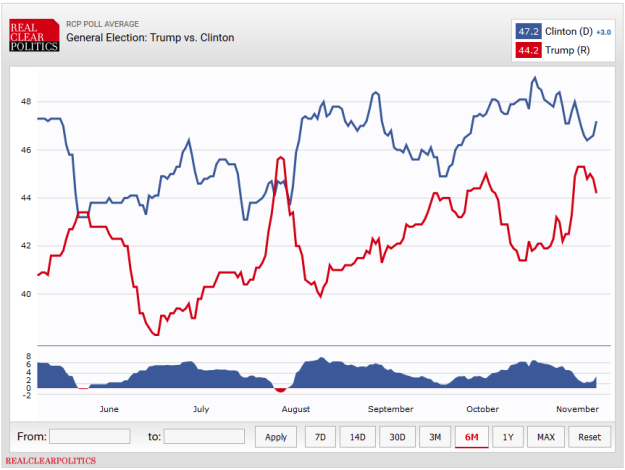
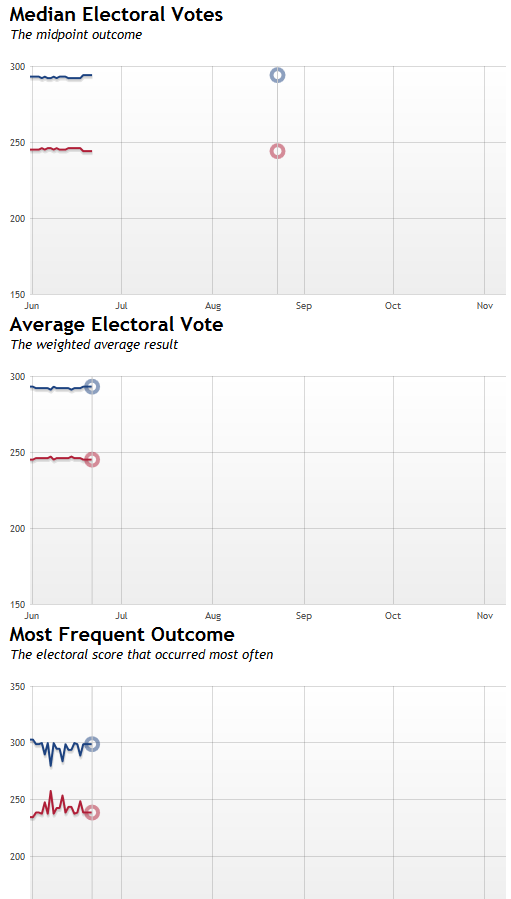
While Clinton’s lead in the popular vote and her probable margin in the electoral college has gone up and down, it’s worth remembering that, over the last 6 months, Trump only ever had a lead for an aggregated total of eight days:

rcp

Exactly as one would suspect from this, it is much more likely than not that Hillary Clinton will be elected the next President of the United States tomorrow.


Election Check-in: 88 Hours To Go!

mappie

Well, here we are, the Friday before the election. Almost made it, America! And, in contrast to how it might have seemed ten days ago, it’s looking like it could be a lively and interesting night on November 8th. We’ll check in on several of our standard indicators, but really at this point it’s all about margins and momentum. So let’s take a look at that.

First, let’s look at the movement in three leading poll aggregators over the last week. RCP is the most “conservative”, in the sense that it takes a small set of polls, and only does a straight mathematical average. HuffPost is the most “liberal” in the sense that it includes almost all polls, and then does regression adjustments on them. 538.com is a data-rich medium, which includes a wider array of polls than RCP, but more selectively than HuffPost, and weights them according to historical accuracy of the pollster, and makes adjustments for historical partisan bias of various pollsters. These three averages include some of the same data across them, some different, and treat it in three different ways. If we average them all, we get:

shift

There are a couple of things to note here. First, Trump has definitely gained over the last week, but he hasn’t done so at the expense of Clinton, who’s average all-in is unchanged. The most likely explanation is that Republican-leaning voters who had been on board with Johnson or undecided are now coming home to the Republican party in the wake of the latest FBI kerfluffle. Second, Clinton’s lead is probably outside a margin of error of roughly 3%, albeit narrowly.

What if we assume the same thing happens over the next four days that did over the last week? That would leave Clinton unchanged at 47%, and gain Trump another 1.7% to bring him to 45%. At this point, assuming current Johnson+Stein polling of around 6% is right, that would leave just 2% undecided. Looking at the makeup of the current undecided/uncertain vote, there’s no clear indication of a decisive break toward either Clinton or Trump. This is kind of a Trump “best case” (all remaining movement is toward him, and he gets a 50-50 split of undecideds), and it still ends up with Clinton-Trump 48%-46%.

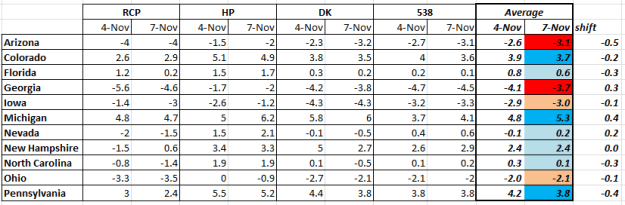
The rub, of course, is that the popular vote doesn’t determine who becomes President. The Electoral College does. Looking again at our above three poll averagers, and adding in DailyKos, who doesn’t do a  national polling average but does track individual states, we see the following movement in what are commonly considered “swing states”over the past week. Since it’s a lot of data, I’m just listing the margin between the two candidates (+ for favoring Clinton, – for favoring Trump):

shift2

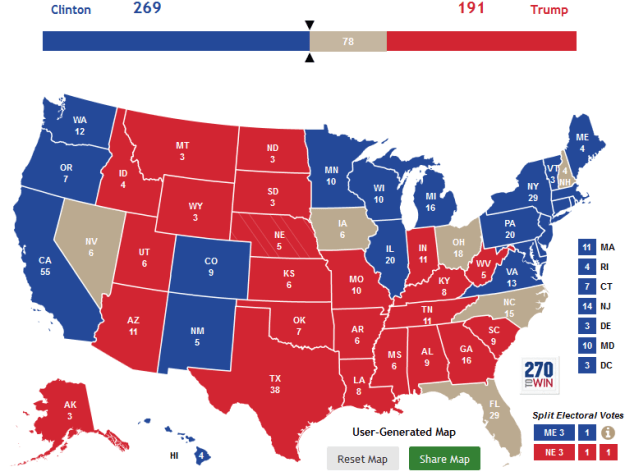
The same shift toward Trump in National margin is apparent in every state, sometimes to a  greater extent, sometimes less. The other thing that you immediately notice is that some of these aren’t really swing states at all. Colorado and Pennsylvania have Clinton margins outside the margin of error, and remain in her column even if Trump makes further gains over the next 4 days equal to what he did the past week. Similarly, Georgia has a Trump margin that’s unlikely to go anywhere. Adding these to the “safe” map for each candidate, you get the following:

270

You could look at this map, in conjunction with the state numbers above, in two ways:

  1. This is a pretty good map for Clinton. Even with further shifts against her, she probably has 269 electoral votes, and Trump can only win if he takes all 7 swing states, and peels off one of the electoral votes in Maine (one of two states that splits its electoral votes). Clinton currently has leads in three of them, and Nevada is 50-50.
  2. This is an extremely borderline map for Clinton. She still has leads in New Hampshire, North Carolina, and Florida , but if the next four days see further movement for Trump equal to the last week, all these leads could go away.

So, in other words, Clinton very likely is headed toward a popular vote win. But even if she’s ahead nationally, the following three electoral college maps are all plausible (I’m splitting Maine in one of them, but not fiddling with the outside chance that McMullin takes Utah, which is an additional wildcard):

case-1case-2case-3

I would advise looking carefully at the updated state averages on Monday (I may publish an update Monday if I have time, but my schedule is looking dicey). In the meantime, let’s take a look at what various sources are saying. Because saying that all three outcomes are possible (or even a larger Clinton blowout, or Clinton collapse) is not the same as saying that they’re all equally likely, and your best bet is still look at an array of indicators.

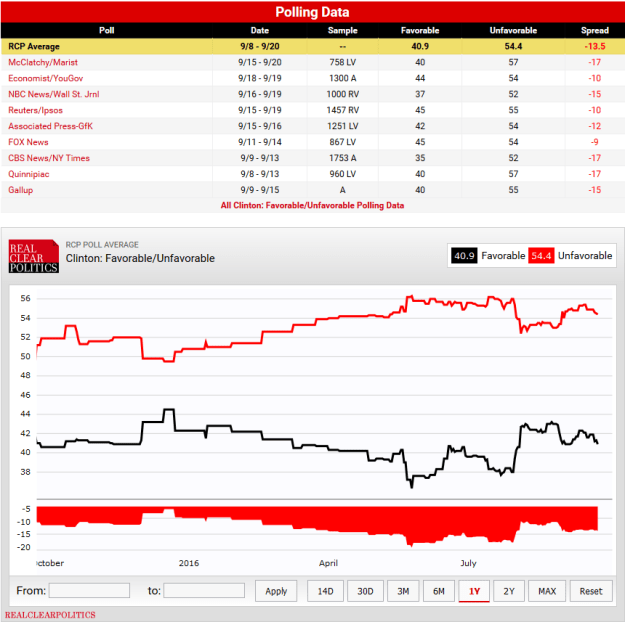
Even after the FBI scare, Clinton still has about a 6 point edge in lower net unfavorability compared to Trump:

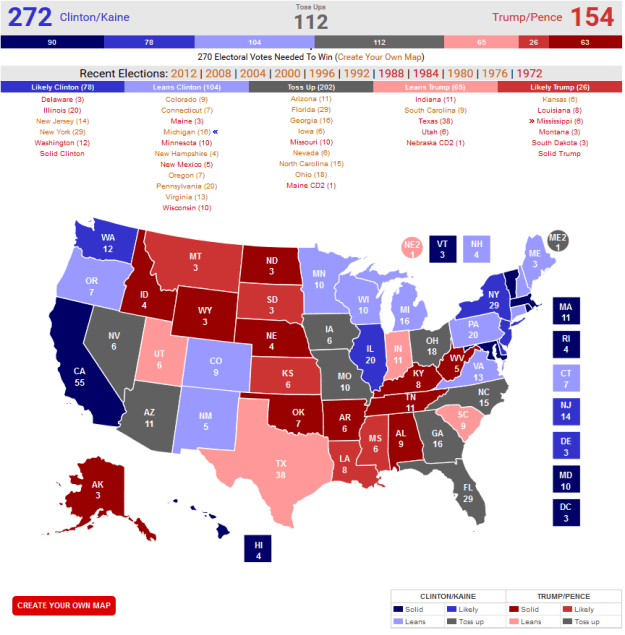
The RCP “No Toss Ups” Map shows the following:

nts

The DailyKos forecast model has this:

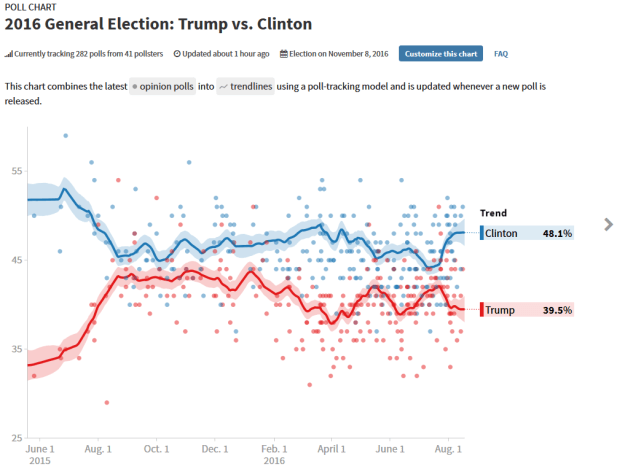
HuffPost’s model shows the following:

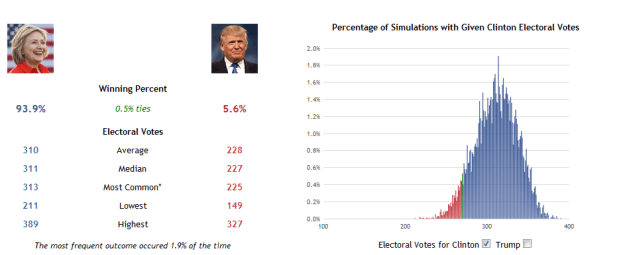
270towin.com’s 10,000 simulations a night are returning the following averages:
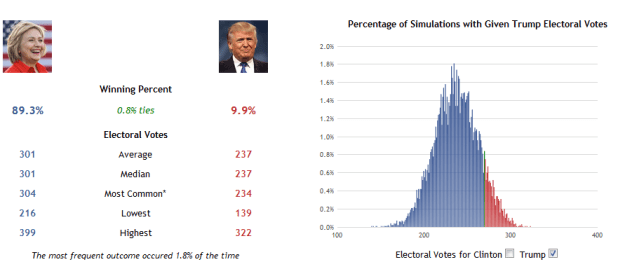
to-win

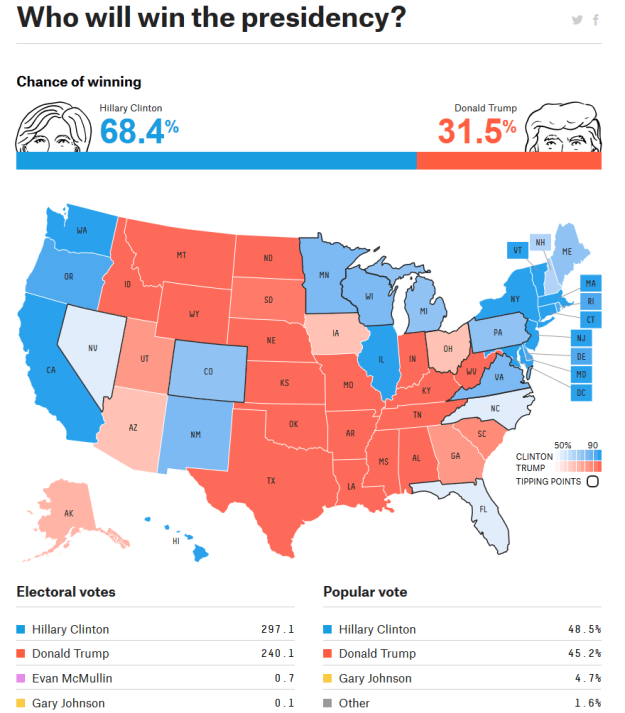
And 538.com is currently showing:

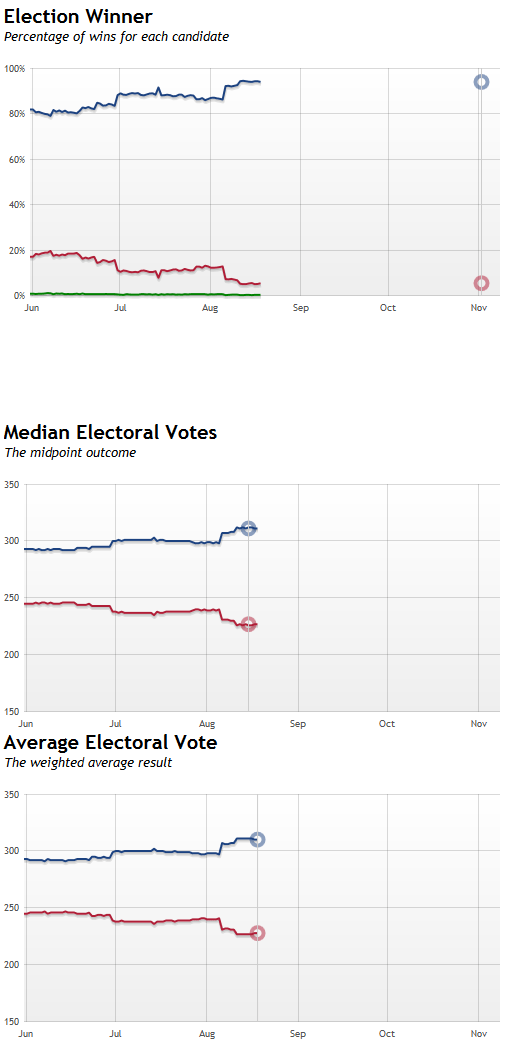
538

Note that 538 shows a much lower confidence level than the others. What this essentially boils down to is a difference not over what the polls are saying, but how likely it is that the polls themselves are wrong. 538.com builds into its model a higher chance that, although state totals indicate a Clinton victory, there could be a polling error of a magnitude such that the polls are wrong. Not a 100% chance, but not zero either, thus they end up around 70/30 instead of the 90%+ that the others are at.

The aggregated betting markets at Predictwise.com are somewhere in-between these two levels:

bet.PNG

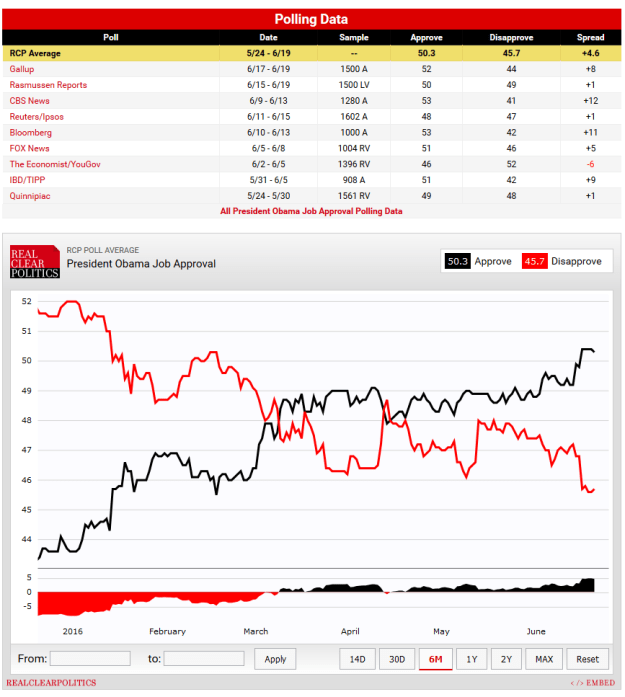
And, finally, President Obama’s approval rating remains at a level that could indicate Democratic victory:

approv

With less than four days to go, based on the preponderance of all available indicators, Hillary Clinton is quite likely to be elected the next President of the Untied States on Tuesday. There is one final relevant indicator: You.

GET OUT AND VOTE!


Election 2016: Two Weeks Notice

weeks

I really despaired of making it this far! It’s actually been both better and far, far worse than I would have imagined. But, putting aside the chance that one candidate refuses to concede the results and stirs up armed revolt, the election will indeed be over in two weeks. I’m as happy as the little pyromaniac girl in the above meme. Who hopefully is not a preview of things to come…

Hey! Do you know who usually wins a Presidential election? The candidate with higher likability. In our case this year, that translates to the candidate with lower net unlikability. But there is a clear difference, with Clinton in single digits at -9.6% net favorability, and Trump over 2x higher with -24.5%:

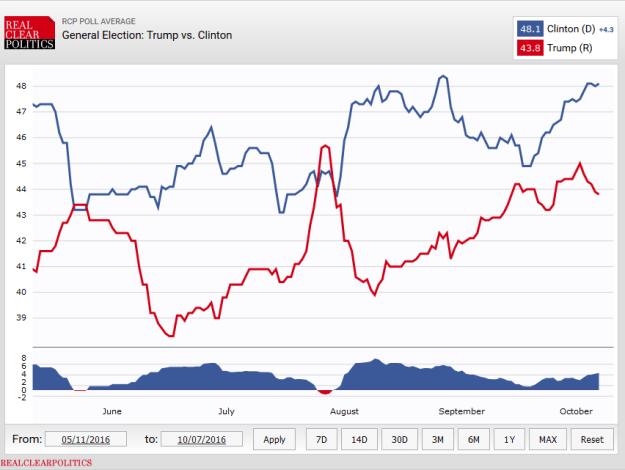
Two weeks out, you would predict on this basis that Clinton will very likely be the winner. What do the polls say? Amazingly, the same thing! Here is RCP’s polling average for the period of May 11th (the day Trump became the presumptive Republican nominee when Kasich and Cruz dropped out after losing Indiana) to today:

rcp

A word about “rigging”: Let’s say you have an average of hundreds of polls over five months by a range of media, educational institutions and private foundations, many of whom even have a house tendency to skew Republican. This average shows that the Democrat has led the Republican in an average of recent polls every single damn day except for two four-day periods, and has a lead of around five points with two weeks to go. If you see that Democrat win, you are not seeing a stolen election. You’re seeing exactly how voters have told pollsters they’re going to vote.

RCP is not the only poll-averaging game in town. HuffPost Pollster also does a polling average, to which they further make trendline adjustments. They have Clinton ahead by around 7 points:

huff

Ah, but what about that wily electoral college? RCPs map of “solid” and “lean” states currently shows a narrow Clinton victory even without the remaining swing states:

rcp-electoral

Their “no toss-ups” map expands the margin even further:

notoss

A word about “rigging”: Let’s say you have an average of hundreds of state polls by a range of media, educational institutions and private foundations, many of whom even have a house tendency to skew Republican. This average at two weeks to go shows that the Democrat wins the electoral college even without the close states, and wins it by a lot more when all the narrow leads are added in. If you see that Democrat win the electoral college by a large margin, you are not seeing a stolen election. You’re seeing exactly how voters have told pollsters they’re going to vote.

270towin runs 10,000 simulations a night using the latest state polls, and comes to a similar conclusion:

270

The simulation’s margins have been wider and lower at certain points, but they’ve never shown Clinton not winning:

270med

All of the above are based on “where things are now” in some form or another, and there are still two weeks left. Nobody in modern Presidential history has come from the kind of position Trump is at now two weeks out and gone on to win, but it is worth pointing out that now does not equal Nov. 8. Forward looking models using various means of taking current data and projecting out are showing the following at 538.com:

538

HuffPost:

And DailyKos:

dk

You may notice that 538 is projecting somewhat higher odds for Trump than anyone else. if you want a really data geeked-out discussion of why, read here. Not to be outdone, an average of thousands of bettors over several betting markets are also overwhelmingly forecasting a Clinton victory:

bet

Finally, there is the theory that an election is a referendum on the incumbent, even when the incumbent isn’t running again. If so, Obama’s net job approval rating over the last few months would also indicate a Democratic victory:

approval

It hopefully doesn’t need to be said again, but every last indicator on the board would lead you to expect that Clinton will win. And, while the margin has been narrower at some times than others, this has been consistently true for the whole period since the primaries ended.

A sizable Clinton victory in two weeks isn’t a sign of a stolen election, it’s what you’d expect to see based on all available data.


Election 2016: One Month To Go!

index

Technically, 31 days, but that’s monthish. And, I mean, how many of us felt like we would never even make it this far? Even better than our group survival thus far, the data is now worth looking at as well.

If you recall some of our earlier analytical forays, a year out, any poll is just about worthless. At 6 months, they’re still not very indicative. By two weeks after both conventions are over, they start to be meaningful. And right about this point, 10 days or so after the first debate, they actually have a pretty strong correlation with final results. So, keeping that in mind, here’s how things look.

On the favorability front, Clinton continues to experience a net unfavorability unprecedented for a major party’s nominee. But, crucially, her gap has closed to single digits post-debate, and remains significantly lower than Trump’s also historically unprecedented unfavorabilty:

We’re probably now at the stage where this gap in their gaps, which has been consistent for months, matters. On the actual how-people-will-vote polling front, Clinton was already on an upswing from her mid-September lows before the first debate. Since then, her position has been further consolidated while Trump’s has turned back down:

polls

Whereas RCP does a straight poll averaging, HuffPost’s Pollster has a somewhat different averaging method that includes trendline results, and is showing an even wider margin for Clinton:

huffpo

State-by-state, the effect of this net change has been dramatic. When they were within a point of each other, her Electoral College margin was a razor-thin 272-266. The current 4-point national lead has swung several of the swing states back from pink to light-blue, and the RCP no toss-ups map currently looks like this:

no-toss

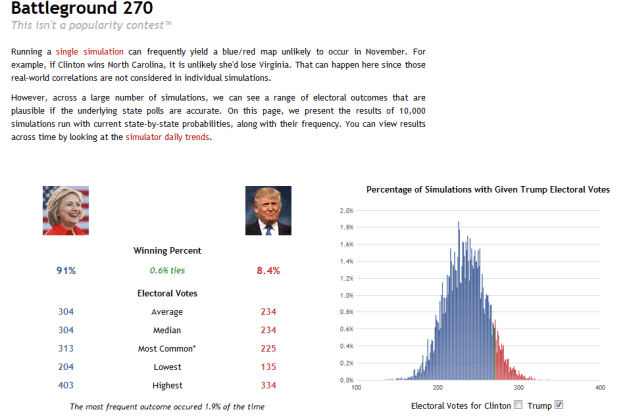
270towin.com’s simulator runs 10,000 simulations a night based on averages of all recent state polling, and it has Clinton winning more than 90% of the time:

270

The crucial caveat is, of course, that the election is not being held today. 538.com’s model projects out the 31 days from now result based on current state polling, with weighting based on the pollster’s history of reliability and partisan bias, and further trendline adjustments based on demographic correlation between states and whether the national polls show a variance to state totals. They then run 20,000 simulations a night. Their “polls-only” model is currently showing the following:

pollsonlyThey also have a “polls-plus” version that includes what you would expect for the incumbent party based on economic performance in the mix. As election day approaches, the two converge, since it’s assumed this is increasingly “priced in” to the polls. This model remains a little more conservative than “polls-only”, and it is showing the following:

pp

It’s always nice to have someone else doing the math too as a sanity-check. DailyKos employs a predictive model that similarly uses regressions and trendlines, and is producing broadly similar results to 538.com:

Meanwhile, the betting markets have several thousand users who are actually ponying-up on what they expect the result to be. Predictwise.com aggregates the results from several of these markets, and they are strongly expecting Clinton to win:

precit

Finally, we can look at the incumbent party President’s approval rating. Obama has had a net positive rating for about 6 months, has been above 50% since August, and has trended up even more strongly in the last few days:

obam

There are other factors that we could examine data on: Clinton has a strong edge over Trump in field offices in key swing states, while Trump is doing very well with White Men without a College Degree, he is actually doing worse than Romney among White voters overall, and the uncertainty in the forecasts is decreasing as fewer undecided and third-party voters remain. These factors, and every one of the above indicators, signal that Clinton remains the likely winner.

Could there be an unexpected change? Always yes. But Wikileaks has pretty much fizzled out on having an October surprise up its sleeves, the pluses and minuses of both candidates are well known, and high-magnitude changes at this stage of a campaign are unusual. We’ll check in again on October 26th, and see how it looks with all three debates concluded, and only two weeks remaining!


State of the Race on the eve of the debate


debate

Good news for my blogging life! I’ve finished the final draft of my screenplay (at last!) and it’s starting to make its way out into the world of submissions. Which should free me up to return to more regular blogging.

As it happens, this is a fortuitous time for an update on the election- we’re 45 days from the finish line, on the eve of the first debate, and have a body of polling that’s now fully absorbed the reaction to Clinton’s “basket of deplorables” remark, and her giving fuel to the ridiculous Healtherist fire by fainting from (and not immediately coming clean about having) pneumonia. So, how do the numbers look?

A popular (and pretty reliable) shorthand is that the relatively more “likable” candidate usually wins. It’s a bit hard to gauge in this case, since Clinton has a historically unprecedented double-digit net unfavorability:

clinton unfav.PNG

This would normally be the kiss of death, except Trump’s has consistently been even higher, and remains so through today, even after Clinton’s bad news stretch:

trump unfav.PNG

Of course, what actually happens in an election is that people vote, not weigh in on favorability. Looking at the RCP polling average, you can certainly see that Clinton’s bad weekend cost her:

pols

At one point, her average margin over Trump was down to 0.9%. Since then, though, it’s started to expand again. But guess what? It isn’t actually about how people vote! Or rather, it is, but in specific states, depending on how they add up in the electoral college. Here, the shifts of the past two weeks have turned several of the light blue swing states pink, leaving Clinton with only a narrow margin:

electoral

Now, there are a few ways to look at this. You could make the case, as RCP analyst Sean Trende does, that Trump behaving exceptionally well under the influence of his new campaign team and Clinton having a horrendous week, combined, still weren’t enough for him to pull ahead. Or you could make the case, as 538.com does, that indications of Clinton’s polling rebound are mixed, and her reliable states are only just enough to get her over the electoral college finish line.

Speaking of 538, their “polls-only” model, crunching all state and national polls, making adjustments for polling firm track-records of of reliability and distortion toward one party or another, trending them forward to election day, and averaging the results of several-thousand trail runs, shows the following:

po

In other words, on average, Clinton carries the popular vote by over 2%, and has a fairly narrow electoral college victory. Her reliable states are the same 272 that the RCP average shows, with Nevada and Florida being pretty close to 50-50 (as indicated by their being light pink). If her polling numbers improve a percentage or two from here, her electoral map gets more solid. If they decline, it stays razor-thin.

Their “polls plus” forecast also weighs economic fundamentals into the forecast. It’s typically a bit more skeptical than polls-only, since the economics indicate more of a 50-50 shot for the incumbent party. However, it weights the economic factors less strongly as election day approaches, figuring everything is more “priced in” to the polls by then. Currently, it’s not too different from “polls only”:

pp

HuffPost’s model does something similar, combining weighted poll averages with trend-lines, and it has Clinton ahead by around 4 points:

huffpost

270towin.com runs 10,000 simulations a night based on the latest state polls, and it currently shows Clinton winning the majority of those simulations:

270

The summary of betting markets at predictwise.com is still pretty bullish on Clinton winning:

predict

Finally, the popularity of the incumbent party can be an indicator. It doesn’t have the greatest track record in years when the incumbent isn’t running for reelection, but is still worth looking at. Obama’s approval numbers shifted into net positive in March/April, and remain fairly strong today:

obama

One thing that I think is important to keep in mind is that, even on a strong run for Trump and coming off of a bad one for Clinton, there isn’t a single indicator on the board that has him ahead. Based on all available data, if the election were held today, you would expect Clinton to win. Somewhat narrowly, but win nonetheless. Unless the debates make things markedly worse for her, or notably better for Trump, the advantage remains Clinton’s.

We’ll tune in to the numbers again on October 7th, at which point we’ll be two weeks past the first debate, a few days after the VP debate, and a month away from the General Election. See you then!


Post-convention, Pre-debate: State of the Race

donald-hillary-800

Didn’t they look so happy together? Ah, for the innocent days of 2005…

I haven’t written about the election for a while. Mostly I’ve been having a busy Summer, and trying to reserve my writing time to finish a screenplay I’ve been working on for a while so that I can get it out into the submission world, and free myself up for new writing projects.

But I’ve also refrained for the very good reason that pre-convention polls, and polls during the conventions, can be quite volatile. An event (A VP pick, an acceptance speech) cause a spike, that spike fades, and then- Bam!- it happens again. It isn’t until a few weeks after both conventions are over that you start to get a sense of how the race is settling out. So here we are, +3 weeks out from the end of the conventions. How do things look?

Clinton is still unprecedentedly unpopular for a major party nominee, with a net favorability rating of -11.5%:

favorable

You would normally associate this profile with the candidate who is going to lose the election. Except that you can see her convention did improve the outlook, and, most vitally, she’s running against a guy with a net -29% favorability rating:

favorable

Looking back over the last few elections, it’s almost a truism- the candidate with the higher favorability rating wins. And, indeed, if we look at the Real Clear Politics polling average for the period from when Trump de-facto secured his nomination after the Indiana primary through today, we see the following:

Tvc

This really isn’t very ambiguous. Except for a four-day period shortly after he’d secured his nomination and while she was still slugging it out with Bernie, and another four days immediately after his convention and before her’s, Clinton has solidly led Trump in an average of recent polls. We can also see that, whereas his convention bump almost immediately collapsed, she has consolidated and maintained the several points she gained during her’s.

One could counter that this is a two-candidate average, but this year The Libertarian and Green parties could both be a factor. It turns out not to matter, because looking at the three-candidate (Clinton-Johnson-Trump) and four-candidate (Clinton-Johnson-Stein-Trump) averages, both Clinton and Trump have lower totals, but the spread is about the same- around +6% Clinton vs. Trump. And it’s not total votes, but who has enough of a margin over the others to capture a state, that determines who wins the electoral college.

Speaking of which, here are RCP’s “Leaning” and “No Toss-up” maps:

lean

toss

Even excluding the swing states, Clinton wins the election. Including all current state margins, she wins it by a blow-out. It’s a very tough map for Trump because, not only would he have to win every swing state (including some that had formerly been shoo-ins for Republicans, like Arizona and Georgia), he’d also have to flip back at least one blue-leaning state.

Fivethirtyeight.com’s Polls-only model (which uses state and local polls, and runs regressions forward to election day) is predicting something almost identical:

polls-only

Their polls-plus model (which combines polling data with “fundamentals” indicators such as economic statistics) is a little more conservative about the size of the popular vote and electoral vote margins, but shows a similarly clear trend:

polls-plus

Huffpost’s Pollster, comes out with a similar result to 538’s “polls only”, forecasting an 8+% Clinton margin:

pollster

Meanwhile, 270towin.com uses the results of current state polls to run 10,000 electoral simulations a night. They have Clinton winning more than 90% of the simulations:

270

They haven’t had her below 80% at any time in the past few months:

tremds

The betting markets are on the same page:

predictwise

Finally, while it’s a weaker indicator than when the incumbent them self is running for election, Obama’s approval ratings also are on the side of a Democratic victory:

opop

So should the Democrat’s start popping champagne corks? Well, that’s never a good idea before the dust is settled.

Nobody as far behind as Trump is at this point has won in the post-war era. But this large a point difference has gone away before (so for example, someone ahead by 15% ended up at only 8% over). FiveThirtyEight has a good discussion of this. On the other hand, Trump has named someone as combative and extreme as himself as his new campaign manager after his third campaign shake-up, even friends and allies are questioning if he even wants to win, and the party establishment is seriously considering cutting all support for him and funneling their resources into trying to hang on to the Senate and prevent the now also-shakey House majority from eroding (see one of my favorite news aggregators with today’s headlines here).

I certainly know where my bet would lie, on the preponderance of all available indicators.


8 from 8: Things I’ve learned in eight years of submissions

eight

In mid-2008 I decided to get organized around what had until then been sporadic literary submissions. A color-coded Excel spreadsheet was born (of course). Over the years it grew to multiple tabs, and the 2008 tab tells me my first submission tracked there was June 26th, 2008. Since today is June 28, 2016, cursory mathematics indicates that I have been at this for eight years!

I aim for a submission a week. I’ve hit something like 70% of that target, racking up 297 total submissions. My stats (so far) are:

stats

Besides getting published, and having lots of fun with Excel along the way, I’ve learned some things. Here, for your perusal, are eight lessons I’ve learned in eight years of doing literary submission:

  1. There’s a lot of research involved. Not all journals are created equal- Some publish only a fraction of a percent of what they receive, and may not be worth your time, especially if you’re just starting out. Some have a reputation for being dynamic, others conservative and stodgy. Some have particular preferences for style & genre, or focus on a particular gender, geography, ethnicity, or subject. I needed to learn to pay attention to all of this in order to increase my odds.
  2. The process has its own rewards. There are many ways to go about this research. Duotrope can help. So can New Pages. Pay attention to where your writer friends are submitting. (If you don’t have writer friends, get some! Writing is a solo activity, which makes community even more invaluable.) When you see a bio of a newer writer you like, look at where they’re publishing. Flip through journals to see what you like. Subscribe to some, or read their online selections. After I’d done this kind of research a while, I started to see connections between my writing, others’, and the publishing world. Ideas about where to submit, and even what to write, bloomed.
  3. A rejection with content is worth its weight in gold. I’ve written about this before, but rejection is not the enemy. Form rejection, with absolutely no clue a human being actually read it, is. The vast majority of rejections I’ve received have been via form letters/e-mails. The rejections that mention something they liked or didn’t like, and maybe even have a suggestion or two, are totally welcome to me now. Both for their rarity, and the fact that they give me something I can use to improve.         
  4. You may never hear back from some places. If you look at my stats above, you’ll see that around 25% of my submissions are still pending. Some have been pending for years. I’m going to go out on a limb and say that, for example, the 25 submissions I still have pending from 2008-2010 probably aren’t going to get published. Some journals will tell you up front that they do not promise a response. Some don’t, and you won’t hear anything except the eerie whistling wind echoing through the dusty, abandoned caverns of the Internet…                                                                               
  5. Being asked to send something else doesn’t automatically mean you’ll get published. This one was a surprise to me. But, in fact, when I submitted something new to places that had passed on something earlier but said they liked it and wanted to see more, they more often than not didn’t publish my new submission. After editing at Mud Season Review, I have some sympathy for this. Whatever the intangible “it” was about the almost accepted piece, the next thing they send often doesn’t have it. Maybe the lesson for publishers is to take the first thing?                
  6. Having something accepted doesn’t automatically mean you’ll get published.
    This was even more surprising to me. But, things happen. Editors leave. Editorial schedules and directions change. Journals run out of funding for the planned issue. Or journals run out of funding, period. Which brings us to..
  7. If you keep at it, you’ll outlast some of them. More than once, I’ve had the experience of getting an e-mail (or even, in prior years, a letter) that turned out not to be an acceptance or a rejection. Instead, it was a journal announcing, regretfully, that they were hanging it up for one reason or another. It turns out it’s a tough gig for everyone, publishers and writers!                                                            
  8. It’s totally worth it. Somewhere in the midst of the vale of research, rejection, missing communications, vanished journals, etc., a real live publication happens. Then another. Eventually, you have an actual body of Published. Work. It’s not only gratifying to see yourself in print, it leads to connections with readers and writers that can be inspiring and rewarding. You have to submit to get there. It’s worth it!                   

So there are eight things I’ve learned in eight years. How about you? I’d love to hear from you about what you’ve learned from the submission process!

Clinton vs. Trump: 4 1/2 months out, the needle points to…

needles

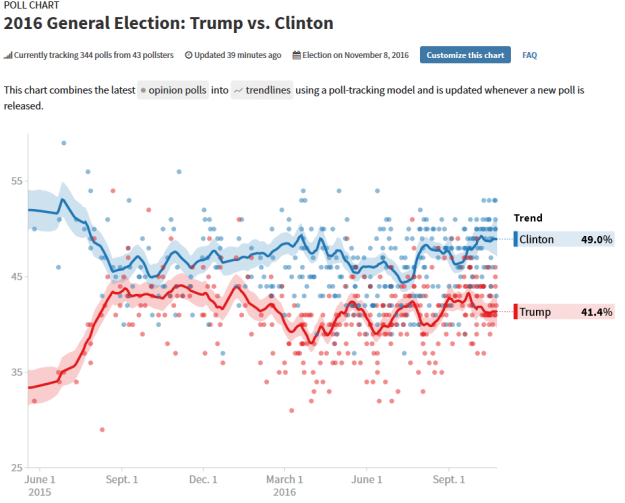
First of all, before we go any further, let’s stipulate that polls at this stage of an election are not very good at predicting final results, though not as bad as they are a year out. You really need to start looking at polling a week or two after both conventions are over, which would be mid-August or so. But you just can’t help it, can you?

Let’s start with this basic fact: Generally, if a candidate had this kind of net unfavorablity rating, you wouldn’t give that candidate a very high chance of being elected:

net

Unless they were running against this candidate:

basic

Score one for Clinton! What about head-to-head polls? Despite my above caveat, there is some sensibility to looking at the polls now. Trump has eliminated his opponents, Clinton’s has gone quiet, nobody really disputes that either is the prospective nominee now, and the last week’s worth of polls even captures reactions after a major news event involving two hot-button issues, terrorism and guns. If we start with the day that Trump became the Republican’s all-but-certain nominee and run through today, we get:

polls

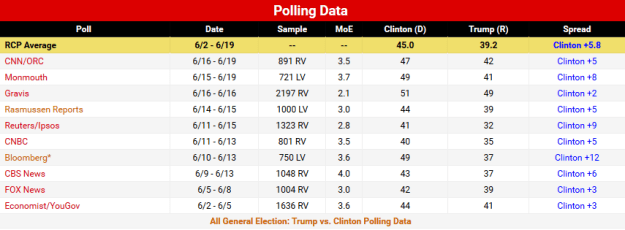
You can see that Trump gained some ground after wrapping up his nomination, and Clinton lost some as her’s dragged on. But she’s now gotten a drift up following her consolidation of nomination, while Trump has dropped. Note that RCP employees a straight averaging of recent major polls:

Capture

However, not all polls are created equal. Different polling firms have different track records of reliability, and also some built-in tendency to skew either Democratic or Republican. 538 does a good overview of this, if you’re interested. Ideally, you’d do some re-balancing of your poll weightings based on historical accuracy and partisan skew. Huffpost Pollster does some version of this, and they’re showing the following:

Capture

It’s worth mentioning that in either polling aggregation, Clinton’s lead is well outside the average margin of error. Of course, the popular vote isn’t everything. In fact, in a U.S. Presidential election, it isn’t even the thing that determines the winner. RCP doesn’t yet have a “no toss-ups” version of their electoral map, but based on the latest state polls, they’re showing the following solid, leaning and toss-up states:

map

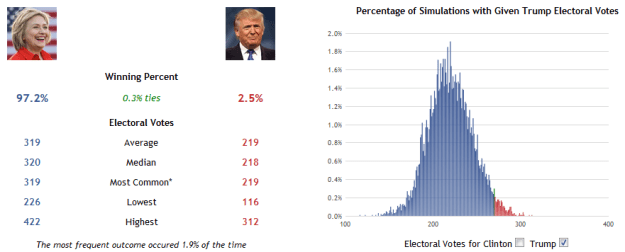
You see a lot of the usual “toss-up state” suspects here, but you also see two that indicate the Republicans are stretched in more territory than usual: Arizona and Georgia. Meanwhile 270towin.com, based on recent state polls where available and extrapolations from 2012 where there isn’t good recent polling, has an electoral simulator that can be fun and terrifying to watch. This simulator does a run of 10,000 simulations a night, for which the latest results are:

stats

They’ve been doing this for three weeks now, and there hasn’t been a lot of variability:

Capture

In addition to silly things like polls and electoral votes, we can also look at the betting markets. These can be much handier to pay attention to than the opinions of pundits because they do the same thing (indicate the opinions of election watchers) but with the advantage of aggregating many thousands of those opinions, and literally asking the opiners to put their money where their mouth is. PredictWise.com, based on the results of several different betting sites, is currently showing:

prediction

Finally, we can look at the popularity of the incumbent party. This isn’t as reliable as when an incumbent is running for reelection themselves (for example, Bill Clinton was sitting on around 60% popularity in early November 2000, but Al Gore ended up with 48.4% of the vote), but it certainly has some value as an indicator. Obama’s approval ratings over the last 6 months look like this:
oproval

It’s certainly early days still, but looking at every statistical leading indicator we have, you would have to say that Hillary Clinton’s chances look pretty good.


Everything is more complicated than it seems at first

love_is_a_complicated_matter_by_byronc-d3chz0b

I had the day off from work on Monday and was off doing things both Sunday and Monday that required real-world presence, so I didn’t get online at all those two days. Which gave me a fortunate and welcome breather from the partisan, ideologized, social media shitstorm that is now our national reaction to any major event. I was still aware enough that along with the tragedy in Orlando there was another, unrelated, arrest in Southern California, and that the Lieutenant Governor of Texas had said something that seemed outrageously upsetting as well.

So I was all prepared Tuesday morning to post something about how I stood with people who celebrate love and diversity, against those like the Orlando ISIL groupie, Southern California extremist and Texas Lieutenant Governor who oppose it.

Before I posted, I thought to look up the latest on James Wesley Howell, the man arrested in Santa Monica on Sunday on his way to a West Hollywood pride celebration with a car-full of guns and explosives. I learned that current indications are that he had a history of dating men and women, his social media indicated no animosity to the gay community, and he had not, as early coverage indicated, stated to police that he planned to do something at the Pride event.

Now, homeboy was rolling into town from Indiana with a prior gun-related charge, some heavy-duty weapons in his car, and explosives that were primed in a way that police can’t fathom there’s some innocent explanation for. So he was clearly a danger in some fashion, and there’s probably more to be revealed here. But one thing he is not, by currently-available evidence, is the kind of Christian/Conservative home-grown terrorist I had originally pictured.

With Texas Lieutenant Governor Dan Patrick, I unfortunately didn’t look further into the story before posting. And I should have. His post Sunday morning of a Bible verse about sowing what one reaps turned out to have nothing to do with Orlando. It was something that had been pre-programmed days before to post at 7 AM that morning, oblivious to any news item. As soon as the unfortunate timing became apparent, it was removed, and his office released a statement of outrage and shock at the shooting, and a new verse was posted offering comfort in times of trouble.

When things like the Orlando tragedy happen, I can get very reactive (actually mostly numb with grief, with a sprinkle of outraged and reactive). And one can easily understand why, based on the last two decades of American public life, I could have thought that a self-righteous official was using the tragedy to moralize at the Gay community’s expense instead of sympathize. You don’t have to dig very far into coverage to find people doing just that. But Lt. Governor Patrick was doing no such thing, and I should have looked before I leaped.

The motive for the shooting itself is turning out to be equally complicated. Once I heard the confirmation that the shooter had pledge support to ISIL in his 911 call, the shooting arranged itself immediately into a narrative about Islamic Fundamentalist-inspired terror in my head, with a generous heaping of homophobia on the side. In fact, there is an emerging body of evidence that indicates the shooter may have been gay, or at least struggling with his sexuality in some fashion. You’ll also find stories indicating that he mentioned three different inspirations inspirations in his 911 call, two of which (ISIL and a Syrian suicide bomber) are actually enemies of each other. And, while he had no particular interest in religion for much of his life, he did have a history of domestic abuse, possible shooting threats as a youth, and quarrels with a coworker during which he spouted invective against all kinds of social groups.

So it may well be that this was an extremely angry and troubled man who glommed on to a pastiche of Islamic radicalism to justify his lashing out at the world, rather than a religious fanatic whose fanaticism led him to violence. And that the animus toward the gay community may have been, much more primarily than religiously inspired, inspired by an internalized homophobia. Or not. Much more will be revealed here too. What we can say is that the real picture may turn out to be much more complicated than the initial picture that I, and many other, people formed.

All of this is a reminder to me that major events are almost always more complicated than they seem at first. Whatever our prejudices, Left or Right, Secular or Religious, may be, the real story is unlikely to be something that fits neatly into them. And so I continue, a little more humble than before.

And I still stand with people who celebrate love and diversity. Because what else can get us through such a complicated world?