Tag Archives: politics

Election Check-in: 88 Hours To Go!

mappie

Well, here we are, the Friday before the election. Almost made it, America! And, in contrast to how it might have seemed ten days ago, it’s looking like it could be a lively and interesting night on November 8th. We’ll check in on several of our standard indicators, but really at this point it’s all about margins and momentum. So let’s take a look at that.

First, let’s look at the movement in three leading poll aggregators over the last week. RCP is the most “conservative”, in the sense that it takes a small set of polls, and only does a straight mathematical average. HuffPost is the most “liberal” in the sense that it includes almost all polls, and then does regression adjustments on them. 538.com is a data-rich medium, which includes a wider array of polls than RCP, but more selectively than HuffPost, and weights them according to historical accuracy of the pollster, and makes adjustments for historical partisan bias of various pollsters. These three averages include some of the same data across them, some different, and treat it in three different ways. If we average them all, we get:

shift

There are a couple of things to note here. First, Trump has definitely gained over the last week, but he hasn’t done so at the expense of Clinton, who’s average all-in is unchanged. The most likely explanation is that Republican-leaning voters who had been on board with Johnson or undecided are now coming home to the Republican party in the wake of the latest FBI kerfluffle. Second, Clinton’s lead is probably outside a margin of error of roughly 3%, albeit narrowly.

What if we assume the same thing happens over the next four days that did over the last week? That would leave Clinton unchanged at 47%, and gain Trump another 1.7% to bring him to 45%. At this point, assuming current Johnson+Stein polling of around 6% is right, that would leave just 2% undecided. Looking at the makeup of the current undecided/uncertain vote, there’s no clear indication of a decisive break toward either Clinton or Trump. This is kind of a Trump “best case” (all remaining movement is toward him, and he gets a 50-50 split of undecideds), and it still ends up with Clinton-Trump 48%-46%.

The rub, of course, is that the popular vote doesn’t determine who becomes President. The Electoral College does. Looking again at our above three poll averagers, and adding in DailyKos, who doesn’t do a  national polling average but does track individual states, we see the following movement in what are commonly considered “swing states”over the past week. Since it’s a lot of data, I’m just listing the margin between the two candidates (+ for favoring Clinton, – for favoring Trump):

shift2

The same shift toward Trump in National margin is apparent in every state, sometimes to a  greater extent, sometimes less. The other thing that you immediately notice is that some of these aren’t really swing states at all. Colorado and Pennsylvania have Clinton margins outside the margin of error, and remain in her column even if Trump makes further gains over the next 4 days equal to what he did the past week. Similarly, Georgia has a Trump margin that’s unlikely to go anywhere. Adding these to the “safe” map for each candidate, you get the following:

270

You could look at this map, in conjunction with the state numbers above, in two ways:

  1. This is a pretty good map for Clinton. Even with further shifts against her, she probably has 269 electoral votes, and Trump can only win if he takes all 7 swing states, and peels off one of the electoral votes in Maine (one of two states that splits its electoral votes). Clinton currently has leads in three of them, and Nevada is 50-50.
  2. This is an extremely borderline map for Clinton. She still has leads in New Hampshire, North Carolina, and Florida , but if the next four days see further movement for Trump equal to the last week, all these leads could go away.

So, in other words, Clinton very likely is headed toward a popular vote win. But even if she’s ahead nationally, the following three electoral college maps are all plausible (I’m splitting Maine in one of them, but not fiddling with the outside chance that McMullin takes Utah, which is an additional wildcard):

case-1case-2case-3

I would advise looking carefully at the updated state averages on Monday (I may publish an update Monday if I have time, but my schedule is looking dicey). In the meantime, let’s take a look at what various sources are saying. Because saying that all three outcomes are possible (or even a larger Clinton blowout, or Clinton collapse) is not the same as saying that they’re all equally likely, and your best bet is still look at an array of indicators.

Even after the FBI scare, Clinton still has about a 6 point edge in lower net unfavorability compared to Trump:

The RCP “No Toss Ups” Map shows the following:

nts

The DailyKos forecast model has this:

HuffPost’s model shows the following:

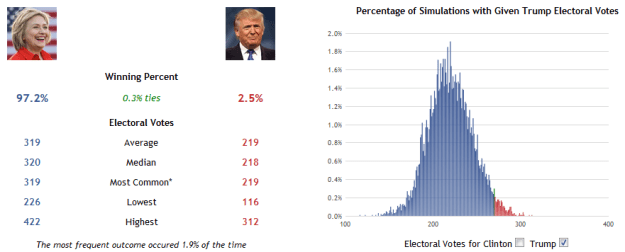
270towin.com’s 10,000 simulations a night are returning the following averages:
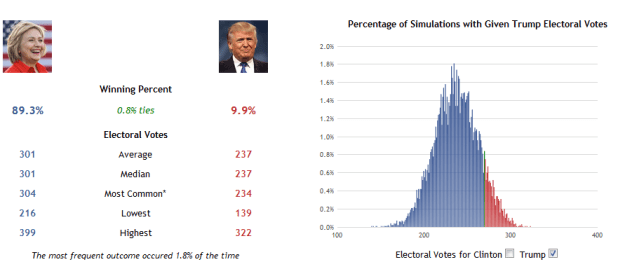
to-win

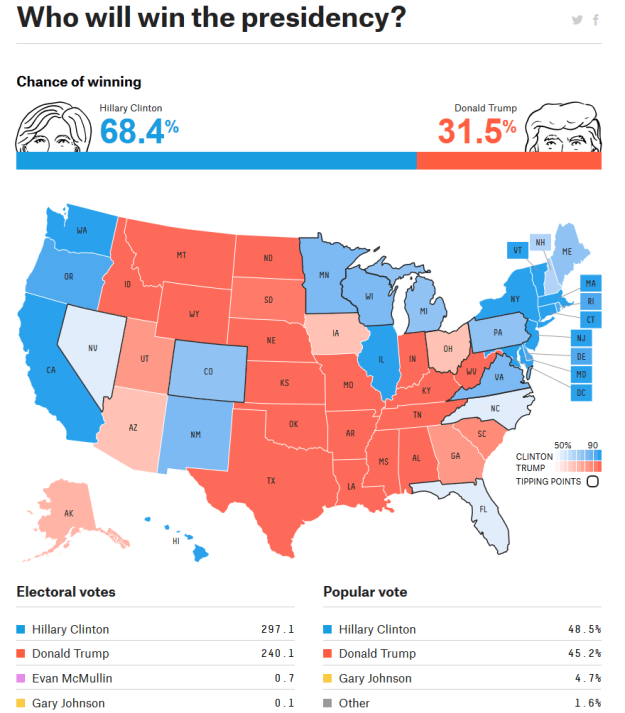
And 538.com is currently showing:

538

Note that 538 shows a much lower confidence level than the others. What this essentially boils down to is a difference not over what the polls are saying, but how likely it is that the polls themselves are wrong. 538.com builds into its model a higher chance that, although state totals indicate a Clinton victory, there could be a polling error of a magnitude such that the polls are wrong. Not a 100% chance, but not zero either, thus they end up around 70/30 instead of the 90%+ that the others are at.

The aggregated betting markets at Predictwise.com are somewhere in-between these two levels:

bet.PNG

And, finally, President Obama’s approval rating remains at a level that could indicate Democratic victory:

approv

With less than four days to go, based on the preponderance of all available indicators, Hillary Clinton is quite likely to be elected the next President of the Untied States on Tuesday. There is one final relevant indicator: You.

GET OUT AND VOTE!


Election 2016: Two Weeks Notice

weeks

I really despaired of making it this far! It’s actually been both better and far, far worse than I would have imagined. But, putting aside the chance that one candidate refuses to concede the results and stirs up armed revolt, the election will indeed be over in two weeks. I’m as happy as the little pyromaniac girl in the above meme. Who hopefully is not a preview of things to come…

Hey! Do you know who usually wins a Presidential election? The candidate with higher likability. In our case this year, that translates to the candidate with lower net unlikability. But there is a clear difference, with Clinton in single digits at -9.6% net favorability, and Trump over 2x higher with -24.5%:

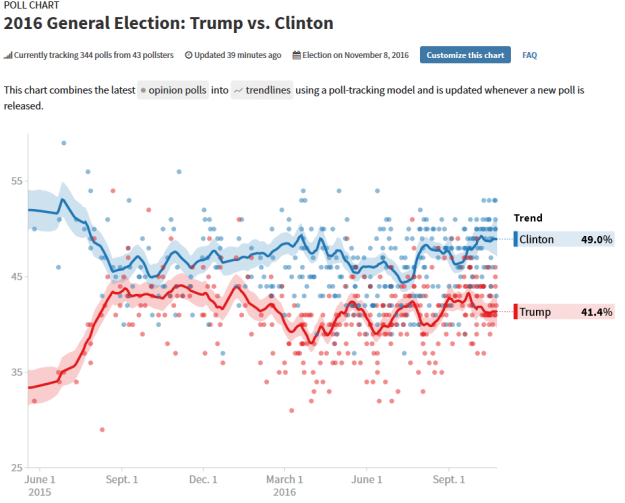
Two weeks out, you would predict on this basis that Clinton will very likely be the winner. What do the polls say? Amazingly, the same thing! Here is RCP’s polling average for the period of May 11th (the day Trump became the presumptive Republican nominee when Kasich and Cruz dropped out after losing Indiana) to today:

rcp

A word about “rigging”: Let’s say you have an average of hundreds of polls over five months by a range of media, educational institutions and private foundations, many of whom even have a house tendency to skew Republican. This average shows that the Democrat has led the Republican in an average of recent polls every single damn day except for two four-day periods, and has a lead of around five points with two weeks to go. If you see that Democrat win, you are not seeing a stolen election. You’re seeing exactly how voters have told pollsters they’re going to vote.

RCP is not the only poll-averaging game in town. HuffPost Pollster also does a polling average, to which they further make trendline adjustments. They have Clinton ahead by around 7 points:

huff

Ah, but what about that wily electoral college? RCPs map of “solid” and “lean” states currently shows a narrow Clinton victory even without the remaining swing states:

rcp-electoral

Their “no toss-ups” map expands the margin even further:

notoss

A word about “rigging”: Let’s say you have an average of hundreds of state polls by a range of media, educational institutions and private foundations, many of whom even have a house tendency to skew Republican. This average at two weeks to go shows that the Democrat wins the electoral college even without the close states, and wins it by a lot more when all the narrow leads are added in. If you see that Democrat win the electoral college by a large margin, you are not seeing a stolen election. You’re seeing exactly how voters have told pollsters they’re going to vote.

270towin runs 10,000 simulations a night using the latest state polls, and comes to a similar conclusion:

270

The simulation’s margins have been wider and lower at certain points, but they’ve never shown Clinton not winning:

270med

All of the above are based on “where things are now” in some form or another, and there are still two weeks left. Nobody in modern Presidential history has come from the kind of position Trump is at now two weeks out and gone on to win, but it is worth pointing out that now does not equal Nov. 8. Forward looking models using various means of taking current data and projecting out are showing the following at 538.com:

538

HuffPost:

And DailyKos:

dk

You may notice that 538 is projecting somewhat higher odds for Trump than anyone else. if you want a really data geeked-out discussion of why, read here. Not to be outdone, an average of thousands of bettors over several betting markets are also overwhelmingly forecasting a Clinton victory:

bet

Finally, there is the theory that an election is a referendum on the incumbent, even when the incumbent isn’t running again. If so, Obama’s net job approval rating over the last few months would also indicate a Democratic victory:

approval

It hopefully doesn’t need to be said again, but every last indicator on the board would lead you to expect that Clinton will win. And, while the margin has been narrower at some times than others, this has been consistently true for the whole period since the primaries ended.

A sizable Clinton victory in two weeks isn’t a sign of a stolen election, it’s what you’d expect to see based on all available data.


Everything is more complicated than it seems at first

love_is_a_complicated_matter_by_byronc-d3chz0b

I had the day off from work on Monday and was off doing things both Sunday and Monday that required real-world presence, so I didn’t get online at all those two days. Which gave me a fortunate and welcome breather from the partisan, ideologized, social media shitstorm that is now our national reaction to any major event. I was still aware enough that along with the tragedy in Orlando there was another, unrelated, arrest in Southern California, and that the Lieutenant Governor of Texas had said something that seemed outrageously upsetting as well.

So I was all prepared Tuesday morning to post something about how I stood with people who celebrate love and diversity, against those like the Orlando ISIL groupie, Southern California extremist and Texas Lieutenant Governor who oppose it.

Before I posted, I thought to look up the latest on James Wesley Howell, the man arrested in Santa Monica on Sunday on his way to a West Hollywood pride celebration with a car-full of guns and explosives. I learned that current indications are that he had a history of dating men and women, his social media indicated no animosity to the gay community, and he had not, as early coverage indicated, stated to police that he planned to do something at the Pride event.

Now, homeboy was rolling into town from Indiana with a prior gun-related charge, some heavy-duty weapons in his car, and explosives that were primed in a way that police can’t fathom there’s some innocent explanation for. So he was clearly a danger in some fashion, and there’s probably more to be revealed here. But one thing he is not, by currently-available evidence, is the kind of Christian/Conservative home-grown terrorist I had originally pictured.

With Texas Lieutenant Governor Dan Patrick, I unfortunately didn’t look further into the story before posting. And I should have. His post Sunday morning of a Bible verse about sowing what one reaps turned out to have nothing to do with Orlando. It was something that had been pre-programmed days before to post at 7 AM that morning, oblivious to any news item. As soon as the unfortunate timing became apparent, it was removed, and his office released a statement of outrage and shock at the shooting, and a new verse was posted offering comfort in times of trouble.

When things like the Orlando tragedy happen, I can get very reactive (actually mostly numb with grief, with a sprinkle of outraged and reactive). And one can easily understand why, based on the last two decades of American public life, I could have thought that a self-righteous official was using the tragedy to moralize at the Gay community’s expense instead of sympathize. You don’t have to dig very far into coverage to find people doing just that. But Lt. Governor Patrick was doing no such thing, and I should have looked before I leaped.

The motive for the shooting itself is turning out to be equally complicated. Once I heard the confirmation that the shooter had pledge support to ISIL in his 911 call, the shooting arranged itself immediately into a narrative about Islamic Fundamentalist-inspired terror in my head, with a generous heaping of homophobia on the side. In fact, there is an emerging body of evidence that indicates the shooter may have been gay, or at least struggling with his sexuality in some fashion. You’ll also find stories indicating that he mentioned three different inspirations inspirations in his 911 call, two of which (ISIL and a Syrian suicide bomber) are actually enemies of each other. And, while he had no particular interest in religion for much of his life, he did have a history of domestic abuse, possible shooting threats as a youth, and quarrels with a coworker during which he spouted invective against all kinds of social groups.

So it may well be that this was an extremely angry and troubled man who glommed on to a pastiche of Islamic radicalism to justify his lashing out at the world, rather than a religious fanatic whose fanaticism led him to violence. And that the animus toward the gay community may have been, much more primarily than religiously inspired, inspired by an internalized homophobia. Or not. Much more will be revealed here too. What we can say is that the real picture may turn out to be much more complicated than the initial picture that I, and many other, people formed.

All of this is a reminder to me that major events are almost always more complicated than they seem at first. Whatever our prejudices, Left or Right, Secular or Religious, may be, the real story is unlikely to be something that fits neatly into them. And so I continue, a little more humble than before.

And I still stand with people who celebrate love and diversity. Because what else can get us through such a complicated world?

Once more unto the Super-Tuesday breach…

S3

Well, last Tuesday we had New York with 291 delegates on the Democratic side, and today five Northeastern states are up at once with a combined 462 more. This looks like one of those rare times that the preferences of the East Coast will have a major effect on choices the nation makes-28% of all the delegates left in the rest of the race will be chosen by this time tomorrow. Here’s where things stand:

Democrats

First off, hoo-boy was I wrong! I said last week that I thought there were signs that Bernie Sanders was going to do better in New York than the polling seemed to indicate. In fact, he got shellacked in New York 58%-42%, a proportion pretty much matching what the polling averages were indicating.

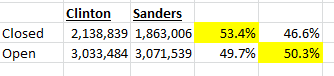
Looking back, I would say that, whatever traces I thought I was sniffing, I should have been a good data-head and really crunched the numbers, because I was badly under-estimating the effect of New York being a closed primary. It’s been observed that Sanders has drawn a lot of his support from voters who register Independent, who can participate in states that have open primaries, but can’t in states with closed primaries. Indeed, if you crunch the numbers on averages of non-Southern open primaries vs. closed primaries, you find the following:

OVC

Sanders wins a narrow majority of total votes in open primaries, but has lost the closed primaries 47-53. All five of today’s states have closed or semi-closed primaries, which means Sanders will not be picking up cross-over voters. Thus, you can probably take the polls that show him facing double-digit losses in Maryland & Pennsylvania at face value. His best bets for the night look like Connecticut and Rhode Island, where he’s narrowly behind:

Conn

RI

If he ends up 0-5 on a night when 28% of the remaining delegates are up, that’s not going to silence the voices calling for him to admit the game is up. Narrowly winning 2 of the smaller states, both from his native New England, won’t either. He’ll certainly have the money and the enthusiastic base of supporters to stay in until the end. There’s even an open primary coming up next week, Indiana, and he remains within striking distance in polling of the largest state of all, California. And a decent argument can be made that he should stay in for the good of his movement, and democracy in general. But in terms of realistic chances, the New York blowout made his already up-hill shot even steeper, and tonight is liable to make it steeper still.

Republicans

In a certain sense, the Republican side is much clearer, and in a certain sense, it’s murky as %$#@. After a very strong New York last week, Trump is showing solid leads in all five states tonight, and the Republican delegate rules are liable to expand his haul even further.

But behind the scenes, Cruz continues to have a much better ground game for the nuts and bolts of picking up delegates that are still being chosen in state conventions even after the voting has ended. In the current Republican game of delegate-by-delegate attrition, in which a Trump who hasn’t reached the required 1,237 delegates by the convention could have serious problems thereafter, every bit counts.

And then there’s the alliance! Cruz and Kasich are strategically agreeing to stay out of each other’s way in several of the remaining contests. This may indeed be too little, too late, but it does stand a decent shot of handing Cruz Indiana next week, and getting Kasich several Western States. If it does work, Cruz getting all 57 of the winner-take-all delegates next week could seriously complicate Trump’s remaining math. If it doesn’t, that 57 plus his haul from tonight will probably put Trump on track to get close enough to the 1,237 that the game is, effectively, over.

Stay tuned!

Four things I’ve avoided by not writing about the 2016 election until now

Capture

I’m going to be breaking from my usual themes occasionally over the next year to talk about the presidential election. I really can’t help it, I’ve been a political junkie for actually longer than I can remember- my mom tells me as a three year old, I was fascinated with watching “the Watergate” on TV. My promise in my coverage: I have my leanings (solidly Democratic). But my analysis will be fact-based, to the chagrin of both leftie friends and rightie friends. You can look back at my postings from 2012 to get an idea of what that will look like.

However, to keep it in synch with my more usual blog themes, this first entry will be in the form of a list. The thing about Presidential politics is, there’s a lot of noise in media coverage that tends to drown out the signal. Before Nov. 1 of the year before the election, it isn’t even worth paying attention to, really, because the early speculation is based on so little, empirically, and early numbers aren’t indicative of much of anything. Here’s a few things I’ve been able to avoid talking about by not writing about it until now:

1. 4 whole candidates! First, and in an originally 22-candidate field, the value of this is not to be overlooked, by waiting I’ve avoided having to talk about Chaffe, Perry, Walker and Webb at all! Especially relieving, because I would have thought Walker had a decent chance at the Republican nomination, so it’s nice not to have to endure the daymare that would have been.

2. Joe Biden. I love Uncle Joe! Always have. He was actually one of my two preferred candidates at the start of 2008 (the other was Bill Richardson, which goes to show you what I know). But it would have been a long shot for him, and explaining that to people imbibing the latest media narrative would have grown tiresome. Now I don’t have to!

3. Arguing about Bernie Sanders. I actually can’t win with Bernie. My small cadre of rightie friends starts in on the whole tired socialist trip whenever I talk about Bernie. And my Progressive friends call me a cynic when I try to talk realistically about his chances (which have been, and remain, low according to every reliable indicator). Then I have my mainline Democratic friends who try to convince me that Bernie is worthless or even dangerous and Hillary is golden. By not writing about the election until now, I’ve at least had some break from this argument.

4. Dismissing Trump. My early take was that he would be gone before voting started, and certainly would not be in the top three by Super Tuesday. I’m glad I didn’t have a chance to write more about this, because I’m starting to question my premise. Nate Silver at 538.com, who I put a lot of stock in, still thinks Trump is ultimately doomed, because he’s so unpalatable to the party power brokers, and they have numerous opportunities in the process to derail him one way or another. It’s a solid argument. But, now that he’s been in the lead for three and a half months straight, is polling first or second in the three first primaries, and actual voting starts in 90 days, I’m a little less sure. I still don’t expect him to be the nominee (my current best guess is Rubio), but he’s actually in this thing for real.

More to follow!