Category Archives: books

Book reviews: Glasshouse, The Writers Journey

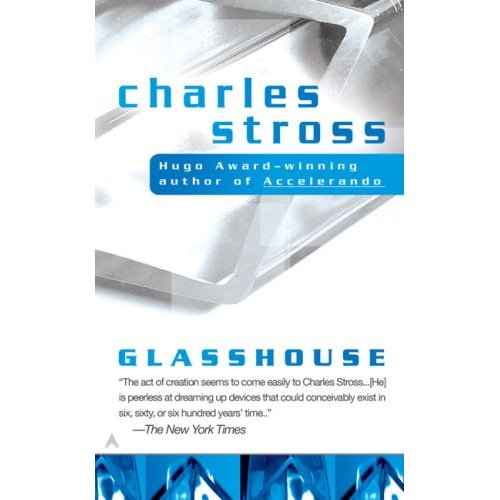
Glasshouse (Charles Stross, Ace, 2006, 352 pp.) 
Yes, that’s right, you’re getting two reviews for the price of one today. Having finished both books in the past week, I thought it would be nice to combine and expedite. Glasshouse was actually the final book of my Sci-Fi book club in San Francisco before I moved eastward. I don’t think they ever formally met to review it, but heck, I’ll give my review now:

Great! Disquieting in a good way. A little rushed at the end.

Without sacrificing my strong anti-spoiler stand, I can tell you that most of the book involves a character from a post-human future participating in a re-created simulation of late 20th/early 21st century life. This results in multiple opportunities to see our society from the outside, and appreciate how strange and even absurd some everyday things that we take for granted are. I think this is one of the highest functions sci-fi can serve. An additional layer of disquiet is provided by the fact that our narrator is someone who has undergone extensive self-induced memory restructuring (a kind of brain engineering not uncommon in this future). The result is that throughout, they can’t be quite sure who they were before the experiment, just what they’re doing there, and even which of their memories are real versus manufactured. This creates a feeling of being trapped inside a feeling of being trapped that is used to good dramatic purpose throughout.

About my only criticism is that the denouement feels very rushed. Things happen in 10 pages that easily could (and should) have been developed over 30-50 pages. I can’t hold a grudge though. As a writer, I can testify that endings are hard, and this book remains well worth the time of anyone who enjoys contemplating just what “self” is and how we use memory to construct it.          

The Writers Journey: Mythic Structure for Writers (Christopher Vogler, Michael Wiese Productions, 3rd. Edition, 2007, 407 pp.)

Speaking of being a writer, this is a GREAT book on writing and story structure. It’s written specifically with reference to film, Vogler being a professional story consultant for the movie industry, but the principles that he covers are applicable to stories of all kinds. Inherently so, since what he’s done is drawn upon the stages of the Hero’s Journey as originally written about by student of Carl Jung and mythologist extraordinaire Joseph Campbell.

Vogler uses the character archetypes and structures of myth repeatedly found worldwide, and shows how they’re employed in film as a way of teaching what makes a story work. Hence the use of a monster in the photo above to highlight the mythic aspects of the book.  

The Writers Journey was recommended to me by my friend Robert Evans of my former San Francisco writing group. Just as he promised, it proved very helpful with the screenplay that I’m currently working on. Besides which, it was delightful fun seeing examples of how universals of story structure and character development can be found in films ranging from The Wizard of Oz and The Lion King through Ordinary People and Pulp Fiction. Along the way, I gained a grudging admiration for Titanic, a strong desire to see more John Wayne movies, and even an interest in re-watching Beverly Hills Cop. Giving birth to that last wish is surely a feat that only a great writer could have accomplished!       

Review: Superman/Batman: Vengeance

Superman/Batman: Vengeance (Jeph Loeb/Ed McGuiness, DC, 2006, originally Superman/Batman #20-25)

Dearest Blog, I don’t know if we’ve ever discussed this before, but I am a comics collector from way back. Probably this is not news to you, given my other proclivities, but just for the record, there it is. 

In my earliest form, in the halcyon age of those spinny metal wracks in supermarkets, I was a fan of horror comics. I would load up every time my parents went shopping. As I got a little older, I became an acolyte of Marvel. This was in the early-mid 80s, when they were really the shit- The X-Men, Fantastic Four, Thor, Spiderman et al were in the midst of some of their best runs. Except for following writer/artist John Byrne’s run on Superman when he went to DC from Marvel, and Frank Miller’s work on Batman, I wasn’t very interested in DC. Compared to Marvel’s attempts at psychological and physical realism, DC was just a little too cartoony, too hokey, with the fake cities (Metropolis, Central City, etc.), unlimited god-like powers, silly weaknesses like kryptonite and the color yellow.

As with many things that had been a key part of my life (writing being front and center on that list), I put down comics when I went to graduate school in the mid-90s. My soul went into hibernation and life got more and more off track. After recovery and separation and other major life changes, I began to pick up things again (writing being front and center!) in 2002. And so comics have returned to my life, fueled by the collections of storylines into big softcover trade paperbacks that has become one of the major distribution modes of the 2000s.

I’ve caught up with some great stuff this decade. And to my surprise, I’ve found that in my old age I’ve become a big fan of DC. In part, it’s certainly because younger writers and artists have shaken up the formerly staid world of DC. But I think it also reflects my own ability to connect now, after a lot more of life’s twists and turns, with the basic, archetypal legends that DC has to offer. They deliver comics myth-making in its most elemental form.

None are more archetypal than Superman and Batman, two golden oldies still running strong after 70 years. Each has several monthly series devoted to them, but they also co-starred during the 2000s in Superman/Batman. I have dearly loved it for how it takes the two biggest toys in the DC Universe, presents them at the peak of their careers, and spins an ongoing storyline involving the two of them but liberally drawing on heroes and villains from all over DC. 

This is the fourth collection from that series, and it’s a doozy! I’m allergically opposed to spoilers, so I won’t give away much that you don’t learn in the first few pages: Superman and Batman find themselves crossing paths in a parallel universe with the Maximums, a wonderful parody/homage of the “Ultimate” version of Marvel’s Avengers. This could be a throwaway concept in the wrong hands, but the Maximums are very well done, the kind of loving forgery that shows as much affection as cattiness toward Marvel. Along the way, alternate Supermans and Batmans galore enter in, as do Bizarro and Batzaro. The series also draws in threads from almost everything that’s happened in issues 1-19. You should probably read the other three collections first (“Public Enemies”, “Supergirl” and “Absolute Power”), but once you’re done, this volume delivers international, intergalactic and interdimensional fun in a way that only DC can get away with.


Review: The Big Book of Conspiracies

The Big Book of Conspiracies (Doug Moench, Paradox Press, 1995, 223 pp.)

I just finished this book, which had been part of my recent Amazon birthday haul, so I thought I would strike the iron of review while the reading is still hot. Or something like that.

I have to say I quite enjoyed it, perhaps even more than its sister volume The Big Book of the Unexplained. I certainly found this tome to be more disquieting. And delightful. That’s right, delightfully disquieting.

That’s what you get when you have well-researched text on some of the darkest conspiracy allegations out there illustrated by 39 different comic artists. I think this is actually a pretty compelling combination, which could profitably be used a lot more than it is. There’s like this, and Classic Comics. And I guess that whole Introducing/For Beginners book series, which I’m also a big fan of. Someone likes narrative art, apparently…

A word on the artists themselves: they were really good! It was a pleasure to run in to a few names I knew well from mainstream comics: Frank Quitely, Michael Avon Oeming and Bob Smith, for example. A lot of the others though, were from alternative comics, with styles ranging from cartoonish to dark and surreal. I look forward to catching up with what they’ve been up to since the mid-90s.

As far as the text goes, Moench is a comics writer as well, and the writing benefits from the best features of the medium: it’s lucid, fast-moving, and entertaining. It’s also, despite the obvious mirth behind the form, well-researched and packed with information. As in a five page double column bibliography citing the sources for what’s presented in the 39 chapters.

Conspiracy theory is as conspiracy theory does, and some of what’s presented here is definitely a wild leap, or based on specious connections. I enjoyed further researching a lot of it online as well, and, predictably, some things are less sinister (and solid) than they appear to be at first glance. There are others, though, that get more disquieting. To touch on a Golden Oldie, what the heck is up with Lee Harvey Oswald? I’m finding that to be the most interesting (and fruitful question) in the whole JFK thing- maybe there was only one gunmen, and he was that one. But how did he end up there, and why, everywhere in his history that you look, do you find strange connections? There’s something to this whole CIA-Mafia-Cuban Exile thing.

The JFK assassination, of course, ended up in the book a lot, and much of the rest was pretty familiar territory as well: RFK, MLK, CIA mind control, Freemasons, Karen Silkwood, the always dear to my heart UFO-conspiracies. There were also some that were new to me such as:

  • Multiple intriguing threads linking Jonestown to the CIA
  • The international businessman/secret agent James Douglas Morrison that started showing up all over the place right after Jim Morrison’s “death”
  • Truly bizzare Reagan assassination attempt tidbits such as the fact that John Hinckley Senior was a friend of George Bush Sr., his son Neil Bush had dinner plans with John’s brother Scott Hinckley the day of the assassination attempt, and a second Jodie Foster-obsessesed young man threatening Reagan was arrested with a gun at New York Port Authority a few days after the attempt
  • John Whiteside Parsons. Look him up online, and bathe in the weird goodness that is this sadly deceased patriot/JPL scientist/follower of Aleister Crowley. 

The book also re-introduced me to the strange death of Danny Casolaro, who was found dead in a hotel of an apparent suicide as he was working on a book about the conspiracy that he claimed linked the October Surprise, Iran Contra, the S&L scandal and just about every other shady late 80s thing there was with a government attempt to steal a security-monitoring software. Were some of his sources questionable? Yep. Did he have financial troubles and other frustrations that could lead to suicide? Yep. Was he being warned off before his death in calls overheard by third parties? Yep. Were his research files missing from the hotel, and never subsequently found? Yep. Again, worth further reading on your part.

But don’t tell anyone I told you so. Or send them a hyperlink to this review…


I love packages from Amazon!

Even when, no, especially when, like this one, I already know what’s in them. Birthday and holiday gift cards are a beautiful thing, because they allow me to go on shopping sprees for things that have been piling up in the back of my mind for a while.

Sometimes, like in this case, I enjoy giving it my shopping expeditions a thematic spin. My purchases were:

The Big Book of Conspiracies I got the The Big Book of the Unexplained several years ago, I think in the excellent used comics section at Aardvark Books in the Castro in SF. Ever since then, I’ve been on the lookout for this volume on conspiracy theories from the same series. The basic format is a series of short articles on different topics, all written by the same person but illustrated by different comic artists for each section. The BBotU certainly alerted me to some aspects of the paranormal that I hadn’t known about previously, while also reacquainting me with some old friends. I’m looking forward to the same here. Despite the obviously tongue-in-cheek presentation in terms of form, the content is actually quite well cited. And there’s something about the juxtaposition that gets it further under the skin than reading or seeing something on TV alone would do. I’m also looking forward to the hours of joy in further researching online new things I run across in this book. I’ve found one can both do some instant debunking, and crawl further down the rabbit hole this way.

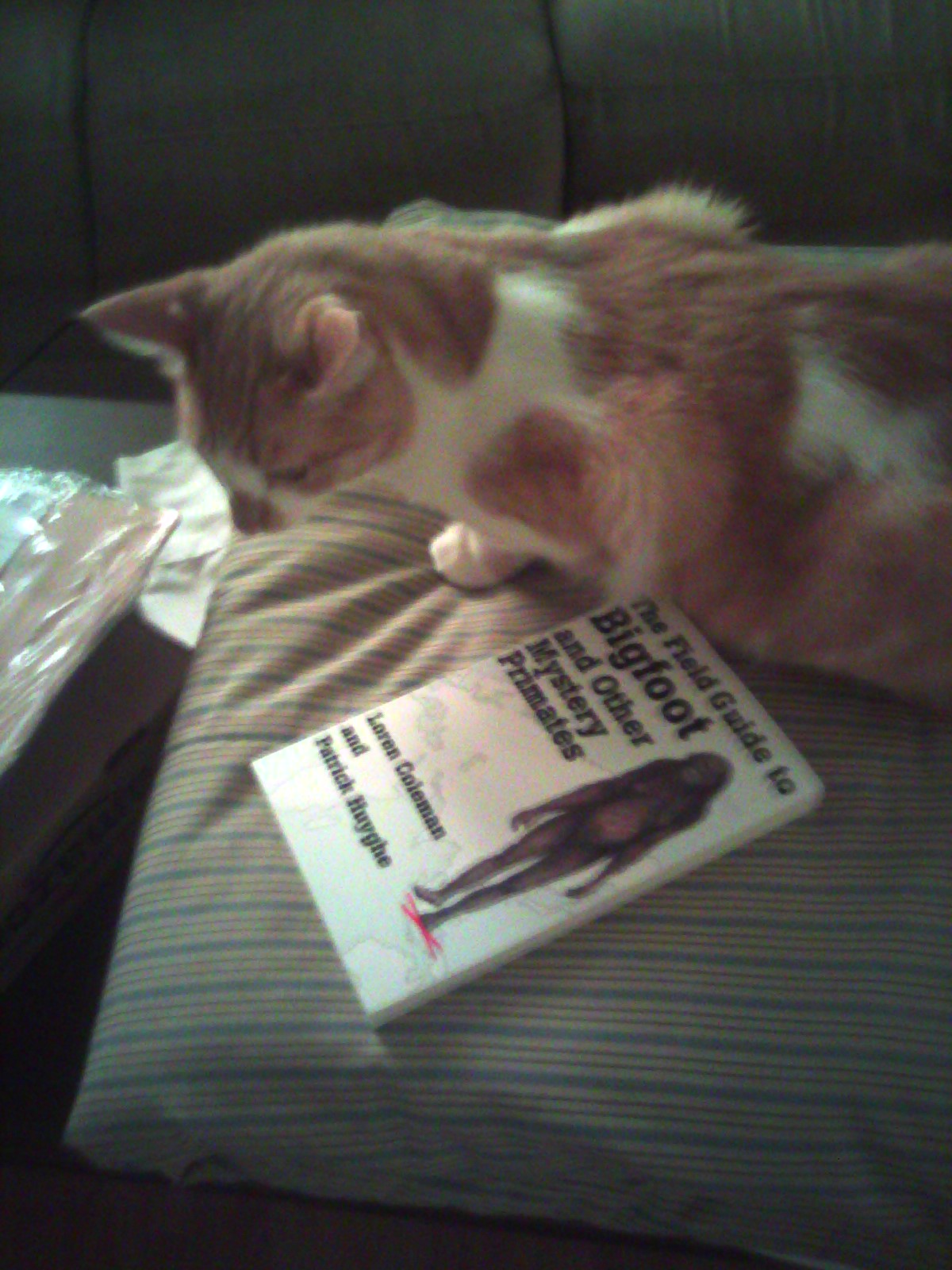
The Field Guide to Bigfoot and Other Mystery Primates This volume is co-authored by Loren Coleman, leading cryptozoologist and proprietor of the International Cryptozoology Museum that Abbey and I visited recently in Portland, Maine. It’s set up as a pretty straightforward field guide in some ways- illustrations, species descriptions, range maps, footprint outlines, etc. It just happens that the subject matter is a little more exotic and/or possibly nonexistent. Could come in handy, since I plan to doing a lot of tromping through the woods in these parts. Bonus question: Is the creature next to the book a mystery primate? I don’t know, but now that I have the field guide I can find out!

The Mysterious Monsters I am especially excited about this volume, as you can see. But hey, you’ve gotta understand! I got this book as a kid, around 10 years old, from a book fair at elementary school. The Mysterious Monsters in question are the Abominable Snowman, Bigfoot and the Loch Ness Monster, and the book was actually pretty low on sensationalism and strongly evidence-focused in its treatment of the subject. This was one of my first forays into the world of the unexplained which, obviously, has had a lifelong effect on me. The beloved volume vanished at some point, along with a lot of things that were in my childhood room, as things from one’s childhood room will tend to do. Over the years I’ve tried to track it down, but was hobbled by the fact that I couldn’t remember two key pieces of information: the title, or the author’s name. I did try googling based on my recollection of content many times, but to no avail. And then, a week or so ago, for whatever reason, I found a combination of search terms that led me straight to it. I’m looking forward to re-reading it, and seeing what I make of it now that I’m about 4x as old as the first time I read it. Talk about unexplained phenomenon!

10 Essential Sci-Fi Books

(from my Sci-Fi Book Club)
(and thoughts on 11 others)

One of the things I sorely miss about SF (the city, San Francisco) is my SF (the genre, Sci-fi) Book Club. We started in March 2008, taking turns each picking a book. Our membership waxed and waned from nearly 10 to barely 2 or 3 at times. We had periods where we met every 6 weeks like clockwork, then some others where we couldn’t get together a next meeting for months. Even in the face of all these starts and stops, we got through 21 books by the time I moved to the Boston Area in July 2011.

Despite being a very book kind of guy and card-carrying geek of multiple lineages (Star Trek, Star Wars, comics collector, D&D player, I could go on), I had actually never read much Sci-fi, so I was interested to see what was out there, and what I would think of it. From the admittedly not completely scientifc selection of the books picked by the guys and surprisingly large number of gals in our group, here’s my vote on a top 10, in alphabetical order (spoiler light beyond the basic premises, since I hate spoilers):

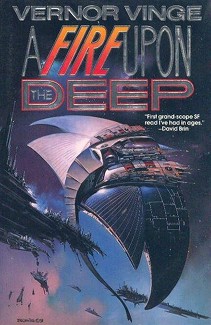
1. A Fire Upon the Deep  (Vernor Vinge, 1993) In full disclosure mode, I must note that this is one of the ones I picked. That being said, I really didn’t know a lot about it beyond being familiar with Vernor Vinge from his relationship to thought about the Singularity. It turned out to be a delight for the way it combined genres- at heart it’s a kind of horror story, with a really scary ultra-intelligence monster. But the story gets told in a unique Sci-fi setting (a race across across the galaxy, which turns out to be segregated by zones where intelligence, and even the laws of physics, are more advanced on the edge, and get duller toward the center). And a great deal of the action happens in what is basically a fantasy setting, full of castles and palace intrigue. Really well written, delightful all the way through, and provocative.

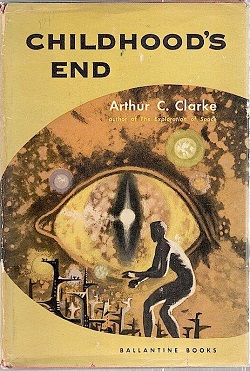
2. Childhood’s End (Arthur C. Clarke, 1953) This was the third book we read, deservedly a classic. Clarke is a master of clear, simple prose. The book itself is the prototypical “saucers appear over every capital on Earth” story, and once you read it, you’ll see its influence everywhere. As far as what those saucers are doing there, who’s in them, and what they want with us, though, the thing I found most striking about the book was its originality, both at the time of publication, and still today almost 60 years later.

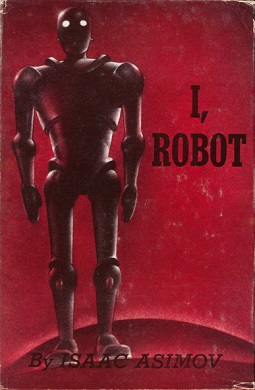
3. I, Robot (Isaac Asimov, 1950) Again, a classic, and one whose influence you’ll find everywhere you look. The thing that most impresses me about Asimov, though, is the warm humanity of the writing. The stories ring true not so much based on whether predictions about technology and future society are on target (though some of them are), but mostly because they are full of the author’s shrewd understanding of what people are like and why they do what they do. In the hands of someone else this could come off very cynical, but with Asimov it’s more of a wise, knowing, “Ah, yes, that’s who we are.”

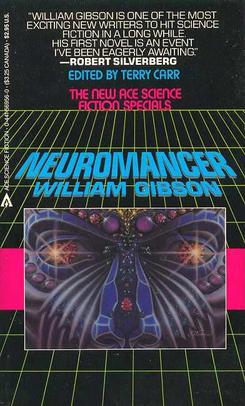
4. Neuromancer  (William Gibson, 1984) Here is born cyberpunk. And happy birthday to it! In many ways, a chillingly plausible look at a world more technologically advanced, but more socially decayed. Did this foresee many aspects of the Internet, or actually influence its development? And seriously, could The Matrix pay some copyright for ripping off every element of character and visual design it had from this book (albeit with a very different storyline)? But beyond all the further thoughts I could unload about it, at heart it’s a damn well done film noir story thrust into the realm of cyberspace (a term it invented!).  

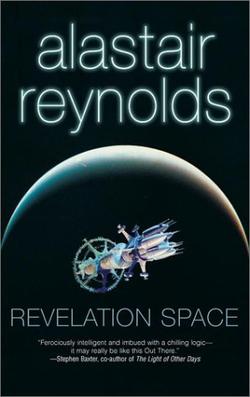
5. Revelation Space (Alastair Reynolds, 2000) All the books I’ve described so far do an excellent job with character, but I don’t think any of them get as deep into the psychology of their (often deeply flawed) main characters as this book does. Along the way, there’s horror, intrigue, skillful plotting as three widely divergent storylines converge, and high concept cosmic evolution. Given that so many of the works we read came from a Sci-fi heyday of the 50s to the 70s, this makes me glad to say: Well done, 2000s!

6. The Forever War (Joe Haldeman, 1974) When it first came out, this was a kind of parable about the Vietnam War told through the main character’s experience of a war lasting generations due to the time dilation between it’s far-flung battlefields. Nobody quite knows how the war is going, why we’re fighting, or even exactly who the enemy is. Sad to say, it has a whole new resonance thirty-five year later after our own decade-long Forever War Against Terror.

7. The Martian Chronicles (Ray Bradbury, 1950) This was the book we kicked off with. As we should have, since it gave us the vital middle of the ABC “big three” of classic sci-fi (Asimov, Bradbury, Clarke). In terms of science, the Mars it portrays was already badly outdated by the mid 60s, and throughout, the technology of how we get there and stay there is treated as an afterthhought. And that really doesn’t matter, because it functions on the level of fable- the things in it are true, because they’ve always been true. And that truth is suffused with some of the most heartbreakingly beautiful prose you will ever read.

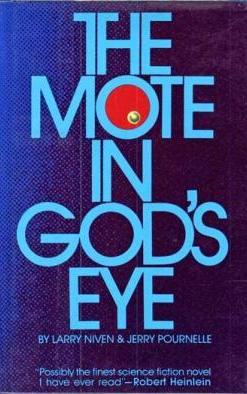
8. The Mote In God’s Eye (Larry Niven and Jerry Pournelle, 1974) There’s also some feudality here, in that there are lords and ladies in an interstellar monarchy. This turns out to be a feature of several of the books we read, a portrayal of human civilization becoming more feudal as it spreads out across multiple star systems. The focus of the action, though, is first contact with the Moties. I’ll leave it to you to find out all about them, but suffice it to say it is a superb portrayal of just how physically and culturally alien an alien race might turn out to be. Plus it’s just good, character-rich, well-plotted, fast-paced fun to read.


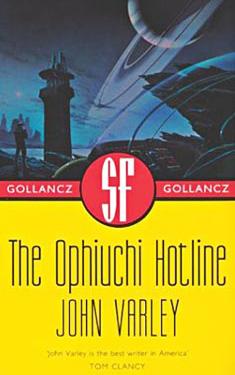
9. The Ophiuchi Hotline (John Varley, 1977) Set in a solar system that is now thoroughly inhabited (except for, curiously, but for good reasons, Earth) this book is rollicking good fun. It has everything you’d need for a good time- clones, aliens, spaceships, genetic engineering. It also delivers a future that seems quite plausible to me (especially the banana meat trees) despite how exotic it is. And it makes you think about just how little say we might have in the shape of our own future if there really are other intelligences and a higher cosmic order.

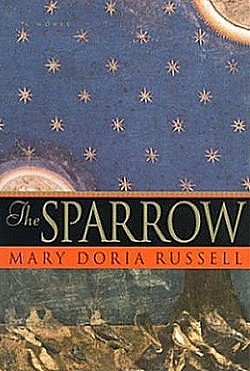
10. The Sparrow (Mary Doria Russell, 1996) This could be exhibit A in the “Is literary fiction that happens to use Sci-fi themes or settings still Sci-fi?” argument. Or, conversely, “Can Sci-fi be ‘serious’ literature?” I’ve always thought it’s a bit of a silly distinction. Dickens and Shakespeare were, in their time, writing that day’s equivalents of potboilers. Meanwhile, many things that are supposed to be “important books” today will vanish in the mists of time, and thus prove to be quite as disposable as anything Danielle Steele ever wrote. Good writing is good writing, and time will tell what the enduring literature is. But this massively sidetracks us. A great book, literarily. And great sci-fi. Also one of my favorite kinds of sci-fi, near future, and involving first contact. Which turns out to be far less about the aliens, and far more about who we are and how we make meaning in life.

Honorable Mention (9 other good reads):
Berserker (Fred Saberhagen, 1967)– May man versus killer robot spaceships always be so fun.
Eon (Greg Bear, 1987)– I think about this one a lot, almost a top 10. Stunning ideas about future human evolution, with a time travel twist. Plus great use of Ralph Nader. Really.  
Flashforward (Robert J. Sawyer, 1999)– I told you that CERN supercollider would be trouble… 
IQ83 (Arthur Herzog, 1978)– A potboiler? Yes. But damn would it be fucked up if this happened.
Quarantine (Greg Egan, 1992)– While this didn’t make my top 10, I do think Egan is one of the finest, and most philosophically challenging, sci-fi writers out there. Check out Distress and Permutation City for further mind-bending.
Starship Troopers (Robert Heinlein, 1959)– Right wing? Left wing? Somehow to blame for the movie made from it? And Showgirls as well, through mere association? Or just damn fun reading?
The Divine Invasion (Philip K. Dick, 1981)– One of my favorite authors. If I hadn’t already read his book VALIS before I got to the group, it would have been in the top ten above, and this is more from that same, very good, vein.
The Gods Themselves (Isaac Asimov, 1972)– I don’t believe Asimov wrote a bad book. Besides which, anything featuring trisexual energy beings is an automatic yes.
The Road  (Cormac McCarthy, 2006)– See The Sparrow above vis-a-vis Sci-fi and literary fiction. Either way, a great book that somehow manages to be heartwarming and unrelentingly grim at the same time.


Dishonorable Mention (2 cautionary tales)
Last and First Men (Olaf Stapledon, 1930)– It deserves props for ambitious future history, and recognition as one of the earliest sci-fi novels. It was also very dry and slow. The only one I never finished from the group, sad to say.
The Blind Assassin (Margaret Atwood, 2000)– Great book, albeit very slow to start and frequently quite bleak. Not Sci-fi, though it does contain a sci-fi tale within the tale. Discussions on group policy were had afterward.
10 Books in 2010 Self-challenge (update)

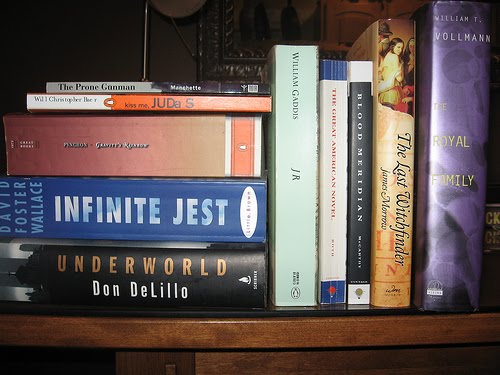
I got this idea lodged in my head that I would challenge myself to read 10 pending “always meant to get to it” books in 2010. I like the symmetry of the numbers, and I figured it would give me a good literary kick in the ass without being such a big list that I couldn’t possibly finish. I did a blog about this last month with my list as it stood at that time, asking for particular recommendations. Since then, I’ve added a few more to the list, so I’m now up to 22. Help!

-the Illiad
-Paradise Lost
-Short Stories of Dostoevsky
-something by Tom Robbins (what?)
-Catcher in the Rye
-Jesus’ Son
-Letters to a Young Poet
-something by Raymond Chandler (what?)
-something by Raymond Carver (particular recommendation?)
-the Analects
-the Varieties of Religious Experience
-Aristotle’s Poetics
-The Corrections
-Good in Bed
-Pass it On
-something by DeLillo (I’m leaning towards “Libra”)
-Godel, Escher, Bach
-Please Kill Me
-The Epic of Gilgamesh
-Jung (either Man and His Symbols or his autobiography)
-Cannery Row
-Tales of the City

Since I’ve got to get this down to 10, are there any particular plugs for “must reads” from the list? Any specific recommendations for the authors I’m not sure about which book to pick (Tom Robbins, Carver, Chandler, DeLillo)? Your input is appreciated…

Help with my Ten Books in 2010 self-challenge

I’ve decided to issue myself a self-challenge in 2010: I’m going to try to read 10 books that are on my “always wanted to, but never got around to” list.

Now is the part where you come in- I’ve started a list, but it has over ten entires, with more being added all the time. Any particular “yea” votes? Or suggestions about something I might want to add? The list so far (mixing sacred and profane, in no particular order):

-the Illiad
-Paradise Lost
-Short Stories of Dostoevsky
-something by Tom Robbins (what?)
-Catcher in the Rye
-Jesus’ Son
-Letters to a Young Poet
-something by Raymond Chandler (what?)
-something by Raymond Carver (particular recommendation?)
-the Analects
-the Varieties of Religious Experience
-Aristotle’s Poetics
-The Corrections
-Good in Bed
-Pass it On
-something by DeLillo (I’m leaning towards “Libra”)
-Godel, Escher, Bach
-Please Kill Me
-The Epic of Gilgamesh

Any suggestions?