DJ Vermonster has released a rough mix of “Electro 1”, a track on their forthcoming EP!
Who is DJ Vermonster? Why is DJ Vermonster? Find out more here!
DJ Vermonster has released a rough mix of “Electro 1”, a track on their forthcoming EP!
Who is DJ Vermonster? Why is DJ Vermonster? Find out more here!


2023 was the 50th anniversary of hip hop, and in honor of this anniversary, the idea bloomed in my mind last year that I should review the top 50 albums of that 50 years. As I crunched together a list from various sources, 50 proved to be too restrictive- many of the classics were getting squeezed out. So, to make a little more room, I opted for 100 albums, two for each of hip hop’s 50 years. Due to some medical situations, I took a three+ month hiatus from blogging last year, so I didn’t finish the series. But I’m back at it, and I don’t mind extending into 2025 if you don’t!
For its formative years, hip hop was a live entertainment form, with the first recorded singles not emerging until 1979, and the first albums in 1980. So my review covers 1980-2023, with 50 posts of two albums each. The only ground rule I made for myself (besides looking for 2×50, aka 100, albums that were widely well-regarded) was that I had to have at least one from each year. As you’ll see by and by, some years get multiple albums, but since we have 100 spots for 43 years, it tends to all work out.
And with that, let’s embark on our next installment!
Nas, Illmatic (1994)– I have to admit I really knew next to nothing about either Nas or this album besides that it was considered a 90s classic, and the artist had an 00s beef with Jay-Z. Turns out there is a lot to know! The son of a jazz musician, Nas came up in the Long Island hip-hop scene after his family moved from Queens, and along the way got the attention of Rakim, Kool G Rap, and 3rd Bass. Serch of 3rd Bass became his manager and got him the record deal that led to this debut album. And he puts it all into this debut- songs he had been writing since he was 16, vivid recollections of his youth in the Queensbridge housing project, a reverence for and references to hip hop’s entire musical history to this point, and a really engaging lyrical delivery. I can’t say I picked up on all of this while listening, but I am subsequently informed that his lyrical style here included layered rhythms, multisyllabic rhymes, internal half rhymes, assonance, and enjambment. Take that, poets! All in all, it felt catchy, musical, and weighty and real while still being a fun listen. The album was apparently released to a lot of hype that its sales didn’t quite live up to, but great critical acclaim. Sales caught up long term, and the critical reputation and influence on the genre has remained. Upon finally hearing it, I’m down with that!
Scarface, The Diary (1994)- As I started listening, before catching up on reading on it, I thought for sure this was a West Coast album. It has the synthy squlech, funk samples, mix of humorous and horrific situations, and laid back pacing that reminded me of the West Coast scene, and the vocal flow carried a kind of heaviness that put me in mind of Tupac. I still stand by those impressions, but it turns out Scarface is a Houston rapper, and one of the members of the Geto Boys on Grip It! On That Other Level. Which makes more sense to me, given how much that album reminded me in parts of N.W.A.. On Scarface’s part, the album is an explicit statement of being one of the founders of gangsta rap, disputing SoCal’s claim on the throne. Well, regardless of where it comes from, it’s grooving, slightly sinister, tells an actual story, and is delivered with earned authority.
If you’re curious about the sources I used to compile my list, you can check them out here:
And if you want to catch up on the previous installments, here they are…
Finally, if you’d like a playlist for the entire list, you can find that here. Listen to it sequentially for the historical development of the genre, or play on shuffle for maximum historical scramble!

2023 was the 50th anniversary of hip hop, and in honor of this anniversary, the idea bloomed in my mind last year that I should review the top 50 albums of that 50 years. As I crunched together a list from various sources, 50 proved to be too restrictive- many of the classics were getting squeezed out. So, to make a little more room, I opted for 100 albums, two for each of hip hop’s 50 years. Due to some medical situations, I took a three+ month hiatus from blogging last year, so I didn’t finish the series. But I’m back at it, and I don’t mind extending into 2025 if you don’t!
For its formative years, hip hop was a live entertainment form, with the first recorded singles not emerging until 1979, and the first albums in 1980. So my review covers 1980-2023, with 50 posts of two albums each. The only ground rule I made for myself (besides looking for 2×50, aka 100, albums that were widely well-regarded) was that I had to have at least one from each year. As you’ll see by and by, some years get multiple albums, but since we have 100 spots for 43 years, it tends to all work out.
And with that, let’s embark on our next installment!
Snoop Doggy Dogg, Doggystyle (1993)– The two albums in this post are so well-paired, being the respective apotheoses of West Coast and East Coast hip hop just as that was becoming a vital distinction. Some might make the case, reasonably, that The Chronic is the signal album of the West Coast scene. But I would say this album is really a continuation of The Chronic, where Snoop had originally been introduced, and an even fiercer distillation of producer Dr. Dre’s G-funk sound. It also broke through to mass culture, both in musical influence and controversy, at an even higher level than its predecessor. In terms of production, performance, and structure, the album is well nigh flawless- connecting skits that tell vivid stories, sharp and surprising lyrical turns, Snoop’s distinctive lackadaisical flow, metallic beats, laid-back funky grooves, and distinctive squelchy synthesizers, cleverly deployed samples and interpolations. There isn’t a second of it that isn’t a great listen. And it is, just as often, appalling. The general critical question of gangster rap might be summarized as: Is it reflecting and even criticizing a certain urban reality, or is it glorifying and amplifying the worst parts of that reality? That question becomes super-salient with this album because the sexual braggadocio, the misogyny, drug culture, and gang violence are all turned up to the max. Sometimes with a humor that feels tongue in cheek, sometimes with a genuine sense of menace, but in a way that never leaves one comfortable. Which is, in a way, another mark of a great album.
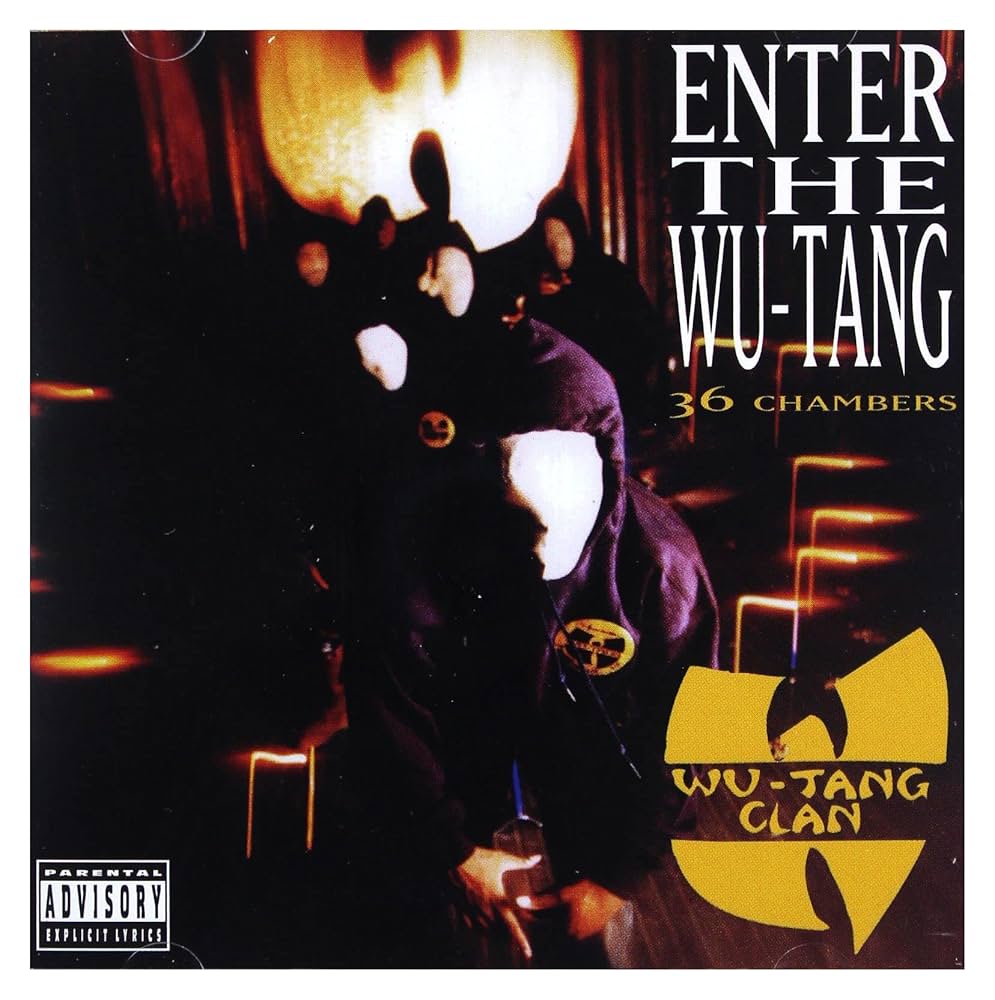
Wu-Tang Clan, Enter the Wu-Tang (36 Chambers) (1993)- From the West to the East… There are certainly those who would make the case for Jay-Z, Nas, or the Notorious B.I.G. having made the quintessential East Coast hip hop album. Not a ridiculous case, and all of them will appear later in our list. But this, much like The Chronic/Doggystle for the West, is the album that established the 90s renaissance of East Coast hip hop artistically and commercially, and served as an inspiration for those to come. Coming from the same Long Island neighborhood, cousins RZA and GZA had seen their childhood trio with another cousin, the future Ol’ Dirty Bastard, fall through. They’d then been signed separately, but had their solo careers similarly falter. This soured them on the industry, but not on their music, and they became determined to do their own project with other rising stars from their neighborhood. Mix together nine members with distinctive voices in both senses of the word, alternating wacky humor and menace, a crunchy sound that is in part an artifact of their limited budget, and a melange of influences that include classic soul samples, Five Percent Nation philosophy, kung fu movies, and comics, and you get a debut album that is, against the odds, a masterpiece. It was a sensation at the time, remains influential, and, most tellingly, still sounds like a fresh and amazing surprise today.
If you’re curious about the sources I used to compile my list, you can check them out here:
And if you want to catch up on the previous installments, here they are…
Finally, if you’d like a playlist for the entire list, you can find that here. Listen to it sequentially for the historical development of the genre, or play on shuffle for maximum historical scramble!
2023 was the 50th anniversary of hip hop, and in honor of this anniversary, the idea bloomed in my mind last year that I should review the top 50 albums of that 50 years. As I crunched together a list from various sources, 50 proved to be too restrictive- many of the classics were getting squeezed out. So, to make a little more room, I opted for 100 albums, two for each of hip hop’s 50 years. Due to some medical situations, I took a three+ month hiatus from blogging last year, so I didn’t finish the series. But I’m back at it, and I don’t mind extending into 2025 if you don’t!
For its formative years, hip hop was a live entertainment form, with the first recorded singles not emerging until 1979, and the first albums in 1980. So my review covers 1980-2023, with 50 posts of two albums each. The only ground rule I made for myself (besides looking for 2×50, aka 100, albums that were widely well-regarded) was that I had to have at least one from each year. As you’ll see by and by, some years get multiple albums, but since we have 100 spots for 43 years, it tends to all work out.
And with that, let’s embark on our next installment!
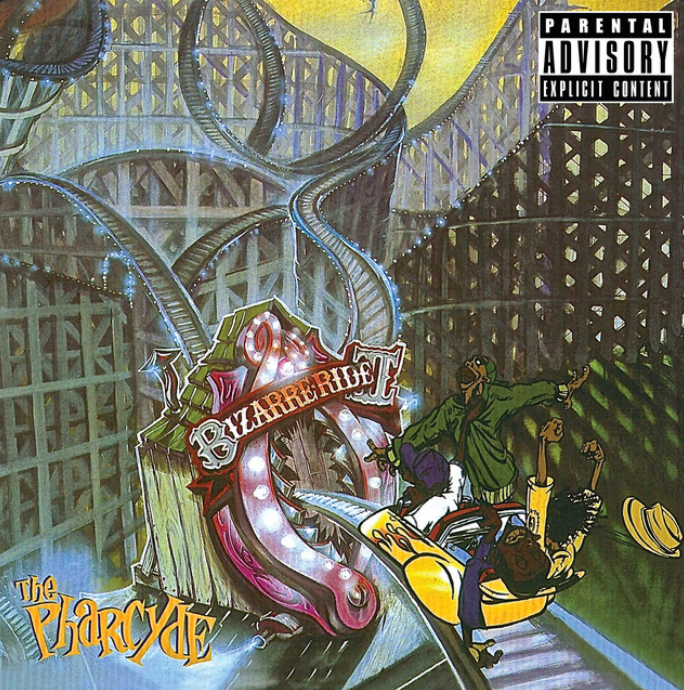
The Pharcyde, Bizarre Ride II the Pharcyde (1992)– This album is a delight from start to finish! It lives up to its title, producing the audio equivalent of a spin through a bizarre fun house, with jazzy grooves, psychedelic effects, madcap vocal interludes, and just the right hint of disquiet. While it often comes across as cutting-up, there’s plenty of serious material on the way, critiquing Black stereotypes, police stops, and the effects of drugs on the community. Part of what makes the whole thing work is the chemistry- it was the product of four L.A.-area school friends, and has the feel of friends messing around. Wickedly quick-witted, musically literate friends! It was a moderate commercial success upon release, and the critics liked it pretty well, but everyone was a little befuddled by how far out of the mainstream of Southern California hip hop it was at the time. In retrospect, the album is seen as one of the foundations of 90s alternative hip hop, and influenced artists like J Dilla and Kanye West. And it remains a great listen today!
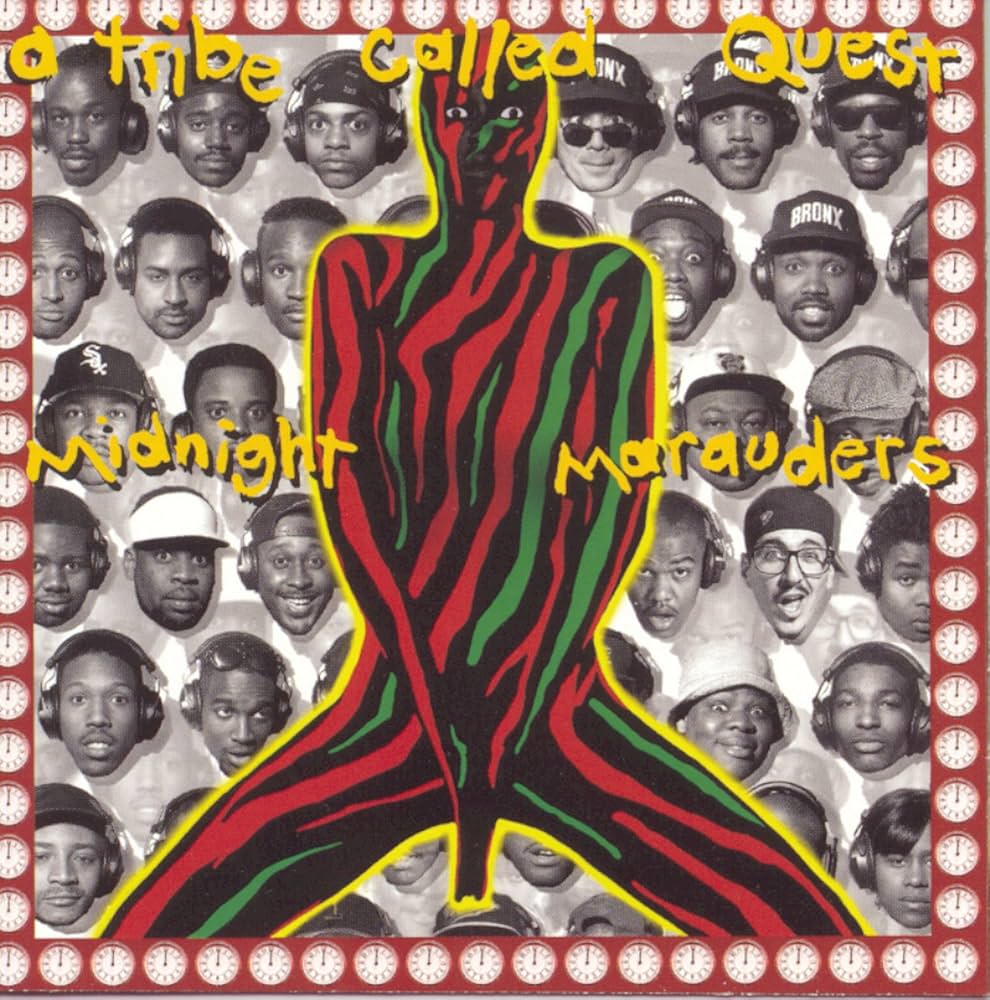
A Tribe Called Quest, Midnight Marauders (1993)- Speaking of alternative hip hop, here comes an album that many consider to be both a peak of the golden era of that sound, and an inspiration to future versions of it. The group was aware of the pressure to top the critical and popular acclaim of their previous album, The Low End Theory, and their reaction was to relax into it, taking two years and working in a makeshift studio in group member Phife Dawg’s grandmother’s basement. In the music that resulted, they dive even further into using jazz, funk, and soul samples from the 70s, and harder, grittier beats. Weirdly, the sound is more gritty, but also more polished at the same time, and even gets into concept album territory with a framing introduction and intervals from a semi-robotic, but very soulful and socially conscious telephone operator. Extra credit if you go look at the front and back cover of the album, which features a 71-member who’s who of hip hop at the time. Kind of fitting, as the album is sometimes cited as the last common favorite of mainstream, alternative, East Coast and West Coast hip hop scenes.
If you’re curious about the sources I used to compile my list, you can check them out here:
And if you want to catch up on the previous installments, here they are…
Finally, if you’d like a playlist for the entire list, you can find that here. Listen to it sequentially for the historical development of the genre, or play on shuffle for maximum historical scramble!

Once upon a time there was a guy named Chris. Having spent years backfilling on decades gone past, in 2021 he set out on a quest to catch up on newer music. He listened to the critics choices for the best albums of the 2010s, and picked his favorites. He did the same for 2020, picking his top 20 from the critics most highly rated albums. And he listened to new releases monthly in 2021, eventually picking the 21 best albums of 2021. That was so much fun he decided to do it again in 2022 and 2023, listening each month and picking out the 22 best albums of 2022 and the 23 best albums of 2023. He is me!
There are links to the albums in the posts cited above, but if you’d like a one-stop playlist, I’ve got that set up in YouTube Music:
Also, do you want to know a secret? The review is still going on! Here are the previous editions of the 2024 monthly review if you missed them:
( January February March April )
A quick word on the “yes” and “maybe” categories I’ve sorted things into, before we get going with the latest:
Yes– This isn’t a guarantee, but it represents the albums that, upon first listen, I think could definitely be in the running for best of the year.
Maybe– These albums have something to recommend them, but also something that gives me pause. I’m putting them in their own category, because I have found “maybes” sometimes linger and eventually become “yeses”.
Now let’s get on with my top picks from 124 May new releases that I listened to!

Adeem the Artist, Anniversary– It’s country, but with a sheen reminiscent of 70s AM radio, and just the tiniest hit of electronic as well. Mostly, it’s good hooks, lyrical clarity, and emotional honesty. And songs describing same sex love, advocating for trans rights, mentioning Palestine, and discussing the historic legacy of racism tell you how out of country mainstream this North Carolina by way of New York artist is.
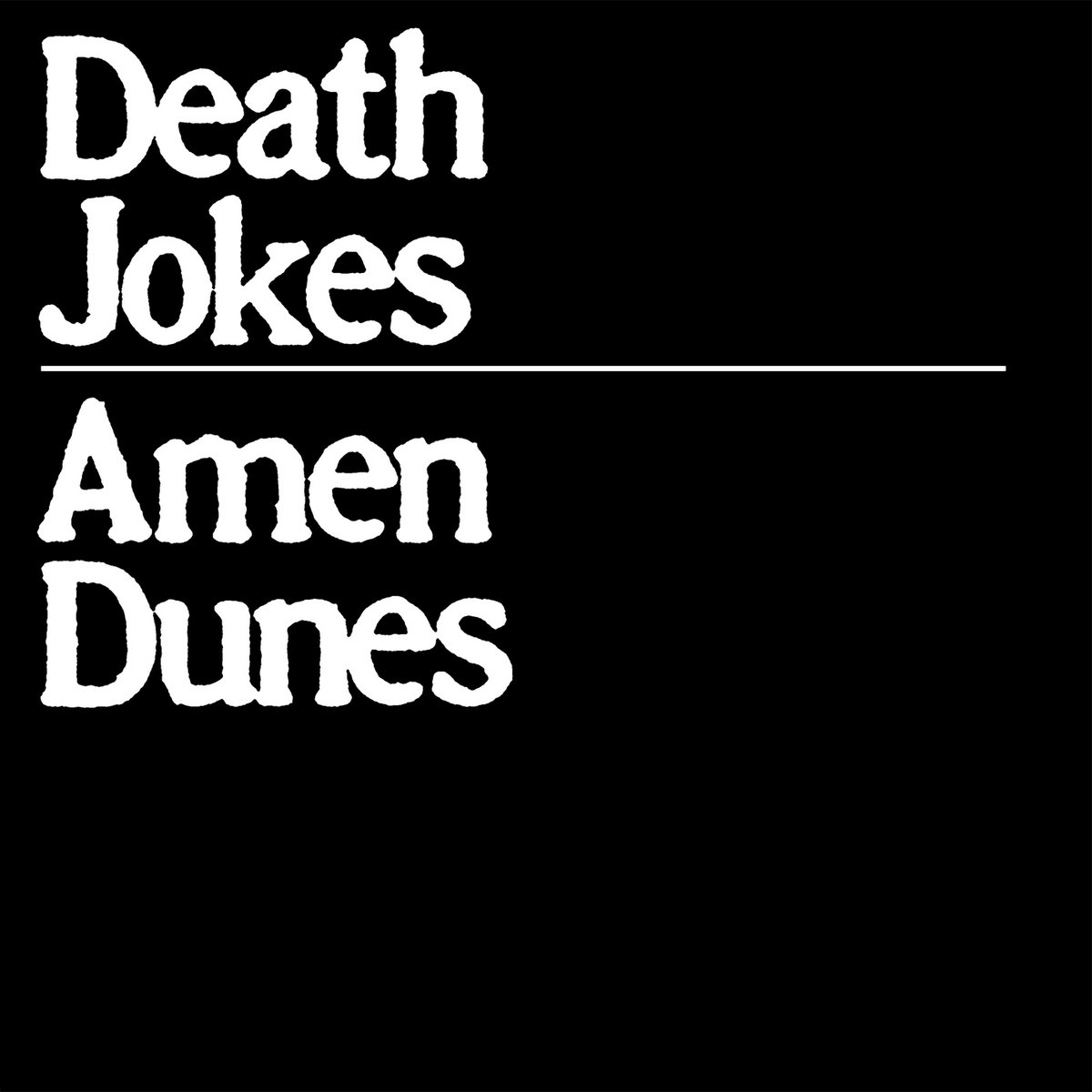
Amen Dunes, Death Jokes– Combining a sometimes-dark psychedelia with electronic music in a very evocative way. And sure enough, AMG subsequently told me that, “The project of Damon McMahon, Amen Dunes unites folk, psych-rock, electronic, and industrial elements into an intuitive, searching whole. ” Along the way there are samples from Lenny Bruce, Richard Pryor, and J Dilla, which gives you an idea of the scope of what the music and lyrics are going for here.

Anastasia Coope, Darning Woman– The vocal and musical loops and layers, the echoes, the stark voice, intelligent lyrics, and hint of the unearthly all steal one’s breath. Whatever it is this 21-year-old musician and painter is doing, it’s both beautiful and unsettling.

Belly, 96 Miles From Bethlehem– Spare and powerful hip hop based on the unrest in Palestine from this Palestinian-Canadian artist. In many ways, it sounds like a typical (though very good) socially conscious hip hop album in production and themes- family, faith, odes to one’s love. But in this case the family is in Palestine, the faith is Islam, and the lost love is Gaza and the West Bank. Powerful and timely.

Blitzen Trapper, 100’s of 1000’s, Millions of Billions– Warm, fuzzy pop with elements of singer-songwriter, psychedelia, and Neil Young-style ragged edges. Altogether, it brings to mind 70s AM radio, which is not to say that this Portland, Oregon band doesn’t feel fresh and vital. Well done Portland, Oregon band!

Crimeapple & Big Ghost Ltd, Bazuko– This collaboration between Colombian-born Crimeapple and anonymous blogger, hip hop writer and music producer Big Ghost is from another era, in several ways. Its stark mix, flow, and stories of the street feel like they belong to the late 90s/early 00s, and the subject matter largely revolves around the crack epidemic of the eighties. It doesn’t feel lost in time for all this, though, more like a great album that we all somehow missed.

F.U.N, Slum Village– J Dilla’s old group demonstrating that their excellence never was all about J Dilla. The mix is varied, metallic and urgent, the flow dynamic, and the lyrics interesting and positive. The whole thing feels redolent of the best of 00s hip hop. This Detroit group has been through a lot of changes, but they still know how to bring it!

Girl and Girl, Call a Doctor– Well, holy shit. The opening reminds me of one of Lou Reed’s story-poem songs. What follows carries on with that literate wordiness and uncomfortable emotional openness and marries it with a spare nervy rock as it sketches out the inner life of a troubled youth confronting some sort of medical crisis. An actual story arc! Delivered with equal helpings of wryness and sincerity. I’m keeping my eye on this Australian band!

Gyasi, Rock’N Roll Swordfight– Rock ‘n’ Roll Swordfight is a live album stitched together from three concerts in 2023. You could be forgiven for thinking that the concerts were by some kind of amalgam of Led Zeppelin and glam-era superstars like T Rex and David Bowie, which is to say, it is delightfully over the top rock in the best seventies fashion. Gyasi has me sold!

Hannah Vu, Romanticism– This second album from Los Angeles-based songwriter Hannah Vu certainly lives up to the title, it’s full of lush romanticism, though it serves equal parts darkness and difficulty with the sweetness. AKA it tells the truth about romance in a way that’s musically and lyrically compelling.

Ibibio Sound Machine, Pull the Rope– Such a joyful mix of multiple different strains of dance/electronic music! Fronted by London-born Nigerian singer Eno Williams, it is not a surprise that it’s redolent with Eurodance and Afrobeat. But what is, if not a surprise, a welcome find, is its knack for musical and lyrical hooks amidst the energy and fun.

King Hannah, Big Swimmer– Between hypnotically plainspoken vocals, poetic lyrics, and slow spare arrangements with a distorted feedback-laden guitar wall in the background, the songs here are arresting. This second album from singer Hannah Merrick has a lot to recommend it.
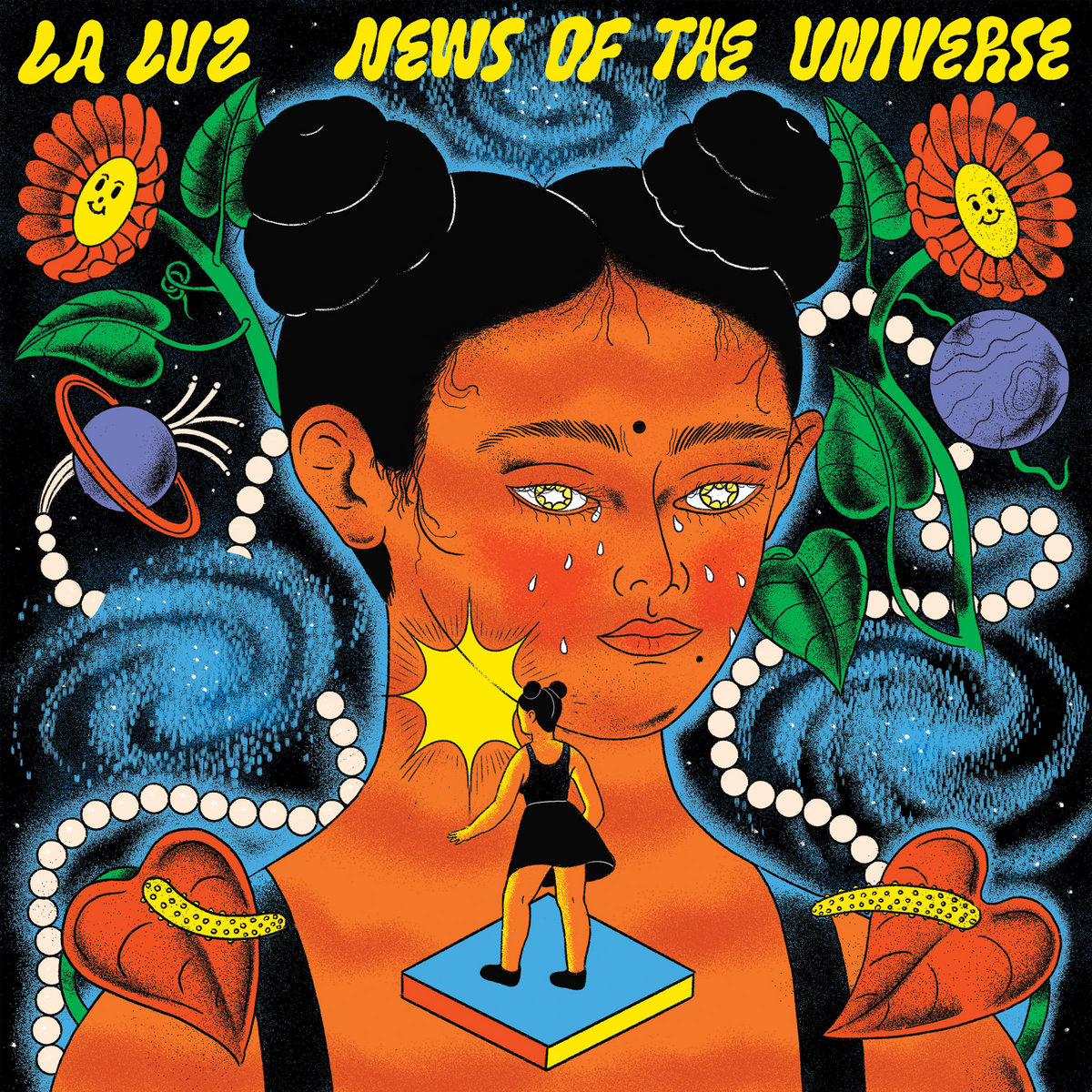
La Luz, News of the Universe– I’ve liked other things by La Luz, and how could I not? Their synthesis of surf music, reverb-drenched garage rock, and the sixties girl group sound is fuzzy, warm, and dark all at the same time. On this album the Seattle band is in top form, and the songs are informed by lead songwriter Shana Cleveland’s experience with cancer. It all adds up to a deep and powerful album.
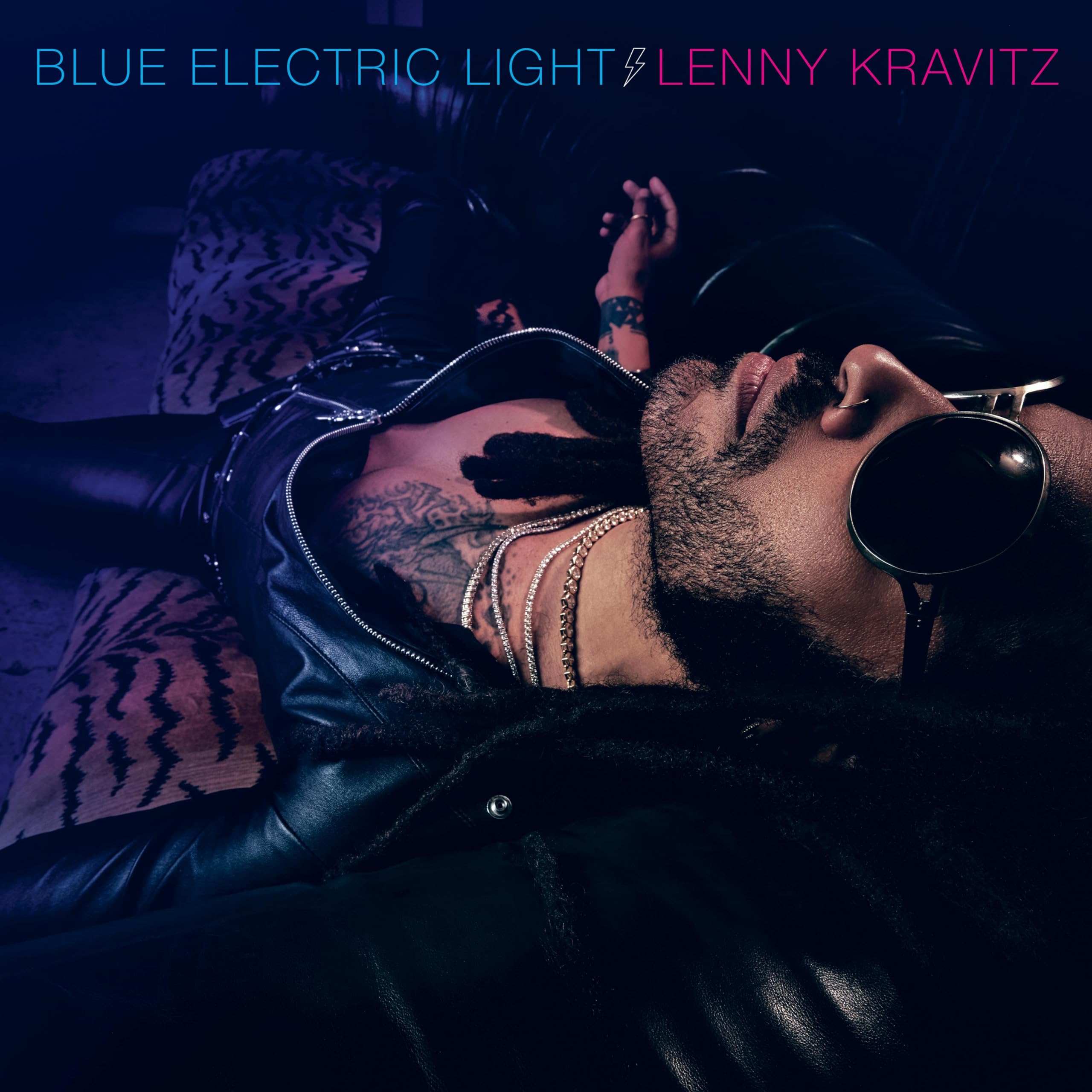
Lenny Kravitz, Blue Electric Light– Lenny Kravitz is in fine form here- 90s guitar god rock, funk, R&B, and electronic dance music all get their due, and never feel like they don’t fit together. It may not be especially new or different per his usual, but there’s genuine tenderness and vulnerability here, and musically it can’t be faulted.

Of Montreal, Lady on the Cusp– It starts off with a song declaring rock is dead, then transitions into another lamenting being too depressed to f&^%, and goes on in this lyrical arch vein supported by weary vocals, and a lively off kilter musical mix bridging the asynchronity of post-rock, impossibly stirring melodies, and the kaleidoscope mix style of electronic. Now I don’t want rock to be dead, but this 19th studio album from this Athens GA band at least gives us some hope that, if so, something interesting might replace it.
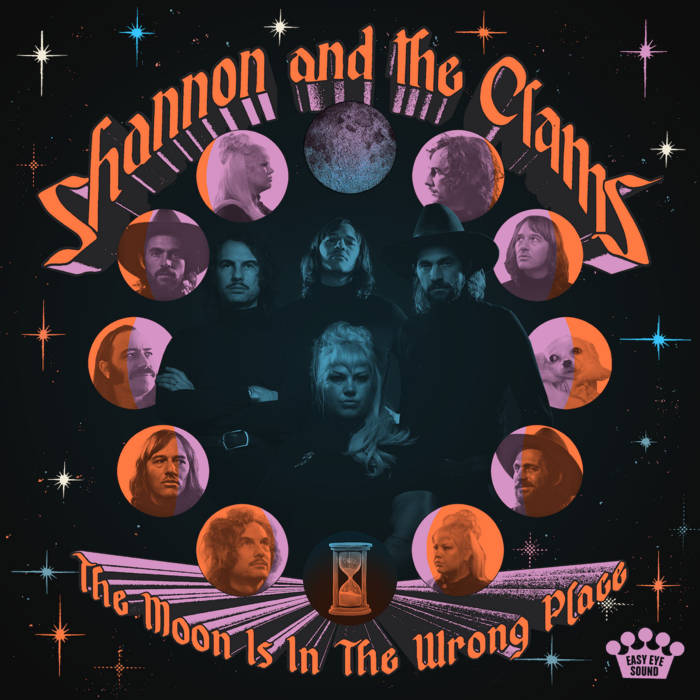
Shannon and the Clams, The Moon is in the Wrong Place– Shannon and the Clams have always been a great band, and I really love their retro garage rock/60s girl group feeling. But there’s no denying their music here is lent a terrible additional power and focus through lead singer Shannon Shaw’s wrestling with the untimely passing of her partner.

Shellac, To All Trains– While it definitely gets an added layer of import from being Steve Albini’s final album, honestly it does very well on its own even without that. This reminds me of the playful, more inventive side of 80s hardcore, and is full of clever surprises. All the way around, a fitting epitaph for one of noise rock’s greatest champions.
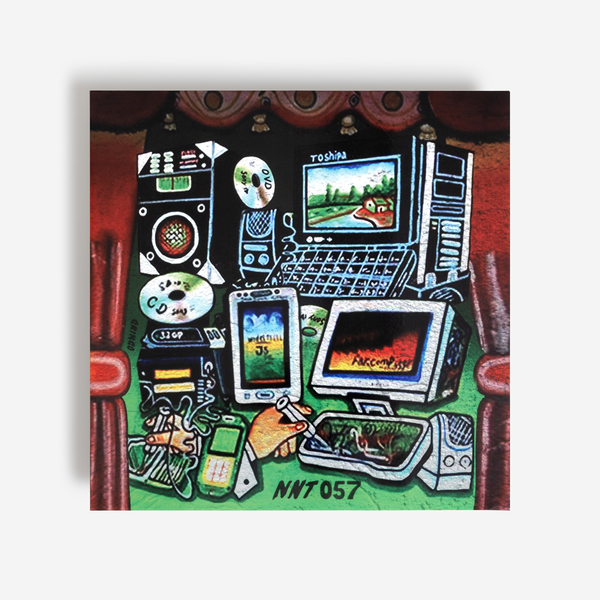
Sisso & Maiko, Singeli Ya Maajabu– Hello glitchy beats, over the top low-bit video game sound effects, and afro-pop exuberance! Tanzanian producer Sisso’s eponymous Dar es Salaam studio represents the forefront of the East African singeli genre. Singeli’s relentless speeds of over 200 BPM provide ample room for experimentation, which is taken further by collaboration with avant garde keyboardist Maiko. This is how the new is born.

The Courettes, Hold On, We’re Comin’– Potent garage punk combo featuring a Brazilian guitarist, a Danish drummer, and lots of cool rock & roll stomp. Amen. And an incredible set of covers ranging from early sixties pop rock to the New York Dolls to Taylor Swift. Really. Nothing but solid fun!
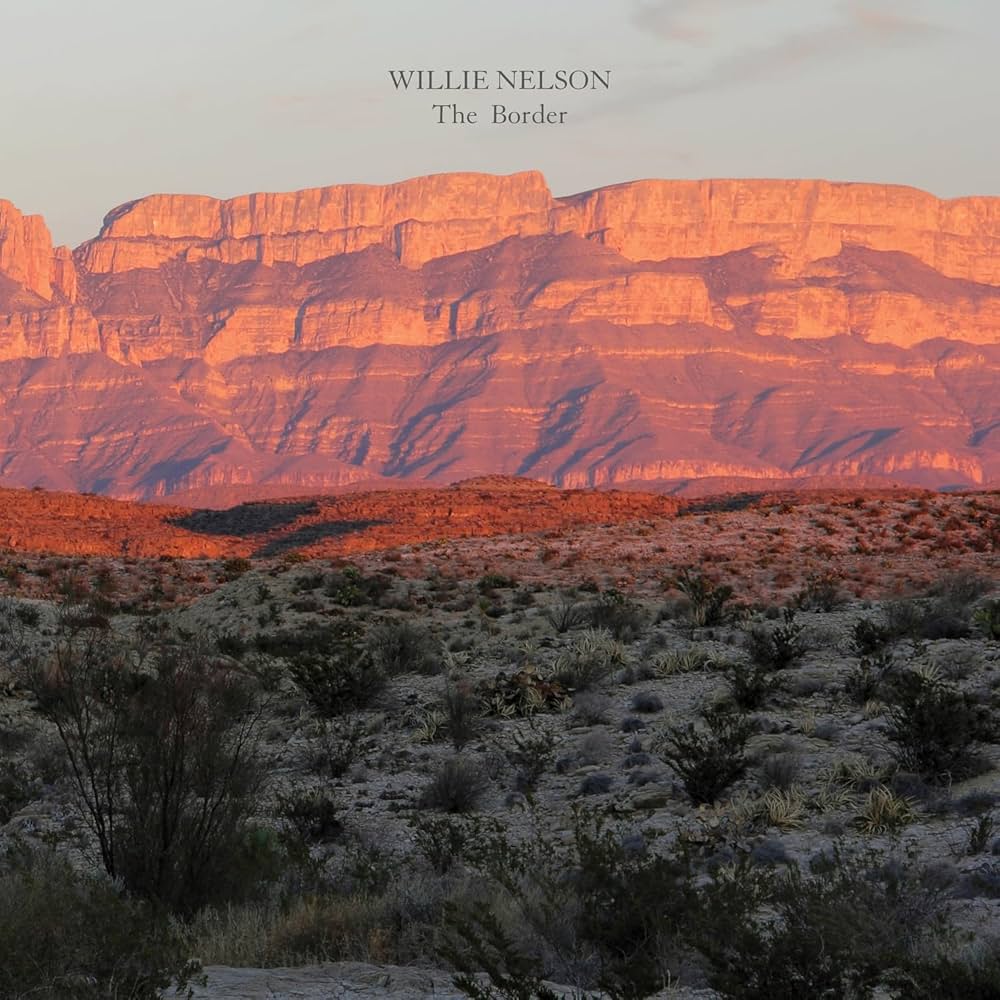
Willie Nelson, The Border– His 75th Album! And my goodness he’s in fine form here. A border patrol agent, a dream about being Hank Williams’s guitar, a passel of sweet love songs. Not thematic unity, but it sounds and feels like it belongs together and has a powerful intro and a sweet outro.

Willow, Empathogen– Willow has ended up on my Honorable mention list in two previous years, and for good reason- her music is inventive, brash and as smart as it is fun. She’s pushing her previous boundaries again here, with a glitchy electronic approach joined to something more like jazz, torch songs, and R&B crooning.

Young Jesus, The Fool– It feels like an anguished indie folk acoustic kind of thing, but sharper and darker than the typical outing in that oeuvre, and with surprising (and haunting, unsettling) music and vocal effects along the way. This Chicago band currently located in L.A. is on my watchlist now!
Maybe
And there we are, May out. June should follow soon! And, since I’m about to start listening to September, July and August review notes are complete and those postings should be out before too long…


2023 was the 50th anniversary of hip hop, and in honor of this anniversary, the idea bloomed in my mind last year that I should review the top 50 albums of that 50 years. As I crunched together a list from various sources, 50 proved to be too restrictive- many of the classics were getting squeezed out. So, to make a little more room, I opted for 100 albums, two for each of hip hop’s 50 years. Due to some medical situations, I took a three+ month hiatus from blogging last year, so I didn’t finish the series. But I’m back at it, and I don’t mind extending into 2025 if you don’t!
For its formative years, hip hop was a live entertainment form, with the first recorded singles not emerging until 1979, and the first albums in 1980. So my review covers 1980-2023, with 50 posts of two albums each. The only ground rule I made for myself (besides looking for 2×50, aka 100, albums that were widely well-regarded) was that I had to have at least one from each year. As you’ll see by and by, some years get multiple albums, but since we have 100 spots for 43 years, it tends to all work out.
And with that, let’s embark on our next installment!
Dr. Dre, The Chronic (1992)– For his debut solo album, N.W.A. co-founder and producer extraordinaire Dr. Dre pulled out all the stops. There is no denying this album’s quality and influence- it almost single-handedly introduced the G-funk musical style of minimal (and retro funk) sampling, laid back grooves, live bass and guitar, and squelchy synths that would dominate a good chunk of 90s hip hop. It commercially established Death Row Records when it went triple platinum, and launched the careers of Snoop Dogg, Nate Dogg, and Warren G. And it remains a consistent pick among both artists and critics as one of the best (and best produced) hip hop albums ever. There’s also no denying that the album is thick with misogyny and glorification of violence. It’s true that this isn’t the only mode- there’s also a lot of humor, and post-L.A. riots tracks that rival anything Public Enemy did in terms of sharp and furious social/political critique. But it can still be hard to listen to without getting a little morally queasy. After all the hue and cry though, and despite my qualms, as an album it’s masterful. It has a narrative frame holding the whole thing together, musically it grooves, swings, and surprises, it’s alternately menacing and hilarious, and there isn’t a track that sounds out of place or lets you down.
Pete Rock & CL Smooth, Mecca and the Soul Brother (1992)- Whatever I listened to after The Chronic was going to have a tough act to follow, and I wasn’t familiar with this album at all beyond the track “They Reminisce Over You (T.R.O.Y.)”. But, with the quiet spiritual incantation that opens the first track, and the hard metallic beats and jazz samples it slides into from there, I was immediately in. The debut album from New York duo Pete Rock and CL Smooth is definitely working in a recognizable groove- sophisticated East Coast conscious hip hop circa early 90s- and perhaps doesn’t do a lot new or different with it. But it’s a favorite groove of mine! And, if one could often wonder if G-funk is furious at, or in love with, the problems of the neighborhoods it rose from, this album is unambiguous about (as one track puts it) escaping from “The Ghetto of the Mind”.
If you’re curious about the sources I used to compile my list, you can check them out here:
And if you want to catch up on the previous installments, here they are…
Finally, if you’d like a playlist for the entire list, you can find that here. Listen to it sequentially for the historical development of the genre, or play on shuffle for maximum historical scramble!
Last year was the 50th anniversary of hip hop, and in honor of this anniversary, the idea bloomed in my mind that I should review the top 50 albums of that 50 years. As I crunched together a list from various sources, 50 proved to be too restrictive- many of the classics were getting squeezed out. So, to make a little more room, I opted for 100 albums, two for each of hip hop’s 50 years.
For its formative years, hip hop was a live entertainment form, with the first recorded singles not emerging until 1979, and the first albums in 1980. So my review will cover 1980-2023, with 50 posts of two albums each. The only ground rule I made for myself (besides looking for 2×50, aka 100, albums that were widely well-regarded) was that I had to have at least one from each year. As you’ll see by and by, some years get multiple albums, but since we have 100 spots for 43 years, it tends to all work out.
*June 2024 addendum: Due to some medical situations, I took a three+ month hiatus from blogging. It’s unlikely I’ll finish this series this year. But I’m back at it, and I won’t mind extending into 2025 if you don’t!*
And with that, let’s embark on our next installment!
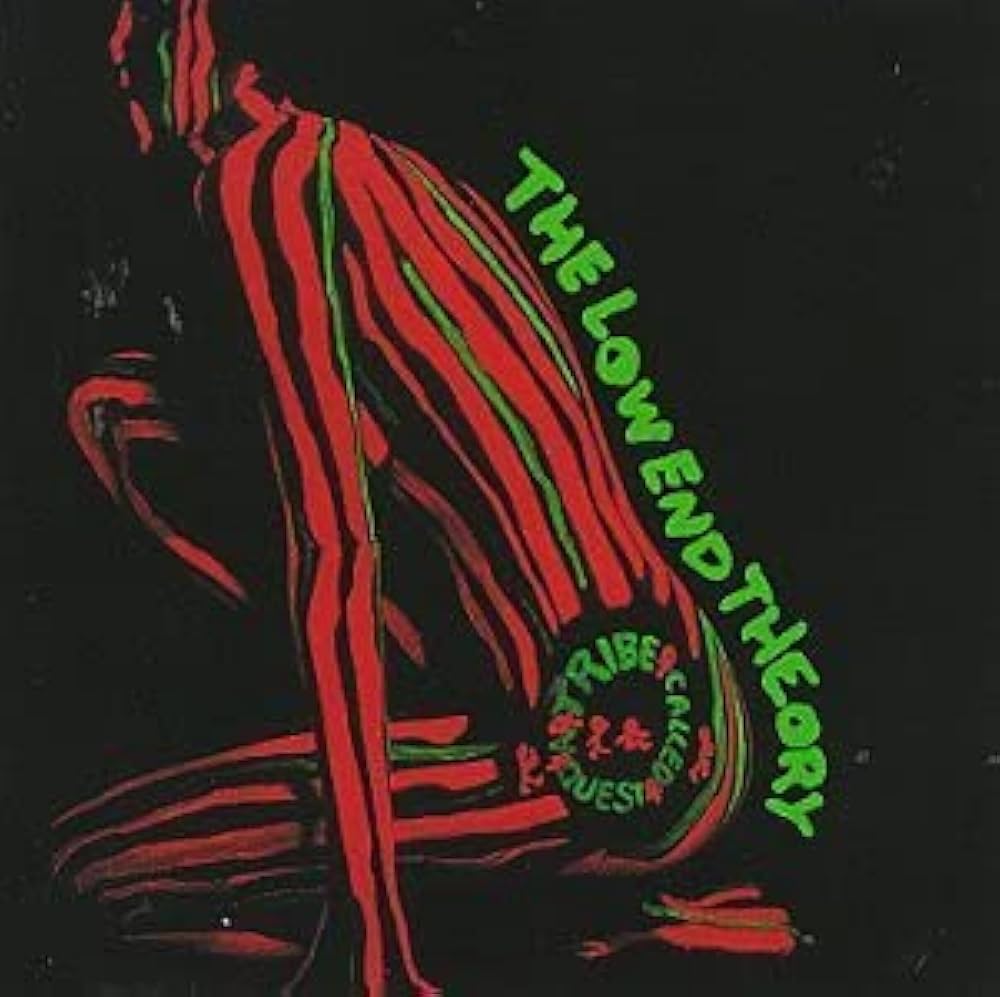
A Tribe Called Quest, The Low End Theory (1991)– They weren’t the first to do this, in fact we’ve had several examples so far in this list, but this album is a whole new level of jazz sample-fueled hip hop. More than that, it consciously seeks to link the genre to the larger history of Afrocentrism and Black music in America, and to use that history to critique the ways the contemporary industry isn’t measuring up to the social and political legacy of the music. All of that might be a bit heavy, except it’s delivered with such an innovative music mix, and poetic and quirky flow and rhyme. In other words, this album overflows with the energy and positive power of the conscious hip hop of the nineties. Formed by a circle of high school friends from Queens, A Tribe Called Quest were co-founders of the Native Tongues Collective with Jungle Brothers, De La Soul, Queen Latifah, and Monie Love. They went into this, their second album, with group MC Phife Dawg’s recent diagnosis of diabetes leaving him and fellow member/rapper/producer Q-Tip determined to make something beyond what they’d previously done, which led them to focus on the “low end” of the status of Black men and the bass end of music. The results speak for themselves, with an album that was their commercial breakthrough, a long term critical favorite, and an ongoing influence on the next generation of hip hop artists and producers. As for me, this genre of hip hop was my jam in the nineties. Listening to it now, there’s certainly an element of familiarity and nostalgia, but the energy, innovation, and downright fun is as fresh as ever.
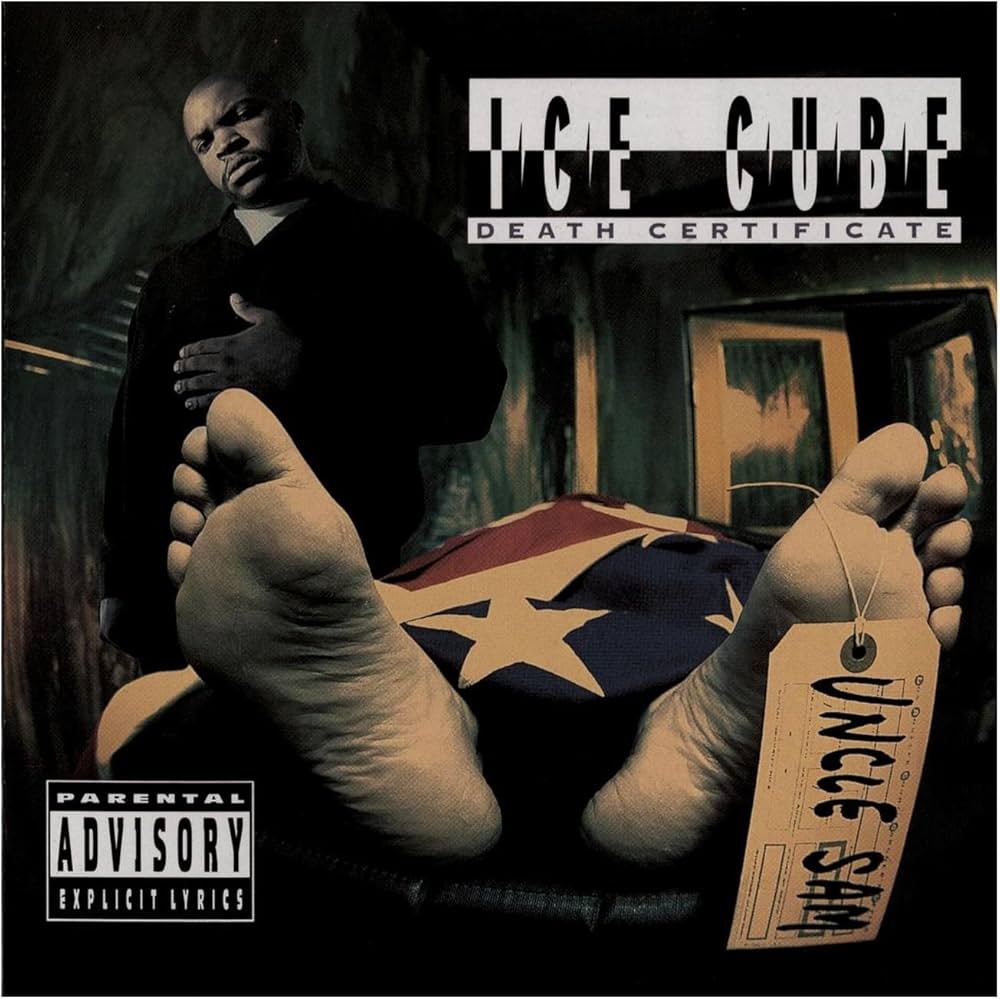
Ice Cube, Death Certificate (1991)- It’s interesting that these two albums ended up together in post order, because this might very well be the yang to the yin of the prior selection. In all kinds of ways- the anger in the flow, the hard and dense mix, the lyrics sketching out the darkest sides of street life. But as is true of all yins and yangs, you can also see the inextricable link between the two. Both are founded on response to the frustration of the Black American experience, both are musically innovative while hearkening back to cultural heritage (jazz for A Tribe Called Quest, 70s funk and soul for Ice Cube), and both deliver their message with humor and artistic ambition. In Death Certificate‘s case, the very structure shows the intent to aim for statement, with a “death” side stating the problems of contemporary life, followed by a “life” side describing his vision of where things need to go, and intros/outros and sketch sections holding the whole thing together. So, despite personifying two nineties sub-genres that seem diametrically opposed musically and thematically- alternative/conscious hip hop and gangsta/g-funk hip hop- the aims and the means of these two albums are not so different. This is not to excuse the racialism, homophobia, and misogyny of Ice Cube’s lyrics so often on display here, that all deserves criticism. But I can see how much more crafted and ambitious this is than his previous album, AmeriKKKa’s Most Wanted, how much of the West Coast nineties sound it anticipates, and understand how it ended up on so many “best” lists.
If you’re curious about the sources I used to compile my list, you can check them out here:
And if you want to catch up on the previous installments, here they are…
Finally, if you’d like a playlist for the entire list, you can find that here. Listen to it sequentially for the historical development of the genre, or play on shuffle for maximum historical scramble!
As I’m sitting down to write this Sunday night, there are about 35 hours until polls open. If you’re reading it Monday, it’s less than 24! So here we are, at our last update before the election itself. What does the semi-final picture look like?
Trump’s lead in the RealClearPolitics poll average has narrowed over the last four days from 0.4% to 0.1%. Over at 538, with it’s more rigorous methodology of weighting polls according to the pollster’s track record of reliability and partisan tilt, Harris remains ahead, but her lead is down from 1.4% to 1% over the past four days:

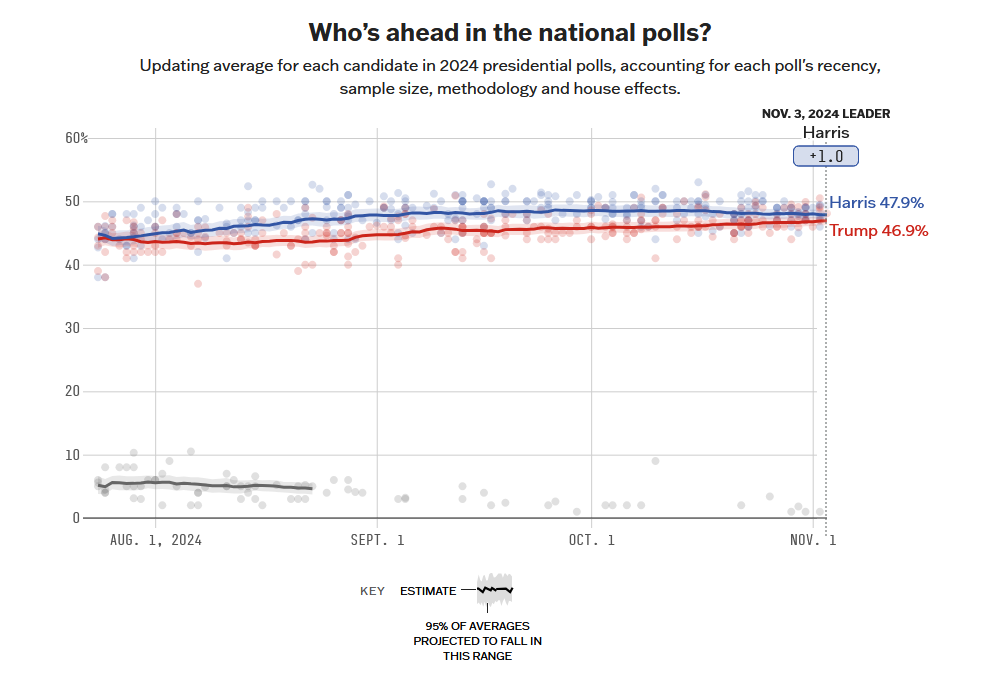
That’s a bit of a mixed picture. It’s also well within the standard polling error of +/-3%. The other thing we can observe is that the 538 Harris lead is below the point- somewhere in the neighborhood of 2% to 3%- where a Democratic national lead doesn’t necessarily translate into an Electoral College lead. But, between the margin of error and the unknowns of how late deciders will break (the last two elections they have gone disproportionately to Trump, but there have been many other elections where they break toward the Democratic candidate, or go roughly equally to both sides) she definitely could get there.
Can we get a clearer picture by looking at the states? For the 7 swing states, RCP continues to show Trump leading in 5 of 7 states. 538, with it’s more reliable methodology, now shows the same, with Nevada going from a tie four days ago to a 0.4% Trump lead. Other than that, it’s also a scattered picture- Trump’s leads in Arizona and North Carolina are up from four days ago, his leads in Georgia and Pennsylvania are down, and Harris has bumped up slightly in Wisconsin and down slightly in Michigan. All of these changes are so small though that they could be statistical noise. And, crucially, every swing state margin remains less than the polls margins of error, and the same 4 of 7 states from four days ago remain separated by less than 1%:

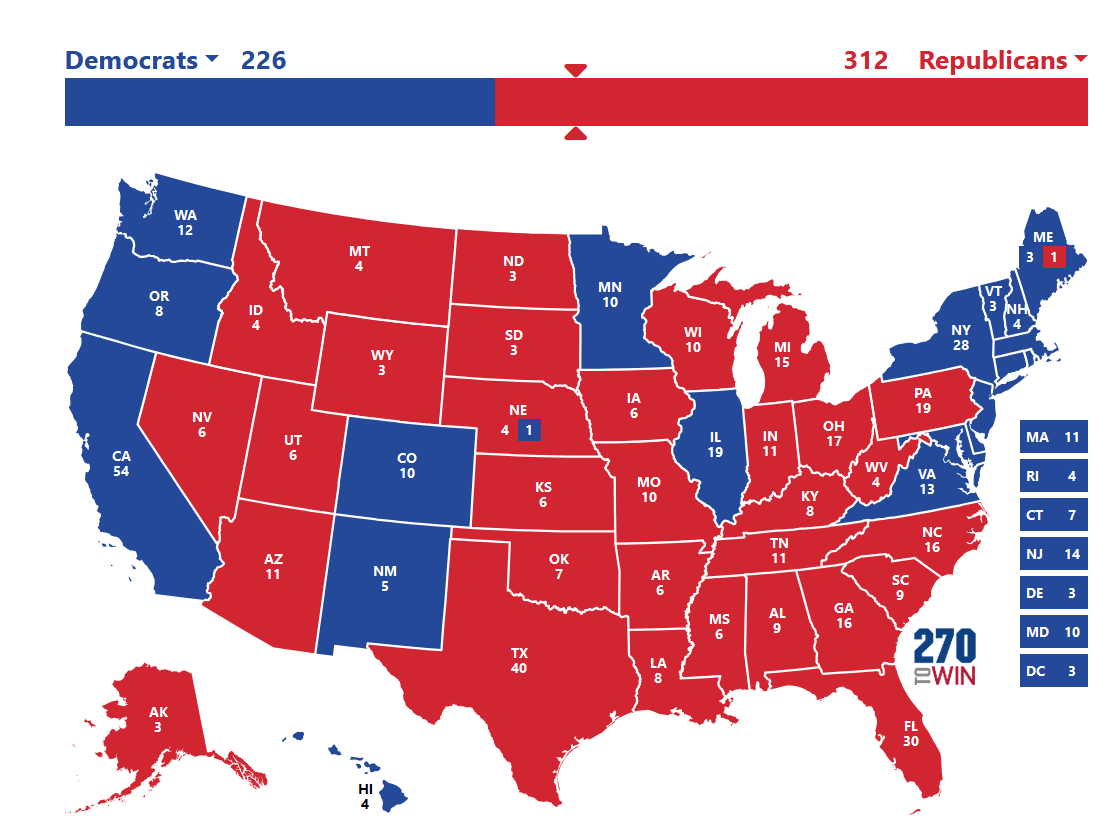
So what does that add up to? RCP still has the same map as four days ago (but note that their Pennsylvania average only has Trump ahead there by 0.3%, so if that state changed it would flip things to 270-268):

538’s state polls now would result in the same electoral map as above, with the exact same Pennsylvania proviso as above (their average only has Trump ahead by 0.2% in Pennsylvania).
And so, what was true four days ago remains true- with four states separated by less than 1%, and all seven below the margin of error, it wouldn’t be a major surprise to see either candidate win any given state. It would even be consistent with these numbers to see either Harris or Trump win all seven. It’s one thing to say that, but visually it’s kind of startling when you realize that both these outcomes would be entirely consistent with current polling:

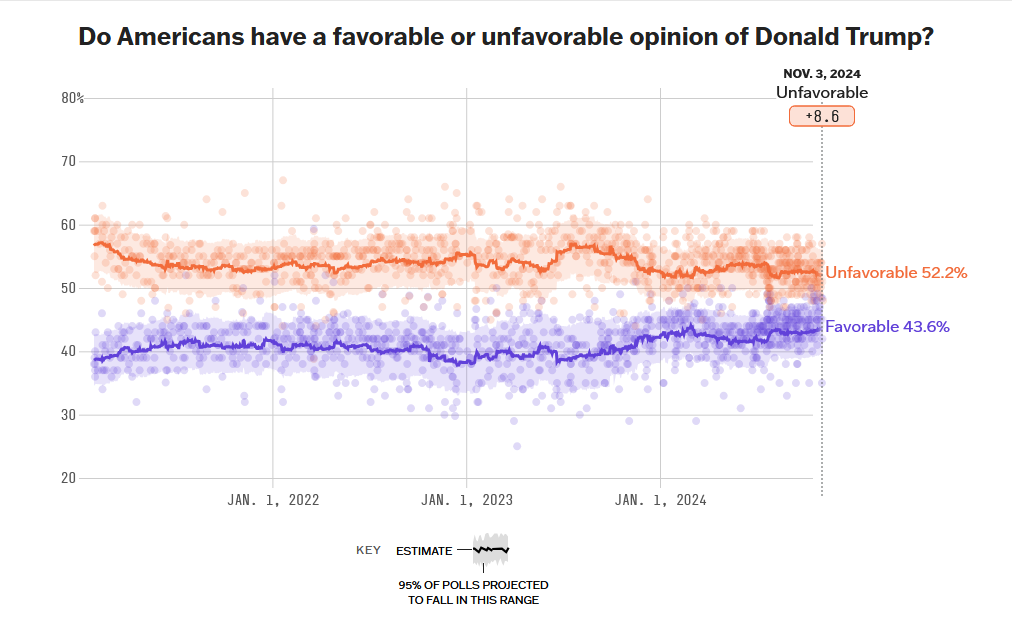
Approval ratings, which are another kind of stand in for preference, still show an edge for Harris, but her net negatives have grown from 1.5% four days ago to 2% today, while Trump’s net negative has improved by 0.4%. Still advantage Harris, but getting to the point where it’s not really a meaningful difference:

In some good news for Democrats as a whole, their Congressional preference edge has expanded a little from four days ago:
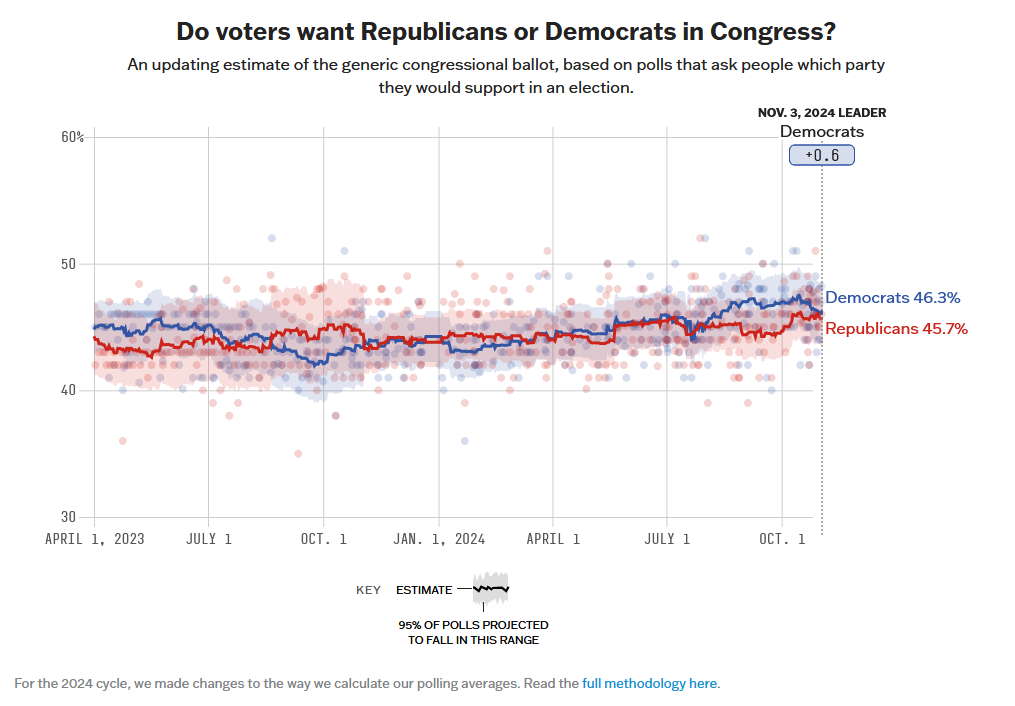
No change in this, but a significant indication of overall strength for Democrats remains that, through 100 special elections over the past two years, the party has outperformed by an average of 6% against the partisan lean of the races in question (per a spreadsheet compiled by Nathaniel Rakich of 538):

There’s also no change in this indicator, but it remains true that Biden’s percentage in Democratic primaries was ahead of Trump’s in Republican primaries, indicating that Republicans had comparatively more wavering partisan supporters to bring home for their nominee:
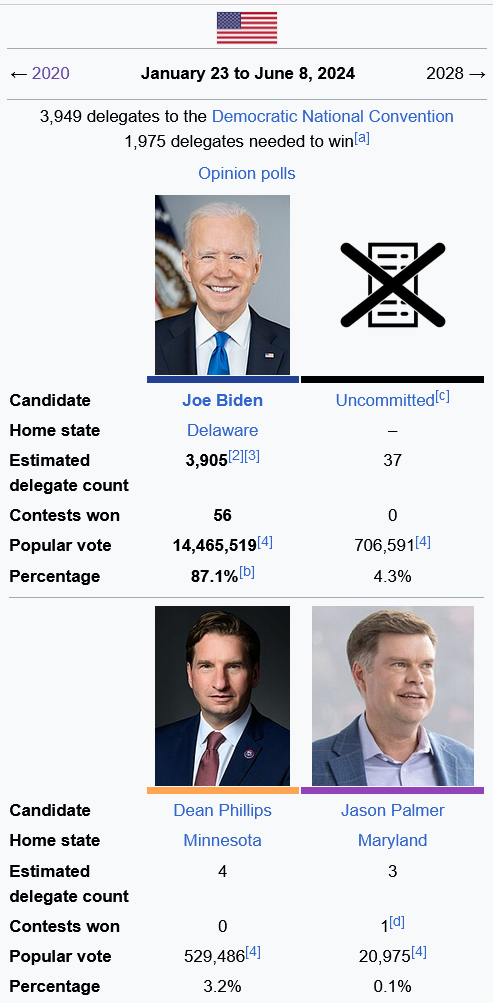
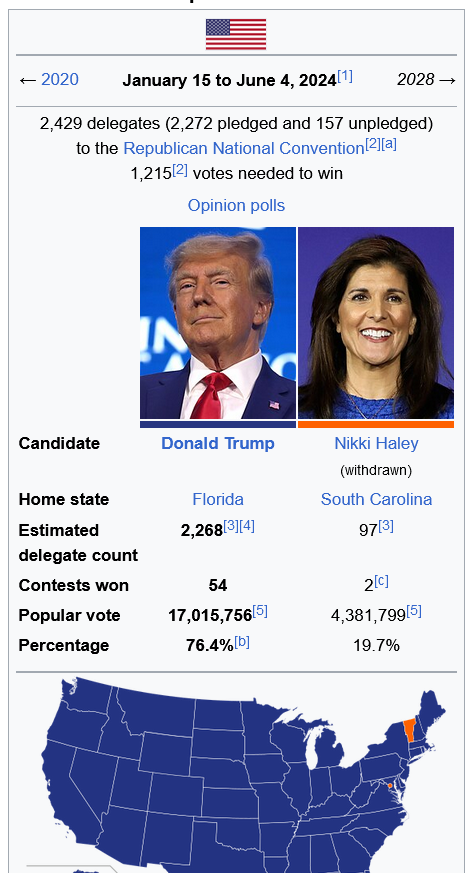
The one thing that has really shifted over the last four days is the betting markets, where Trump’s chances went down by 10% and Harris’s correspondingly rose. I think they spotted the arbitrage exposure I talked about in the last post and are hedging their bets (every pun intended):
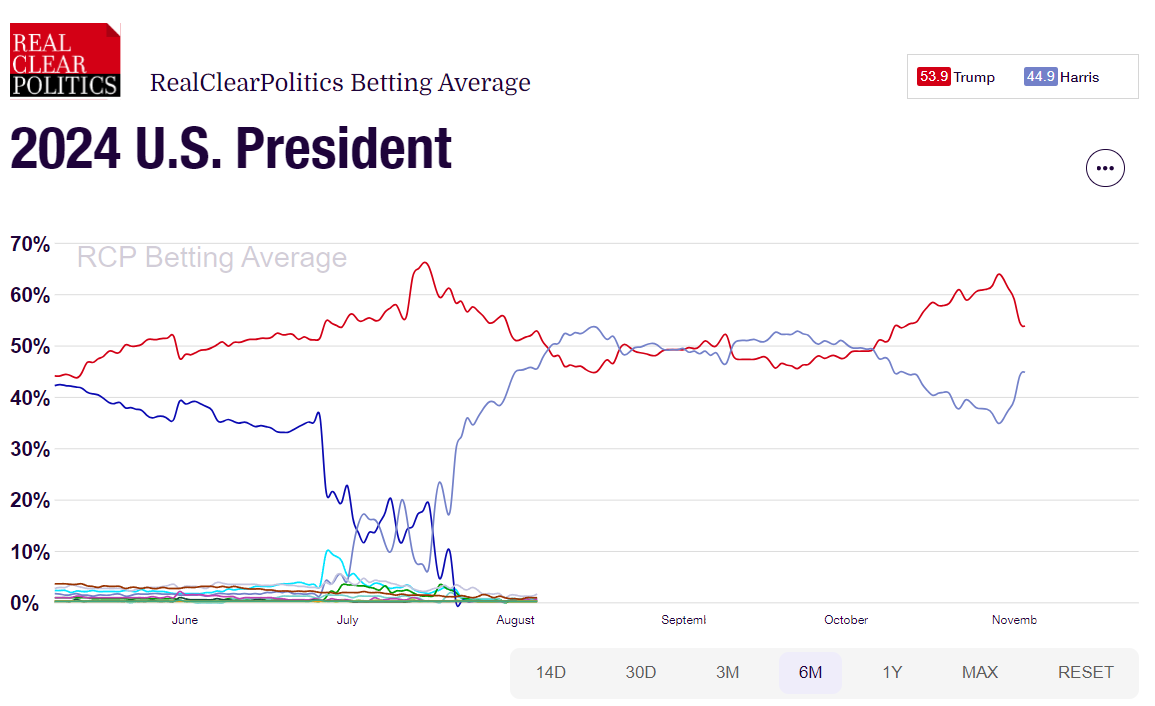
Perhaps unsurprisingly, the numbers the betting markets are converging on are pretty close to where the forecast modelers have ended up. 538’s forecast model is not far off from 50/50:

And 538’s now solo founder Nate Silver, who has his model behind a paywall but gives frequent updates, is even closer to 50/50:

We talked four days ago about doing a map that leaves blank the four states that are within 1%. Since those states haven’t changed, the results are the same- there is one path by which Harris could get there, winning all three of Michigan, Pennsylvania, and Wisconsin. Trump would win with any one of the three:

This is probably a good place to remind ourselves of something both 538 and Silver repeat often, that just because the forecast models are close, it doesn’t mean the outcome will be. To understand why, a quick look at the 538 model’s results is helpful. Though the overall distribution of outcomes equates to a 53% chance of Trump winning, the single most common way he does it in 1,000 runs of the model is to win all seven swing states (the big red spike on the right). Similarly, Harris has an aggregate 46% chance of winning over 1,000 runs of the model. But she’s as likely to do it with 286, 308 or 319 electoral votes as she is to squeak by (the four highest blue spikes on the left):

Overall, looking at the indicators, it feels to me like a just about even mix of signs of closing momentum towards Harris and Trump. As mentioned last time, there are some reasons to think that things could be better for Harris than the polls indicate:
These are all logical takes, supported by empirical data, but the logic here cuts both ways. If polls are underestimating Harris by a few percent, she could be headed for a comfortable win. On the other hand, if they’re still underestimating Trump the way they did the last two cycles, he could be headed for a blowout. Or, things could be exactly as they appear, and a handful of votes in a few key states (with Pennsylvania being the most likely tipping point) could see either candidate squeak by.
My best advice remains what it was four days ago- follow some of the most empirically grounded commentators on the lead-up to election night (and on election night itself). Axios had a good round-up of suggested follows:
“Pick a few trustworthy accounts rather than gorging on whatever pops up.
Jon Ralston (@RalstonReports) is your man in Nevada … Garrett Archer (@Garrett_Archer) in Arizona … Greg Bluestein (@bluestein) and the Atlanta Journal-Constitution crew in Georgia.
Dave Wasserman of Cook Political Report (@redistrict) is an essential follow if you want live play-by-play of crucial counties, as are the two Nates — @NateSilver538 and @Nate_Cohn.”
And the good folks at Electoral-Vote.com had some sage advice on where election night results could indicate a developing Blue or Red Wave (as opposed to a 50-50 muddle where it would take several days for the winner to become apparent):
“Many people have already voted but, due to various state laws, we are unlikely to know the winner of the presidential election on Nov. 5. Maybe not even on Nov. 6 if it really is as close as the polls say it is. Much of the problem is due to Republican-controlled state legislatures that want the election to devolve into chaos to provide cover for Donald Trump if he tries to claim victory on Nov. 5 and is then ultimately defeated. The biggest issue is whether absentee ballots can be pre-processed or even fully processed before Election Day. If the process of verifying the signatures on the envelopes may not begin before 7 a.m. on Election Day, there is no conceivable way they can all be verified, the envelopes opened, and the ballots taken out, prepped, and scanned by midnight. Here is the lay of the land by (swing) state:
The bottom line here is that Georgia will probably come in first, then Michigan, then the eastern part of North Carolina. If there is a huge blue wave, it will show up in the big cities there and that will be a big clue how the state will go. If there is no blue wave, that will also be obvious fairly early.”
And there we are. Our final indicators are:


Remember my update from a week ago when there was a little under two weeks left? Guess what? It’s now less than one week! 6 days to go as I’m writing this, probably 5 by the time you’re reading it. What’s changed over the last week?
Trump now has a narrow lead in the Real Clear Politics tracking poll. In the more reliable 538 national polling average Harris retains a lead, but it’s down a bit from a week ago. In another perhaps not great sign for the Harris campaign, she’s actually down from her top numbers earlier in the year in both averages:

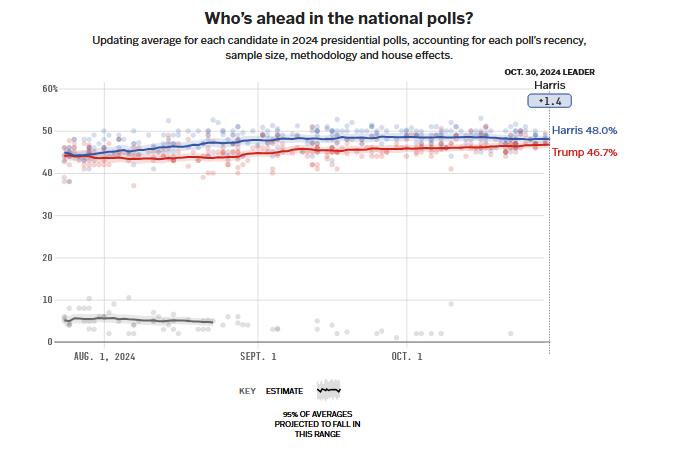
As noted a week ago there’s a point- somewhere in the neighborhood of 2% to 3%- where a Democratic national lead doesn’t necessarily translate into an Electoral College lead anymore, and Harris remains below that point. So let’s look at the Electoral Vote! On the swing state front, RCP now shows Trump leading in 5 of 7 states, a slip from his 7 of 7 lead a week ago states. 538 has a more robust methodology of weighting polls according to history of pollster accuracy and partisan lean, and it shows a scattered picture- Harris’s lead has expanded a bit in two states, Trump’s lead has expanded a bit in four, and in Nevada Harris is down a little, making that state a tie.
So, less blanket movement toward Trump than a week ago, at which time he had improved vs. Harris in every state except one. But Harris is also down a state from a week ago, and not making progress in four others where she was already behind. Another major takeaway from the chart is that none of the leads for either candidate is outside the margin of error, and in 4 of 7 states they’re separated by less than 1%:

So what does that add up to? RCP still has Trump winning the Electoral College, but not by the blowout form a week ago:
Their map has pretty much now converged with 538’s, except that 538 has Nevada tied:

What was true a week ago remains true- with four states separated by less than 1%, and all seven below the margin of error, it wouldn’t be a major surprise to see either candidate win any particular state. It would even be consistent with these numbers to see either Harris or Trump win all seven (although Trump’s lead in Arizona and Georgia is starting to look more substantial).
Approval ratings, which are another kind of stand in for preference, still show an edge for Harris, but a week ago she had swung back into net negative territory and her negatives have now grown over a week ago. Trump, meanwhile, continues to trend a little less negative, to the point that they’re only separated by 7 points:


Democrats still retain a narrow lead in the Generic Congressional ballot, but down by over a point from a week ago:
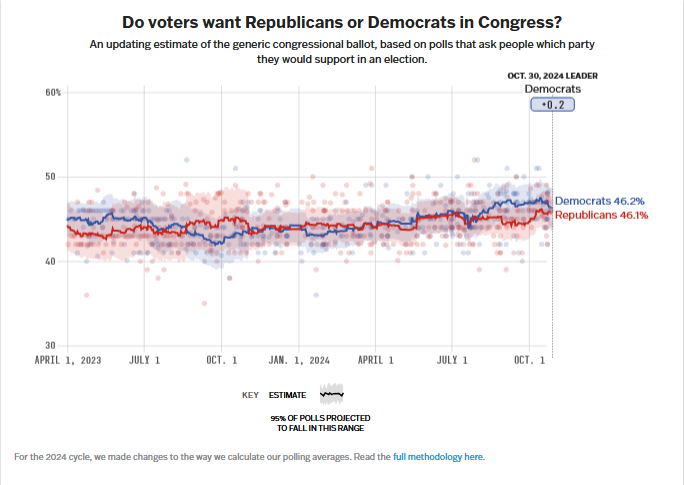
A significant indication of overall strength for Democrats remains that, through 100 special elections over the past two years, the party has outperformed by an average of 6% against the partisan lean of the races in question (per a spreadsheet compiled by Nathaniel Rakich of 538):
There’s no change in this indicator, but it remains true that Biden’s percentage in Democratic primaries was ahead of Trump’s in Republican primaries, indicating that Republicans had comparatively more wavering partisan supporters to bring home for their nominee:
The betting markets had shifted toward Trump in a big way a week ago, and have gone even further in that direction over the last week, predicting a more than 63% chance of him winning the election:
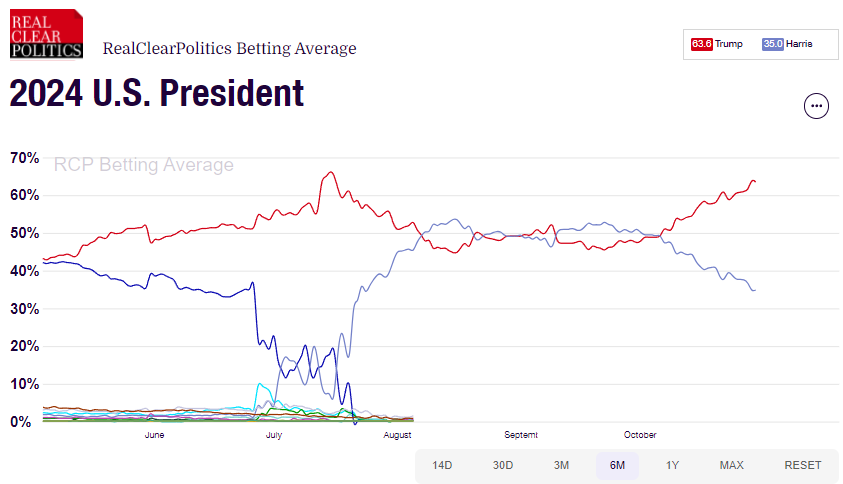
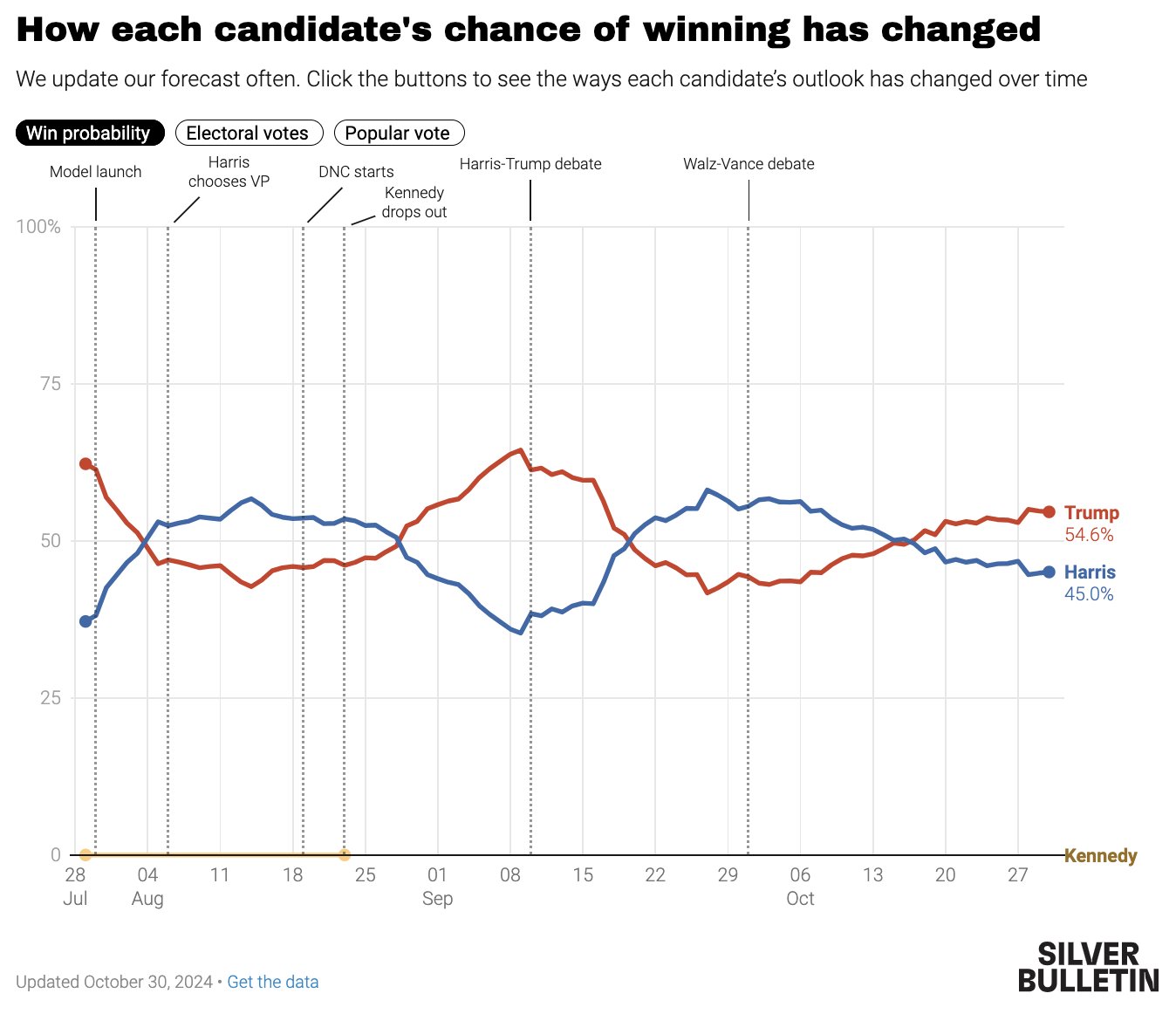
Given the closeness of many of the numbers above, and what we’ll be discussing next, there may be an arbitrage opportunity there if anyone is interested… To whit, 538’s forecast model is basically 50/50:

538’s now solo founder Nate Silver has his model behind a paywall, but did give an update on it today that is a little more positive for Trump, but is still very close to 50/50:
If we do a map that leaves blank the four states that are within 1%, there is one path by which Harris could get there, winning all three of Michigan, Pennsylvania, and Wisconsin. Trump would win with any one of the three:
Overall, it feels to me like some slowing (but not stopping) of the motion toward Trump, mixed with an improved sign or two for Harris. There are some reasons to think that things could be better for Harris than the polls indicate:
These are all logical takes, supported by some empirical data, but the logic here cuts both ways. If polls are underestimating Harris by a few percent, she could be headed for a blowout. On the other hand, if they’re still underestimating Trump the way they did the last two cycles, he could be headed for a blowout. Or, things could be exactly as they appear, and a handful of votes in a few key states could see either candidate squeak by.
My best advice is to follow some of the most empirically grounded commentators on the lead-up to election night (and on election night itself). Axios had a good round-up of suggested follows recently:
“Pick a few trustworthy accounts rather than gorging on whatever pops up.
Jon Ralston (@RalstonReports) is your man in Nevada … Garrett Archer (@Garrett_Archer) in Arizona … Greg Bluestein (@bluestein) and the Atlanta Journal-Constitution crew in Georgia.
Dave Wasserman of Cook Political Report (@redistrict) is an essential follow if you want live play-by-play of crucial counties, as are the two Nates — @NateSilver538 and @Nate_Cohn.”
And the good folks at Electoral-Vote.com had some sage advice on where election night results could indicate a developing Blue or Red Wave (as opposed to ye olde 50-50 muddle which would take days to untangle):
“Many people have already voted but, due to various state laws, we are unlikely to know the winner of the presidential election on Nov. 5. Maybe not even on Nov. 6 if it really is as close as the polls say it is. Much of the problem is due to Republican-controlled state legislatures that want the election to devolve into chaos to provide cover for Donald Trump if he tries to claim victory on Nov. 5 and is then ultimately defeated. The biggest issue is whether absentee ballots can be pre-processed or even fully processed before Election Day. If the process of verifying the signatures on the envelopes may not begin before 7 a.m. on Election Day, there is no conceivable way they can all be verified, the envelopes opened, and the ballots taken out, prepped, and scanned by midnight. Here is the lay of the land by (swing) state:
The bottom line here is that Georgia will probably come in first, then Michigan, then the eastern part of North Carolina. If there is a huge blue wave, it will show up in the big cities there and that will be a big clue how the state will go. If there is no blue wave, that will also be obvious fairly early.”
We’ll check in one final time Sunday evening with 36ish hours to go. Until then, our indicators are:


Last year was the 50th anniversary of hip hop, and in honor of this anniversary, the idea bloomed in my mind that I should review the top 50 albums of that 50 years. As I crunched together a list from various sources, 50 proved to be too restrictive- many of the classics were getting squeezed out. So, to make a little more room, I opted for 100 albums, two for each of hip hop’s 50 years.
For its formative years, hip hop was a live entertainment form, with the first recorded singles not emerging until 1979, and the first albums in 1980. So my review will cover 1980-2023, with 50 posts of two albums each. The only ground rule I made for myself (besides looking for 2×50, aka 100, albums that were widely well-regarded) was that I had to have at least one from each year. As you’ll see by and by, some years get multiple albums, but since we have 100 spots for 43 years, it tends to all work out.
*June 2024 addendum: Due to some medical situations, I took a three+ month hiatus from blogging. It’s unlikely I’ll finish this series this year. But I’m back at it, and I won’t mind extending into 2025 if you don’t!*
And with that, let’s embark on our next installment!
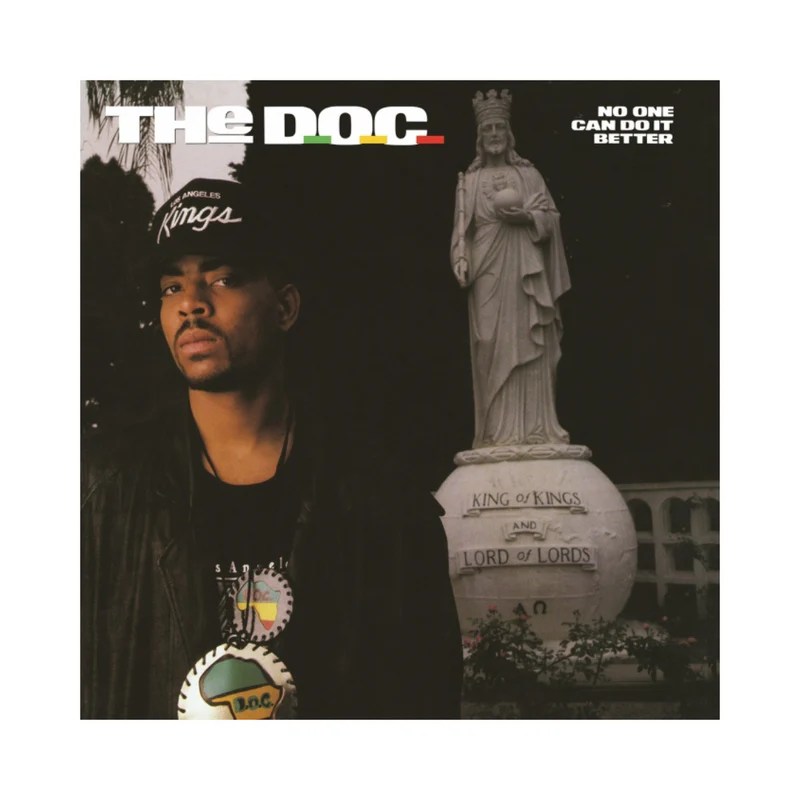
The D.O.C, No One Can Do It Better (1989)– This sounds to me like an encapsulation of 80s hip hop- it’s replete with the breaks, turntabilism, and hard rock samples of the new school, and the soul and funk samples and swing of new jack. It also exemplifies the hard-hitting gangsta rap sound of the eighties as it was turning to the G-funk gangster sound of the nineties, but with a substantive heft more reminiscent of Public Enemy. My initial impression on this is backed up by subsequent research- Tracy Lynn Curry, a.k.a. The DOC, came out of Houston’s Southern hip-hop scene, but became a collaborator with N.W.A. and even contributed lyrics to their debut album. They returned the favor here, Dr. Dre producing this album, multiple N.W.A. members contributing to various tracks, and Eazy-E putting it out on his fledgling record label. For good measure, one of the closing tracks of the album, “The Formula” is even credited as being the first G-funk single. Shortly after release, The D.O.C. would join Dre in becoming one of the co-founders of Death Row Records. All in all, a solid album that feels like the eighties turning into the nineties.
Ice Cube, AmeriKKKa’s Most Wanted (1990)- I think it’s no accident that this installment of the blog is feeling all kinds of liminal. With this album, we have a double milestone- it’s our 34th review, meaning we’ve now made it past one third through, and it’s the first album on the list from the nineties. After Ice Cube split from N.W.A. and their record label amidst various financial disputes, he worked with lyrics from Dr. Dre’s cousin Sir Jinx and production from Public Enemy’s Bomb Squad to make this solo debut. The album feels like it puts together the best of all these worlds- Ice Cube’s hard-hitting delivery, the humor of Southern California gangsta rap, the densely layered production of Public Enemy, and both N.W.A.’s and Public Enemy’s versions of social and political commentary. It also brings along Ice Cube’s considerable misogyny and revelry in scenes of violence. But it sounds consistently powerful and high quality, and dives full-force into its mission of rubbing America’s face in everything about rap in general and Ice Cube in particular that made it uncomfortable. That’s not a bad way for the genre to kick off the nineties!
If you’re curious about the sources I used to compile my list, you can check them out here:
And if you want to catch up on the previous installments, here they are…
Finally, if you’d like a playlist for the entire list, you can find that here. Listen to it sequentially for the historical development of the genre, or play on shuffle for maximum historical scramble!
 Chris LaMay-West