
Remember my update from a week ago when there was a little under two weeks left? Guess what? It’s now less than one week! 6 days to go as I’m writing this, probably 5 by the time you’re reading it. What’s changed over the last week?
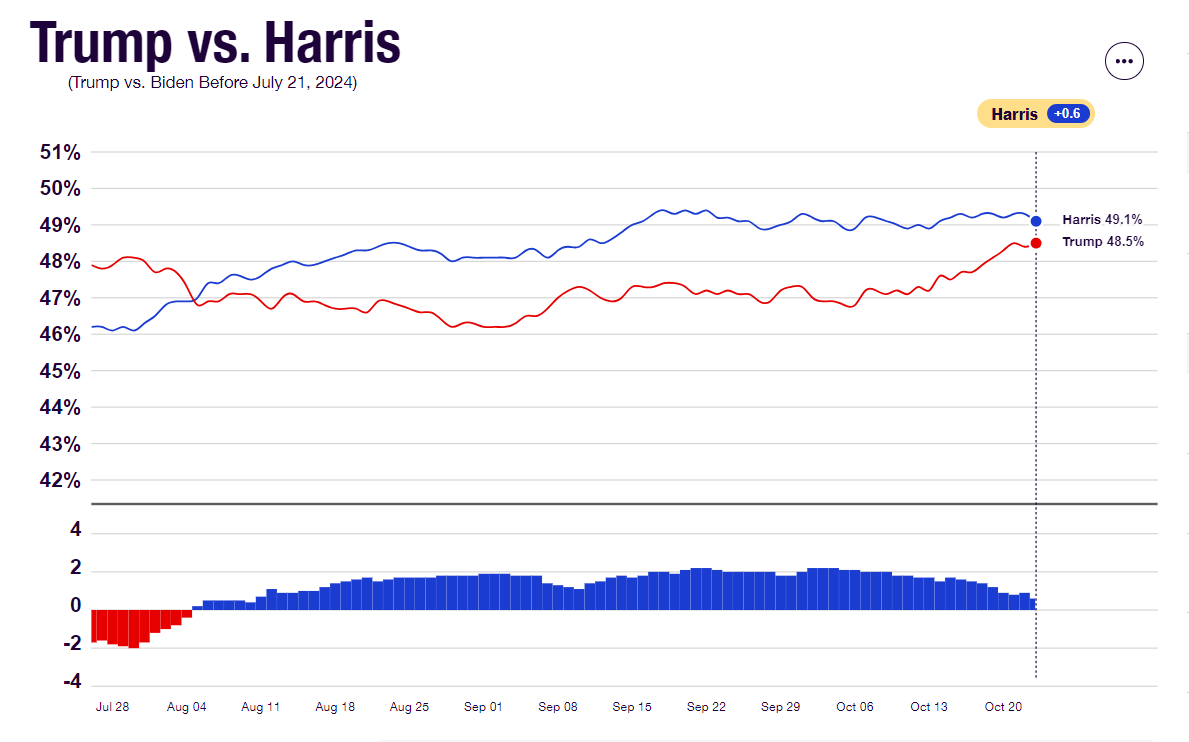
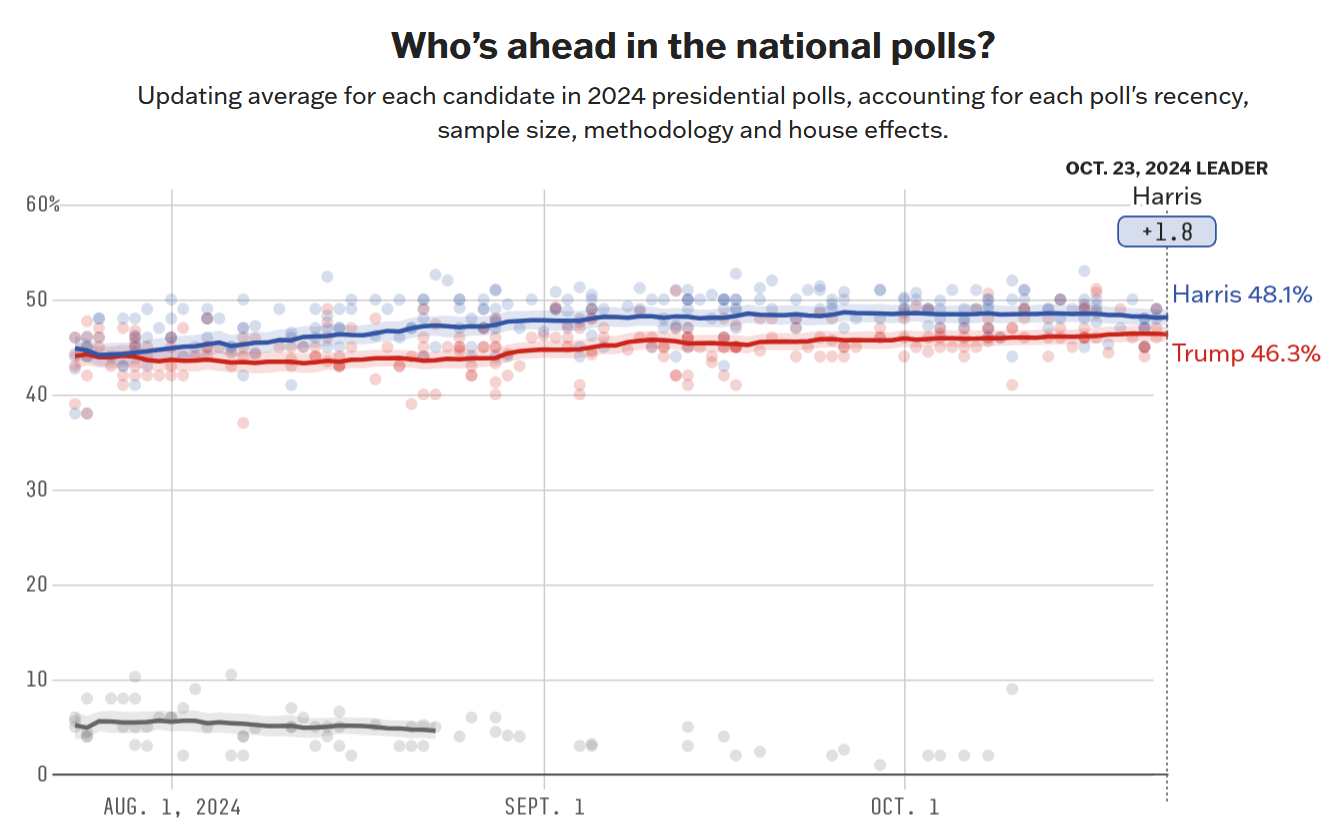
Trump now has a narrow lead in the Real Clear Politics tracking poll. In the more reliable 538 national polling average Harris retains a lead, but it’s down a bit from a week ago. In another perhaps not great sign for the Harris campaign, she’s actually down from her top numbers earlier in the year in both averages:

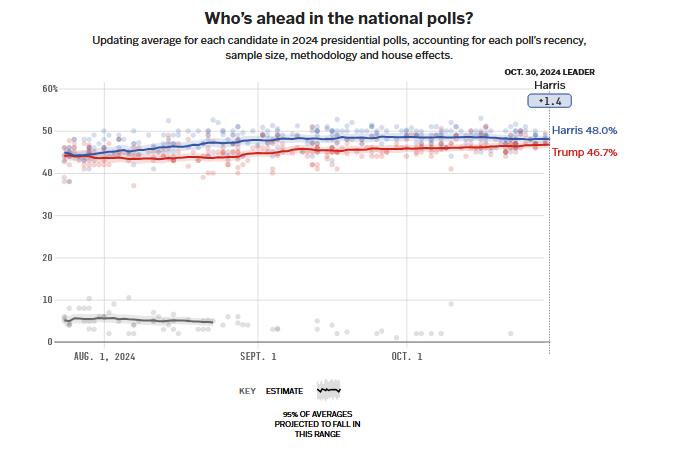
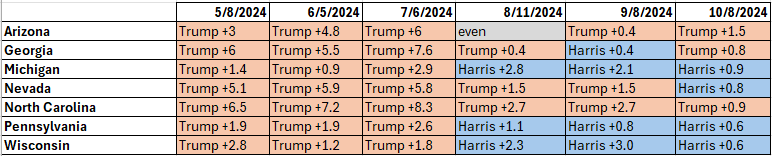
As noted a week ago there’s a point- somewhere in the neighborhood of 2% to 3%- where a Democratic national lead doesn’t necessarily translate into an Electoral College lead anymore, and Harris remains below that point. So let’s look at the Electoral Vote! On the swing state front, RCP now shows Trump leading in 5 of 7 states, a slip from his 7 of 7 lead a week ago states. 538 has a more robust methodology of weighting polls according to history of pollster accuracy and partisan lean, and it shows a scattered picture- Harris’s lead has expanded a bit in two states, Trump’s lead has expanded a bit in four, and in Nevada Harris is down a little, making that state a tie.
So, less blanket movement toward Trump than a week ago, at which time he had improved vs. Harris in every state except one. But Harris is also down a state from a week ago, and not making progress in four others where she was already behind. Another major takeaway from the chart is that none of the leads for either candidate is outside the margin of error, and in 4 of 7 states they’re separated by less than 1%:

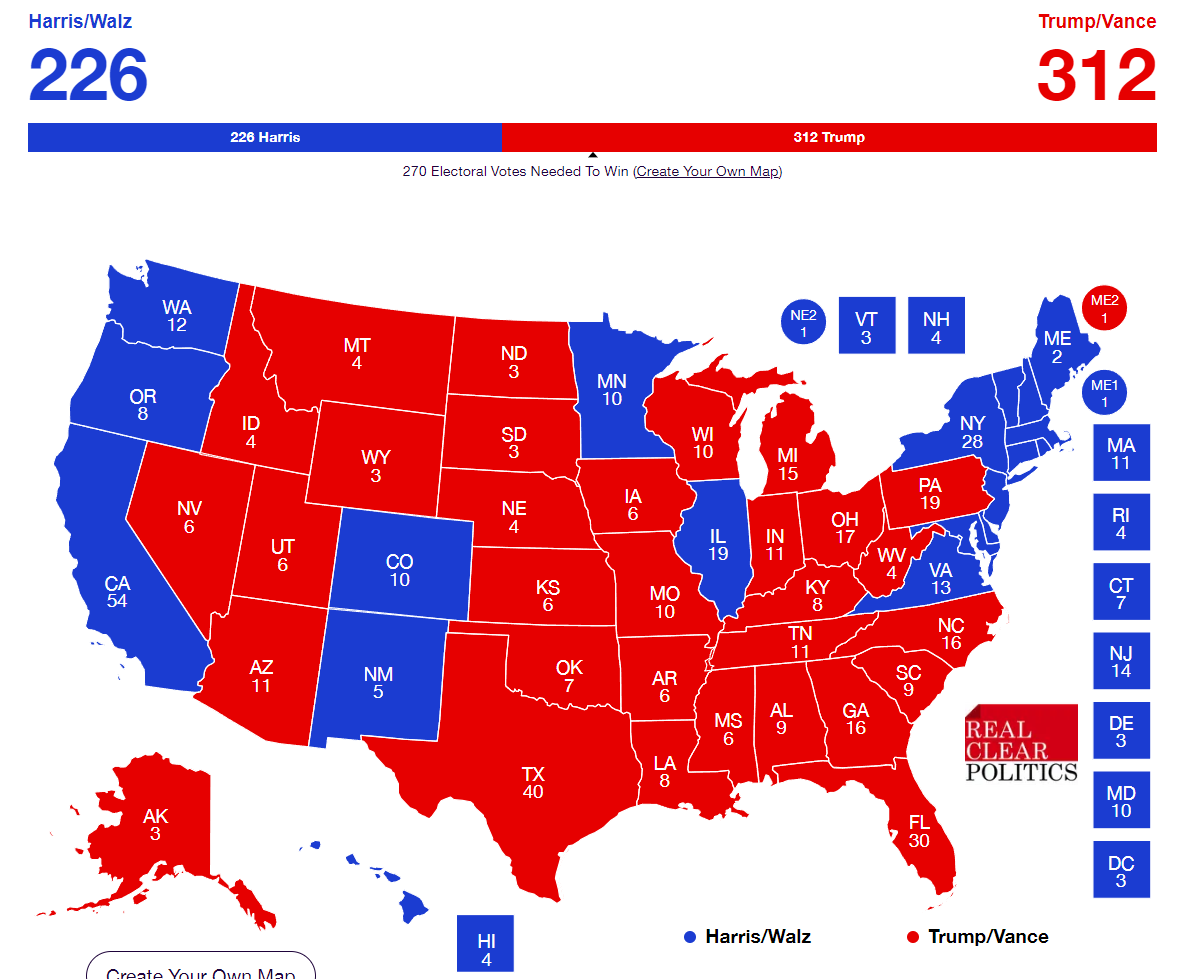
So what does that add up to? RCP still has Trump winning the Electoral College, but not by the blowout form a week ago:

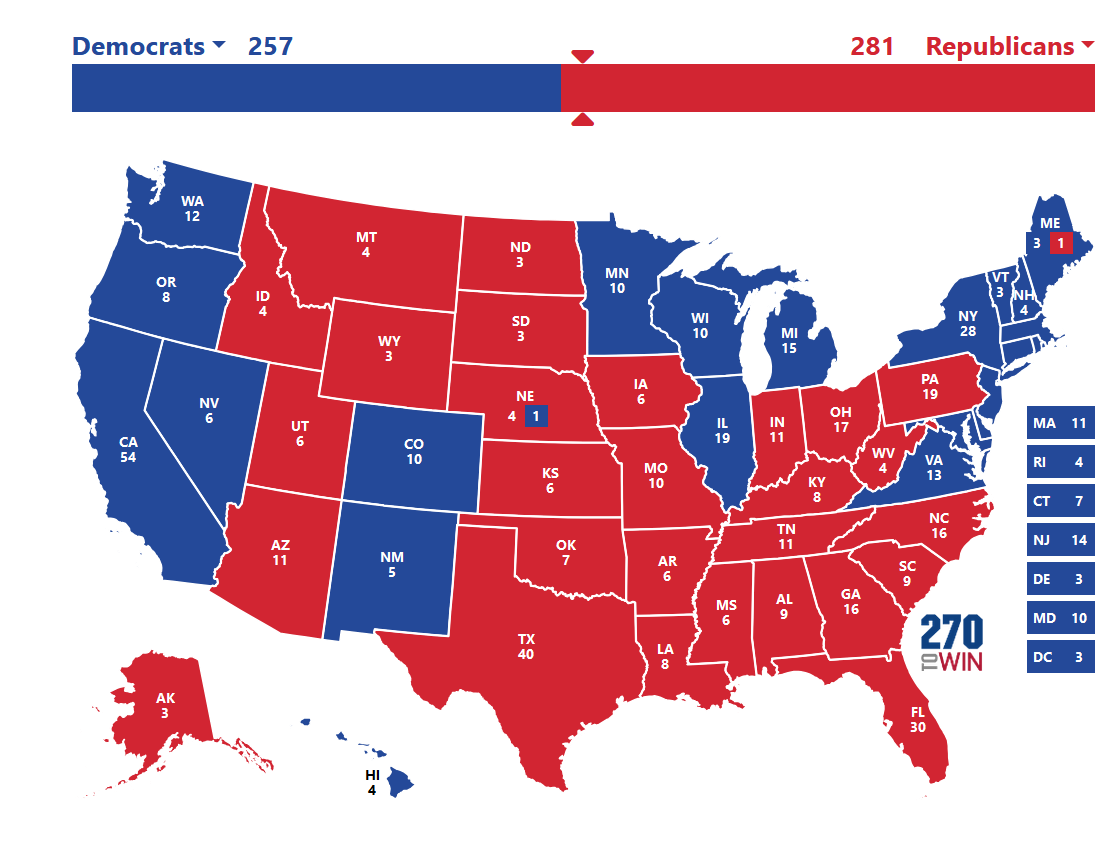
Their map has pretty much now converged with 538’s, except that 538 has Nevada tied:

What was true a week ago remains true- with four states separated by less than 1%, and all seven below the margin of error, it wouldn’t be a major surprise to see either candidate win any particular state. It would even be consistent with these numbers to see either Harris or Trump win all seven (although Trump’s lead in Arizona and Georgia is starting to look more substantial).
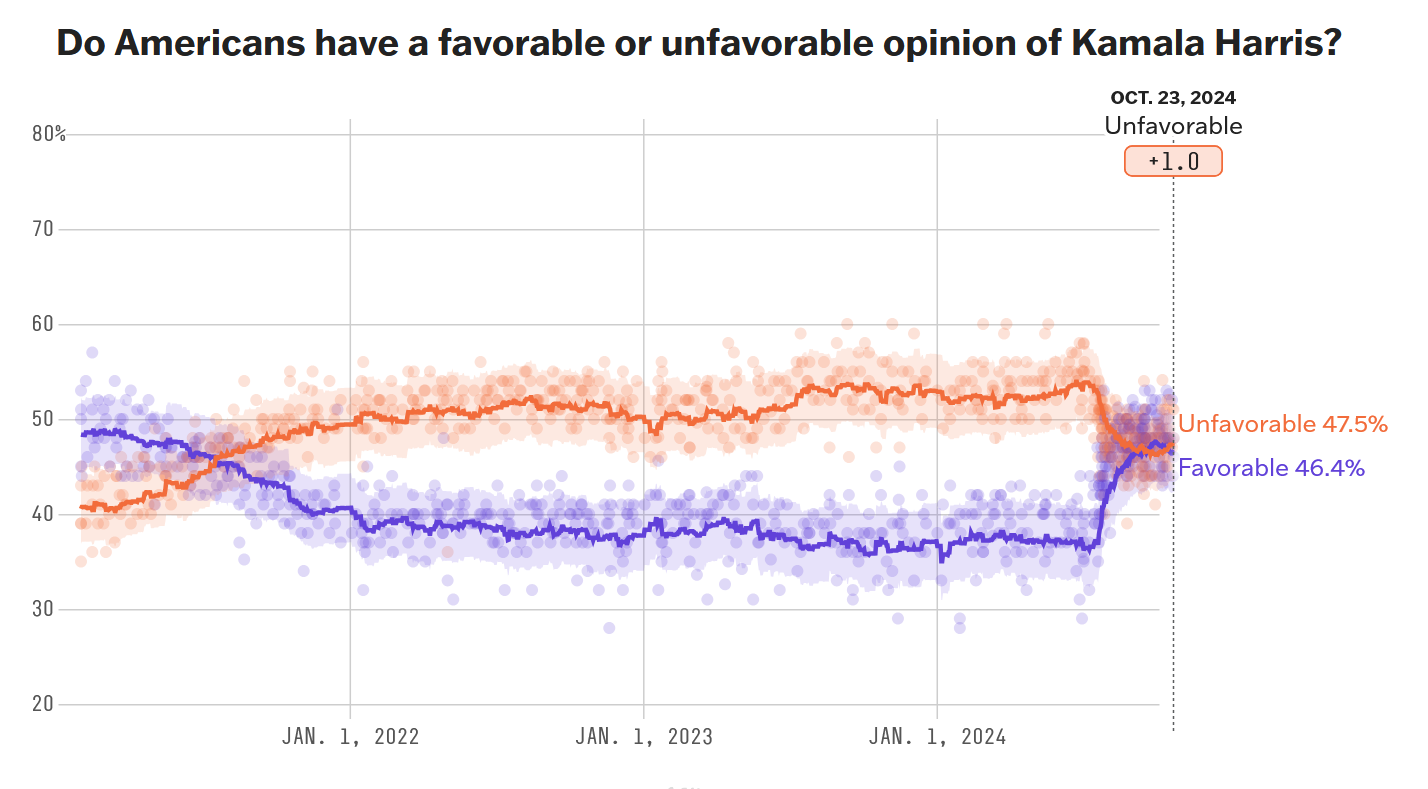
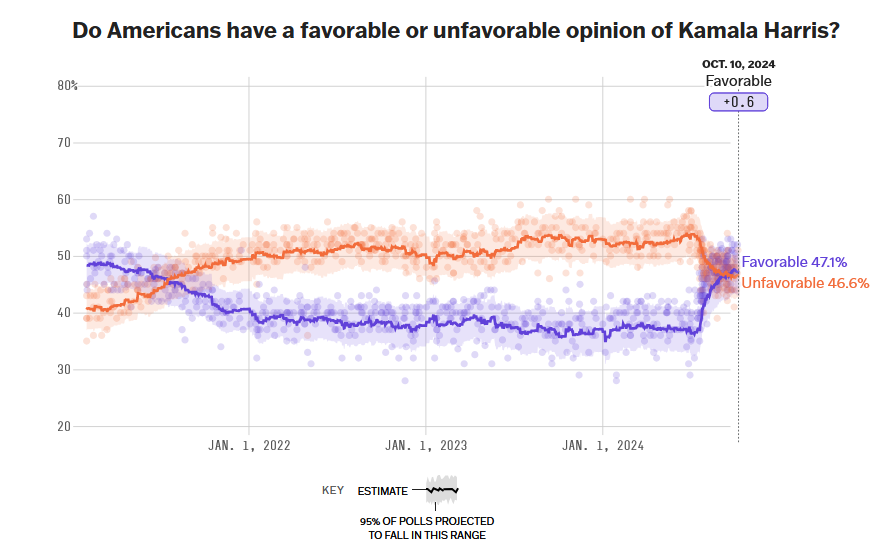
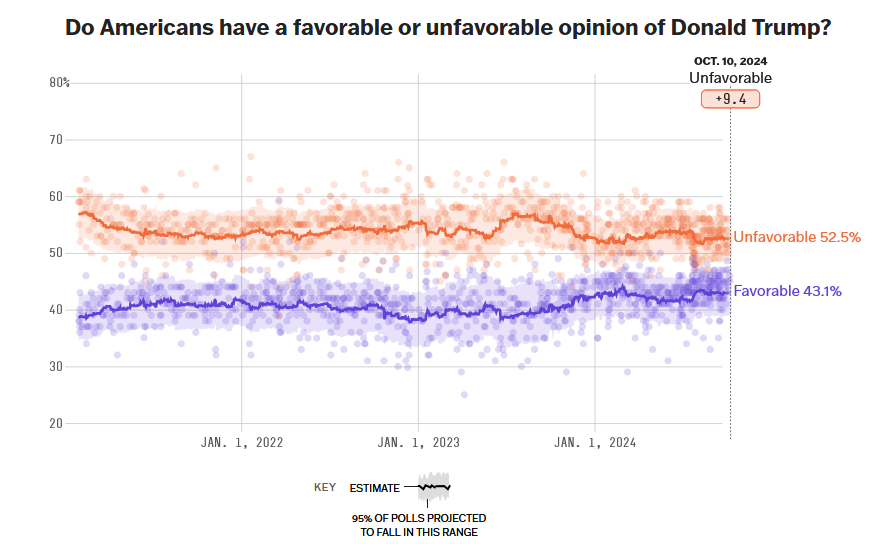
Approval ratings, which are another kind of stand in for preference, still show an edge for Harris, but a week ago she had swung back into net negative territory and her negatives have now grown over a week ago. Trump, meanwhile, continues to trend a little less negative, to the point that they’re only separated by 7 points:


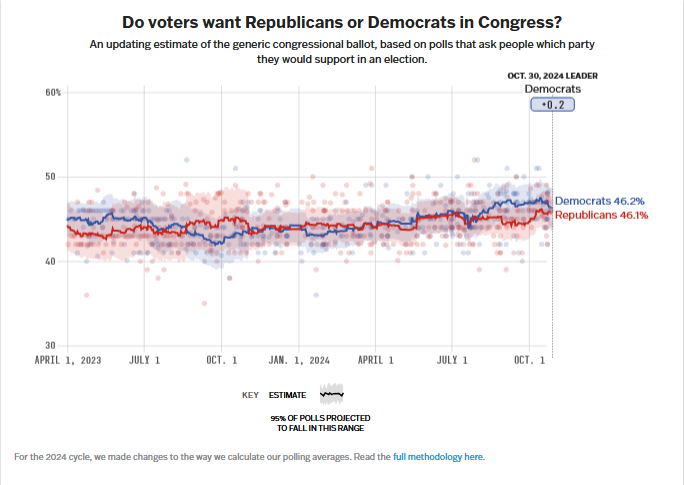
Democrats still retain a narrow lead in the Generic Congressional ballot, but down by over a point from a week ago:
A significant indication of overall strength for Democrats remains that, through 100 special elections over the past two years, the party has outperformed by an average of 6% against the partisan lean of the races in question (per a spreadsheet compiled by Nathaniel Rakich of 538):

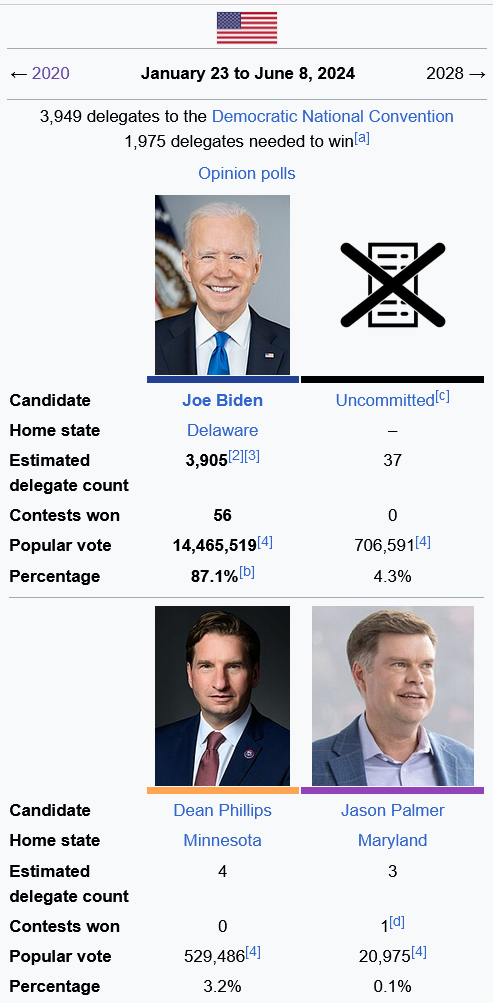
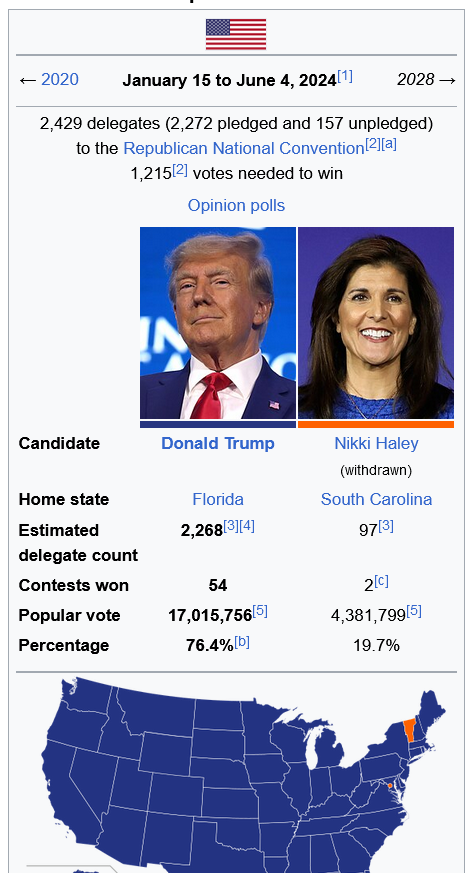
There’s no change in this indicator, but it remains true that Biden’s percentage in Democratic primaries was ahead of Trump’s in Republican primaries, indicating that Republicans had comparatively more wavering partisan supporters to bring home for their nominee:
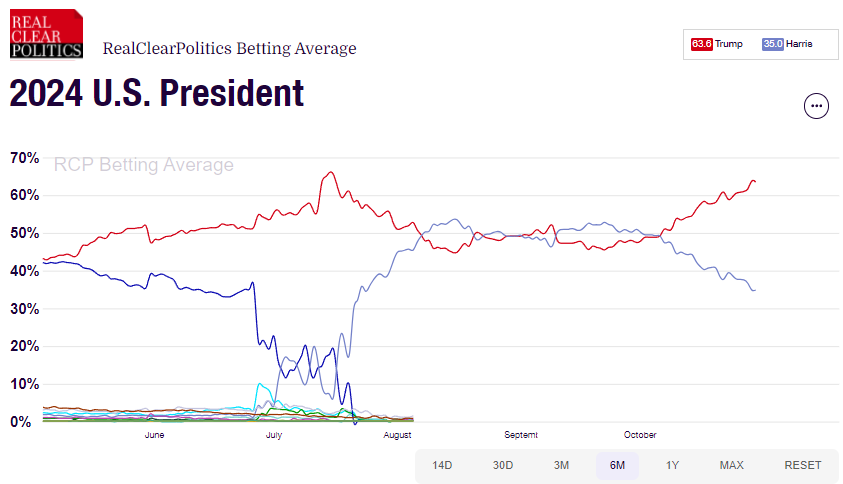
The betting markets had shifted toward Trump in a big way a week ago, and have gone even further in that direction over the last week, predicting a more than 63% chance of him winning the election:
Given the closeness of many of the numbers above, and what we’ll be discussing next, there may be an arbitrage opportunity there if anyone is interested… To whit, 538’s forecast model is basically 50/50:

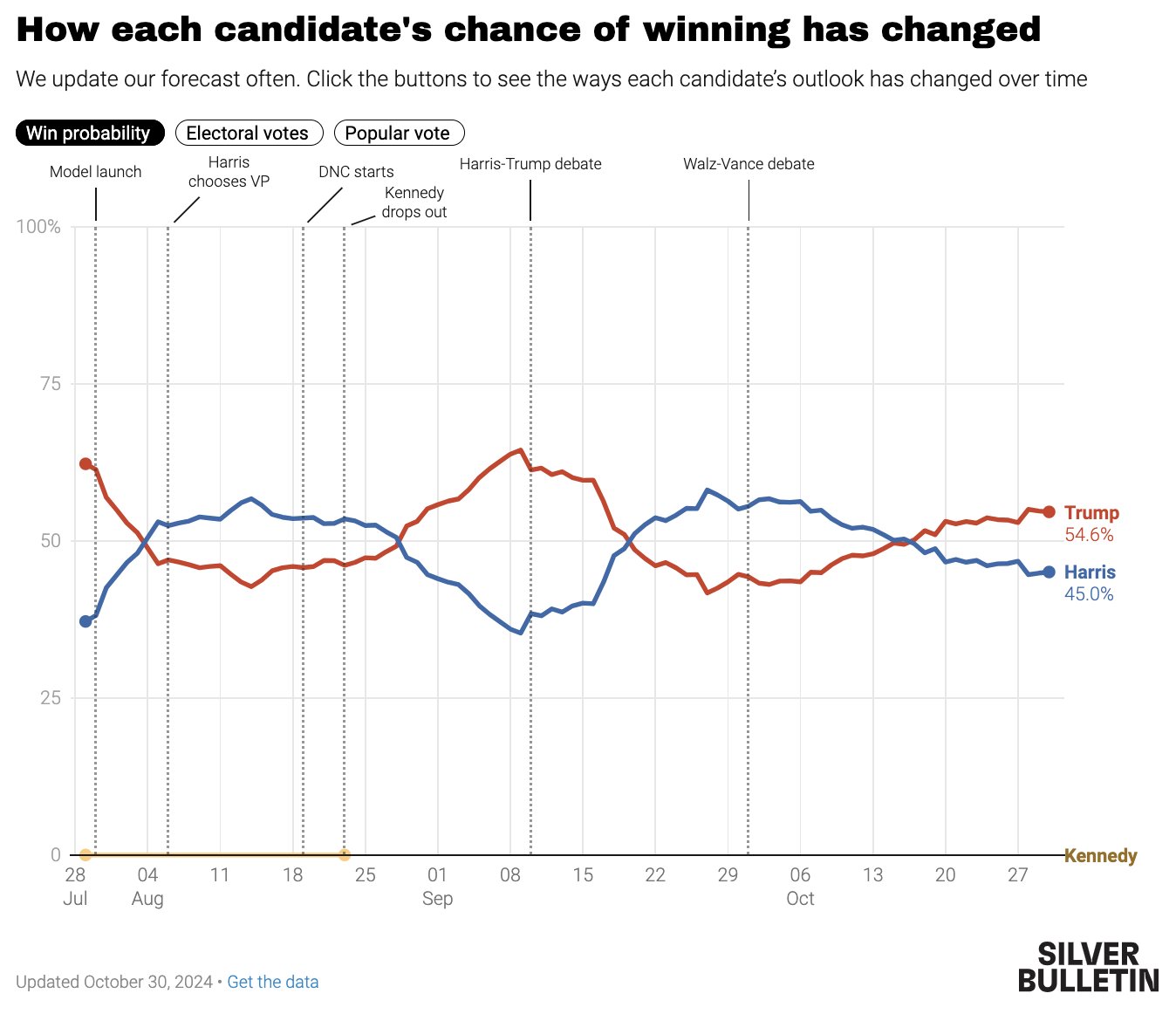
538’s now solo founder Nate Silver has his model behind a paywall, but did give an update on it today that is a little more positive for Trump, but is still very close to 50/50:
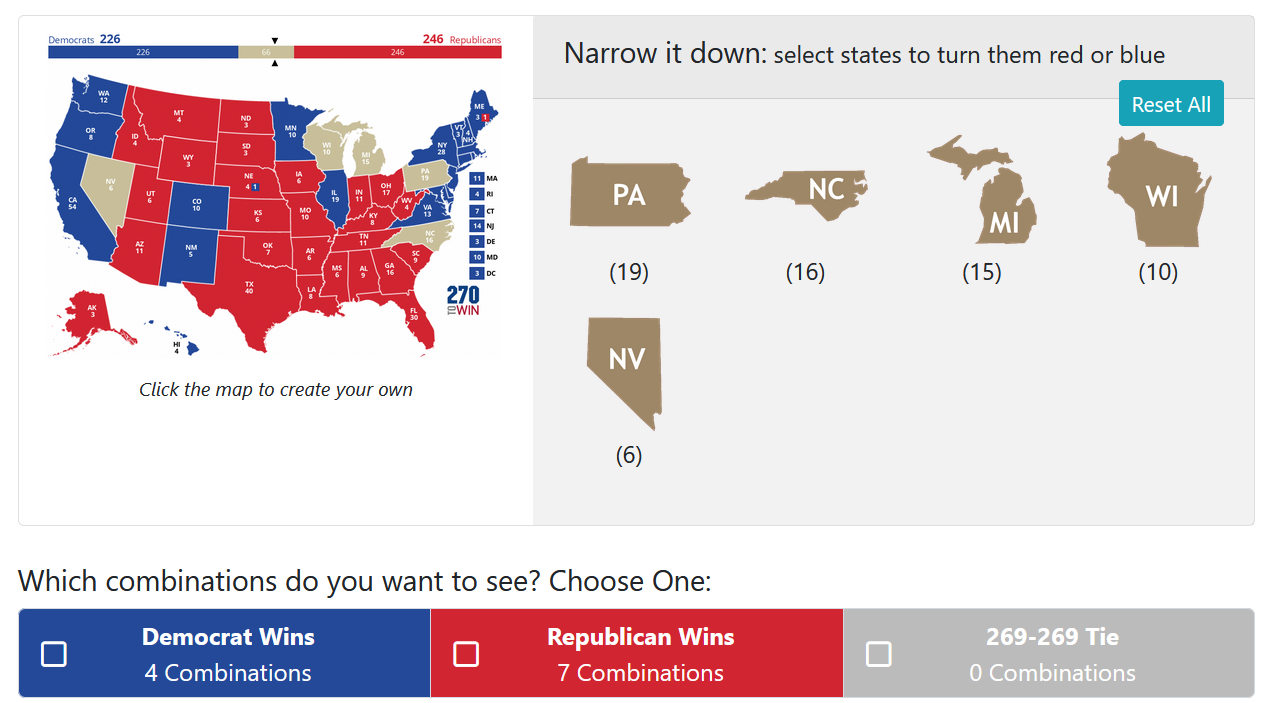
If we do a map that leaves blank the four states that are within 1%, there is one path by which Harris could get there, winning all three of Michigan, Pennsylvania, and Wisconsin. Trump would win with any one of the three:

Overall, it feels to me like some slowing (but not stopping) of the motion toward Trump, mixed with an improved sign or two for Harris. There are some reasons to think that things could be better for Harris than the polls indicate:
- As mentioned earlier, in 100 special elections over the past two years, Democrats have consistently done better by several percentage points than the dynamics of the races would indicate
- Harris is running behind Democratic Senate candidates in several swing states and, other things being equal, it would be surprising if her numbers didn’t end up equalizing a little more there
- Pollsters may have bent over backwards to correct the sampling models that had them systemically underestimating Trump supporters in 2016 and 2020, and may now be systemically overestimating his support
These are all logical takes, supported by some empirical data, but the logic here cuts both ways. If polls are underestimating Harris by a few percent, she could be headed for a blowout. On the other hand, if they’re still underestimating Trump the way they did the last two cycles, he could be headed for a blowout. Or, things could be exactly as they appear, and a handful of votes in a few key states could see either candidate squeak by.
My best advice is to follow some of the most empirically grounded commentators on the lead-up to election night (and on election night itself). Axios had a good round-up of suggested follows recently:
“Pick a few trustworthy accounts rather than gorging on whatever pops up.
Jon Ralston (@RalstonReports) is your man in Nevada … Garrett Archer (@Garrett_Archer) in Arizona … Greg Bluestein (@bluestein) and the Atlanta Journal-Constitution crew in Georgia.
Dave Wasserman of Cook Political Report (@redistrict) is an essential follow if you want live play-by-play of crucial counties, as are the two Nates — @NateSilver538 and @Nate_Cohn.”
And the good folks at Electoral-Vote.com had some sage advice on where election night results could indicate a developing Blue or Red Wave (as opposed to ye olde 50-50 muddle which would take days to untangle):
“Many people have already voted but, due to various state laws, we are unlikely to know the winner of the presidential election on Nov. 5. Maybe not even on Nov. 6 if it really is as close as the polls say it is. Much of the problem is due to Republican-controlled state legislatures that want the election to devolve into chaos to provide cover for Donald Trump if he tries to claim victory on Nov. 5 and is then ultimately defeated. The biggest issue is whether absentee ballots can be pre-processed or even fully processed before Election Day. If the process of verifying the signatures on the envelopes may not begin before 7 a.m. on Election Day, there is no conceivable way they can all be verified, the envelopes opened, and the ballots taken out, prepped, and scanned by midnight. Here is the lay of the land by (swing) state:
- Arizona: Although Arizona is in the Mountain Time Zone, its results may be available long before some of the swing states in the Eastern Time Zone because Arizona law allows processing of all ballots as soon as they are received and they can be counted as soon as they have been processed. The results may not be released until the polls close, though. If a large number of ballots are dropped off in person on Election Day, that could slow the process down.
- Georgia: Not as good as Arizona, but still pretty good. Signatures are verified as the absentee ballots come in, but opening the envelopes may not begin until the third Monday before Election Day. That is to say, Oct. 21. This means that all the absentee ballots arriving before Election Day will be counted before Election Day. Polls close early (7 p.m.) on Election Day. The combination of precounting the absentee ballots and an early closing time in the Eastern Time Zone means that Georgia will probably be the first swing state to report a winner. If it is a blowout either way, that could set the tone for the rest of the night.
- Michigan: In Michigan, in all but the smallest jurisdictions, ballots can be preprocessed and counted starting 8 days before the election. Since polls close at 8 p.m., an hour later than Georgia, most likely Georgia will report first, but Michigan will probably be the second swing state to report. If the same candidate wins both of them, that candidate will probably be in for a good night. However, a Harris (Michigan)/Trump (Georgia) split is probably more likely.
- Nevada: Signature verification can begin as soon as ballots are received and counting can begin 15 days before the election, so absentee ballots will largely be counted before Election Day, as in Arizona. But since Nevada, unlike Arizona, is an all-mail-in-election state, its results might be available even before Arizona’s. That said, the Silver State is one time zone west of Arizona, and no state can release results until the polls are closed, so maybe not.
- North Carolina: Oh boy. Hurricane Helene battered the western portion of the state, so the U.S. Supreme Court gets to call the winner. Not officially (yet), but there are sure to be endless lawsuits due to the difficulty in voting for people in the 25 affected counties. Other than that, the state isn’t so bad. Absentee ballots may be verified and put into the tabulating machines 5 weeks before Election Day. Polls close later than in Georgia (7:30 p.m.) but the big problem here is going to be the western part of the state. Still, fairly early on, there will be a big clue how things are going because the biggest cities (Charlotte, Raleigh, Greensboro, Durham, and Winston-Salem) were not hit by the hurricane and it will be possible to compare their vote totals with 2020. Harris must surge here to win the state and the presence or absence of a surge will be known before the western counties report.
- Pennsylvania: Pennsylvania introduced early in-person voting only in 2020, so there is not much experience with it. Unfortunately, early in-person ballots are considered absentee ballots, and these may not be counted until 7 a.m. on Election Day. At least there is no need to verify signatures and open envelopes for the early votes. Still, in a large state that may determine the winner, and where every vote may count, it could take a couple of days to count all the ballots, unless there is an unexpected blowout.
- Wisconsin: As we note above, Wisconsin was the third closest state in 2020 (after Georgia and Arizona). Like Pennsylvania, preprocessing of the ballots may not begin in Wisconsin until the polls open on Election Day. If everything ends up depending on Wisconsin, we likely won’t know for a while who won the Badger State. Wisconsin election officials have begged the state legislature to change the law so they can at least pre-process the ballots and have them stacked up, ready to put in the counting machines at 7 a.m. on Election Day, but Republicans in the legislature have no interest in doing so.
The bottom line here is that Georgia will probably come in first, then Michigan, then the eastern part of North Carolina. If there is a huge blue wave, it will show up in the big cities there and that will be a big clue how the state will go. If there is no blue wave, that will also be obvious fairly early.”
We’ll check in one final time Sunday evening with 36ish hours to go. Until then, our indicators are:













 Chris LaMay-West