Category Archives: presidential election

New Hampshire wrap-up: It’s over.

I’m going to answer my own question from yesterday, based on last night’s results. The Republican nomination contest is essentially decided.

Bold words after just two states? Consider the results of the candidates placement from last night:

Romney– Got more votes than he did in 2008, got a higher percentage than McCain won by in that same year, and was not far away from 20% ahead of the next comer. If anybody got positive momentum for South Carolina last night, it was him. Yes, SC is not a good state for him, and Perry and Gingrich are both sitting on millions in advertising they can unleash against him over the next ten days. But you’ll see below why I think it won’t matter.

Paul– Strong second last night, following up on a strong third in Iowa. South Carolina will be a little harder for him, but he’s probably in a position to keep getting double digit seconds and thirds in many states to come, if he chooses to stay in. But is unlikely to ever do better than that.

Huntsman– I actually like him a lot, but then as a Progressive I would, for the same reasons in reverse that Joe Lieberman used to be the Conservative’s favorite Democrat. It doesn’t matter, because New Hampshire is probably the only state until maybe Utah that he can score double-digits in, and it’s only a matter of time until money and/or a sense of futility forces him out.

Gingrich– Squeaking ahead of Santroum isn’t a bad result for him, but being fourth isn’t a good one either. What this not-bad-enough-to-knock-either-one-out result really means is that they’ll both be in through South Carolina, along with Perry. Which means that Romeny, who would probably lose the state by 10-15% against a united Conservative candidate, will win it.

Santorum– Fifth ain’t great, and his Iowa momentum is now officially tapped out. Nearly tied with Gingrich, though, means he’ll be alive and kicking in South Carolina. It’s possible one of them will decisively pull ahead of the other there, leading one to drop out. More likely, they split the conservative vote pretty evenly, and are both encouraged enough to stay in through Florida at the end of the month, dividing the vote there and delivering that state to Romney as well.

Perry– Skipped New Hampshire to make his last stand in South Carolina. The problem with doing that, of course, is that people write you off after two single-digit performances in a row. Presumably he’ll give up the ghost after three in a row.

The upshot of all of the above? By the end of this month, Romney will have won the first four contests. The field will effectively be winnowed down to him, Paul and whoever the last Conservative standing is. Yes, technically it will take him a while to officially pile up the delegates needed. And some opponent will probably score a surprise victory or scarily-close second here and there. But the early division of the field will have gotten him enough ahead that nobody will be in a position to catch him. Finis.

New Hampshire: This is the end! Or not.

In a few hours now, we’ll be seeing the results roll in from the New Hampshire primary. In my case, I’ll probably be on a news website by 8 PM refreshing live results every 15 minutes. Because that’s just the way I am… For the record, here’s what the latest polling is showing:

The statistical model over at fivethirtyeight.com is pretty much in line with this too. Astute cases are being made, like this one from Politico.com, that tonight’s result will essentially mean that the nominating contest is over for the Republicans, since a strong win in NH will position Romney for a sweep of South Carolina and Florida too. Of course, you can find a contrarian view at the very same news site, which just goes to show that hope for an interesting primary season springs eternal.

My take? I have to side with the sweep theory. Even in the debates this weekend, most of the candidates still focused on bashing each other in pursuit of second (and third) place rather than targeting Romney in pursuit of first. Perry’s decision to stay in through South Carolina and the fact that however they finish tonight, Santorum and Gingrich will be around for that contest too practically guarantees that Romney wins South Carolina, however underwhelmingly. And the fact is, you can’t second or third place your way to winning the nomination, but you absolutely can get there through a string of underwhelming first place finishes.

I can still make a case for some interest tonight though. Romney is so thoroughly expected to win, and win big, that he has the most to lose. Finishing 20% ahead of the next comer could just get him an “as expected”, but having someone get closer than that and/or finishing first, but with the same 31% share he had in 2008, will probably be counted against him. And that would make South Carolina tougher, to be sure.

The thing is, nobody else is likely to walk out of tonight with good enough news. If Gingrich can get ahead of Santorum into fourth place he does himself some favors, but fourth is still pretty far back. If Santorum can get into the top three, that would be something, but third is still third. Ron Paul is expected to get second, so anything else would be bad for him, but he’s the kind of candidate who can keep going regardless. And no matter how they place, they’ll all be in South Carolina for the next 10 days, carving up the vote there so thoroughly that Romney can comfortably win even with only 25-30%.

Huntsman is the only candidate having last-minute momentum, and it isn’t impossible that he could pull off a surprise second. But even so, he has nowhere to go after New Hampshire. The party at large is clearly not looking for someone more centrist than Romney, and no amount of bounce will make Huntsman of interest in famously conservative South Carolina.

One piece of good news in the New Hampshire windup? If you read my earlier blog on “the gaffe” you know that I abhor how feeding frenzies around stray comments obscure actual substance. To their credit, Gingrich and Santorum took the high road and avoided pouncing on Romney’s “I like to be able to fire people” miss-comment, recognizing the substance of what he was saying about flexible health care being better for companies. Glimmers of adulthood are always welcome in a presidential race.

Iowa Morning After Thoughts

Just a few quick reactions to last night’s first in the nation honest to goodness voting, in terms of placement order:

Romney- A win is a win, even if only by 8 votes, and he’s going on to New Hampshire, which he’s overwhelmingly likely to win too. Double bonus! On the other hand, the fact that he just squeaked past Santorum, Paul was also in the 20s, another two candidates were at or above 10%, and he only barely got more votes in Iowa than in 2008 even after 4 years of campaigning is hardly a ringing endorsement. He’s never going to win by ringing endorsement though, more by lack of credible alternative. Which probably will work for him in the end…

Santorum- I really think this is more like a flash in the pan. He just happened to get what every other anti-Romney missed by timing, a surge just before voting actually started. New Hampshire isn’t going to be good territory for him though, which means he’ll have a good two weeks of media scrutiny before getting to friendlier ground in South Carolina. And like Bachmann and Perry, he isn’t especially well-suited to being in the spotlight. Even yesterday, past statements by him that will be a little too unpalatable to more centrist voters were starting to surface.

Paul- Doesn’t get as much traction as first or second would have gotten him, but more than doubled his ’08 vote. And he’s going on to New Hampshire, where he can make a strong play for second as well. In any case, a candidacy like his can hang in there with less funds than any of the others. There’s every chance he’s positioned to remain some kind of presence up until the convention, which will be an interesting challenge for party leadership. 

Gingrich- Coming in fourth isn’t great, especially since he’s poised to come in third or fourth in New Hampshire too. On the other hand, I wouldn’t count him out. He’s scrappy and wily. With Bachmann out and Perry possibly folding, if Santorum starts to shrivel over the next few weeks under media scrutiny, he could, by Super Tuesday, once again be the only credible anti-Romney. Of course, in the meantime, lack of funds and organization is preventing him from even getting on the ballot in some states, so he may not be able to capitalize on this turn of events even if it does occur.

Perry- Seems to be making contradictory statements about whether or not he’s still in. It’s hard to see how fifth in Iowa, and likely ending up there again in New Hampshire, is a prelude to a comeback. On the other hand, he’s unique in having the funds to stay in as long as we wants, success or no. He can easily remain through South Carolina and even Florida. The only effect I can see that having though, is not positioning him for a breakout, but preventing Santorum or Gingrich from solidifying as viable alternatives to Romney.

Bachmann- Our first casualty of the actual election season. One thing I do like about her story is that she was never taken as a token candidate because of her gender. She was fully viable. Except for being batshit crazy. It shows how much room Hillary Clinton, and yes indeed, Sarah Palin too, opened up in 2008, which I think is good for the future of our republic no matter what party you’re in.

Huntsman- I think it’s actually remarkable he got votes at all, considering that he’d consciously abandoned the state. This shouldn’t effect his decent shot at doing well in New Hampshire, but it’s hard to see where he’d have to go from there.

And so, on to New Hampshire!

Newt, we hardly knew ye…

In a few hours, we should all start feasting on the results of the first real honest-to-gosh voting in the country, from the Iowa Caucuses. (At least us political junkies will be feasting.)

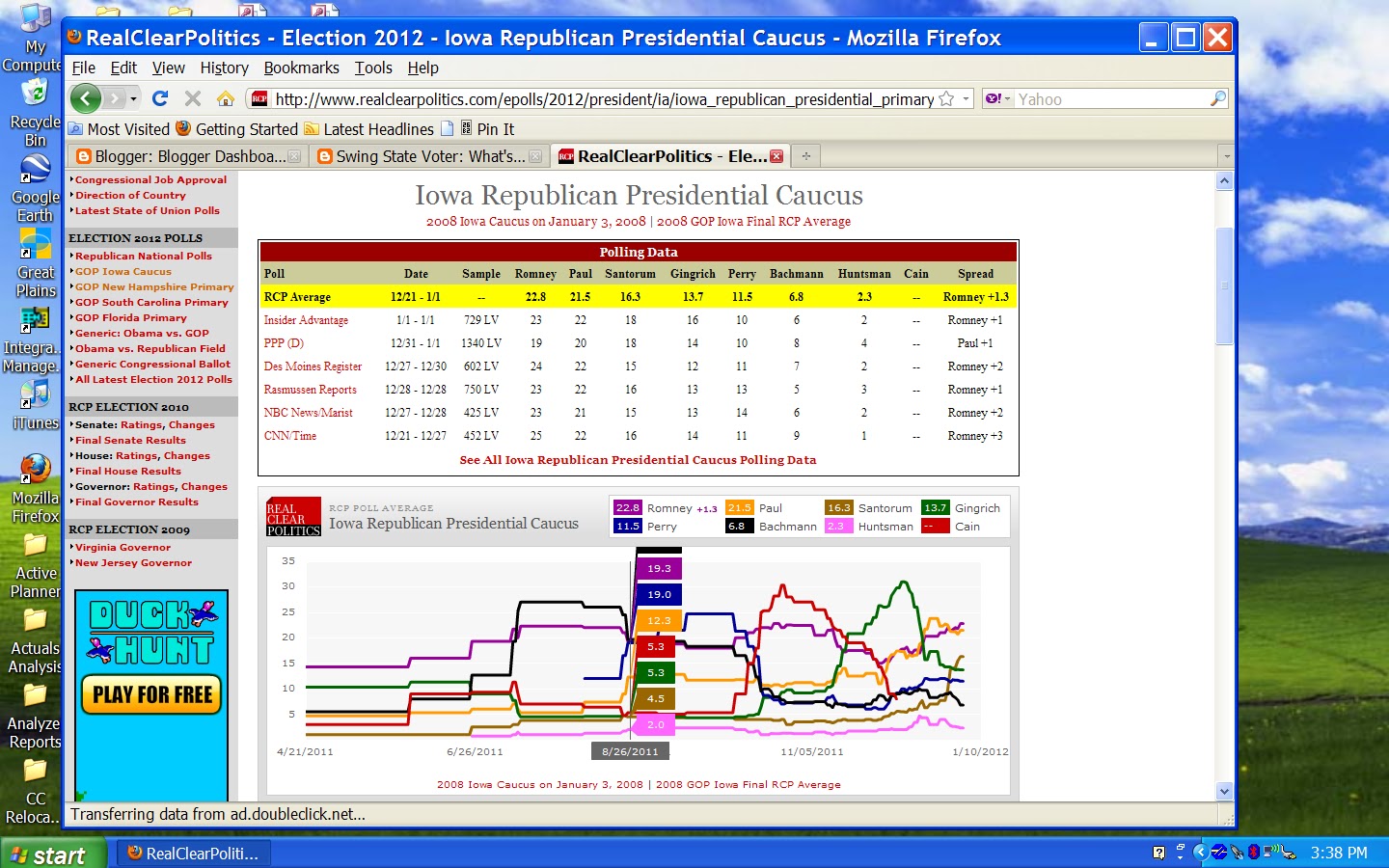
The RealClearPolitics national poll of polls isn’t very up-to-date at this point, since it has only one poll of six that includes any results after 12/18. That’s actually no big loss, since from this point on individual state results are what matter. Here’s what the much more up-to-date Iowa polling average is showing:

As you can see, Romney is currently eking out an extremely narrow lead over Ron Paul, and Rick Santorum is in the midst of a surprising last-minute surge that has him at third and rising. Poor Newt, who only a few weeks again was strongly leading, is now fourth.

These rankings may indeed hold, but, as my new friend Swing State Voter reminds us, a caucus is not like a primary. In short, it doesn’t depend on simple votes by secret ballot, but on committed voters showing up to very small meetings throughout the state, and publicly standing up for a candidate and convincing their neighbors to do so as well. This tends to favor candidates with the funding to organize and turn people out statewide (in this case Romney, and, though the polls don’t show it, Perry), or with a devoted following who will show up no matter what (Ron Paul to a T, and whoever the Evangelical vote most strongly backs, which seems at this point to be Santorum).

Absent from this list? Newt Gingrich, which could be very bad news for him.

It’s hard to see how a fourth place finish in Iowa wouldn’t result in a third or worse in New Hampshire, which would rapidly erode his position of strength in South Carolina and Florida later this month. Of course, as many analysts have pointed out, including Nate Silver at FiveThirtyEight.com, how you do relative to expectations actually ends up mattering more than where you place. If enough people think that Gingrich is a goner, and he then does better than expected in Iowa or New Hampshire, he could still remain viable. You may recall how in 1992 a cat named William Jefferson Clinton got blown out in Iowa and then placed second in New Hampshire, but compared to the DOA he was believed to be at that point, was actually able to spin that as a victory. Still, I wouldn’t advise Newt to hold his breath on pulling that off.

What about Romney? A win, even a narrow one, in Iowa, followed by almost certain victory in New Hampshire could turn this back into the quick coronation he’s wanted it to be all along. The only other candidates who were not sitting presidents that I could find who pulled this double-header off in the post-Watergate era were Al Gore in 2000 (who won 50 out of 50 primaries and caucuses) and John Kerry (who won 46 out of 50). But…

As Swing State has also pointed out, Santorum is the only person in that list who’s showing surging momentum, and as I’ve noted above, caucus dynamics favor “devotional” candidates like Ron Paul. Romney could just as easily end up third (even if very, very narrowly). He’d probably still win New Hampshire, but the fact that three other candidates there are sitting on double digits would be harder to spin away. The field would remain plenty feisty into Super Tuesday. And that field, which has concentrated on tearing each other down instead of targeting Romney in Iowa, could now start to spend against him heavily.

So it may not be quite over yet (before it’s begun!). Tune in in a few hours…   

The Gingrinch will not steal Christmas, but don’t count him out

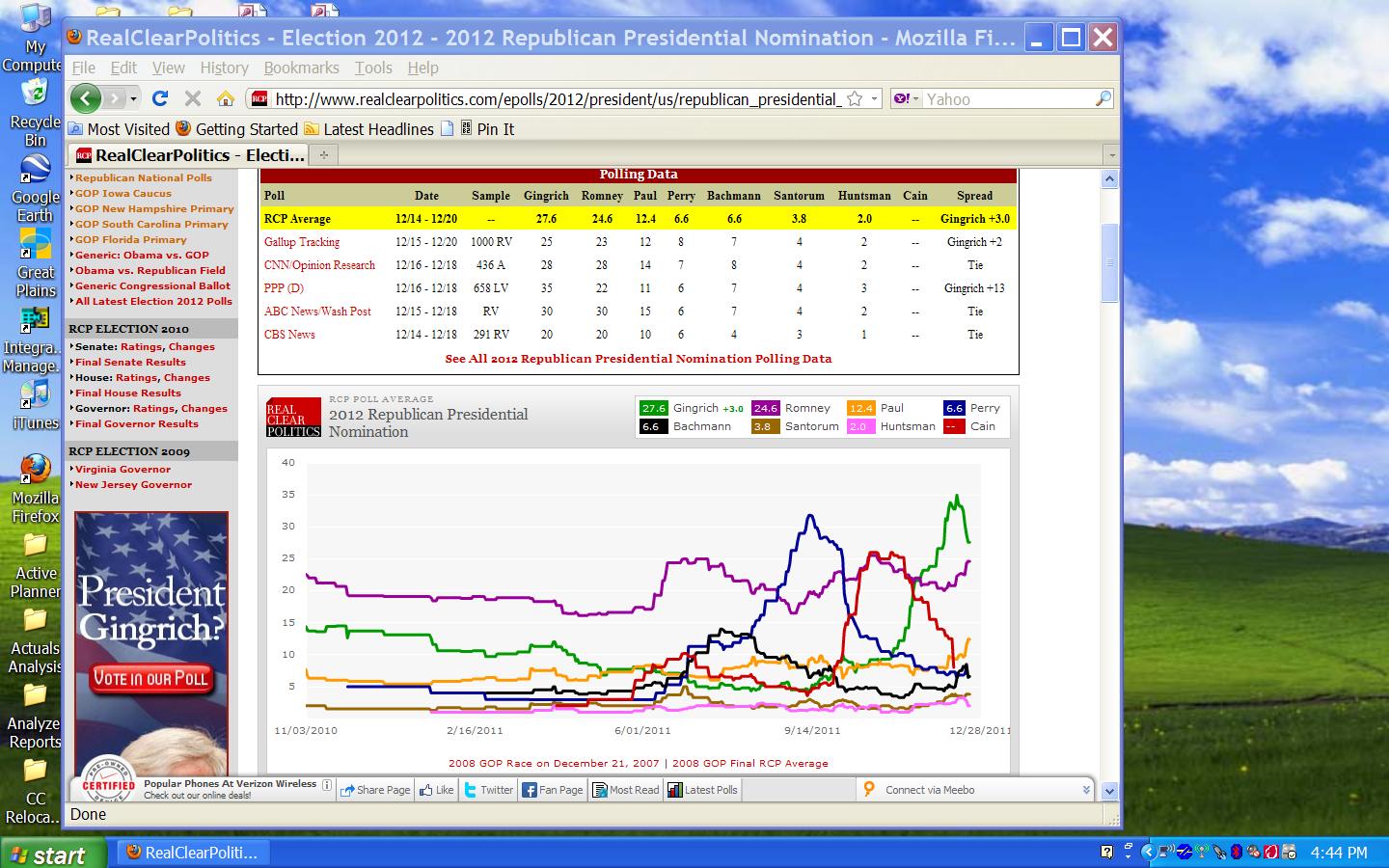
In my blog from a  few weeks ago about Gingrich’s sudden rise among Republican voters, I looked at the timing of the previous booms and busts of alternates to Romney. Based on the periodicity of Bachmann, Perry and Cain, I’d made a numerological guess that he would peak on 12/2, and start a sharp drop-off on 12/23. As you can see below, things have ended up working out a little differently:

In fact his high, of 35%, was reached on 12/13/11. And while the last three claimants to the anti-Romeny throne each had roughly three weeks on top before beginning their respective plunges, poor Newtie only seems to have gotten a few days. His polling average started a fall on 12/16, and as of 12/21, has fallen 5 percent in 5 days.

While this certainly looks to prevent him from running away with it (which I think he would have if he truly held on to a lead three weeks from his 12/13 peak, which would have had him still way on top when Iowa votes January 3rd), I think there’s equally good reasons to think he’s far from finished. He has a lot more going for him in terms of intellect, policy acumen and public presence than Bachmann and Perry, who wilted under scrutiny, and certainly doesn’t have the kind of problems that Cain did when he propositioned his way to collapse.

What’s going on is more like the effects of the whole field aiming their ammunition at him over the last 10 days, and the fact that the focus on him is showing him to be a little unpalatable. But, without the major handicaps of the others, there’s nothing here that would wipe him off the map. Which makes it quite possible that we end up with something like: Gingrich loses Iowa, but not by enough to be embarrassing (especially since current trends make it seem like Ron Paul might win!). Romney wins New Hampshire, but not by enough to be impressive. Gingrich then wins South Carolina and Florida, leaving three consistent vote-getting candidates to duke it out in February and March, maybe long enough that nobody has enough delegates to win the nomination until June. Or maybe not even then.

At the very least, Romney does not appear to be in for a cake walk. I read a piece recently that laid out four scenarios, none of which involved Romney quickly and decisively wrapping it up. I also read an interesting piece comparing Romney to Nixon in 1968 as an ideologically indistinct candidate that the party didn’t particularly want, but eventually swallowed its distaste for after repeatedly failing to find an alternative. Finally, the other day I read this article on Gingrich’s current fall which makes many of the same points I made in my original blog on November 19th.

Which, if nothing else, at least backs up my conviction that, in a parallel world where I’d opted for journalism school instead of years of misadventure in the business world, I could have made a pretty fair political journalist.

Gingrich at his peak? Maybe yes, maybe no…

My November 19th blog on Republican Booms and Busts used the admittedly small sample size of the average timeline of other Republican candidates’ rise and fall as alternatives to Romney to predict that the latest anti-Romney, Newt Gingrich, would hit a polling peak on December 2nd, and begin a plunge on December 23rd. So how’s it looking?

Actually not too bad for the first part. On December 1st, Gingrich reached his all-time peak (so far) of 26.6% on the Real Clear Politics polling average, and has remained at that level since then:

Might this be the peak? One good reason to think it could is that polling slowed down so much around Thanksgiving that there is only one national poll covering the period after 11/20, a Rasmussen Reports poll that had Gingrich at 38% and Romney at 17%. Since this is only a single poll, and Rasmussen polls historically tend to skew more conservative, the chances of it being an outlier are fairly high, and new polls that show Gingrich still ahead, but by less than 21%, would tend to back him off a little from the high this poll contributed to.

On the other hand, today’s piece of breaking news is that Herman Cain is suspending his campaign following the damage wrought this week by a woman who claims to be having an affair with him. While he denies it, he does admit to paying her bills and she has phone records that show months of contact between them. Prior to this, he had stabilized at around 15% despite the swarm of earlier allegations of woman trouble, and could probably have hung in around there until the voting started.

Now his votes will be looking for somewhere new to go, and all indications are that Gingrich and Perry are more likely to get them than Romney, which push Newt even higher and keep him near the top long enough to actually still be in the lead when voting starts one month from today.  

There are still plenty of good reasons to think that Romney will eventually be the nominee. Look at this Washington Post article, for example, to see the advantages his lead in money and organization give him in building a machine that will accumulate delegates throughout the process. But it’s looking increasingly like Newt might just hang in there long enough to at least make it interesting.

Republican Booms and Busts

Oddly, I’m not talking about the business cycle here. Instead, I’m talking about the following phenomenon (provided courtesy of the “poll of polls” updated daily at Real Clear Politics):

That green line now reaching for the sky on the far right (all appropriate puns intended) is Newt Gingrich, currently enjoying a popularity boom in the polls tracking candidates for the Republican nomination. As you’ll see to the left, the same thing has previously happened to Michelle Bachmann (black), Rick Perry (blue) and Herman Cain (red). Mitt Romney (purple), meanwhile, remains remarkably range-bound, never lower than 15%, never much higher than 25%, as various opponents shoot up and fade away.

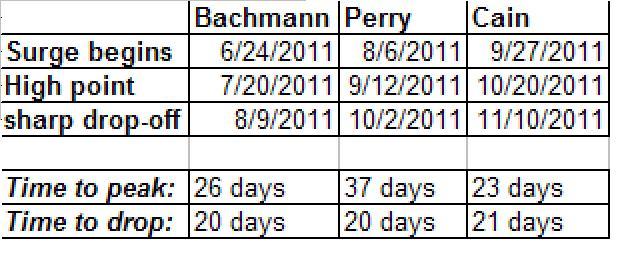
Now I’m hardly the first person to notice this. But, lover of figures and charts that I am, Gingrich’s path along the same boom as his predecessors made me wonder if there’s any regularity to the pattern. Curious, I tracked the timing of the beginning of the surge, reaching peak, and start of drop-off of the last three candidates:

It was interesting to see that, while the three boomlets so far have taken different amounts of time to reach a peak, that amount of time from peak to beginning of steep drop was remarkably similar. It makes me wonder if there’s some kind of structure to media saturation, boredom and vicious turn, such that the newscycle of three weeks is inherently how long you can stay on top once you get there. Even more fun, since we can spot on the polling graph the date of the beginning of Gingrich’s surge, it’s actually possible to predict the timing of his peak and fall based on the average of the last three:

So, if his cycle follows the average of the last three candidates, he’ll reach his polling high on December 2nd, and begin a steep drop-off December 23rd. Which won’t be a great Christmas present for him. Even worse giving the following dates:

1/3/12    Iowa
1/10/12  New Hampshire
1/21/12  South Carolina
1/31/12  Florida

In other words, his peak of popularity will likely come (and start to end) too early to translate into success in the first primaries and caucuses. Which would leave the consistently medium Mitt Romney again on top just as the voting starts, giving him the nomination despite GOP voters’ obvious equally consistent search for someone they’re more excited about than him. A lot of people have thought all along that this is the most likely outcome, and I tend to agree. But I can imagine a few reasons Newt’s experience might be different:

1. Everything tends to slow down over the holidays, and media cycles are probably no exception. Thanksgiving, Christmas and New Year’s just might stretch out the cycle enough that Newt is still at or near the top when voting starts.

2. If you look at the above dates, one thing that can be clearly seen is that, in each case the next comer was already starting to climb a few days before the previous person started to plunge. In other words, the “anybody but Romney vote” has probably remained consistent, and just looks for someone new to transfer to. This might work for Newt because there’s nobody else left. Bachmann, Perry and Cain have all had their day, Huntsman is too centrist for the field, Santorum has never gotten more than 2-3%, and Ron Paul is Ron Paul. Of course, someone new could get in, but this would be difficult at this point given early primary filing dates being closed or soon closing. So, the opposition to Romney might have to stick with Gingrich now, for better or for worse. 

3. A large part of what’s happened with the last three anti-Romneys is that they were still relatively unknown to a general audience, and the inevitable airing of their dirty laundry (plus just letting people hear the ridiculous kinds of things they say) started to pull down their popularity shortly after its surge. Gingrich has plenty of negatives, but they’re well known both in the party and among the public in general. If primary voters are liking him now, it’s not like they’re about to find out things they didn’t know that will make them reconsider.

Mind you, these are just reasons he might not totally self-incinerate before the voting starts in January. All this might really mean is that Romney is left with a somewhat credible opponent at that point. With his funding, organization, and consistent hanging in there, he’s still likely to be the nominee in fairly short order.

Which leaves us all with the shudder-inducing possibility that we could have a general-election that de facto begins by, say, April 1. Seven months of gaffes and spin and irresponsible rhetoric, saints preserve us all… 

2012 Election: The Gaffe

As you may have heard, this guy is running for President again:

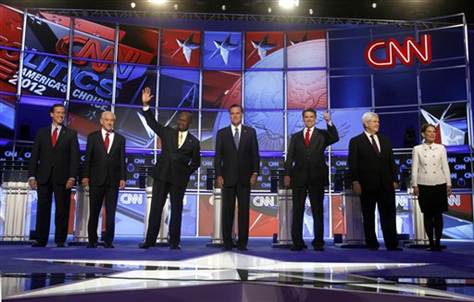
It will almost certainly be one of the four people in positions three through six below who will run against him:

It’s not looking like it will be easy for Obama. Incumbents usually win, but there are exceptions. The chief being that Presidents who have presided over a recession whose effects are still being felt usually lose. But there are also exceptions to that. Nate Silver, who is just about the most canny analyst out there, is putting the current odds of Obama being re-elected at roughly 50/50. However, I’m not here, at least today, to discuss his chances. I’m sure I’ll get around to that eventually, since presidential election seasons are to me what the football season is to the average American male. What I want to talk about today is the gaffe.

You know the one. Somebody says or does something a little silly. Maybe a lot silly. Rides in a tank and looks goofy. Gives a hoarse yell at a rally. Makes a comments that seems slightly pro-something they claim to be anti. Then it gets covered ad nauseam. In fact, this kind of moment will be what quite a lot of the presidential coverage ends up being about. Versus, say, a candidate’s policy positions. Their actual record of achievement, or lack thereof. The truthfullness of claims they make.

Because those things require time to report about, and time to listen to or read about. And some thought and concentration to actually follow. And the American attention-span has become more and more fragmented by each new media that has come along. It’s a little funny, since media bandwidth has exponeentially increased. But the average content of a single communication seems to decrease inversely, as more and more signals rush in to fill the bandwidth. Think of newspapers versus radio versus television versus the Internet circa 2000 versus social media now, and I think you’ll see what I mean.

So it is perhaps inevitable that short incidents with some entertainment value (i.e. “the gaffe”) will triumph over substance. But I don’t think it can be good for us as a Republic. Who out there wants to commit with me to try to ignore the gaffe and concentrate on the substance this go-around?   


Misadventures of the Electoral College

I don’t much care for the Electoral College.

While my dislike admittedly increased following the election of 2000, it’s a position I’ve always held. Outdated, undemocratic and all that.

It strikes me kind of funny when people defend it by talking in terms of the rights of small states being protected against the power of larger ones. I’ll concede that this made some sense in the days when Rhode Island might secede from the Union if they didn’t like how Virginia voted, but it’s not 1798 any more.

I also note with amusement that many people who had described the Electoral College as archaic on national TV just weeks before were sudden fans in the winter of ’00. “Well, those are the rules, he won fair and square,” is what their argument boiled down to. It’s very hard to imagine them being as sanguine if the situation had been reversed. Talk radio, Fox News, House Republicans and the rest would doubtless still be fulminating about President Gore’s illegitimacy and how the will of the people had been subverted.

And here’s the funny thing, the thing that nobody seems to remember: the situation almost was reversed in 2004. If just 59,347 people (1.05% out of 5.6 million total) had changed their votes in Ohio, John Kerry would have won the Electoral College 271 to 266 and would be president today. Even though he still would have been almost 3 million votes behind George W. Bush nationally.

While this would have been an act of national salvation as far as I’m concerned, that still wouldn’t make it right. We’ve had two serious malfunctions in a row, and might well be poised for a third. Even if this third would likely as not involve a narrow popular vote win for McCain invalidated by an large electoral college victory for Obama, which would tickle me as an end result, it wouldn’t be democratic. It’s time to banish the Electoral College to the scrap heap of history. Maybe it can snuggle up with the Articles of Confederation and the Poll Tax.

Banish it constitutionally, of course, which means it might take a decade or two to get the necessary 3/4 of states to approve the needed amendment. Long or short, the process still might be worth it. The last Electoral/Popular inversion resulted in lies leading to an unnecessary war here, a destroyed New Orleans there, here an act of treason against a CIA employee in harm’s way, there a suspension of habeas corpus (Ee-i, Ee-i, Oh!), but worse disasters are possible. In 1876, the maneuvering leading to the Electoral College invalidation of Samuel J. Tilden’s popular vote victory resulted in the premature end of post-Civil War Reconstruction in the South and 88 years of segregation and effective denial of full citizenship to a significant portion of the nation’s population.

Talk about undemocratic.

Politics & Promises

So I like this Barack Obama kid. I use the term “kid” advisedly, as it’s true that he’s nine years older than me. Then again, I’m not running for President. And he is only about one third of the combined age of the two democrats in the race I most liked, Joe Biden and Bill Richardson. He’s also running against someone 25 years older than him, which is a whole almost-grown person’s worth of age.

Age and experience are not trivial matters in being able to manage the Presidency (cf. my earlier stated preference for Joe and Bill) but they are also not necessarily decisive. Teddy Roosevelt and JFK each filled out the office pretty darn well, and Mr. William Jefferson Clinton was the same age in 1992 that Mr. Obama is now. And Obama brings something that I still remain hopeful is going to matter: A vastly different perspective from anyone who has held the office in the last fifty years.

It’s not too much to hope, I think, that a bi-racial man raised in Indonesia and Hawaii who from birth has expected to live half his life in the twenty-first century will have a significantly different worldview from the previous occupants of the office. Going further out on a limb, one might hope that this difference will manifest in a different kind of politics, one more holistic than binary and better suited to this new millennium. I remain hopeful, but somewhat less so than I was a few months ago.

Yes, you do what you have to in a campaign in order to get elected. But when you start to do silly misconstsruals and misrepresentations of what your opponents say in order to score points (like harping on Mr. McCain’s “hundred years”), when you adopt positions you don’t really believe in to appeal to one base and then soft-pedal them when it comes time to switch to another (like renegotiating NAFTA), when you break a promise to abide by public funding because it’s become expedient to do so and then try to spin it as a protest against how broken the funding system is, well, it starts to seem…

Twentieth century. Old millennium. Typical. Disappointing to the expectations you yourself had stirred up that this time, things might be different.

John McCain, meanwhile, is championing public funding of elections, campaign finance reform, and is the one offering to have a live, no rules or handlers-mediated series of public debates throughout the country, to which the Obama campaign is saying, oh well, let’s wait and see. Who’s representing a different kind of politics now?

Don’t get me wrong, McCain himself has back-pedaled on so many admirable and risky against-the-grain positions that he formerly held and become such a creature of Bush policies that the reform sheen is decidedly off of him. And like I said, I do like this Obama kid, and remain hopeful that he will be a breath of fresh air in many useful ways.

I wish though, that instead of Obama vs. McCain we could get a contest of two committed reformers refusing to play the same old game. Like maybe pre-January Obama versus 2000 primary season McCain.

Now that would be a contest worthy of the land of the free and the home of the brave.