Category Archives: lists

10 Essential Sci-Fi Books

(from my Sci-Fi Book Club)
(and thoughts on 11 others)
One of the things I sorely miss about SF (the city, San Francisco) is my SF (the genre, Sci-fi) Book Club. We started in March 2008, taking turns each picking a book. Our membership waxed and waned from nearly 10 to barely 2 or 3 at times. We had periods where we met every 6 weeks like clockwork, then some others where we couldn’t get together a next meeting for months. Even in the face of all these starts and stops, we got through 21 books by the time I moved to the Boston Area in July 2011.

Despite being a very book kind of guy and card-carrying geek of multiple lineages (Star Trek, Star Wars, comics collector, D&D player, I could go on), I had actually never read much Sci-fi, so I was interested to see what was out there, and what I would think of it. From the admittedly not completely scientifc selection of the books picked by the guys and surprisingly large number of gals in our group, here’s my vote on a top 10, in alphabetical order (spoiler light beyond the basic premises, since I hate spoilers):
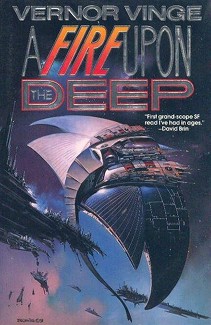
1. A Fire Upon the Deep  (Vernor Vinge, 1993) In full disclosure mode, I must note that this is one of the ones I picked. That being said, I really didn’t know a lot about it beyond being familiar with Vernor Vinge from his relationship to thought about the Singularity. It turned out to be a delight for the way it combined genres- at heart it’s a kind of horror story, with a really scary ultra-intelligence monster. But the story gets told in a unique Sci-fi setting (a race across across the galaxy, which turns out to be segregated by zones where intelligence, and even the laws of physics, are more advanced on the edge, and get duller toward the center). And a great deal of the action happens in what is basically a fantasy setting, full of castles and palace intrigue. Really well written, delightful all the way through, and provocative.

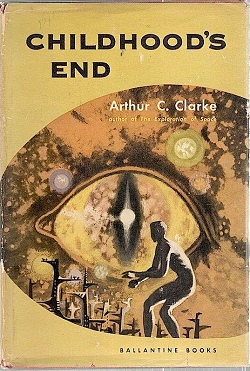
2. Childhood’s End (Arthur C. Clarke, 1953) This was the third book we read, deservedly a classic. Clarke is a master of clear, simple prose. The book itself is the prototypical “saucers appear over every capital on Earth” story, and once you read it, you’ll see its influence everywhere. As far as what those saucers are doing there, who’s in them, and what they want with us, though, the thing I found most striking about the book was its originality, both at the time of publication, and still today almost 60 years later.
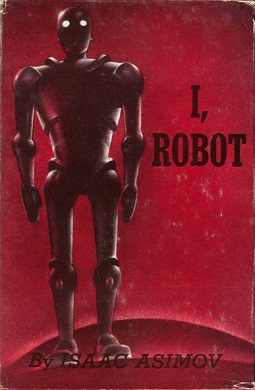
3. I, Robot (Isaac Asimov, 1950) Again, a classic, and one whose influence you’ll find everywhere you look. The thing that most impresses me about Asimov, though, is the warm humanity of the writing. The stories ring true not so much based on whether predictions about technology and future society are on target (though some of them are), but mostly because they are full of the author’s shrewd understanding of what people are like and why they do what they do. In the hands of someone else this could come off very cynical, but with Asimov it’s more of a wise, knowing, “Ah, yes, that’s who we are.”
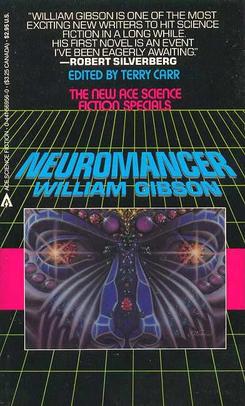
4. Neuromancer  (William Gibson, 1984) Here is born cyberpunk. And happy birthday to it! In many ways, a chillingly plausible look at a world more technologically advanced, but more socially decayed. Did this foresee many aspects of the Internet, or actually influence its development? And seriously, could The Matrix pay some copyright for ripping off every element of character and visual design it had from this book (albeit with a very different storyline)? But beyond all the further thoughts I could unload about it, at heart it’s a damn well done film noir story thrust into the realm of cyberspace (a term it invented!).  
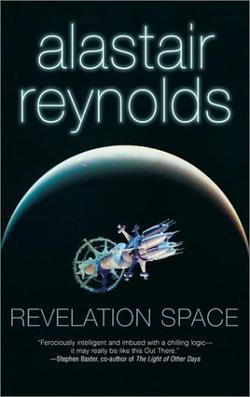
5. Revelation Space (Alastair Reynolds, 2000) All the books I’ve described so far do an excellent job with character, but I don’t think any of them get as deep into the psychology of their (often deeply flawed) main characters as this book does. Along the way, there’s horror, intrigue, skillful plotting as three widely divergent storylines converge, and high concept cosmic evolution. Given that so many of the works we read came from a Sci-fi heyday of the 50s to the 70s, this makes me glad to say: Well done, 2000s!

6. The Forever War (Joe Haldeman, 1974) When it first came out, this was a kind of parable about the Vietnam War told through the main character’s experience of a war lasting generations due to the time dilation between it’s far-flung battlefields. Nobody quite knows how the war is going, why we’re fighting, or even exactly who the enemy is. Sad to say, it has a whole new resonance thirty-five year later after our own decade-long Forever War Against Terror.

7. The Martian Chronicles (Ray Bradbury, 1950) This was the book we kicked off with. As we should have, since it gave us the vital middle of the ABC “big three” of classic sci-fi (Asimov, Bradbury, Clarke). In terms of science, the Mars it portrays was already badly outdated by the mid 60s, and throughout, the technology of how we get there and stay there is treated as an afterthhought. And that really doesn’t matter, because it functions on the level of fable- the things in it are true, because they’ve always been true. And that truth is suffused with some of the most heartbreakingly beautiful prose you will ever read.
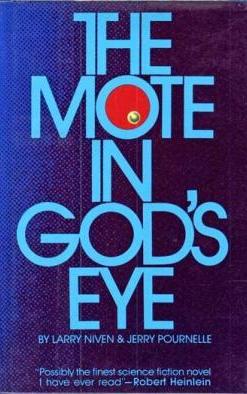
8. The Mote In God’s Eye (Larry Niven and Jerry Pournelle, 1974) There’s also some feudality here, in that there are lords and ladies in an interstellar monarchy. This turns out to be a feature of several of the books we read, a portrayal of human civilization becoming more feudal as it spreads out across multiple star systems. The focus of the action, though, is first contact with the Moties. I’ll leave it to you to find out all about them, but suffice it to say it is a superb portrayal of just how physically and culturally alien an alien race might turn out to be. Plus it’s just good, character-rich, well-plotted, fast-paced fun to read.


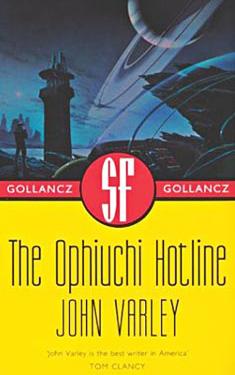
9. The Ophiuchi Hotline (John Varley, 1977) Set in a solar system that is now thoroughly inhabited (except for, curiously, but for good reasons, Earth) this book is rollicking good fun. It has everything you’d need for a good time- clones, aliens, spaceships, genetic engineering. It also delivers a future that seems quite plausible to me (especially the banana meat trees) despite how exotic it is. And it makes you think about just how little say we might have in the shape of our own future if there really are other intelligences and a higher cosmic order.
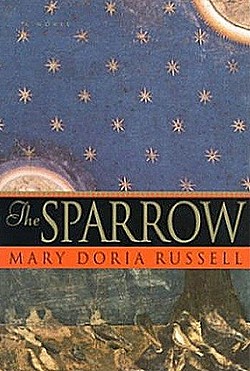
10. The Sparrow (Mary Doria Russell, 1996) This could be exhibit A in the “Is literary fiction that happens to use Sci-fi themes or settings still Sci-fi?” argument. Or, conversely, “Can Sci-fi be ‘serious’ literature?” I’ve always thought it’s a bit of a silly distinction. Dickens and Shakespeare were, in their time, writing that day’s equivalents of potboilers. Meanwhile, many things that are supposed to be “important books” today will vanish in the mists of time, and thus prove to be quite as disposable as anything Danielle Steele ever wrote. Good writing is good writing, and time will tell what the enduring literature is. But this massively sidetracks us. A great book, literarily. And great sci-fi. Also one of my favorite kinds of sci-fi, near future, and involving first contact. Which turns out to be far less about the aliens, and far more about who we are and how we make meaning in life.

Honorable Mention (9 other good reads):
Berserker (Fred Saberhagen, 1967)– May man versus killer robot spaceships always be so fun.
Eon (Greg Bear, 1987)– I think about this one a lot, almost a top 10. Stunning ideas about future human evolution, with a time travel twist. Plus great use of Ralph Nader. Really.  
Flashforward (Robert J. Sawyer, 1999)– I told you that CERN supercollider would be trouble… 
IQ83 (Arthur Herzog, 1978)– A potboiler? Yes. But damn would it be fucked up if this happened.
Quarantine (Greg Egan, 1992)– While this didn’t make my top 10, I do think Egan is one of the finest, and most philosophically challenging, sci-fi writers out there. Check out Distress and Permutation City for further mind-bending.
Starship Troopers (Robert Heinlein, 1959)– Right wing? Left wing? Somehow to blame for the movie made from it? And Showgirls as well, through mere association? Or just damn fun reading?
The Divine Invasion (Philip K. Dick, 1981)– One of my favorite authors. If I hadn’t already read his book VALIS before I got to the group, it would have been in the top ten above, and this is more from that same, very good, vein.
The Gods Themselves (Isaac Asimov, 1972)– I don’t believe Asimov wrote a bad book. Besides which, anything featuring trisexual energy beings is an automatic yes.
The Road  (Cormac McCarthy, 2006)– See The Sparrow above vis-a-vis Sci-fi and literary fiction. Either way, a great book that somehow manages to be heartwarming and unrelentingly grim at the same time.


Dishonorable Mention (2 cautionary tales)
Last and First Men (Olaf Stapledon, 1930)– It deserves props for ambitious future history, and recognition as one of the earliest sci-fi novels. It was also very dry and slow. The only one I never finished from the group, sad to say.
The Blind Assassin (Margaret Atwood, 2000)– Great book, albeit very slow to start and frequently quite bleak. Not Sci-fi, though it does contain a sci-fi tale within the tale. Discussions on group policy were had afterward.

Three Intentions for 2009

For New Year’s 2007, I was on a retreat in the Santa Cruz mountains which had a New Year’s Eve ritual inviting us to form and share three general intentions for the year. I went to the same retreat again this New Year’s for several days, but I was back in the city for New Year’s Eve itself, so I didn’t do the ritual this time. I can’t be more specific about the reason, except that it involved my girlfriend, some close friends, and Lord of the Rings Trivial Pursuit. In any case, the ritual was such a valuable thing for me in 2008, not to mention which my intentions also largely came to pass, that even though I didn’t do it there, I’d like to do it again for this year, and share it with you. Here are my intentions for 2009:

1. To invest more in myself physically- I’ve always done gangbusters investing in my mental life, and the last few years I’ve been getting much better with doing the same emotionally and spiritually. My physical life has always been the least developed- sometimes I’ve even thought fondly about being a brain in a jar hooked up to a supercomputer. So, I think this is a year to work on that. What does that mean? Beats me, it’s just a general intention! Seriously, I imagine it will mean all kinds of things about diet, about exercise, about consciously investing in clothes and wardrobe, and about trying new physical activities. Maybe yoga wind surfing?

2. To reconnect with my Muse- While I’ve done a lot of writing in the last two years, and even started and completed some brand new stories, I haven’t really felt the fire (as one example, I haven’t written any new poetry) since going in to rehab at the end of 2006. I think that’s a pretty natural result of having to focus on recovery first these last two years, and I mostly have patience with it as part of a natural ebb and flow. But I do think this is my year to get back in touch with it, while staying safe and sober. So, I’m re-reading old journals to see what’s there that I can connect with, starting to learn music, reading new poetry, creating more time for writing in my weekly schedule and just generally inviting the Muse to alight. Tell her if you see her!

3. To be a little less self-obsessed and a little more connected to other people- Recovery literature regularly talks about most of our problems coming back to self-obsessed suffering, and for me this is definitely true. My external life has really gotten to be pretty darn good these last two years, and the only things I really suffer from these days are old patterns of thinking and feeling that still unspool in my head. So the solution, I have heard, is to spend a little less time there and a little more focusing on other people. Not to mention I might do something nice for others in the process. So tell me, what’s going on with you? Maybe I can take you out to lunch soon…

Those are my intentions for 2009. How about you?

Eight From 2008

While it’s not standard for year-end countdowns, I’ve decided that a top eight albums is the best approach to take for 2008. What can I say? I’m a sucker for numbers and symmetry. Here, in alphabetical order, are my top picks:

1. Get Awkward (Be Your Own Pet)- They’re punk and garage with a dash of metal. Their songs are simultaneously tongue-in cheek and brash, slapping you to the mat from the start and keeping you there throughout. They’re fronted by a brash blonde girl. They’re from Nashville. What on Earth is not to like?

2. Brighter Than Creation’s Dark (Drive-By Truckers)- This album has it all. Male lead vocals. Female lead vocals. Straight-up country. Rock that reminds one of the Seventies in a good way. Music that sounds like storm clouds brooding. And as good as it is musically, it’s even better lyrically. The 19 tracks herein include heartfelt paeans to family, subtle evocations of domestic discontent, a soldier musing on the unknown life of the unnamed foe he’s just killed, and a song from the viewpoint of someone who has had it with a friend’s (family member’s? spouses?) crystal meth addiction.

3. Lust, Lust, Lust (the Raveonettes) There was a good case to be made with their previous album, Pretty in Black, that the Raveonettes had lost their mind. On this album they find it again and the lust, menace, and shimmering clouds of guitar feedback are ours to enjoy.

4. Narrow Stairs (Death Cab for Cutie)- I’ve been a late convert to Death Cab, but like many an infatuation acquired in later life, I’ve made up for it by falling hard. A song like “I Will Posses Your Heart” that starts with a four minute drum intro shouldn’t hold your attention, but in their hands it keeps you rapt, and brings a shiver when the lyrics finally kicks in with their mixture of romanticism and dark obsession. And really, at the end of the day, anybody who writes a bleak, piercing song about searching for Kerouac’s ghost can call me their bitch.

5. & 6. Nouns (No Age), Rip It Off (Times New Viking)- These two bands are probably tired of being mentioned in the same breath, but they really are two peas in one wonderful lo-fi pod. Of the two, No Age brings more melody and traditional pop structure in their navigations of ragged walls of sonic distortion. This makes Nouns more consistently listenable, but Rip It Off more exciting and challenging.

7. Stop Drop and Roll! (the Foxboro Hot Tubs)- Yes, okay, it’s really Greenday in musical drag buying time while they try to figure out how to follow American Idiot. But what glorious drag it is! Their roaring, rocking success at producing rock in the Kinks/Who/Hollies et al vein makes me wonder why rock ever stopped sounding like that.

8. We Started Nothing (the Ting Tings)- Dance music with the form and attitude of rock, this album is just good clean fun from start to finish.

Those are my picks, but in the interest of full disclosure, Bruce Springsteen’s Magic only made honorable mention on my 2007 list, and it’s turned out to be one of the few albums from that year that I still regularly listen to. I reserve the right to listen further… And so should you!

Top Ten Albums of 2007

You might reasonably ask why I’m coming out with this list in mid-February. The truth is, I think you have to build in at least a good month of overhang, because you still may not have found and digested some of the year’s best albums properly by midnight on December 31st. This past year took some digesting too, unfortunately more from dearth than from girth. Here, in alphabetical order, are my picks for the best albums of 2007:

1. Chrome Dreams II (Neil Young)- Neil Young is a pleasure even when he’s piddling around. It’s an especial pleasure to find him here, well past the age of 50, still able to narrate interesting stories with his plaintive wail on a coherent set of songs that alternate between relaxed folkiness and Crazy Horse style assaults of heavy guitar feedback.

2. Icky Thump (White Stripes)- A so-so White Stripes album is kind of like so-so sex. It’s still pretty compelling, and you certainly never think of leaving before it’s over. As with Get Behind Me Satan, there’s a little too much self-conscious experimentation here to really achieve the straight ahead, undiluted quality of their best work. Nevertheless, I’ll still take a near miss from Jack and Meg over the best effort of many another outfit any day of the week.

3. I’m Not There (soundtrack, various)- Soundtracks usually have trouble succeeding as truly acceptable stand-alone albums since a significant layer of their meaning relies so heavily on the movies they spring from. Without that they run the risk of just being a weird assemblage of songs. This soundtrack, however, benefits from coming out of a movie that was itself about music and the life (through the work) of a single musician. Between unusual songs, unusual approaches to familiar songs and a surprising variety of artists participating, this ends up being a fresh and invigorating showcase of Dylan’s song craft. I particularly recommend disc two.

4. Juno (soundtrack, various)- See caveat above about sound tracks as albums. How delightful, then, that this soundtrack pulls it off. The heart and soul of the effort, of course, is Kimya Dawson’s delightful folk-punk songs, with their innocent and exuberant insistence on simple, fun lyrics. More remarkable is that the songs here by other artists, despite their diversity of styles and eras, feel like they belong with Dawson’s songs and create a quirky, yearning and ultimately sweet organic whole.

5. Losin’ It! (Vancougar)- Many have their eye on the music scenes in Canada’s big cities as the source of the next big thing. This quartet from Vancouver certainly encourages you to think that hope may not be in vain. Part punk, part girl-group harmony and all energy, every time I listen to this album I wish there were more people out there making rock with this sense of loving attention to it’s basic idioms and joyous adventure. And still producing songs that are actually about something, with distinctive voices from each of the individual members. Keep your eye out on what these gals are up to next.

6. Twelve (Patti Smith)- Well here’s someone who knows a thing or two about loving attention to rock’s idioms. A good cover should honor the essence of the original, but approach it sonically in a new and different way. If covers are going to sound just like the original, after all, that’s what we have originals for. Patti Smith breathes new life into all twelve songs she covers here, not tripping at all in the transition from Tears for Fears to Neil Young to Jefferson Airplane to Dylan to Nirvana to Stevie Wonder (et al) and holding the whole thing together with the hypnotic power of her own singular voice and vision. Outstanding fun for any music lover.

7. Under the Blacklight (Rilo Kiley)- Try it and see if these songs aren’t so damn hooky that they get stuck in your head the next day. And yet leave behind shards of lyrics that unsettle as they slowly dissolve. There’s more than a trace of the now thankfully peaking and passing dance-rock indie sub-genre here, but with a lean more toward the rock side of the equation such that they end up with a genuine power and urgency that the efforts of many others in this vein ultimately lack. More than that, Jenny Lewis’ incisive and insightful lyrical vision and lush and world-weary vocal delivery carries the whole thing to another level entirely.

8. 93-03 (Frank Black)- I’d agree in principle that it’s questionable to include a greatest hits collection in a list of the top albums of the year. Nonetheless, the first 11 tracks of this compilation of the first ten years of the solo career of the former Pixies front man is one of the most consistently excellent listens of the year.

9. Almost Made Its- No, this isn’t a band or an album name. Although it’s a good name, isn’t it? Pay me a nickel if you use it. What I mean is all the albums that made a vigorous stab at being superb but just missed it. Art Brut’s It’s a Little Bit Complicated, the Foo Fighters Echoes, Silence , Patience & Grace, Kings of Leon’s Because of the Times, Bruce Springsteen’s Magic, and Tegan and Sara’s the Con are all worthy of attention.

10. There is no number 10. Lest it escape anyone’s attention, it’s a bad sign when the best albums of the year include two soundtracks, a greatest hits collection and a covers album. It’s no accident that Frank Black got on the list with a set of songs from the mid-90s, the most recent of rock’s periodic outbursts of renaissance. That last musical fluorescence has run it’s course, and once again the old Gods are nearly dead. It’s time for a revolution!