I love packages from Amazon!

Even when, no, especially when, like this one, I already know what’s in them. Birthday and holiday gift cards are a beautiful thing, because they allow me to go on shopping sprees for things that have been piling up in the back of my mind for a while.

Sometimes, like in this case, I enjoy giving it my shopping expeditions a thematic spin. My purchases were:

The Big Book of Conspiracies I got the The Big Book of the Unexplained several years ago, I think in the excellent used comics section at Aardvark Books in the Castro in SF. Ever since then, I’ve been on the lookout for this volume on conspiracy theories from the same series. The basic format is a series of short articles on different topics, all written by the same person but illustrated by different comic artists for each section. The BBotU certainly alerted me to some aspects of the paranormal that I hadn’t known about previously, while also reacquainting me with some old friends. I’m looking forward to the same here. Despite the obviously tongue-in-cheek presentation in terms of form, the content is actually quite well cited. And there’s something about the juxtaposition that gets it further under the skin than reading or seeing something on TV alone would do. I’m also looking forward to the hours of joy in further researching online new things I run across in this book. I’ve found one can both do some instant debunking, and crawl further down the rabbit hole this way.

The Field Guide to Bigfoot and Other Mystery Primates This volume is co-authored by Loren Coleman, leading cryptozoologist and proprietor of the International Cryptozoology Museum that Abbey and I visited recently in Portland, Maine. It’s set up as a pretty straightforward field guide in some ways- illustrations, species descriptions, range maps, footprint outlines, etc. It just happens that the subject matter is a little more exotic and/or possibly nonexistent. Could come in handy, since I plan to doing a lot of tromping through the woods in these parts. Bonus question: Is the creature next to the book a mystery primate? I don’t know, but now that I have the field guide I can find out!

The Mysterious Monsters I am especially excited about this volume, as you can see. But hey, you’ve gotta understand! I got this book as a kid, around 10 years old, from a book fair at elementary school. The Mysterious Monsters in question are the Abominable Snowman, Bigfoot and the Loch Ness Monster, and the book was actually pretty low on sensationalism and strongly evidence-focused in its treatment of the subject. This was one of my first forays into the world of the unexplained which, obviously, has had a lifelong effect on me. The beloved volume vanished at some point, along with a lot of things that were in my childhood room, as things from one’s childhood room will tend to do. Over the years I’ve tried to track it down, but was hobbled by the fact that I couldn’t remember two key pieces of information: the title, or the author’s name. I did try googling based on my recollection of content many times, but to no avail. And then, a week or so ago, for whatever reason, I found a combination of search terms that led me straight to it. I’m looking forward to re-reading it, and seeing what I make of it now that I’m about 4x as old as the first time I read it. Talk about unexplained phenomenon!

2012 Election: The Gaffe

As you may have heard, this guy is running for President again:

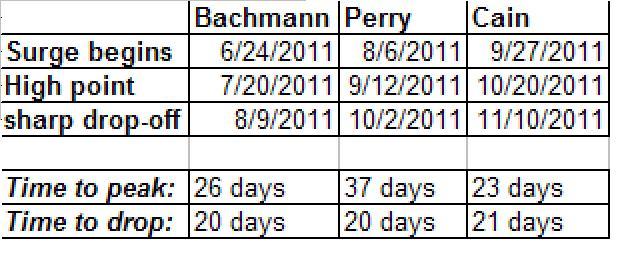
It will almost certainly be one of the four people in positions three through six below who will run against him:

It’s not looking like it will be easy for Obama. Incumbents usually win, but there are exceptions. The chief being that Presidents who have presided over a recession whose effects are still being felt usually lose. But there are also exceptions to that. Nate Silver, who is just about the most canny analyst out there, is putting the current odds of Obama being re-elected at roughly 50/50. However, I’m not here, at least today, to discuss his chances. I’m sure I’ll get around to that eventually, since presidential election seasons are to me what the football season is to the average American male. What I want to talk about today is the gaffe.

You know the one. Somebody says or does something a little silly. Maybe a lot silly. Rides in a tank and looks goofy. Gives a hoarse yell at a rally. Makes a comments that seems slightly pro-something they claim to be anti. Then it gets covered ad nauseam. In fact, this kind of moment will be what quite a lot of the presidential coverage ends up being about. Versus, say, a candidate’s policy positions. Their actual record of achievement, or lack thereof. The truthfullness of claims they make.

Because those things require time to report about, and time to listen to or read about. And some thought and concentration to actually follow. And the American attention-span has become more and more fragmented by each new media that has come along. It’s a little funny, since media bandwidth has exponeentially increased. But the average content of a single communication seems to decrease inversely, as more and more signals rush in to fill the bandwidth. Think of newspapers versus radio versus television versus the Internet circa 2000 versus social media now, and I think you’ll see what I mean.

So it is perhaps inevitable that short incidents with some entertainment value (i.e. “the gaffe”) will triumph over substance. But I don’t think it can be good for us as a Republic. Who out there wants to commit with me to try to ignore the gaffe and concentrate on the substance this go-around?   


Greetings from the International Cryptozoology Museum!

This past weekend Abbey and I went to the International Cryptozoology Museum in Portland, Maine. Cryptozoology, for those who may not be hip to the field, is the study of (as yet) unknown animals. In other words, the Zoology of animals that are not yet documented by science, but some day may be. Here to the left, for instance, is the cabinet for Yeti artifacts. The museum is the brainchild of Loren Coleman, who founded it in 2003 to house some of the many objects he’s collected in decades of work in the field. In-between teaching public policy and being one of the world’s foremost experts on the copycat suicide phenomenon, he’s spent a lot of time on the trail of unknown animals, and authored over 20 books on the subject.

Coleman is widely regarded as a serious and careful researcher, which befits Cryptozoology, since, of all the paranormal disciplines, this is the one that is most like conventional science. While there certainly are cryptids (unknown creatures) that seem supernatural, and researchers that specialize in the more paranormal aspect of the field, most people who work in it would say that these are animals that live, breathe, eat and poop like any others, it’s just that science hasn’t gotten a proper hold of them yet. The museum itself keeps a good balance of appropriate seriousness and whimsy. Like the giant beaver diorama to the right featuring guest appearances by Indiana Jones and Steve Irwin. Delightfully cute and silly. And yet, there were 8 foot long beavers around in North America as recently as 10,000 years ago, so who’s to say that in some remote mountain lakes in Canada or the U.S. West, surprises may not linger?

Bigfoot, of course, as the marquee North American cryptid, gets proper treatment here.  Besides posing for a picture with Abbey and I…


…there were some quite interesting displays on the footprints, hair samples and other leavings of our possible native ape. I also really enjoyed the cabinet of artifacts related to the 1967 Patterson film,  which is either a thorough fake, or some of the best evidence. I’ve gone back and forth on that question myself, but I have to say that lately computer enhancements and  scientific studies of the gait and body proportions of whatever’s walking in the film have me leaning towards “best evidence”.

The museum itself definitely doesn’t ignore hoaxes or issues of fakery. There are several exhibits devoted to the subject, one of the creepiest of which has to be the recreation to the left here of the Feejee Mermaid. Said “mermaid” was a fixture of P.T. Barnum’s traveling show. While the original was lost in the 1860s, the consensus is that it was probably the dried hairless remains of the upper half of a monkey sewed together with the lower half of a fish. More recent hoaxes and misidentifications are covered as well.      

And speaking of recent, Maine is apparently getting its very own cryptid sightings right up to the present day. The color-coded pins in the map to the right display the locations of sightings of various cryptids. Some are more prosaic, like the ongoing sightings of big cats that indicate that the Eastern Cougar may not be quite as extinct as advertised. Then there are your star cryptids, like lake/sea monsters and Bigfoot, of which there are actually a significant number of New England sightings. Abbey and I observed a cluster of pins in Baxter State Park and have accordingly decided to vacation there. My favorite, though, is the Specter Moose. It was apparently a huge whitish-gray moose with antlers that spanned ten feet wide, and was seen a lot around the turn of the last century. I hope he (or she (or descendants)) is still out there!

So, to sum up, cryptozoology is fun, and so is the museum. On top of which, Loren Coleman is there in person most days, and how often do you get to meet a real cryptozoologist? Plus, Portland is a beautiful town, with ridiculously pretty harbor views. Go visit when you have a chance!


10 Essential Sci-Fi Books

(from my Sci-Fi Book Club)
(and thoughts on 11 others)

One of the things I sorely miss about SF (the city, San Francisco) is my SF (the genre, Sci-fi) Book Club. We started in March 2008, taking turns each picking a book. Our membership waxed and waned from nearly 10 to barely 2 or 3 at times. We had periods where we met every 6 weeks like clockwork, then some others where we couldn’t get together a next meeting for months. Even in the face of all these starts and stops, we got through 21 books by the time I moved to the Boston Area in July 2011.

Despite being a very book kind of guy and card-carrying geek of multiple lineages (Star Trek, Star Wars, comics collector, D&D player, I could go on), I had actually never read much Sci-fi, so I was interested to see what was out there, and what I would think of it. From the admittedly not completely scientifc selection of the books picked by the guys and surprisingly large number of gals in our group, here’s my vote on a top 10, in alphabetical order (spoiler light beyond the basic premises, since I hate spoilers):

1. A Fire Upon the Deep  (Vernor Vinge, 1993) In full disclosure mode, I must note that this is one of the ones I picked. That being said, I really didn’t know a lot about it beyond being familiar with Vernor Vinge from his relationship to thought about the Singularity. It turned out to be a delight for the way it combined genres- at heart it’s a kind of horror story, with a really scary ultra-intelligence monster. But the story gets told in a unique Sci-fi setting (a race across across the galaxy, which turns out to be segregated by zones where intelligence, and even the laws of physics, are more advanced on the edge, and get duller toward the center). And a great deal of the action happens in what is basically a fantasy setting, full of castles and palace intrigue. Really well written, delightful all the way through, and provocative.

2. Childhood’s End (Arthur C. Clarke, 1953) This was the third book we read, deservedly a classic. Clarke is a master of clear, simple prose. The book itself is the prototypical “saucers appear over every capital on Earth” story, and once you read it, you’ll see its influence everywhere. As far as what those saucers are doing there, who’s in them, and what they want with us, though, the thing I found most striking about the book was its originality, both at the time of publication, and still today almost 60 years later.

3. I, Robot (Isaac Asimov, 1950) Again, a classic, and one whose influence you’ll find everywhere you look. The thing that most impresses me about Asimov, though, is the warm humanity of the writing. The stories ring true not so much based on whether predictions about technology and future society are on target (though some of them are), but mostly because they are full of the author’s shrewd understanding of what people are like and why they do what they do. In the hands of someone else this could come off very cynical, but with Asimov it’s more of a wise, knowing, “Ah, yes, that’s who we are.”

4. Neuromancer  (William Gibson, 1984) Here is born cyberpunk. And happy birthday to it! In many ways, a chillingly plausible look at a world more technologically advanced, but more socially decayed. Did this foresee many aspects of the Internet, or actually influence its development? And seriously, could The Matrix pay some copyright for ripping off every element of character and visual design it had from this book (albeit with a very different storyline)? But beyond all the further thoughts I could unload about it, at heart it’s a damn well done film noir story thrust into the realm of cyberspace (a term it invented!).  

5. Revelation Space (Alastair Reynolds, 2000) All the books I’ve described so far do an excellent job with character, but I don’t think any of them get as deep into the psychology of their (often deeply flawed) main characters as this book does. Along the way, there’s horror, intrigue, skillful plotting as three widely divergent storylines converge, and high concept cosmic evolution. Given that so many of the works we read came from a Sci-fi heyday of the 50s to the 70s, this makes me glad to say: Well done, 2000s!

6. The Forever War (Joe Haldeman, 1974) When it first came out, this was a kind of parable about the Vietnam War told through the main character’s experience of a war lasting generations due to the time dilation between it’s far-flung battlefields. Nobody quite knows how the war is going, why we’re fighting, or even exactly who the enemy is. Sad to say, it has a whole new resonance thirty-five year later after our own decade-long Forever War Against Terror.

7. The Martian Chronicles (Ray Bradbury, 1950) This was the book we kicked off with. As we should have, since it gave us the vital middle of the ABC “big three” of classic sci-fi (Asimov, Bradbury, Clarke). In terms of science, the Mars it portrays was already badly outdated by the mid 60s, and throughout, the technology of how we get there and stay there is treated as an afterthhought. And that really doesn’t matter, because it functions on the level of fable- the things in it are true, because they’ve always been true. And that truth is suffused with some of the most heartbreakingly beautiful prose you will ever read.

8. The Mote In God’s Eye (Larry Niven and Jerry Pournelle, 1974) There’s also some feudality here, in that there are lords and ladies in an interstellar monarchy. This turns out to be a feature of several of the books we read, a portrayal of human civilization becoming more feudal as it spreads out across multiple star systems. The focus of the action, though, is first contact with the Moties. I’ll leave it to you to find out all about them, but suffice it to say it is a superb portrayal of just how physically and culturally alien an alien race might turn out to be. Plus it’s just good, character-rich, well-plotted, fast-paced fun to read.


9. The Ophiuchi Hotline (John Varley, 1977) Set in a solar system that is now thoroughly inhabited (except for, curiously, but for good reasons, Earth) this book is rollicking good fun. It has everything you’d need for a good time- clones, aliens, spaceships, genetic engineering. It also delivers a future that seems quite plausible to me (especially the banana meat trees) despite how exotic it is. And it makes you think about just how little say we might have in the shape of our own future if there really are other intelligences and a higher cosmic order.

10. The Sparrow (Mary Doria Russell, 1996) This could be exhibit A in the “Is literary fiction that happens to use Sci-fi themes or settings still Sci-fi?” argument. Or, conversely, “Can Sci-fi be ‘serious’ literature?” I’ve always thought it’s a bit of a silly distinction. Dickens and Shakespeare were, in their time, writing that day’s equivalents of potboilers. Meanwhile, many things that are supposed to be “important books” today will vanish in the mists of time, and thus prove to be quite as disposable as anything Danielle Steele ever wrote. Good writing is good writing, and time will tell what the enduring literature is. But this massively sidetracks us. A great book, literarily. And great sci-fi. Also one of my favorite kinds of sci-fi, near future, and involving first contact. Which turns out to be far less about the aliens, and far more about who we are and how we make meaning in life.

Honorable Mention (9 other good reads):
Berserker (Fred Saberhagen, 1967)– May man versus killer robot spaceships always be so fun.
Eon (Greg Bear, 1987)– I think about this one a lot, almost a top 10. Stunning ideas about future human evolution, with a time travel twist. Plus great use of Ralph Nader. Really.  
Flashforward (Robert J. Sawyer, 1999)– I told you that CERN supercollider would be trouble… 
IQ83 (Arthur Herzog, 1978)– A potboiler? Yes. But damn would it be fucked up if this happened.
Quarantine (Greg Egan, 1992)– While this didn’t make my top 10, I do think Egan is one of the finest, and most philosophically challenging, sci-fi writers out there. Check out Distress and Permutation City for further mind-bending.
Starship Troopers (Robert Heinlein, 1959)– Right wing? Left wing? Somehow to blame for the movie made from it? And Showgirls as well, through mere association? Or just damn fun reading?
The Divine Invasion (Philip K. Dick, 1981)– One of my favorite authors. If I hadn’t already read his book VALIS before I got to the group, it would have been in the top ten above, and this is more from that same, very good, vein.
The Gods Themselves (Isaac Asimov, 1972)– I don’t believe Asimov wrote a bad book. Besides which, anything featuring trisexual energy beings is an automatic yes.
The Road  (Cormac McCarthy, 2006)– See The Sparrow above vis-a-vis Sci-fi and literary fiction. Either way, a great book that somehow manages to be heartwarming and unrelentingly grim at the same time.


Dishonorable Mention (2 cautionary tales)
Last and First Men (Olaf Stapledon, 1930)– It deserves props for ambitious future history, and recognition as one of the earliest sci-fi novels. It was also very dry and slow. The only one I never finished from the group, sad to say.
The Blind Assassin (Margaret Atwood, 2000)– Great book, albeit very slow to start and frequently quite bleak. Not Sci-fi, though it does contain a sci-fi tale within the tale. Discussions on group policy were had afterward.

The theme of this Tuesday’s Blog is…

I put myself on a new schedule of posting twice a week. I figured that, if I make it a regular assignment for myself, just like a column I might write for someone else, the chances of it getting done go way up. So now “update blog” sits on my Google calendar at a set time every Tuesday and Saturday.

This is my third week doing it, I actually didn’t want to have any fanfare and announcement (for what, all three readers?) and then not follow through. Especially after how little I was able to blog the last year and a half as life just seemed to swamp writing. This regular schedule is actually part of a counterattack on the problem, the essence of which is weekly dedicated time: 4 hours a week for my screenplay, plus an hour for editing my poetry collection, and then two Blogs a week.

So why am I mentioning it now? Because tonight, dear reader, I can’t find anything my brain is collected enough to want to write about. This may be a side effect of the heat having been out for the past five days- blood has porobably been pulled out of my brain, and devoted to more important activities. Whatever the cause, here I am, content lite. But, DAGNABIT TO HELL, two blog posts a week, rain or shine.

So here you go. You’d best behave, or I’ll do it again.  

America’s Stonehenge

"Something there is that doesn't love a wall,
That wants it down.' I could say 'Elves' to him,
But it's not elves exactly, and I'd rather
He said it for himself."
-Robert Frost, "Mending Wall"

Yesterday my lovely bride Abbey and I went to America’s Stonehenge, a possibly archeological site just outside of Salem, New Hampshire. (Salem, NH, by the way is an unnecessarily confusingly close 37 miles from Salem, MA. Manchester, NH and Manchester, MA, and Concord, NH and Concord, MA are in a similar vein. As are Burlington, MA and Burlington, VT, although those last two at least have the decency to be separated by 200 miles. But that’s not what we’re here today to discuss…)

A short trail through the woods…

…leads to the main site…

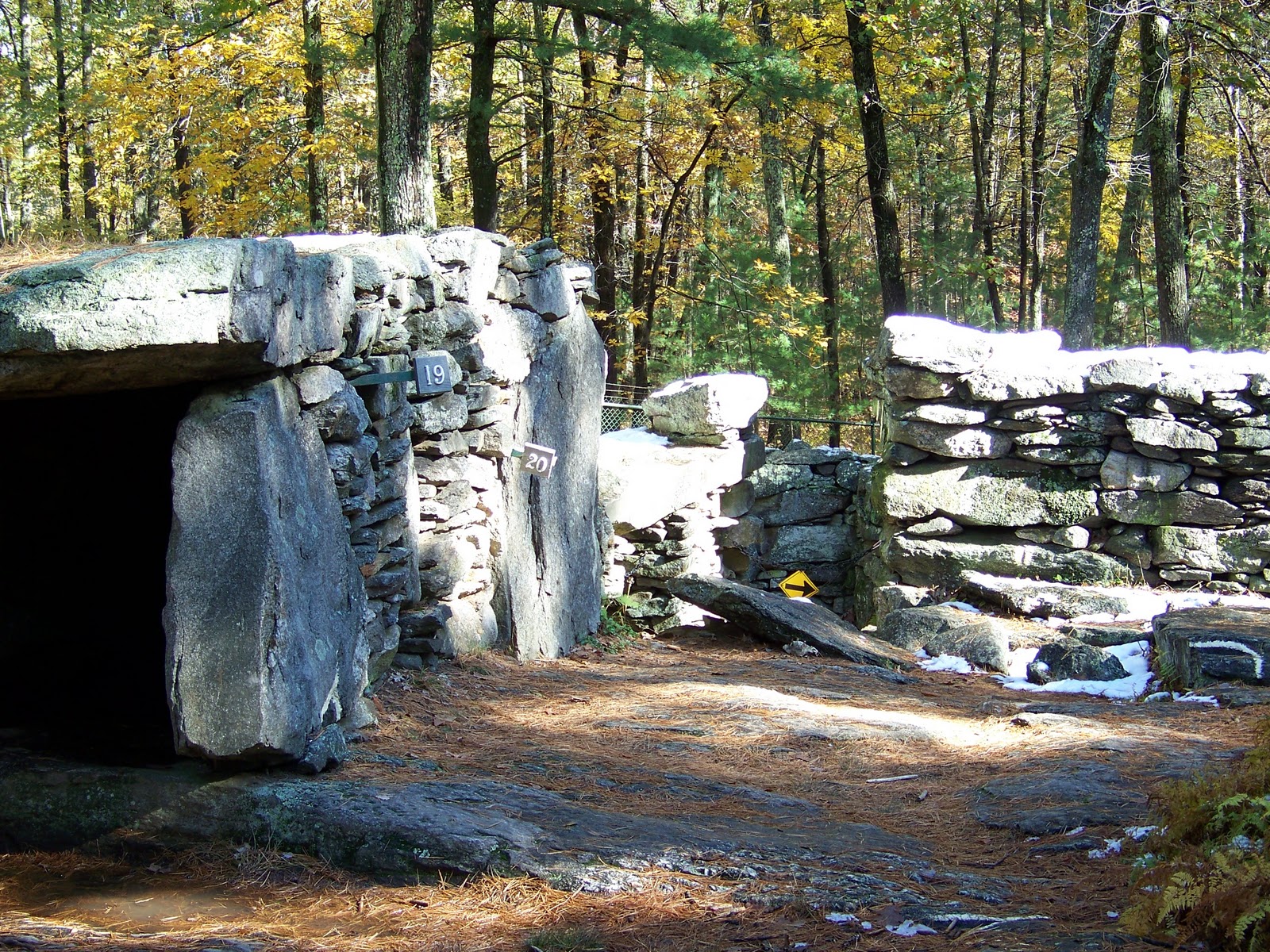
which contains a maze of stone walls and chambers…

…about which several theories have been floated.

Some claim it to be a Native American megalithic site, for which there’s some decent evidence. Charcoal pits, pottery and other artifacts found on site have been dated to between 2,000 and 100 BC. There’s even evidence of a a stone slab being quarried in situ nearby.

Some researchers have even lined up walls and standing stones on the site with astronomical alignments, as a map there explains:

This stone, for example, would have had the summer solstice rise directly above it circa 1,800 BC:

As always, there are a few wrinkles with this theory, such as the fact that, given enough stones or lines, some are always going to line up with something. When I visited the Nazca lines in Peru in 2009, museums and guides in the area noted that 20% of the lines could be lined up with astronomical occurences. 20% could be lined up with sources of water. 20% could be lined up with mountain peaks and other features of the landscape. In other words, there were so many of them that 20% could be lined up with almost anything you choose.

It’s also worth noting that many of these stones have been “set up” from presumed “fallen” locations, and that 20th century clearing of the trees has occurred to create openings in the skyline. I.e., it would be very difficult at this point to know what the exact arrangement of stones, or view of the sky from them, was when the site was originally inhabited.

Further muddying the waters, the site was the location of the farm of one Jonathan Pattee (and family) in the early 1800s. Historical records show he used stone structures there for storage (cellars etc.) and also rearranged and cleared a lot of stone off of the site. Signs there also made reference to more stone being carried of in the 19th century when the site was used for quarrying purposes.

In the 1930s, the site, already of interest to picnickers, occultists, and my dear friend H.P. Lovecraft, was purchased by William Goodwin, who “restored” many of the structures there. Some people seem to be of the opinion that Goodwin only did maintenance-type work, setting up obviously toppled stones, restoring rocks that had been scattered from walls, etc. Others have the suspicion that he extensively rearranged things to support his pet theory, that Irish monks had established a settlement in the area around 900 AD.

Barry Fell, a subsequent researcher, believed that the site may have been even older, and contained evidence of Phoenician occupation. There is a small museum on site, which includes petroglyphs said to resemble Old World languages including Phoenican and Celtic:

Whatever one makes of all these claims, somebody clearly built a lot of something there. My own personal feeling is that there was some kind of original megalithic site in the area. Subsequent occupants made such extensive changes, though, that it’s very difficult at this point to determine what was there, or how it was arranged. Whatever it was or is, though, it’s pretty damn neat!

My favorite was the Oracle Chamber, guarded below by the lovely Abbey, which really is kind of eerie inside, and features some advanced drainage and acoustics:

I’d kind of like to go back there for a ghost hunt sometime:

It should be noted that the current owners since the late 50s have been careful stewards, making restorations only according to historical photographs, and sponsoring archaeological research at the site. On top of which, they have an alpaca farm there, which firmly establishes them as awesome in my book:

   
The opening quote, by the way, besides being suitably stone wall and elf-themed, was inspired by the fact that Robert Frost wrote “Mending Wall”, and many other of his most well-known poems, at a family farm in Derry, New Hampshire, right next-door to Salem. If you should happen to be in Derry you might, as Abbey and I did, stop off at the super-yummy Windham Junction Country Kitchen:

Some might fine meatloaf there, let me tell you!

The end of the Iraq War and the Courage of Progressive Convictions

This week’s announcement that all our troops will be home from Iraq by the end of the year got me thinking. We’ve certainly heard the obligatory Neo-Con voices saying that this a mistake, harms our security, harms the region, etc. I haven’t heard as many Progressive voices crowing, but I suspect that’s because they are so weary from the long years of misguided war that they’re just glad it’s finally over. That, and a sprinkle of sense and tact enough to know that this is a solemn occasion, suffused with a lot of loss for everyone involved.

But at the heart of this development lies a great irony: the Administration tried for what the Neo-Cons wanted, an extended ongoing presence after direct combat was ended. It failed to secure Iraqi cooperation with that goal, and it is this failure that has resulted in the end result Progressives have wanted for years, a complete end to the war, with all troops home.

This seems symptomatic to me of a frustration I’ve had with this Administration, the fact that it more often than rarely delivers, or tries to deliver outcomes that match the Conservative policy agenda. This, of course is done in the quite reasonable name of trying to work with the opposing side and achieve compromise. This after all, is actually a key trait of the Progressive worldview, the idea that even those who don’t agree with you may have some valid views, and that it’s important to find common ground.

Here’s the thing: Finding common ground is not a value the Conservative movement shares. They operate in the land of ideas like “we’re right, you’re wrong” and “if you’re not with us, you’re against”. And they’ve gotten where they have, electorally, by sticking to their guns (quite literally in some cases!) even when those guns are unpopular.

Wouldn’t it be something to see Progressives in power be equally unapologetic?

Apparently, I’m most like the Dalai Lama and Nelson Mandela

You must be wondering, dear reader, what I am referring to. Perhaps my recent Nobel Peace Prize? No, alas, the Nobel Committee has ignored me for yet another year. And in any case, if they were to award me, it should no doubt be for literature. Duh.

I am referring instead to my score on the political compass test.

It’s a nifty little thing that proceeds on the idea that the traditional left-right spectrum we’re used to in the U.S. is too limited, in that it collapses together what should actually be two different axes, one for economic freedom/control and one for social-political freedom/control.

I’ve taken it a couple of times over the years. In my most recent round, I ended up in the middle of the lower left quadrant, adjacent to, as alluded to above, the Infinite Sea of Compassion and first President of a free South Africa. Not a bad neighborhood really, but what I find to be interesting is my drift over the years.

I recall taking the test in the early 2000s and ending up socially liberal, but economically more conservative. Kind of a classic “New Democrat” in the Clinton mold. Later on, say circa 2004/2005, the anti-personal freedom and pro-business control excesses of the Bush years had pushed me further leftward on the economic scale, landing me more in classic Liberal territory, aka FDR and Johnson’s Great Society.

And now, a few years later, the corporate shenanigans of the Great Recession, and the chilling proof of the plutocracy’s ability to control outcomes throughout the political system have pushed me further leftward on the economic spectrum. This actually makes sense to me in terms of how I currently feel- what I would call a compassion-based world view. We’re here to take care of each other while also giving each other the freedom and space to live our own lives. Rather like everyone is everyone else’s mom, but the really cool while at the same time totally responsible mom.

How about you? I’d be fascinated to hear other people’s scores on the test, and whether the results surprise them or not…   

APOD, NDEs & the Omega Point

One of my favorite web sites is Astronomy Picture of the Day. I think the name is pretty much self-explanatory, but if it isn’t, take a look at the site and you’ll quickly get the picture. (Heh heh, I made a funny…)

Today’s post got me thinking in a meta-science vein. I say meta-science to place my ramblings in a field of thought that some might call pseudo-scientific, but I think of as being science that we just haven’t gotten around to yet. Rather like what Aristotle considered “metaphysics”, literally, “that which is beyond the physics” as it stood in his day. The clip in question is of what approaching the speed of light would look like in terms of its visual effects:

It occurred to me that what things looked like with all three effects (visual aberration, doppler and intensity) was remarkably similar to what people report in Near Death Experiences- seeing objects from a distorted, “floating above” perspective, shadowy indistinct figures and rushing toward a tunnel of light. This makes me wonder if those visual effects could have something to do with a speeding up of mental process that somehow approaches the speed of light.

If something like that was going on, it reminds me a little of Frank Tipler’s speculations about the Omega Point. In short, he saw consciousness eventually permeating the entire physical universe as the universe approached its “end” in a singularity, such that an infinite amount of thought processing could occur, and the subjective time experienced by this consciousness would be practically infinitely greater than the objective time of milliseconds it occupied. Could this be something like what human consciousness is doing in the instant before death, thus producing visual effects similar to what would be observed as one approaches the speed of light?

Don’t ask me precisely how, that’s for quantum physicists and neuroscientists to puzzle out, I’m just here to point the way. In all seriousness, I think (and history attests) that thought experiments and being open to flights of fancy is often the way that new perspectives emerge. It’s a noble pursuit. I just wish I had the nth dimensional math skills to take it further!

****************

Bonus image! Also from Astronomy Picture of the Day, and having nothing to do with the above topic, but it sure is purty. A mosaic of the MESSENGER probe’s images of Mercury from its first “day” there, the Mercurian day being 176 days long:

Weekend with Beats and Beats

This has been quite a fine weekend exploring our new home.

First, Beats. As in, yesterday we got out to Jamaica Plain for a free music festival:

To be precise, it was the first Jamaica Plains Music Festival, a free all-day gathering in the park featuring exclusively local bands. Some of the bands were quite good, but what I really liked was the ethos- a festival in the community featuring the creative talent of the community. I hope to find a lot more of this kind of thing as I become part of the local creative community.

I also thought it was very interesting to see the differences between the crowd at the festival and San Francisco, where Abbey and I got to several outdoor music gatherings in our time across the street from Golden Gate Park. Some pertinent observations:

  • The crowd in JP was very much whiter. Not quite exclusively, but definitely into the 90+ percentile.
  • It was also much more enchilded. As I think back, most of my close friends in San Francisco were childless, and meaning to stay that way. I guess it’s that kind of city!
  • Compared to any large outdoor gathering in SF, there was much less whiff of ganja in the air. As in zero.
  • Ditto with the whiff of homeless.

That’s it for now. Further cultural anthropology of Greater Boston to follow at a later time…

Now, on to Beats. Abbey and I headed to Lowell, Massachusetts today. This is somewhere I’ve wanted to visit since teenage nights staying up to the early AM hours in my parent’s living room reading biographies of Jack Kerouac while drinking kool-aid infused with vodka I’d snuck into the house. Today’s pilgrimage to Kerouac’s boyhood home featured no vodka (or kool-aid, for that matter), but I did get to see a display including a typewriter he used:

And a beautiful riverside memorial garden with excerpts from his work engraved in stone:

The city itself was poignant. The downtown area was chiefly historical sites from Lowell’s history as a mill town and old mill buildings that have been converted to condos. It felt a little sketchy, not because their were ruffians around but more because everything was felt abandoned, almost like a huge open air museum with only a smattering of visitors. Ghostly or not, though, I’ll be back- I still have Jack’s grave to visit.

For now, I had a great weekend, and am really enjoying exploring my new home with my lovely bride. More to follow!